Notes
|
Topics to be learn :
|
Early Humans and the Study of the Sky :
Around 15,000 to 20,000 years ago, early humans lived a simple and nomadic life. They moved from place to place in search of food and water. They lived in natural caves, hunted animals and collected food from forests. At night, they observed the shining stars in the sky and became curious about them.
Importance of Observing the Sky :
Early humans carefully observed the stars and their changing positions over many years. They learned that certain groups of stars appeared in different seasons. These observations helped them in many ways.
- Predicting Seasons: By observing the stars, early humans could identify the arrival of different seasons, such as the monsoon and winter. This helped them plan their movements and collect food and water.
- Finding Directions at Night: Hunters and travellers used stars to find directions while moving through dark forests and unfamiliar places at night.
- Observing Comets: Early humans also observed comets. Comets are objects that sometimes appear in the sky with bright glowing tails. They move across the sky and disappear after some time.
| Cave Paintings and Ancient Sky Observations :
Ancient cave paintings provide evidence that early humans observed the sky and natural events.
These paintings help us understand the curiosity and early knowledge of humans about the sky and the universe. |
Difference Between the Sky and Space :
In everyday life, people often use the words 'sky' and 'space' in the same way. However, scientifically, they are different. The main difference is the presence of Earth's atmosphere.
Earth's Atmosphere :
- Earth is surrounded by a layer of gases called the atmosphere.
- The air is thick near the Earth's surface because of gravity.
- As we move higher, the air becomes thinner and atmospheric pressure decreases.
- On high mountains like the Himalayas, the air is thinner than at sea level.
- At about 100 km above the Earth's surface, the air becomes extremely thin. This height is commonly used as the boundary between the atmosphere and space.
Why Does the Sky Appear Blue?
- Sunlight is made up of different colours.
- When sunlight enters the atmosphere, it hits tiny gas molecules and gets scattered in different directions.
- Blue light scatters more than red and orange light.
- This scattered blue light reaches our eyes, making the daytime sky appear blue.
- In space, there is almost no air or dust to scatter sunlight. Therefore, space appears black, even when sunlight is present.
Where Does the Sky End and Space Begin?
- The region around Earth containing the atmosphere is commonly called the sky.
- At about 100 km above Earth's surface, the boundary of space is generally marked. This boundary is known as the Kármán Line.
- Beyond this boundary lies space, which is extremely vast and contains planets, stars, galaxies and other celestial objects.
Remember: The sky appears blue because of the atmosphere, while space appears black because there is almost no atmosphere to scatter sunlight.
Altitude Mapping: From Surface Air to Deep Space :
| Entity / Activity | Altitude / Distance | Physical Realm | Atmospheric & Operational Conditions |
| Flying Birds & Kites | Near surface (< 1 km) | Lower Sky (Atmosphere) | Dense life-supporting air, high oxygen levels |
| Rain Clouds & Lightning | Around 6 km | Sky (Troposphere) | Moisture-rich air; weather phenomena occur exclusively here |
| Mount Everest Peak | 8.8 km from sea level | Sky (Atmosphere) | Rare air, low atmospheric pressure, requires supplemental oxygen |
| Commercial Passenger Aircraft | 10 km | Sky (Upper Troposphere) | Cruising altitude; requires pressurized passenger cabins |
| Supersonic Fighter Jets | Around 20 km | Sky (Stratosphere) | Very rare air; jet engines require intake oxygen for fuel combustion |
| ATMOSPHERIC BOUNDARY | Around 100 km | Transition Boundary | Air becomes extremely rare; beyond this line, atmosphere ceases |
| Navigational Satellites | 300 to 450 km | Outer Space (Low Earth Orbit) | Zero atmospheric drag; free orbital velocity |
| Crewed Space Stations (ISS) | 450 to 550 km | Outer Space (Low Earth Orbit) | Total vacuum; microgravity; astronauts live in pressurized modules |
| Geostationary Satellites | Around 36,000 km | Outer Space (High Orbit) | Matches Earth's 24-hr rotational period; communications satellites |
| Aditya-L1 Solar Observatory | 15,00,000 km (15 Lakh km) | Deep Space (L1 Point) | Gravitationally balanced Sun-Earth Lagrangian point 1 |
Development of Astronomy and Famous Observatories :
Astronomy is the study of the Sun, Moon, stars, planets and other objects in space. Over time, humans have developed better instruments to study the universe. The development of astronomy can be divided into three main stages.
Naked-Eye Astronomy (Before 1609 AD) :
- Before the invention of telescopes, people observed the sky with their naked eyes.
- Ancient Indian, Babylonian and Greek astronomers studied the movements of stars and planets.
- They identified different constellations and calculated the movements of planets.
- They could also predict solar and lunar eclipses by using mathematical calculations.
Invention of the Optical Telescope (From 1609 AD) :
In 1609 AD, the use of telescopes in astronomy began. Telescopes helped scientists see distant objects in space more clearly.
Important discoveries made using telescopes were:
- Craters on the Moon: Scientists discovered that the Moon has mountains, holes and an uneven surface.
- Sunspots: Scientists observed dark spots on the surface of the Sun, showing that the Sun changes over time.
- Four Moons of Jupiter: Scientists discovered four moons revolving around Jupiter. This showed that not all celestial bodies revolve around Earth.
Modern Astronomy and Space Exploration :
Today, scientists use advanced telescopes and spacecraft to study distant objects in space. They can observe different types of radiation that cannot be seen with our eyes.
- X-ray and Gamma-ray Telescopes: These telescopes study powerful events in space, such as black holes and exploding stars.
- Ultraviolet and Infrared Telescopes: These instruments help scientists study distant galaxies, stars and objects hidden by dust clouds.
- Spacecraft and Robotic Probes: Spacecraft, landers and rovers travel to other planets and send pictures and scientific information back to Earth.
Famous Astronomical Observatories in India and the World :
An observatory is a place where scientists study stars, planets and other objects in space using special instruments and telescopes.
Important Observatories :
(1) Jantar Mantar :
- Location: Jaipur, Rajasthan.
- Built by: Maharaja Sawai Jai Singh II, about 300 years ago.
- Importance: It was built to study the movements of the Sun, Moon and planets and to calculate time.
(2) Hanle Observatory (IAO) :
- Location: Hanle, Ladakh.
- Importance: It is situated at a height of about 4,500 metres.
- The dry climate, clear skies and high altitude make it a good place for observing the universe.
(3) Giant Metrewave Radio Telescope (GMRT)
- Location: Khodad village, Junnar Taluka, Pune, Maharashtra.
- Importance: It has 30 large radio antennas.
- It is used by scientists from India and other countries to study radio waves coming from space.
(4) Space Telescopes – Hubble and James Webb :
- Location: Space.
- Hubble Space Telescope: It observes distant stars, planets and galaxies.
- James Webb Space Telescope: It mainly uses infrared light to study distant galaxies, stars and the early universe.
- James Webb operates about 1.5 million kilometres from Earth.
Remember: Astronomy has developed from observing stars with naked eyes to using powerful telescopes and spacecraft to explore the universe.
Stars, Constellations (Nakshatras) and Hemispheres :
When we look at the night sky, we see many shining objects. These objects include stars and planets. Stars produce their own light, while planets shine by reflecting sunlight.
Difference Between Stars and Planets :
Planets:
- There are eight planets in our solar system.
- They revolve around the Sun in fixed paths called orbits.
- Planets do not have their own light.
- They shine by reflecting the light of the Sun.
Stars:
- Stars produce their own light and heat.
- Our Sun is also a star.
- Stars produce energy through nuclear reactions.
- They appear as shining points of light in the night sky.
Constellations (Nakshatras)
- A group of stars that forms a recognisable pattern in the sky is called a constellation.
- In Indian tradition, constellations are also associated with the term Nakshatras.
- The stars in a constellation appear to maintain the same pattern over many years.
- Due to Earth's rotation from west to east, constellations appear to move from east to west across the sky.
- Different constellations are visible during different seasons of the year.
Importance of Constellations in Agriculture
- In ancient times, farmers observed the stars to understand seasonal changes.
- They used the appearance of certain constellations as traditional signs for planning farming activities.
- This knowledge was passed from one generation to another.
Famous Marathi Proverb:
‘पडतील स्वाती तर पिकतील मोती’
Meaning: If good and timely rainfall occurs during the Swati period, farmers may get a rich and good harvest.
- Here, the word Moti (pearls) represents a rich and valuable crop.
- It shows the importance of timely rainfall for agriculture.
Earth and Visibility of Constellations
- Earth is spherical in shape.
- A person standing on Earth can see only a part of the sky at a time.
- The horizon limits how much of the sky we can see.
- The Equator divides Earth into two halves called the Northern Hemisphere and Southern Hemisphere.
- People in different hemispheres see different groups of stars.
(1) Northern Hemisphere:
- People living in the Northern Hemisphere can see northern constellations.
- One example is Ursa Major, also known as Saptarishi.
(2) Pole Star (Dhruva Tara):
- The Pole Star appears almost directly above the Earth's North Pole.
- It helps people find the north direction.
- It is visible from the Northern Hemisphere but not from most places in the Southern Hemisphere.
(3) Southern Hemisphere:
- People living in the Southern Hemisphere can see southern constellations.
- They cannot see many of the northern constellations because Earth blocks their view.
Remember: The stars and constellations we see depend on our location on Earth and the time of the year.
Comets, Meteors and Their Impact – Science and Superstitions :
Comets and meteors are natural objects found in space. They have attracted human attention for thousands of years. Science helps us understand their nature, movements and effects on Earth.
Comets: Composition and Structure
- Comets are made of ice, frozen gases, dust and rocky materials.
- They are often called dirty snowballs.
- They revolve around the Sun in long, oval-shaped orbits.
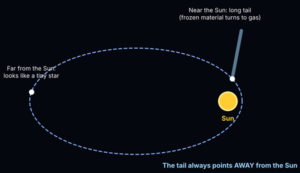
When Far from the Sun: Comets remain frozen because of the extremely low temperature in space. They appear as small, faint objects.
When Near the Sun: The Sun's heat causes the ice in a comet to change directly into gas. A glowing cloud of gas and dust forms around the comet. This is called the coma.
Formation of the Comet's Tail:
- Solar heat and solar wind push gas and dust away from the Sun.
- This forms a long, bright tail.
- The tail of a comet always points away from the Sun.
Famous Comets and Their Orbital Periods
Different comets take different amounts of time to complete one revolution around the Sun.
- Halley's Comet: It takes about 76 years to complete one revolution around the Sun. It can be seen from Earth approximately once in a person's lifetime.
- Comet A3: It takes an extremely long time to complete its journey around the Sun. Its estimated orbital period is about 80,000 years.
- Comet Bappu: It was discovered in July 1949 by Indian astronomer Dr. Vainu Bappu. Its estimated orbital period is about 60,000 years.
Comet Shoemaker-Levy 9 and Jupiter (1994)
- Comet Shoemaker-Levy 9 was discovered in 1993 near Jupiter.
- Jupiter's strong gravity broke the comet into more than 20 pieces.
- Between 16 and 22 July 1994, these pieces crashed into Jupiter.
- The impacts created large dark marks and gas clouds in Jupiter's atmosphere.
- These marks could be seen through telescopes from Earth for several months.
This event helped scientists understand the effects of comet impacts on planets.
Meteors (Shooting Stars) and Meteorites
- Small pieces of rocks and dust travel around the Sun in space.
- Sometimes, these pieces enter Earth's atmosphere due to gravity.
- They become very hot because of their high-speed movement through the atmosphere.
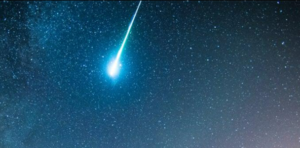
- They produce a bright streak of light in the sky. This is called a meteor.
- People commonly call meteors shooting stars, but they are not real stars.
What is a Meteorite? :
- Sometimes, a larger piece of space rock survives its journey through the atmosphere.
- If it reaches the Earth's surface, it is called a meteorite.
- A meteorite may create a large hole or crater when it hits the ground.
Lonar Lake in Maharashtra :
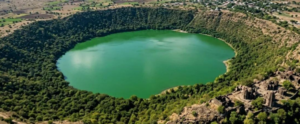
- Lonar Lake is situated in Buldhana district of Maharashtra.
- It was formed when a large meteorite struck the Earth's surface thousands of years ago.
- The impact created a large circular crater in the Deccan basalt rocks.
- Over time, rainwater collected in the crater and formed a lake.
- The lake is known for its saline and alkaline water.
- Scientists from different parts of the world visit Lonar Lake to study its rocks and impact crater.
Science and Superstitions :
Science teaches us to understand natural events through observation and evidence rather than blind beliefs.
(1) Celestial Events are Natural:
- The movement of stars and planets is a natural process.
- Comets and meteors are also natural objects.
- These events can be explained through science.
(2) No Influence on Human Destiny:
- The movement of stars, planets and comets does not decide our future or destiny.
- We should not believe that these objects have magical powers over human lives.
(3) Avoiding Superstitions:
- Some people believe that the appearance of a comet brings war, disease or disaster. This belief has no scientific evidence.
- Some people believe that seeing a shooting star brings good luck or fulfils wishes. This is also a superstition.
Remember: Comets, meteors and other celestial events are natural phenomena. We should develop scientific thinking and avoid blind beliefs.
The Milky Way Galaxy (Akashganga) and the Universe :
The Earth is a very small part of the vast universe. To understand our place in space, we need to learn about galaxies, stars and the universe.
Definations :
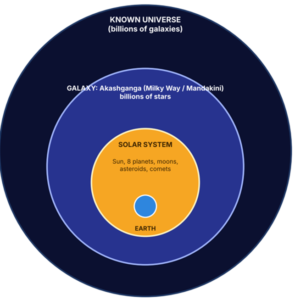
- Galaxy: a huge cluster of billions of stars arranged in a spiral. Our galaxy is Akashganga (Mandakini).
- Solar System: the Sun, eight planets revolving in their own orbits, their moons, millions of asteroids and many comets.
- Known Universe: the vast expanse of all known galaxies. Millions of galaxies are scattered in space and are constantly moving away from each other. What lies beyond is not known; efforts continue to find out.
(1) Light Pollution and the Milky Way :
- In big cities, bright streetlights, buildings and vehicles make the night sky very bright.
- This makes it difficult to see faint stars and the Milky Way. This problem is called light pollution.
Example: Los Angeles (1994)
- In 1994, an earthquake caused a major power failure in Los Angeles, USA.
- The city became dark due to the power cut.
- People suddenly saw a bright, milky white band across the night sky.
- Some people were frightened because they had never seen it before.
- This white band was actually the Milky Way Galaxy.
(2) Structure of the Milky Way (Akashganga) :
- The Milky Way is the galaxy in which our Solar System is located.
- In India, it is commonly called Akashganga or Mandakini.
- A galaxy is a huge group of billions of stars, gases and dust held together by gravity.
- Galaxies can have different shapes, such as spiral, elliptical and irregular.
How Does the Milky Way Look?
- With our naked eyes, it looks like a faint, milky white band in the night sky.
- Through powerful telescopes, we can see millions of individual stars, gas clouds and star clusters.
(3) Understanding the Size of the Universe :
The universe is extremely large. The following examples help us understand its enormous size.
Distance on Earth:
- The distance between Mumbai and New York is approximately 13,000 km.
- This shows how large our Earth is.
Size of the Sun:
- About 13 lakh Earths could fit inside the Sun by volume.
- We can imagine the Earth as a tiny ball among the many small sweet balls in a Boondi Ladoo, compared with the huge size of the Sun.
Distance Between Earth and Sun:
- The Sun is about 14 crore kilometres away from Earth.
Distance to the Nearest Star:
- After the Sun, Proxima Centauri is the nearest star to Earth.
- It is about 3 lakh times farther away than the distance between Earth and the Sun.
Speed of Light:
- Light travels at a speed of about 3 lakh kilometres per second.
- Even at this great speed, light takes about 1 lakh years to travel across the Milky Way Galaxy.
(4) Andromeda Galaxy and the Known Universe
Andromeda Galaxy (Devyani):
- Andromeda is the nearest large neighbouring galaxy to the Milky Way.
- In Indian tradition, it is also known as Devyani.
- It is slightly larger than the Milky Way.
- It has been known to humans for thousands of years.
The Known Universe:
- The universe contains millions and millions of galaxies.
- Each galaxy contains billions of stars.
- Galaxies are moving away from one another as the universe expands.
- The part of the universe that we can observe with scientific instruments is called the Observable Universe.
- Scientists continue to study the universe to understand its size, structure and origin.
Remember: Our Earth is part of the Solar System, the Solar System is part of the Milky Way Galaxy, and the Milky Way is one of the billions of galaxies in the universe.
Famous Indian Astronomers: Aryabhatta to Jayant Narlikar
India has a rich history of astronomy. Many Indian scientists made important contributions to the study of stars, planets and the universe. Four famous Indian astronomers are discussed below.
(1) Aryabhatta (About 1,500 Years Ago) :
Aryabhatta was one of the greatest ancient Indian mathematicians and astronomers.
- He explained that the Earth rotates on its own axis.
- He stated that the apparent daily movement of stars and the Sun is caused by Earth's rotation.
- He explained that the Earth moves around the Sun.
- He calculated the time taken by Earth to rotate on its axis and the time taken by the Moon to revolve around Earth.
- He wrote his famous book called Aryabhatiya, which contains mathematical and astronomical knowledge.
(2) Bhaskaracharya II (12th Century CE) :
Bhaskaracharya II was a famous Indian mathematician and astronomer.
- He worked at the famous astronomical centre of Ujjain.
- He studied solar and lunar eclipses.
- He explained the changing phases of the Moon.
- He studied the movements and positions of planets.
- His mathematical work helped in understanding astronomical events.
(3) Dr. Vainu Bappu (1927–1982) :
Dr. Vainu Bappu was a famous Indian astronomer who made important contributions to modern astronomy.
- As a student, he built a spectrometer at home to study the light coming from stars.
- In July 1949, he discovered a comet along with other astronomers. It was named Comet Bappu-Bok-Newkirk.
- He completed his doctorate from Harvard University in 1952.
- He helped develop modern astronomical observatories in India.
- The Vainu Bappu Observatory at Kavalur, Tamil Nadu, is named after him.
(4) Dr. Jayant Narlikar (1938–2025) :
Dr. Jayant Narlikar was a famous Indian astrophysicist and cosmologist.
- He established the Inter-University Centre for Astronomy and Astrophysics (IUCAA) in Pune, Maharashtra.
- IUCAA is an important centre for research in astronomy and astrophysics.
- He wrote many books, articles and science-fiction stories to explain astronomy in simple language.
- He encouraged students to ask questions and develop scientific thinking.
- He inspired many young people to take an interest in science and astronomy.
Remember: Aryabhatta, Bhaskaracharya II, Vainu Bappu and Jayant Narlikar made valuable contributions to Indian astronomy and inspired future generations of scientists.
India's Space Research: ISRO Missions
India has made great progress in space research. The Indian Space Research Organisation (ISRO) develops satellites and spacecraft to study the Moon, Mars, the Sun and Earth. India's space missions are known for their scientific achievements and cost-effective technology.
Important Lunar and Mars Missions
(i) Chandrayaan-1 (2008) :
- It was India's first mission to the Moon.
- It studied the Moon's surface, minerals and chemical composition.
- It helped discover evidence of water molecules on the Moon.
(ii) Mangalyaan – Mars Orbiter Mission (2014) :
- It was India's first mission to Mars.
- The spacecraft successfully entered Mars' orbit in its first attempt.
- It studied the atmosphere and surface of Mars.
- India became the first country to achieve success in its first attempt at a Mars orbital mission.
(iii) Chandrayaan-3 (2023) :
- It was India's third mission to the Moon.
- On 23 August 2023, its Vikram lander successfully landed near the Moon's south polar region.
- The Pragyan rover explored the lunar surface.
- India became the first country to achieve a successful landing near the Moon's south polar region.
Aditya-L1: India's Solar Mission
- Aditya-L1 is India's first space mission dedicated to studying the Sun.
- It was launched on 2 September 2023 by ISRO.
- It is placed about 15 lakh kilometres from Earth near the L1 point.
- It continuously observes the Sun without being blocked by the Earth or Moon.
- It studies different layers of the Sun, including the photosphere, chromosphere and corona.
- It also studies solar flares, solar storms and Coronal Mass Ejections (CMEs).
- Its information helps scientists understand how solar activity affects satellites and communication systems on Earth.
NISAR: Joint NASA-ISRO Mission
- NISAR stands for NASA-ISRO Synthetic Aperture Radar.
- It is a joint mission of NASA (USA) and ISRO (India).
- It was launched on 30 July 2025 from Sriharikota, India.
- It moves around Earth in a low Earth orbit.
- It observes the Earth's land and ice surfaces every 12 days.
- It uses advanced radar technology to study changes on Earth's surface.
Main Uses of NISAR:
- It studies forests, crops and agricultural conditions.
- It helps scientists understand climate change.
- It monitors changes in Earth's surface caused by earthquakes and other natural events.
- It studies the melting of glaciers and polar ice sheets.
- Its information helps in disaster management and environmental protection.
Remember: ISRO's missions like Chandrayaan, Mangalyaan, Aditya-L1 and NISAR show India's growing achievements in space research.
How to Observe the Night Sky :
Observing the night sky is an interesting activity. It helps us learn about stars, planets, constellations and other objects in space. We should follow some simple guidelines for better observation.
Choosing the Right Place and Time
(i) Avoid Bright Lights:
- Choose a place away from city lights, streetlights and bright buildings.
- Open fields and hilltops are good places for observing the night sky.
(ii) Choose a Clear Night:
- Observe the sky on clear nights without clouds.
- Low humidity and clear weather make stars easier to see.
(iii) Use Star Charts and Mobile Apps:
- Use star charts, astronomy magazines or mobile apps to identify stars, planets and constellations.
- Check which celestial objects will be visible on that particular night.
Observe the Western Sky First
- Always observe the western sky first, especially after sunset.
- Earth rotates from west to east.
- Due to this rotation, stars and planets appear to move from east to west.
- Objects in the western sky may soon disappear below the horizon.
- Therefore, observe them first before looking at other parts of the sky.
Using Telescopes and Other Instruments
(i) Naked-Eye Observation:
- We can observe stars, constellations, the Milky Way and meteors with our naked eyes.
- We can also identify some bright planets.
(ii) Binoculars and Small Telescopes:
- Binoculars and telescopes help us see distant objects more clearly.
- We can observe craters and mountains on the Moon.
- We can see the different phases of Venus.
- We can also observe the four largest moons of Jupiter.
(iii) Guidance from Experts:
- Beginners should attend astronomy workshops and telescope-making camps.
- Experts can teach them how to use telescopes properly and identify objects in the sky.
Remember: Choose a dark and clear place, use a star chart and observe the western sky first for a better night-sky experience.
We reply to valid query.