Notes
|
Topics Covered
|
Introduction :
In physics, motion is defined as a continuous change in the position of an object with respect to time and a chosen reference point.
Examples of Motion :
- A butterfly moves from one place to another.
- A snake moves by slithering.
- A horse moves by galloping.
- Ocean tides rise and fall.
- Dust particles move and dance in a beam of sunlight.
Relativity of Rest and Motion :
Rest and motion are relative concepts; an object is never in absolute rest or absolute motion. Whether a body is perceived as stationary or moving depends entirely on the chosen frame of reference (observer's perspective):
- Passenger inside a moving bus: A passenger sitting in a moving vehicle is at rest with respect to fellow passengers inside the vehicle, but is in motion with respect to trees, road signs, and bystanders standing outside on the road.
- Earth's rotation and orbital motion: An object sitting on a table appears stationary relative to a person inside the room (Earth's surface frame of reference), but is moving at a high speed through space relative to an observer positioned on the Sun or in outer space.
- At Rest : An object is at rest when its position does not change with time with respect to a reference point.
Study of Motion in Physics : The basic types of motion studied in physics are:
- Linear Motion: Motion along a straight path.
- Circular Motion: Motion along a circular path.
- Oscillatory Motion: Motion that moves to and fro repeatedly around a fixed position.
Motion in a Straight Line :
Position, Reference Point, and Rectilinear Motion :
To specify the location of an object precisely, we must establish a fixed reference location:
- Position: The exact location of an object specified relative to a chosen reference point.
- Reference Point (Origin 'O'): The fixed baseline point about which the position of an object is measured.
- Rectilinear Motion (Linear Motion): Motion of an object along a straight line path where the direction remains unchanged.
| SIGN CONVENTION FOR STRAIGHT-LINE MOTION
In one-dimensional linear motion, position is represented along a straight coordinate axis with origin O:
• Positions to the RIGHT of origin O are taken as POSITIVE (+m). Example: +40 m indicates 40 metres to the right of O. • Positions to the LEFT of origin O are taken as NEGATIVE (-m). Example: -20 m indicates 20 metres to the left of O. • Position at origin O is assigned exactly 0 m. |

Describing Position :
To describe the position of an object, we need three things:
- Reference Point (Origin O)
- Distance: The distance of the object from the reference point.
- Direction: The direction of the object from the reference point.
| Instant vs Interval :
· An instant of time is a single clock reading at one point in time. · A time interval is the duration between two instants (two clock readings). |
Distance Travelled and Displacement :
- Distance travelled is the total length of the actual path covered by an object, regardless of direction. SI Unit : metre (m)
- Displacement is the net change in position of the object between two instants of time — it is measured along the straight line from the starting point to the final point. SI Unit : metre (m)
Distance vs. Displacement :
Two distinct physical quantities are used to quantify how far an object moves during its trajectory: Distance and Displacement.
| Feature / Property | Distance (s) | Displacement (d or Δx) |
| Definition | Actual total path length covered by the moving body. | Shortest straight-line distance from initial to final position in a specific direction. |
| Quantity Type | Scalar Quantity (has magnitude only, no direction). | Vector Quantity (has both magnitude and specific direction). |
| SI Unit | Metre (m) | Metre (m) |
| Possible Values | Always positive (+) or zero. Cannot be negative. | Can be positive (+), negative (-), or zero (0). |
| Path Dependency | Depends on the actual path followed by the body. | Independent of path taken; depends only on initial and final points. |
| KEY MATHEMATICAL RELATIONSHIP: DISPLACEMENT vs DISTANCE
1. Magnitude of displacement can NEVER exceed distance: |Displacement| ≤ Distance 2. Numerical Ratio Condition: \(\frac{\text{magnitude of displacement}}{\text{total distance travelled}}\) ≤ 1 (The ratio is always less than or equal to 1). 3. Equality Condition: |Displacement| = Distance ONLY when the body moves along a straight line in a single direction without turning back. 4. Zero Displacement: When initial and final positions coincide (e.g. round trip, full circular revolution), Displacement = 0, but Distance > 0. |
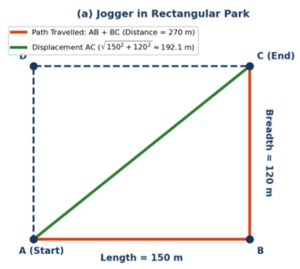
| SOLVED EXAMPLE : Jogger on Rectangular Park Path
Problem Statement: A jogger jogs along one length and breadth of a rectangular park. If the dimensions of the park are 150 m × 120 m, find the distance travelled and displacement of the jogger. Given Data: Length of park (AB) = 150 m, Breadth of park (BC) = 120 m.
Step-by-Step Solution: • Distance travelled (s) = Actual length of total path covered = AB + BC • s = 150 m + 120 m = 270 m • Displacement (d) = Minimum distance between initial position A and final position C = Diagonal AC • Using Pythagoras theorem in right triangle ABC: AC = \(\sqrt{AB^2+BC^2}\) • AC = \(\sqrt{150^2+120^2}=\sqrt{22500+14400} = \sqrt{36900}=\sqrt{900×41}\) = 30\(\sqrt{41}\) ≈ 192.09 m Final Answer: Distance = 270 m, Displacement = 30\(\sqrt{41}\) m (≈ 192.1 m) |
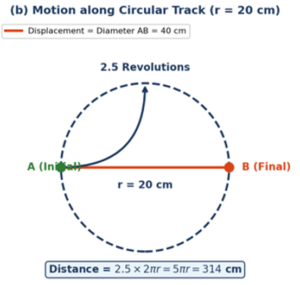
| SOLVED EXAMPLE : Motion Along a Circular Path
Problem Statement: A body moves in a circular path of radius 20 cm. If it completes two and half revolutions along the circular path, find the distance and displacement of the body. Given Data: Radius of circle (r) = 20 cm, Number of revolutions = 2.5
Step-by-Step Solution: • Circumference of circular path = 2πr = 2 × (22/7) × 20 cm = (880/7) cm • Total distance covered (s) = Number of revolutions × Circumference = 2.5 × 2πr = 5πr • Distance = 5 × 3.1416 × 20 cm = 314.16 cm (or 314 cm approx.) • For 2 full revolutions, body returns to starting point A (displacement = 0). • The remaining half revolution brings the body to diametrically opposite point B. • Displacement = Shortest distance AB = Diameter of circle = 2 × r = 2 × 20 cm = 40 cm Final Answer: Total Distance = 314 cm, Displacement = 40 cm (across diameter) |
Rate of Motion: Speed and Velocity :
To describe how fast or slow a physical change occurs, we introduce the concept of rate. Speed and velocity describe the rate at which position changes over time.
Speed : Speed is defined as the distance travelled by an object per unit time:
Speed (v) = \(\frac{Distance\,(s)}{Time\,(T)}\)
- SI Unit: Metre per second (m/s or m·s⁻¹). Other units: cm/s, km/h.
- Unit Conversion Rule: To convert speed from km/h to m/s, multiply by \(\frac{5}{18}\). Example: 36 km/h = 36 × \(\frac{5}{18}\) = 10 m/s.
Classification of Speed:
- Uniform Speed: If a body covers equal distances in equal intervals of time (constant speed).
- Non-Uniform Speed: If a body covers unequal distances in equal intervals of time (variable speed).
- Average Speed (vav): Ratio of total distance travelled to total time taken: vav = \(\frac{s_1+s_2+s_3+...}{t_1+t_2+t_3+...}\)
- Instantaneous Speed: Speed of an object at a specific instant of time (measured by vehicle speedometer).
Velocity (Speed with Direction) : Velocity is defined as the displacement of an object per unit time (speed in a definite direction):
Velocity (v) = \(\frac{Displacement\,(d)}{Time\,(T)}\)
- Vector Nature: Has both magnitude and direction. Velocity changes if speed changes, direction changes, or both change.
Velocity can be classified as :
(i) Uniform velocity : If an object does not change, its velocity during motion, then its velocity is known as uniform velocity, i.e. constant velocity.
(ii) Non-uniform velocity : If an object changes, its velocity during motion, then its velocity is known as non-uniform velocity, i.e. variable velocity.
(iii) Average velocity : It is defined as the ratio of total displacement of the object to the total time taken. Average velocity of a moving object can be zero.
For a body moving along a straight path in a single direction, the average speed and the magnitude of average velocity are identical over any given time interval.
(iv) Instantaneous velocity : The velocity of an object at a particular instant of time or at a particular point of its path is called its instantaneous velocity. A vehicle's speedometer magnitude closely approximates instantaneous speed.
Average Velocity Formulae:
- General Definition: Average Velocity = Total Displacement / Total Time Taken
- Uniform Acceleration Case: When velocity changes at a uniform rate, Average Velocity vav = \(\frac{u+v}{t}\) [where u = initial velocity, v = final velocity].
| Feature | Speed | Velocity |
| Definition | Distance covered per unit time. | Displacement per unit time (Speed in a specified direction). |
| Quantity Type | Scalar (magnitude only). | Vector (magnitude and direction). |
| Sign / Values | Always positive (+) or zero. Never negative. | Can be positive (+), negative (-), or zero (0). |
| Straight Path Motion | Equal to magnitude of velocity. | Identical to average speed in single direction straight motion. |
| SOLVED EXAMPLE : Bike Odometer & Average Speed Calculation
Problem Statement: The odometer of a bike reads 1600 km at the start of a trip and 2000 km at the end of the trip. If the bike took 16 h, calculate the average speed of the bike in km/h and m/s. Given Data: Initial odometer reading = 1600 km, Final odometer reading = 2000 km, Time taken (t) = 16 h Step-by-Step Solution: • Distance covered (s) = Final reading - Initial reading = 2000 km - 1600 km = 400 km • Average speed in km/h = \(\frac{Total\,distance}{Total\,time}\) = \(\frac{400\,km}{16\,h}\) = 25 km/h • To convert km/h into m/s, multiply by factor \(\frac{5}{18}\) : • Average speed = 25 × \(\frac{5}{18}\) ≈ 6.94 m/s (or 6.9 m/s approx.) Final Answer: Average Speed = 25 km/h = 6.94 m/s |
| SOLVED EXAMPLE : Swimming Pool Trip (Distance vs Displacement Rate)
Problem Statement: Sarang takes 50 s to swim from one end to the other end and back in a 25 m long swimming pool. Find his average speed and average velocity within 50 s. Given Data: Length of swimming pool = 25 m, Total time interval = 50 s Step-by-Step Solution: • Total distance covered (going to end and returning) = 25 m + 25 m = 50 m • Average Speed = \(\frac{Total\,distance}{Total\,time}\) = \(\frac{50\,m}{50\,s}\) = 1.0 m/s • Since Sarang returns to starting position, Total Displacement = 0 m • Average Velocity = \(\frac{Total\,displacement }{Total\,time}\) = \(\frac{0}{50\,s}\) = 0 m/s Final Answer: Average Speed = 1 m/s, Average Velocity = 0 m/s |
Average Speed and Average Velocity :
- Average speed quantifies how fast or slow an object covers distance over a given time interval: Because distance has no direction, average speed is a scalar quantity.
- Average velocity describes both how fast an object's position changes and the direction of that change. Average velocity has both magnitude and direction
| India's Historical Scientific Contributions
The concept of calculating speed as distance divided by time has ancient roots in India, appearing in foundational astronomical treatises like Aryabhatiya (5th century CE). Practical mathematical applications were elaborated in texts such as Ganitakaumudi (14th century CE) by Narayana Pandita. Ancient Postmen Problem (from Ganitakaumudi, 14th Century CE) Solution : Step 1: Calculate combined distance covered by both postmen in one day: Combined Daily Rate = 9 yojanas/day + 5 yojanas/day = 14 yojanas/day. Step 2: Calculate total time taken to cover 210 yojanas together: Time required = \(\frac{Total\,distance}{Combined\,rate}\) = \(\frac{210\,yojanas}{14\,yojanas/day}\) = 15 days. Step 3: Calculate individual distances covered in 15 days: • First postman distance = 15 days × 9 yojanas/day = 135 yojanas. • Second postman distance = 15 days × 5 yojanas/day = 75 yojanas. Check: Total distance = 135 + 75 = 210 yojanas. They meet after exactly 15 days. |
Acceleration and Retardation :
Whenever an object's velocity changes—whether in magnitude, direction, or both—the object undergoes acceleration:
| Formula :
Average acceleration, a = \(\frac{\text{final velocity - initial velocity}}{time\,interval}\) = \(\frac{v-u}{t_2-t_1}\)
|
- If the magnitude of velocity is increasing, acceleration acts in the direction of velocity (positive: a>0).
- If the magnitude of velocity is decreasing, acceleration acts opposite to the direction of velocity (negative / retardation: a<0).
- Acceleration can arise from a change in magnitude of velocity, a change in its direction, or both.
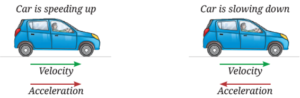
Acceleration can be classified as
(i) Uniform acceleration : If an object travels in a straight line and its velocity increases or decreases by equal amounts in equal intervals of time, then the object is said to be in a uniform acceleration.
e.g. (a) The motion of a freely falling body.
(b) The motion of a ball rolling down on an inclined plane.
(ii) Non-uniform acceleration : If velocity of an object increases or decreases by unequal amounts in equal intervals of time, then the object is said to be in a non-uniform acceleration.
e.g. (a) The movement of a car on a crowded city road.
(b) The motion of the train leaving or entering the platform.
(iii) Instantaneous acceleration : It is defined as the acceleration of an object at a specific point of time or at a particular instant of its motion.
- Mathematically, it is the limit of the average acceleration as the time interval Δt approaches zero
| EXPERT INSIGHT: HIGH VELOCITY vs HIGH ACCELERATION
High velocity does NOT imply high acceleration! Acceleration measures ONLY how fast velocity changes. • Example 1: A jet plane cruising in a straight line at a constant speed of 900 km/h has ZERO acceleration because its velocity is not changing. • Example 2: A fast-moving vehicle hitting a concrete wall comes to rest in a fraction of a second, experiencing an enormously high negative acceleration (retardation) despite having zero velocity at the end. |
| SOLVED EXAMPLE : Bus Acceleration and Braking (Two-Phase Motion)
Problem Statement: A bus is moving on a highway with velocity 36 km/h. Driver presses accelerator for 10 s, increasing velocity to 54 km/h. Later, driver presses brake and bus stops in 5 s. Find acceleration in both cases. Given Data: Phase (i): u = 36 km/h, v = 54 km/h, t = 10 s. Phase (ii): u = 54 km/h = 15 m/s, v = 0 m/s, t = 5 s. Step-by-Step Solution: • Convert velocities into m/s: • Initial velocity u = 36 × \(\frac{5}{18}\) = 10 m/s • Final velocity v = 54 × \(\frac{5}{18}\) = 15 m/s • Phase (i) Acceleration a₁ = \(\frac{v_1-u_1}{t}\) = \(\frac{15-10}{10}\) = +0.5 m/s² • (Positive sign indicates acceleration in direction of motion) • Phase (ii) Brakes applied: Initial velocity u = 15 m/s, Final velocity v = 0 m/s, time t = 5 s • Phase (ii) Acceleration a₂ = \(\frac{v_2-u_2}{t}\) = \(\frac{0-15}{5}\) = -3.0 m/s² • (Minus sign indicates retardation/deceleration opposite to direction of motion) Final Answer: Phase 1 Acceleration = +0.5 m/s²; Phase 2 Acceleration = -3 m/s² (Retardation = 3 m/s²) |
Speed vs Acceleration :
|
Uniform Acceleration and Free-Fall under Gravity :
When velocity changes by equal amounts in equal intervals of time, acceleration is constant (uniform). A classic real-world example of constant acceleration is a vertically falling object dropped from rest under Earth's gravity.
| Time Instant (t) | Downward Velocity (v) | Average Acceleration (a) |
| t = 0 s (Release point O) | 0.0 m s⁻¹ | - |
| t = 1 s | 9.8 m s⁻¹ | a = \(\frac{9.8-0}{1-0}\) = +9.8 m s⁻² |
| t = 2 s | 19.6 m s⁻¹ | a = \(\frac{19.6-9.8}{2-1}\) = +9.8 m s⁻² |
| t = 3 s | 29.4 m s⁻¹ | a = \(\frac{29.4-19.6}{3-2}\) = +9.8 m s⁻² |
| t = 4 s | 39.2 m s⁻¹ | a = \(\frac{39.2-29.4}{4-3}\) = +9.8 m s⁻² |
Note on Gravitational Acceleration: The constant downward acceleration experienced during free fall is denoted by g = 9.8 m s⁻².
Graphical Representation of Motion :
Position-Time (s-t) Graphs :
- A position-time graph visually represents how an object's position changes over time with respect to a chosen reference point or origin.
- It is constructed by plotting time along the horizontal x-axis and position along the vertical y-axis.
- Rather than showing a physical route map, it illustrates the rate and nature of motion.
- For straight-line motion in one direction starting from zero position at time zero, a position-time graph is identical to a distance-time graph.
Graph Shapes and Motion Types :
(i) Horizontal Line Parallel to the Time Axis: (Body is at rest)
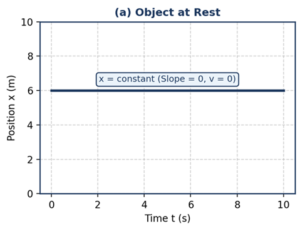
The position value remains constant as time progresses, indicating that the object is stationary (at rest).
(ii) Straight Sloping Line: (Uniform motion) :
For uniform speed, a graph of distance travelled against time is a straight sloping line as shown in figure given below.
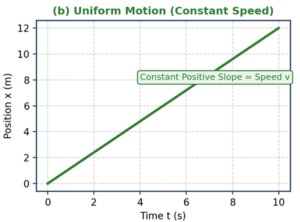
To calculate the speed of the object from a distance-time graph,
Choose any two points say A and B on the straight line.
From points A and B, draw perpendiculars AE' and BC respectively, on time axis.
Now, draw perpendiculars AE amd BF on distance axis.
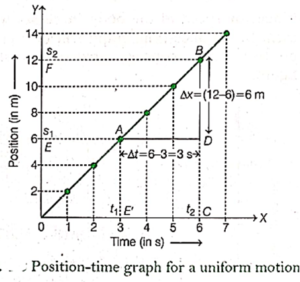
The distance travelled by the object from point A to B is given by
Δ x = BC - CD = s2 - s1
Time taken by the object to cover this distance Δ t = t2 - t1
Speed v = \(\frac{Δx}{Δt}\) = \(\frac{s_2-s_1}{t_2-t_1}\) = Slope of line AB
Slope of distance-time graph is equal to the speed of object.
The intermediate point represent the vehicles position at a specific time.
| SOLVED EXAMPLE : Graphical Calculation of Speed & Distance
Problem Statement: A position-time graph shows motion from A(1 s, 1 m) to B(4 s, 4 m), B to C(7 s, 4 m), and C to D(10 s, 9 m). Calculate speed in segments AB, BC, and CD. Given Data: A(t=1s, x=1m), B(t=4s, x=4m), C(t=7s, x=4m), D(t=10s, x=9m) Step-by-Step Solution: • Segment A to B: Time Δt = 4 - 1 = 3 s, Distance Δx = 4 - 1 = 3 m • Speed_AB = Δx / Δt = 3 m / 3 s = 1.0 m/s • Segment B to C: Time Δt = 7 - 4 = 3 s, Distance Δx = 4 - 4 = 0 m • Speed_BC = 0 m / 3 s = 0 m/s (Body is at rest) • Segment C to D: Time Δt = 10 - 7 = 3 s, Distance Δx = 9 - 4 = 5 m • Speed_CD = Δx / Δt = 5 m / 3 s = 1.67 m/s Final Answer: Speed AB = 1 m/s, Speed BC = 0 m/s, Speed CD = 1.67 m/s |
(iii) Curve slope : (non-uniform motion)
- Non-Uniform Increasing Speed: Curve bending upwards (Concave upward; positive slope increases with time).
- Non-Uniform Decreasing Speed: Curve flattening out (Concave downward; positive slope decreases with time).
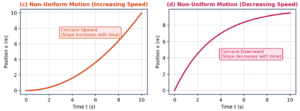
Comparing Velocity: When comparing two objects on the same position-time graph, a steeper slope signifies a larger displacement over the same time interval, meaning a higher average velocity.
Ex.
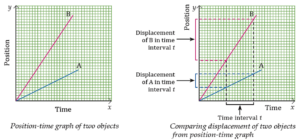
By making lines parallel to axes as shown in Fig., it is found that the displacement of object B is more than object A for the same time interval. That is, the slope of line for B is steeper than the slope for line A. Thus, the velocity of B is higher than that of A.
Displacement-Time Graph
If we find the displacement of a moving object from a reference point at different times and plot displacement (s) against time (t), we obtain a displacement-time graph.
| Velocity, v = \(\frac{Displacement}{Time\,interval}\) = \(\frac{s_2-s_1}{t_2-t_1}\) = Slope of the line |
In a displacement-time graph of a moving object, the slope of the straight line equals the velocity of that object.
Calculating Velocity (The Slope) :
Slope Represents Velocity: Geometrically, the steepness or slope of the line joining two points on the graph represents the average velocity of the object.
Calculation Formula:
By choosing two points corresponding to positions s1 and s2 at times t1 and t2, average velocity v is calculated as: v = (\frac{Change\,in\,position}{Change\,in\,time}\) = \(\frac{s_2-s_1}{t_2-t_1}\)
Ex. Suppose the displacement of a moving objects to a fixed point at times t1 and t2 are s1 and s2 respectively.
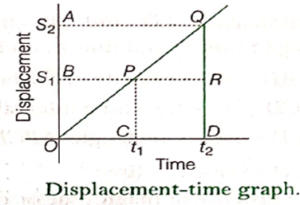
Velocity of object,
v = \(\frac{Displacement}{Time\,interval}\) = \(\frac{s_2-s_1}{t_2-t_1}\) = \(\frac{OA-OB}{OD-OC}\) = \(\frac{DQ-DR}{BR-BP}\) = \(\frac{QR}{PR}\)
This is the slope of the line OPQ.
It is clear that in a displacement-time graph of a moving object, the slope of the straight line is equal to the velocity of that object.
Velocity-Time (v-t) Graphs :
Velocity-time graphs plot velocity on the y-axis against time on the x-axis, providing two key quantitative insights:
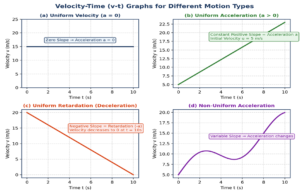
- A velocity-time graph shows how the velocity of a body changes with the passage of time.
- The slope of a velocity-time graph gives the acceleration.
- The area under a velocity-time graph gives the displacement (magnitude only).
(i) Body moving with constant velocity : The graph is a straight line parallel to the time axis — there is no change in velocity, so the body moves with constant velocity.
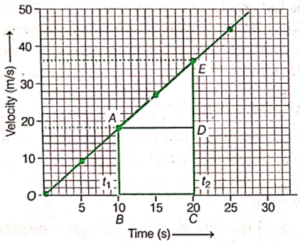
Calculating distance / magnitude of displacement : The area under the velocity-time graph between t₁ and t₂ gives the magnitude of displacement:
| Magnitude of displacement = Area under the velocity-time graph
S = Area of rectangle ABCD + Area of triangle ADE |
(ii) Uniformly accelerated motion (starting from rest) : The velocity-time graph is a straight line passing through the origin.
Interpretation: Velocity changes by equal amounts in equal intervals of time — the graph is a straight line for all uniformly accelerated motion.
Calculation of acceleration from the graph : Acceleration is obtained from the slope of the straight line in a velocity-time graph. If velocity at time t₁ is v₁ and at time t₂ is v₂:
| a = \(\frac{v_2-v_1}{t_2-t_1}\) = \(\frac{Δv}{Δt}\) = Slope of the velocity-time graph |
(iii) Uniform acceleration, initial velocity not zero : The velocity-time graph is a straight line that does NOT pass through the origin, showing positive acceleration.
(iv) Uniform retardation : The velocity-time graph is a straight line with negative slope.
(v) Non-uniformly accelerated motion : The velocity-time graph can have any shape — a curve with increasing or decreasing slope, since velocity changes non-uniformly.
| What You Can Find From a Velocity-Time Graph
• Slope of the line = (change in velocity)/(change in time) = acceleration. • Area enclosed between the line and the time axis = displacement. • For constant velocity: area of rectangle = velocity × time = displacement. • For constant acceleration (trapezium): area = \(\frac{1}{2}\) × (sum of parallel sides) × height = \(\frac{1}{2}\)(u + v) × t. |
| SOLVED EXAMPLE: — Acceleration of an Ascending Lift |
| The velocity-time graph of an ascending passenger lift shows: velocity rises from 0 to 4 m/s in the first 2 s, stays roughly constant (4 to 4.6 m/s) from 2 s to 10 s, then falls from 4.6 m/s to 0 in the last 2 s (10 s to 12 s). Find the acceleration (i) during the first two seconds, (ii) between the 2nd and 10th second, (iii) during the last two seconds.
Solution: (i) Δv = 4 − 0 = 4 m/s; Δt = 2 − 0 = 2 s a₁ = 4/2 = 2 m/s² (ii) Δv = 4.6 − 4 = 0.6 m/s; Δt = 10 − 2 = 8 s a₂ = 0.6/8 = 0.075 m/s² (iii) Δv = 0 − 4.6 = −4.6 m/s; Δt = 12 − 10 = 2 s a₃ = −4.6/2 = −2.3 m/s² (negative sign shows retardation) |
| SOLVED EXAMPLE: Distance from a Velocity-Time Graph |
| A body moves with a velocity of 2 m/s for 5 s, then its velocity increases uniformly to 10 m/s in the next 5 s. Thereafter, its velocity decreases uniformly until it comes to rest after 5 more seconds. Find the total distance covered by the body after 2 s and after 12 s.
Solution: (i) Distance after 2 s = Area of rectangle (constant velocity part) = 2 × 2 = 4 m (ii) Distance after 12 s = Area OAED + Area of ΔBEF + Area of DHGI + Area of ΔFHG = (2 × 10) + (\(\frac{1}{2}\) × 5 × 8) + (6 × 2) + (\(\frac{1}{2}\) × 2 × 4) = 20 + 20 + 12 + 4 = 56 m |
Equations of Motion :
The relation between velocity, acceleration, and the distance travelled by a body in a particular time interval is expressed through the equations of motion. These equations apply only when acceleration is constant.
| Symbols used :
u = initial velocity of the body v = final velocity of the body a = acceleration of the body (constant) t = time taken s = distance travelled |
The Three Equations of Motion :
| First Equation: v = u + at
Second Equation: s = ut + \(\frac{1}{2}\)at² Third Equation: v² − u² = 2as |
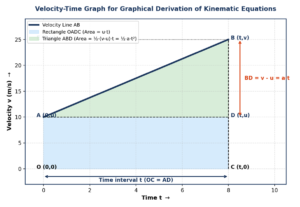
Derivation — First Equation of Motion (v = u + at)
- Consider a velocity-time graph of an object under uniform acceleration a, with initial velocity u (at point A) increasing to v (at point B) in time t.
- From the graph: BC = BD + DC = BD + OA, where BC = v and OA = u, so BD = v − u.
- Acceleration a = (change in velocity)/(time taken) = BD/AD = BD/OC = BD/t, so BD = at.
- Equating both expressions for BD: v − u = at ⟹ v = u + at.
Derivation — Second Equation of Motion (s = ut + \(\frac{1}{2}\)at²)
- Distance travelled s is given by the area OABC (a trapezium) under the velocity-time graph.
- Area OABC = Area of rectangle OADC + Area of triangle ABD = OA × OC + (AD × BD) = u×t + \(\frac{1}{2}\)(t × at) = ut + at².
Derivation — Third Equation of Motion (v² − u² = 2as)
- Distance s = area of trapezium OABC = \(\frac{1}{2}\)(OA + BC) × OC = \(\frac{1}{2}\)(u + v) × t
- From v = u + at ⟹ t = (v − u)/a.
- Substituting: s = (u + v)(v − u)/2a = (v² − u²)/2a ⟹ v² − u² = 2as.
| SOLVED EXAMPLE : Braking Car Distance Calculation
Problem Statement: The brakes applied to a car produce an acceleration of 4 m/s² in the opposite direction to the motion. If the car takes 3 s to stop after application of brakes, calculate the distance it travels during this time. Given Data: Acceleration (a) = -4 m/s² (deceleration), Time to stop (t) = 3 s, Final velocity (v) = 0 m/s Step-by-Step Solution: • From first equation of motion: v = u + a·t • 0 = u + (-4) × 3 ⇒ u = 12 m/s • Now apply second equation of motion: s = u·t + \(\frac{1}{2}\)·a·t² • s = (12 × 3) + \(\frac{1}{2}\) × (-4) × (3)² = 36 + \(\frac{1}{2}\) × (-4) × 9 • s = 36 - 18 = 18 m Final Answer: Distance travelled before stopping = 18 m |
| SOLVED EXAMPLE : Motorbike Uniform Acceleration
Problem Statement: A motorbike accelerates uniformly from 54 km/h to 72 km/h in 2 s. Calculate (i) the acceleration and (ii) the distance covered by motorbike in that time. Given Data: Initial velocity u = 54 km/h = 15 m/s, Final velocity v = 72 km/h = 20 m/s, Time t = 2 s Step-by-Step Solution: • (i) Acceleration a = \(\frac{u-v}{t}\) = \(\frac{20-15}{2}\) = 2.5 m/s² • (ii) Distance s = u·t + \(\frac{1}{2}\)·a·t² • s = (15 × 2) + \(\frac{1}{2}\) × (2.5) × (2)² = 30 + \(\frac{1}{2}\) × 2.5 × 4 = 30 + 5 = 35 m Final Answer: (i) Acceleration = 2.5 m/s², (ii) Distance covered = 35 m |
| SOLVED EXAMPLE : Vertical Throw under Gravity
Problem Statement: A stone is thrown in a vertically upward direction with a velocity of 5 m/s. If acceleration during motion is 10 m/s² downwards, find maximum height attained and time taken to reach top. Given Data: Initial velocity u = 5 m/s, Final velocity at peak v = 0 m/s, Acceleration a = -10 m/s² Step-by-Step Solution: • (i) Maximum height (s = h) using third equation: v² - u² = 2·a·s • 0² - (5)² = 2 × (-10) × h ⇒ -25 = -20·h ⇒ h = 25 / 20 = 1.25 m • (ii) Time taken to reach peak using first equation: v = u + a·t • 0 = 5 + (-10) × t ⇒ 10·t = 5 ⇒ t = 0.5 s Final Answer: Maximum Height = 1.25 m, Time to reach top = 0.5 s |
| Know This : Why Is Stopping Distance So Important?
Stopping distance is the total distance covered from hazard perception to a complete halt. It depends on four key factors: • Initial Speed — higher speeds significantly increase braking distance due to higher kinetic energy. • Reaction Time — the delay between seeing a hazard and applying brakes (thinking distance). • Traction (Grip) — friction between tyres and the road, affected by weather and surface type. • Braking Force — the mechanical efficiency and condition of the vehicle's braking system. Did you know? If you double your speed, you don't just double your stopping distance — you actually quadruple it! This is why keeping a safe gap between vehicles is essential for safety. |
Motion in a Plane — Uniform Circular Motion :
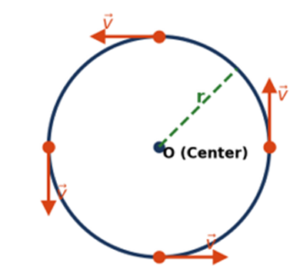
When an object moves in a circular path with constant speed, its motion is called Uniform Circular Motion.
Speed in Circular Path (v) = \(\frac{Circumference}{Time}\) = \(\frac{2πr}{T}\)
| WHY UNIFORM CIRCULAR MOTION IS AN ACCELERATED MOTION
Although the speed (magnitude of velocity) remains constant in uniform circular motion, the DIRECTION of motion changes continuously at every point along the circular path (directed along the tangent). Since velocity is a vector quantity, a continuous change in direction means a continuous change in velocity vector v. Therefore, uniform circular motion is ALWAYS an accelerated motion, even though the scalar speed is constant!
Figure: Velocity vector directions acting along tangents in Uniform Circular Motion. |
Real-World Examples of Uniform Circular Motion:
- Tip of minute hand of a wall clock rotating steadily.
- An artificial satellite orbiting Earth in a circular orbit.
- A stone tied to a string rotated in a horizontal circle.
- A cyclist moving on a circular track at a constant speed.
| SOLVED EXAMPLE : Clock Minute Hand Distance & Displacement
Problem Statement: The minute hand of a wall clock is 10 cm long. Find its displacement and distance covered from 10:00 am to 10:30 am. Given Data: Length of minute hand (r) = 10 cm, Time interval = 30 min (half an hour) Step-by-Step Solution: • In 30 minutes, the minute hand completes exactly half a revolution (180° rotation). • Initial position: pointing at 12; Final position: pointing at 6. • (i) Displacement = Minimum straight-line distance between 12 and 6 = Diameter = 2 × r • Displacement = 2 × 10 cm = 20 cm (directed downwards towards 6) • (ii) Distance covered = Half of total circumference = \(\frac{1}{2}\) × (2·π·r) = π·r • Distance = (22/7) × 10 cm = 220/7 cm ≈ 31.43 cm Final Answer: Displacement = 20 cm, Distance covered = 31.43 cm |
Multistage Analysis & Solved Problems :
In advanced kinematics problems, motion often occurs in multiple distinct phases (e.g., constant speed, followed by acceleration, followed by braking). Below is a complete step-by-step case analysis.
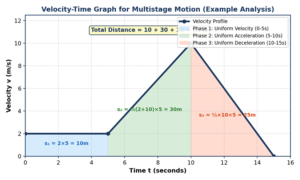
Figure: Velocity-Time profile for a three-phase motion analysis.
| SOLVED EXAMPLE : Multistage Elevator / Vehicle Motion Analysis
Problem Statement: A body moves with velocity 2 m/s for 5 s, then accelerates uniformly to 10 m/s in next 5 s. Thereafter, its velocity decreases uniformly to rest in 5 s. Plot v-t graph and find total distance travelled after 2 s and 12 s. Given Data: Phase 1 (0-5s): u=2, v=2. Phase 2 (5-10s): u=2, v=10. Phase 3 (10-15s): u=10, v=0. Step-by-Step Solution: • (i) Distance covered after 2 s (during uniform velocity phase 1): • s(2s) = Area of rectangle OAB'C' = 2 m/s × 2 s = 4 m • (ii) Total distance covered after 12 s: • • Distance in Phase 1 (0-5s) = Area of rectangle = 2 × 5 = 10 m • • Distance in Phase 2 (5-10s) = Area of trapezium = ½ × (2 + 10) × 5 = ½ × 12 × 5 = 30 m • • Distance in Phase 3 up to 12s (t = 10 to 12s, Δt = 2s): • Deceleration in Phase 3 = (0 - 10) / 5 = -2 m/s² • Velocity at t=12s: v = u + a·t = 10 + (-2) × 2 = 6 m/s • Area of trapezium from 10s to 12s = ½ × (10 + 6) × 2 = 16 m • Total Distance (0 to 12s) = 10 + 30 + 16 = 56 m Final Answer: Distance after 2 s = 4 m, Distance after 12 s = 56 m |
| SOLVED EXAMPLE : Relative Motion of Two Stones Dropped & Thrown
Problem Statement: Two stones are thrown vertically upwards simultaneously with initial velocities u₁ and u₂. Prove that the ratio of maximum heights reached by them is u₁² : u₂². Given Data: Initial velocities u₁ and u₂, final velocity at peak v = 0, acceleration a = -g Step-by-Step Solution: • From third equation of motion: v² - u² = 2as • For Stone 1: 0² - u₁² = 2(-g)h₁ ⇒ h₁ = u₁² / (2g) • For Stone 2: 0² - u₂² = 2(-g)h₂ ⇒ h₂ = u₂² / (2g) • Taking the ratio of heights: h₁ / h₂ = [u₁² / (2g)] / [u₂² / (2g)] = u₁² / u₂² • Hence, h₁ : h₂ = u₁² : u₂² (Proved) Final Answer: Ratio of heights reached h₁ : h₂ = u₁² : u₂² |
Summary Formula Cheat Sheet for Exams :
| Concept / Parameter | Mathematical Formula | SI Unit & Type |
| Average Speed | vav = Total Distance / Total Time | m/s (Scalar) |
| Average Velocity | vav = (u + v) / 2 (for uniform 'a') | m/s (Vector) |
| Acceleration | a = (v - u) / t | m/s² (Vector) |
| Kinematic Equations | 1) v = u + at
2) s = ut + ½at² 3) v² - u² = 2as |
Standard SI units |
| Uniform Circular Motion Speed | v = (2·π·r) / T | m/s (Accelerated Motion) |
We reply to valid query.