Notes
|
Topics To be Learned:
|
Weather, Seasons and the Climate :
(1) Weather : Weather is the condition of the atmosphere at a particular time.
- It changes from hour to hour or day to day.
- Weather includes sunshine, rain, wind, clouds, and temperature.
- For example, a day may be sunny in the morning and rainy in the evening.
(2) Climate : Climate is the average weather condition of a place over many years.
- Different places have different climates.
- Some places are hot throughout the year, while others are cold or receive heavy rainfall.
- Climate changes much more slowly than weather.
(3) Seasons : Seasons are different periods of the year with specific weather conditions.
- They occur because the Earth moves around the Sun.
- Each season lasts for a few months and repeats every year in a cycle.
- The main seasons are spring, summer, monsoon (rainy season), autumn, and winter.
- Seasons are closely related to weather and climate.
The Cycle of Seasons : Weather changes from one season to another.
- Summer is usually hot and dry.
- The monsoon season brings rain and humidity.
- Winter is generally cool or cold.
- Seasons follow a regular pattern based on the climate of a region.
Seasons in India : Most places in the world have four main seasons: spring, summer, autumn, and winter. India experiences an additional season called the monsoon or rainy season. Therefore, India has five main seasons:
- Spring
- Summer
- Monsoon (Rainy Season)
- Autumn
- Winter
Traditional Indian Seasons (Ritus): The Indian year is traditionally divided into six seasons:
| Sanskrit Name | English | Festival Connection |
| Vasanta | Spring | Vasanta Panchami |
| Grishma | Summer | — |
| Varsha | Rainy Season | — |
| Sharad | Autumn | Sharad Purnima |
| Hemanta | Pre-Winter | — |
| Shishir | Winter | — |
Adapting to Seasons :
Living with the Seasons :
- Humans, plants, and animals live according to the changing seasons or ritus.
- The crops we grow, the food we eat, and the clothes we wear change from season to season.
- People wear light cotton clothes in summer and warm woollen clothes in winter.
Changes in Plants : Many trees and shrubs bloom during spring (Vasanta). In some places, trees shed their leaves in autumn (Sharad). Some plants also change the colour of their leaves during autumn.
Changes in Animals : Animals adapt themselves to different seasons. Some animals grow thick fur during winter to protect themselves from the cold. These changes help them survive in different weather conditions.
Climate Change :
- The climate of a place usually remains the same for a long period.
- However, scientists have observed changes in the world's climate in recent years.
- Studies suggest that many of these changes are caused by human activities.
- Activities such as cutting down forests, pollution, and burning fossil fuels contribute to climate change.
Types of Climates in India :
India has a great variety of climates because of its diverse landforms and geographical features. These climatic variations influence the lifestyle of people, the crops grown, and the natural environment in different parts of the country.
Different types of climates :
(i) Alpine Climate : Found in the Himalayan mountain region.
- Winters are very cold and snowy.
- Summers are cool and pleasant.
- People wear thick woollen clothes to protect themselves from the cold.
(ii) Temperate Climate : Found in the lower Himalayas and many hilly regions.
- Winters are moderately cold.
- Summers are not very hot.
- Many hill stations are located in these areas and attract tourists during summer.
(iii) Subtropical Climate : Found in the northern plains of India.
- Summers are very hot.
- Winters are cold.
- This region is suitable for growing wheat and other crops.
(iv) Arid Climate : Found in the Thar Desert in western India.
- Days are extremely hot, while nights are cool.
- Rainfall is very low.
- People use special methods to collect and conserve water.
(v) Tropical Wet Climate : Found along the western coastal region.
- Receives heavy rainfall during the monsoon season.
- The climate is warm and humid.
- It is ideal for growing rice, spices, and other crops.
(vi) Semi-Arid Climate : Found in the central Deccan Plateau.
- Summers are hot.
- Winters are mild.
- Rainfall is moderate and mostly occurs during the rainy season.
(vii) Tropical Climate : Found in eastern India and the southern peninsula.
- Winters are mild and pleasant.
- The region experiences distinct wet and dry seasons.
- Monsoon winds strongly influence the climate.
Factors Determining the Climate
Several geographical factors interact to create the specific climate of a region within India.
(a) Latitude : Latitudes measure distance from the Equator (increasing northward or southward).
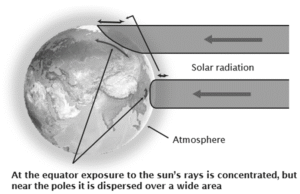
- Places near the Equator (low latitudes) are warmer because the Sun’s rays hit the Earth at a near-perpendicular angle, concentrating energy.
- In contrast, polar regions (high latitudes) receive slanted or oblique rays spread over a larger surface, losing strength as they pass through more of the atmosphere.
- Example: Kanyakumari and the Nicobar Islands are near the Equator and stay hot year-round, whereas Srinagar in the North is much cooler.
(b) Altitude : As altitude increases, atmospheric pressure and air density decrease, causing the air to become thinner and cooler.
- Example: Hill stations like Shimla, Ooty, and Munnar are popular for their cool climates compared to the surrounding plains. The Himalayas are so tall that many peaks stay below the freezing point (the temperature at which liquid turns to solid) and remain covered in snow.
(c) Proximity to the sea : Coastal areas have MODERATE temperatures — the sea acts as a temperature buffer.
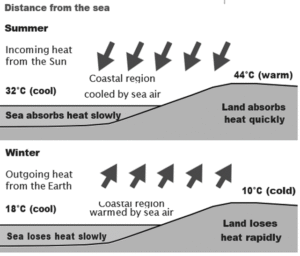
- Sea absorbs and releases heat slowly; land heats and cools quickly.
- Coastal regions experience mild temperatures with little variation between summer and winter.
- Example: Mumbai (coastal) has a temperature range of about 14°C (summer 32°C, winter 18°C), while Nagpur (inland) has a much more extreme range of 34°C (summer 44°C, winter 10°C).
(d) Winds : Wind is the movement of air from one place to another. Winds can carry warm or cool air over long distances. Winds influence temperature, humidity, and rainfall. They play an important role in affecting the weather and climate of a region.
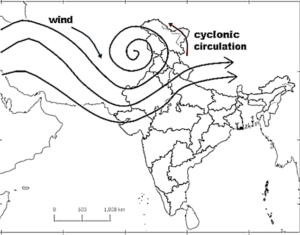
Hot and Dry Winds in Summer :
- States such as Punjab, Haryana, Rajasthan, and Madhya Pradesh often receive winds from the west.
- These winds travel across the deserts of Arabia and Afghanistan.
- They bring hot and dry air.
- As a result, severe heat waves are experienced during summer.
Cold Winds in Winter :
- During winter, cold winds blow from regions across the Himalayas.
- These winds reach the Himalayan foothills.
- They cause cold waves and a drop in temperature.
Winds and Humidity :
- Winds affect not only temperature but also humidity.
- Dry winds contain very little moisture.
- Moist winds carry water vapour and increase humidity.
Winds and Rainfall :
- Winds coming from deserts are usually dry and do not bring rain.
- Winds blowing from the sea carry moisture over the land.
- These moisture-laden winds can cause rainfall.
- Monsoon winds are an important example of winds that bring rain to India.
(e) Topography : The topography of a region plays an important role in determining its climate.
- For example, the Himalayas and Karakoram ranges protect the Indian subcontinent from the wind of the cold deserts of Central Asia.
- On the other hand, the Thar Desert is almost flat, so it cannot stop the hot and dry winds from blowing across it.
| Microclimate
A microclimate is a localised climate in a small area that differs from its surroundings. Examples include enclosed valleys, dense forests, and 'urban heat islands' — cities with large amounts of concrete and little vegetation that trap heat and stay significantly warmer than nearby rural areas. Microclimates influence local flora and fauna, crop choices, and human health. |
The Monsoons :
The monsoon is a system of seasonal winds caused by differences in the heating and cooling of land and ocean. That affect large areas of the Indian Ocean and nearby regions. These regions include South Asia, Africa, and Australia.
The word monsoon comes from the Arabic word 'mausim', which means 'season'.
How Monsoons are Formed? :
- Monsoons follow a regular yearly pattern.
- They are caused because land heats up and cools down faster than the ocean.
- Temperature, air pressure, and wind are closely connected in the monsoon system.
Monsoon During Summer :
- In summer, the Asian landmass becomes very hot. The heated land creates a low-pressure area.
- Air moves from areas of high pressure to low pressure. Therefore, cool winds from the ocean blow towards the land. These winds carry a large amount of moisture.
- When the moisture-laden winds reach the warm land, the moisture condenses into clouds. This results in heavy rainfall.
- Because these winds bring rain, the word monsoon is often used to refer to the seasonal rains.
Monsoon During Winter :
- In winter, the land cools faster than the ocean. The land develops a high-pressure area.
- The ocean remains relatively warmer and has lower pressure. As a result, winds blow from the land towards the ocean.
- These winds are dry and bring little or no rainfall to most parts of Asia.
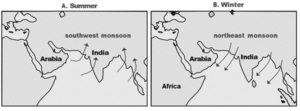
Regional Variations and the Types of Monsoons in India
India experiences two main types of monsoons: the South-West Monsoon in summer and the North-East Monsoon in winter. The South-West Monsoon brings most of India's rainfall, while the North-East Monsoon provides rain to parts of eastern and southern India. The Western Ghats influence the distribution of rainfall.
Arrival of the Monsoon : In India, the monsoon rains usually begin in early June. They first reach the southern tip of the Indian peninsula. The rains gradually move northward. By mid-July, the monsoon covers most parts of the country.
(a) The South-West Monsoon : The summer monsoon is known as the South-West Monsoon. The name comes from the direction from which the winds blow. These winds carry large amounts of moisture from the oceans and bring heavy rainfall.
Effect of the Western Ghats :
- The Western Ghats act as a natural barrier to the monsoon winds.
- The western slopes of the mountains receive heavy rainfall.
- The Deccan Plateau on the eastern side receives less rainfall.
- Rainfall in this region is often irregular and interrupted.
(b) The North-East Monsoon : As winter approaches, the direction of the winds changes. The winds start blowing from the land towards the ocean. These dry winds bring cooler weather to South India. This winter monsoon is called the North-East Monsoon.
Rainfall During the North-East Monsoon :
- Some of the winds pass over the Bay of Bengal and pick up moisture.
- These moisture-laden winds bring rainfall to parts of eastern and southern India.
- This rainfall is important for several regions, especially along the southeastern coast.
| Season | Land vs Ocean | Pressure System | Wind Direction | Result |
| Summer (Southwest Monsoon) | Land heats up faster | Low pressure over land; high pressure over ocean | Ocean → Land (SW direction) | Moist ocean winds rise, cool, condense, bring heavy rain |
| Winter (Northeast Monsoon) | Land cools down faster | High pressure over land; low pressure over ocean | Land → Ocean (NE direction) | Dry winds; but those passing over Bay of Bengal bring some rain to SE India |
| Did You Know?
Mawsynram in Meghalaya receives the highest average annual rainfall in the world — about 11,000 mm (= 11 metres!). The monsoons have also inspired many ragas in classical music, such as Meghamalhar and Amruthavarshini. |
Climate and our Lives :
Climate plays an important role in our lives. Human activities and lifestyles are closely connected to the climate of a region. People adapt their food, clothing, and occupations according to the local climate.
Climate and Culture :
- Climate influences local traditions and cultures.
- Many festivals in India are linked to seasons and agricultural activities.
- Harvest festivals are celebrated when crops are ready for harvesting.
Climate and Agriculture :
- Agriculture depends greatly on climate and rainfall.
- Good monsoon rains help farmers grow healthy crops.
- Poor rainfall can reduce crop production.
Effects of Monsoon Failure :
- Monsoon failure means that there is not enough rainfall during the monsoon season.
- Water shortages may occur in many areas.
- People, especially women, may have to travel long distances to collect water.
- Agricultural labourers may migrate to cities in search of work.
Climate and the Economy :
- Climate has a direct impact on the economy.
- A poor monsoon can reduce the supply of grains, fruits, and vegetables.
- This can increase food prices and the overall cost of living.
- Industries also depend on reliable weather conditions and sufficient water supply for production.
Climates and Disasters :
- India's diverse climate can sometimes cause extreme weather conditions.
- These conditions may lead to disasters such as cyclones, floods, and landslides.
- Such disasters affect people's lives and property.
- They can damage crops, roads, buildings, and other infrastructure.
- They also disturb local economies and daily activities.
(a) Cyclones :
A cyclone is a powerful storm with strong winds and heavy rainfall. Cyclones usually form over warm ocean waters. They can cause widespread destruction when they reach land.
Cyclones in India :
- India experiences several cyclones every year.
- The eastern coastline is especially prone to cyclones.
- Some cyclones are highly destructive.
- They can lead to loss of human and animal life.
- They may damage houses, roads, bridges, and other infrastructure.
- Cyclones can also uproot trees and cause soil erosion.
Role of the India Meteorological Department (IMD) :
- The India Meteorological Department monitors and tracks cyclones.
- It provides information about the formation, movement, and landfall of cyclones.
- Early warnings help people prepare and stay safe.
How are Cyclones Formed? :
- Cyclones form when atmospheric pressure over the sea becomes lower than the surrounding areas.
- This creates a low-pressure system.
- Air from nearby areas moves towards the low-pressure region.
- Moist air from the sea enters the system, bringing moisture and rainfall.
- If the low-pressure system becomes very strong and wind speeds increase, a cyclone may develop.
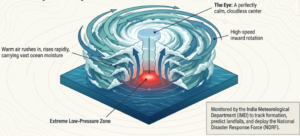
The Eye of the Cyclone :
- As the winds move inward, they carry moisture and form clouds.
- The winds rotate around the centre of the cyclone.
- The centre of the cyclone is usually calm and cloudless.
- This central region is called the eye of the cyclone.
(b) Floods :
A flood occurs when water covers land that is usually dry. It happens when there is more water than the land, rivers, or lakes can hold. Floods are common during the monsoon season.
Causes of Floods : Heavy rainfall can produce large amounts of run-off water. The land may not be able to absorb all the water. Rivers and lakes may overflow when too much water collects in them. Floods can also occur when river banks break or are breached.
Flood-Prone States in India : Some states are more vulnerable to floods than others. These include:
- Uttar Pradesh
- Bihar
- Kerala
- Andhra Pradesh
- Assam
Floods in the Himalayan Region :
- In the Himalayas, floods can occur when glacial lakes overflow.
- Glacial lakes are formed by water from melting glaciers.
- Their water is held back by natural barriers made of rocks and ice.
Glacial Lake Burst : If glaciers melt too quickly or there is excessive rainfall, water pressure increases. The natural barrier may break suddenly. This is known as a glacial lake burst or glacial burst. Such events can cause severe damage to people, property, and the environment.
Urban Flooding :
- Many cities experience flooding during heavy rainfall.
- Drainage systems may become overloaded and unable to carry away excess water.
- Poorly planned construction may block natural waterways.
- Buildings and roads built over water channels can prevent water from flowing freely.
Effect of Concrete and Asphalt
- Urban areas have many concrete and asphalt surfaces.
- These surfaces do not allow rainwater to soak into the ground.
- As a result, water accumulates quickly and increases the risk of flooding.
(c) Landslides :
A landslide is the sudden movement or collapse of rocks, soil, and debris down a slope. It is often caused by heavy rainfall, earthquakes, or volcanic activity.
Where Do Landslides Occur?
Landslides are common in hilly and mountainous areas such as:
- Himachal Pradesh
- Uttarakhand
- Sikkim
- Arunachal Pradesh
- The Western Ghats
They usually occur during the monsoon season.
Causes of Landslides :
The chances of landslides increase because of:
- Cutting down forests
- Construction of roads and buildings without proper methods
- Too many buildings blocking the natural flow of water
Effects of Landslides : Landslides can damage houses, roads, and bridges. They can also cause loss of life and disrupt transportation and communication.
(d) Forest fires :
Forest fires are uncontrolled fires that spread quickly through forests, grasslands, and other vegetation.
Causes of Forest Fires :
Forest fires can be caused by:
- Dry weather conditions
- Droughts
- Strong winds
- Human carelessness, such as leaving campfires unattended or throwing burning cigarettes
Where Do Forest Fires Occur?
Forest fires are common in:
- Uttarakhand
- Himachal Pradesh
- Madhya Pradesh
- Chhattisgarh
- The Western Ghats
Effects of Forest Fires :
Forest fires can:
- Destroy large areas of forests
- Harm and kill wildlife
- Damage the ecosystem
- Pollute the air and reduce air quality
- Force local communities to leave their homes
Consequences of Forest Fires : Forest fires have both environmental and economic impacts. They damage natural resources, affect biodiversity, and cause financial losses due to the destruction of forests and property.
| National Disaster Response Force (NDRF)
NDRF is specially trained for natural and human-made disasters. It has 12 battalion locations across India and plays a key role in rescue and evacuation during cyclones, floods, and landslides. |
Climate Change :
Climate change refers to long-term changes in the Earth's climate, including changes in temperature, rainfall, and weather patterns.
Causes of Climate Change :
In the past, climate change was caused by natural processes. Today, it is mainly caused by human activities such as:
- Burning fossil fuels like coal, oil, and natural gas
- Cutting down forests (deforestation)
- Harmful industrial activities
- Excessive consumption and waste of resources
How Does It Affect the Climate? : The Earth is naturally warmed by greenhouse gases such as carbon dioxide (CO₂), which trap some of the Sun's heat. This is called the greenhouse effect.
Human activities release large amounts of greenhouse gases into the atmosphere. These gases trap extra heat, causing global warming and changing climate patterns.
Effects of Climate Change :
Climate change can:
- Increase temperatures
- Change rainfall patterns
- Cause more extreme weather events
- Affect agriculture and food production
- Harm plants, animals, and ecosystems
- Impact industries and human livelihoods
Climate Change in India : Many parts of India are experiencing rising temperatures. For example, in early 2025, temperatures were 1–3°C above normal in many regions. As a result, winter was shorter and milder than usual. This affected agriculture and small-scale industries.
Reducing Climate Change : Governments and communities are taking steps to reduce climate change by:
- Reducing greenhouse gas emissions
- Planting more trees
- Using renewable energy sources such as solar and wind power
- Improving energy efficiency
- Promoting sustainable lifestyles
Importance of Understanding Climate Change : Understanding climate change helps us prepare for future challenges, protect the environment, and build stronger and more resilient communities.
We reply to valid query.