Notes
|
Topics to be learn :
|
Introduction :
This chapter synthesizes the core concepts of length measurement and physical motion, ranging from historical non-standard units to the modern International System of Units (SI), alongside the technical requirements for accuracy and the classification of various types of motion.
How do we Measure?
Measurement serves as the foundational method for quantifying physical dimensions. Every measurement consists of two essential parts:
- A Number: The numerical value resulting from the comparison.
- A Unit: The standard quantity used for comparison.
For example, in a measurement of "2 metres," 2 is the number and metre is the unit.
Ancient and Traditional Methods :
Before the standardization of units, various cultures utilized body parts or traditional markers to measure distance and quantity.
| Method | Definition/Usage |
| Hand-span | The length between the tip of the thumb and the little finger when the hand is stretched. |
| Yard | The distance between the tip of the middle finger and the chin of an outstretched arm; used for clothes and wires. |
| Footstep | The distance between the big toe and the heel; used for measuring distances between points. |
| Mutthi (Fist) | Used to measure small quantities of grains and pulses. |
| Angul (Finger) | The width of a finger; used for very small distances. |
| Dhanusa | An ancient unit for measuring height found in Jain literature. |
| Yojana | An ancient Indian measure for long distances. |
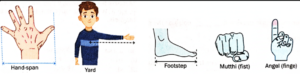
Inconsistency of Ancient Methods: The primary flaw in these methods is that they differ from person to person based on physical size, leading to inaccurate and non-reproducible results.
| DID YOU KNOW? |
India has a rich measurement history —
|
Standard Units :
Standard Units of Measurement :
- Standard units of measurement are fixed units used to measure length, weight, time, and other quantities.
- They ensure that measurements are accurate and the same everywhere.
- The system used all over the world is called the International System of Units (SI Units).
SI Units for Length
- Kilometre (km): Used to measure long distances. 1 km = 1000 m
- Metre (m): The standard unit of length. 1 m = 100 cm
- Centimetre (cm): Used to measure small objects. 1 cm = 10 mm
- Millimetre (mm): Used to measure very small objects. 1mm = 0.1 cm
Need for Standard Units :
- In ancient times, people measured length using body parts like the hand-span, footstep, finger width (angul), and yard.
- These methods were not accurate because body sizes differ from person to person.
- Standard units provide the same measurement for everyone.
- They make measurements accurate, reliable, and uniform.
Rules for Writing SI Units
- Unit names such as kilometre, metre, centimetre, and millimetre are written in lowercase letters.
- Symbols like km, m, cm, and mm are also written in lowercase.
- Do not add 's' to symbols to show plural (write 5 m, not 5 ms).
- Always leave a space between the number and the unit (e.g., 2 m, 15 cm).
Correct Way of Measuring Length :
Choosing the Correct Measuring Instrument
- Use a measuring instrument that is suitable for the object.
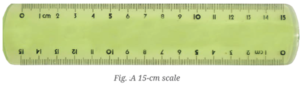
- Use a 15 cm scale to measure small objects like a pencil.
- Use a metre scale or measuring tape to measure larger objects, such as the height of a room.
- Use a flexible measuring tape (tailor's tape) to measure curved objects, such as the girth of a tree or the chest size.
(i) Correct Placement of the Scale
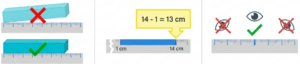
- Place the scale in contact with the object.
- Align the scale along the entire length of the object.
(ii) Correct Position of the Eye
- Keep your eye directly above the point being measured.
- This helps avoid parallax error and gives an accurate reading.
(iii) Measuring with a Broken Scale
- If the zero mark or end of the scale is broken, start measuring from another clear mark, such as 1.0 cm.
- Note the reading at the other end of the object.
- Subtract the starting reading from the ending reading to find the actual length.
- Formula : Length of the object = Final reading − Initial reading
Example
- Initial reading = 1.0 cm
- Final reading = 10.4 cm
- Length = 10.4 cm − 1.0 cm = 9.4 cm
- Therefore, the length of the object is 9.4 cm.
Measuring the length of a curved line
Measuring Irregular Lines :
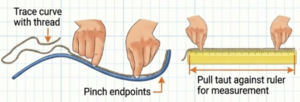
- Curved Lines: A straight scale cannot measure a curve directly. Instead, a thread or flexible measuring tape is used to follow the curve. The thread is then straightened and measured against a standard metre scale.
- Girth and Size: Flexible tapes (tailor's tapes) are used for measuring the circumference of objects like trees or the human chest.
Specialized Tools :
- Visually Challenged Students: Use specialized scales with raised markings that can be identified by touch.
Describing Position :
Position and Motion are Relative : Position and motion are not fixed. They depend on the reference point from which they are observed.
Reference Point : A reference point is a fixed object or place used to describe the position of another object.
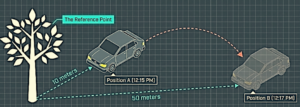
Distance Depends on the Reference Point :
- The distance of an object can appear different from different places.
- For example, a garden may be closer than a school for one person, but farther away for another person.
Using the Same Reference Point :
- If everyone uses the same reference point, their descriptions of position will be the same.
- For example, if all people measure the distance from a bus stand or a city like Delhi, they will get the same position of the object.
Moving Things :
Motion and Rest
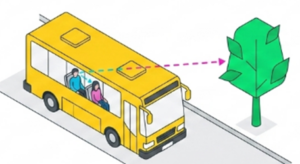
- An object is said to be in motion if its position changes with respect to a reference point over time.
- An object is said to be at rest if its position does not change with respect to the reference point.
- Whether an object is in motion or at rest depends on the reference point.
- Example: Passengers sitting in a moving bus are at rest with respect to the bus, but they are in motion with respect to the trees and buildings outside.
Types of Motion :
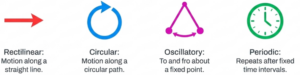
(i) Linear Motion : Linear motion is the motion of an object along a straight line.
Examples:
- A car moving on a straight road.
- An orange falling from a tree.
- Students marching in a straight line during a parade.
(ii) Circular Motion : Circular motion is the motion of an object along a circular path.
Examples:
- An eraser tied to a thread and whirled around.
- A merry-go-round.
(iii) Oscillatory Motion : Oscillatory motion is the to-and-fro motion of an object about a fixed position.
Examples:
- A swing moving back and forth.
- A vibrating metal strip.
(iv) Periodic Motion : Periodic motion is the motion that repeats itself after equal intervals of time.
- Both circular motion and oscillatory motion are periodic because they repeat the same path again and again.
Examples:
- The motion of a swing.
- The motion of a merry-go-round.
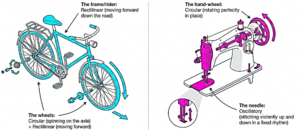
Motion Around Us :
We can observe different types of motion in a children's park:
- A slide shows linear motion.
- A merry-go-round shows circular motion.
- A swing shows oscillatory motion.
We reply to valid query.