Notes
|
Topics to be Learn :
|
Introduction :
- The Earth, the Moon, and the Sun are three important bodies in our solar system. They are connected to each other in many ways. The Earth moves around the Sun, and the Moon moves around the Earth.
- These movements cause many natural events such as day and night, seasons, and the different phases of the Moon. In this chapter, we will learn about these movements and how they affect life on Earth.
Rotation of the Earth
Rotation: The motion of an object in which all its parts move in circles around an imaginary line passing through it. This imaginary line is called the axis of rotation.
Earth’s Rotation is defined as the movement of the Earth around its own axis—an imaginary line passing through the North and South poles.
Key Characteristics :
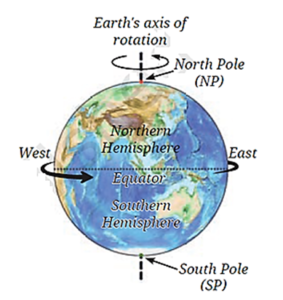
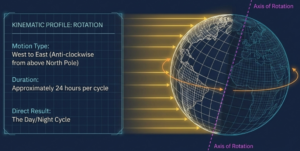
- Duration: One full rotation takes approximately 24 hours (precisely 23 hours, 56 minutes, and 4 seconds).
- Direction: The Earth rotates from West to East (anti-clockwise when viewed from above the North Pole).
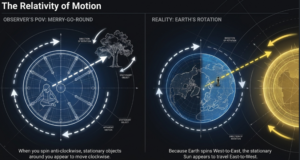
- Apparent Motion: Because the Earth rotates West to East, celestial bodies like the Sun and stars appear to rise in the East and set in the West. This is an optical illusion similar to how stationary objects appear to move when viewed from a rotating merry-go-round.
Primary Effects :
- Day and Night Cycle: Sunlight falls on only half of the Earth at any given time. The half facing the Sun experiences day, while the half facing away remains in darkness (night).
- Sunrise and Sunset: These occur as a specific location on Earth moves into or out of the sunlit half. In India, sunrise occurs earlier in eastern regions than in western regions.
Apparent Motion of Stars
Just as the Sun appears to move because of Earth's rotation, stars also appear to move across the night sky.
- The Earth's axis of rotation points very close to the Pole Star (Dhruva Tara) in the Northern Hemisphere. Because of this, the Pole Star appears nearly stationary, while all other stars (such as the Big Dipper / Saptarishi) appear to revolve around it.
Like the Sun, the Moon also appears to rise in the East and set in the West due to Earth's rotation.
View from the Equator
Imagine standing on the Equator, facing North, as the Earth rotates from West to East:
- In the morning, the Sun appears in your view to the right (East).
- Around noon, after the Earth has rotated, the Sun appears overhead.
- By evening, the Sun appears to disappear to the left (West), and stars become visible at night.
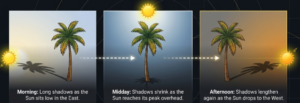
This confirms that due to Earth's rotation, the Sun appears to rise in the East, cross the sky, and set in the West — after which night begins.
Scientific and Historical Evidence of Rotation :
| Evidence Type | Description |
| Aryabhata’s Observation | Used the analogy of a man in a forward-moving boat seeing stationary objects on the shore moving backward to explain why stationary stars appear to move West. |
| Foucault Pendulum | A long string with a heavy bob that demonstrates rotation. A 22-metre version is housed in the Constitution Hall of the New Delhi Parliament building. |
| Star Trails | Long-exposure photographs taken by astrophotographers that record the apparent motion of stars as arcs of a circle. |
| Big Dipper Observations | Observations of the Big Dipper (Saptarishi) show it appearing to move around the Pole Star over the course of a single night. |
Revolution of the Earth :
Revolution is the movement of the Earth around the Sun. It is different from rotation. In rotation, the Earth spins on its own axis. In revolution, the Earth moves around the Sun.
- Earth's Orbit : The Earth takes about 365 days and 6 hours to complete one revolution around the Sun. The path followed by the Earth during its revolution is called an orbit. The Earth's orbit is almost circular in shape.
- Effects of Revolution : The Earth's revolution around the Sun causes many natural changes. One of the most important effects is the change of seasons throughout the year.
Changing view of night sky from the Earth :
As the Earth revolves around the Sun, the night sky looks different at different times of the year. Every evening, after the Sun sets in the west, stars become visible in the sky.
Why Do Different Stars Appear? : Because the Earth is continuously moving around the Sun, the stars seen in the night sky change gradually from one season to another. During a year, different groups of stars can be seen at sunset. This change in the night sky is caused by the Earth's revolution around the Sun.
| Fascinating Fact :
The Bhil and Pawara, indigenous communities from the Tapi Valley in western India, traditionally used the appearance of specific star patterns in the sky as natural markers to predict the arrival of monsoon rains. |
Seasons on the Earth :
Seasons are caused by two combined factors:
- the tilt of the Earth's axis of rotation, and
- the spherical shape of the Earth.
Importantly, the Earth's axis is NOT upright relative to its orbital plane — it is tilted, and this tilt is maintained constantly as the Earth orbits the Sun.
Why Tilt Causes Seasons :
- In June, the Northern Hemisphere is tilted towards the Sun, while the Southern Hemisphere is tilted away from it.
- Because the Earth's surface is curved, the same amount of sunlight spreads over a smaller area in the hemisphere tilted toward the Sun — making that sunlight more intense (concentrated).
- The hemisphere tilted toward the Sun also receives sunlight for more than 12 hours a day, while the opposite hemisphere receives less than 12 hours.
- More intense sunlight + longer daylight duration together produce summer; the opposite combination produces winter.
- In December, conditions reverse: the Northern Hemisphere tilts away from the Sun and experiences winter, while the Southern Hemisphere experiences summer.
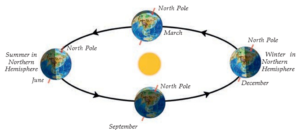
Extreme Cases at the Poles
- In June, the North Pole receives continuous sunlight for all 24 hours, while the South Pole is in complete darkness.
- In December, this situation reverses.
Two Common Misconceptions (Important!) :
| Misconceptions to Avoid
1. Seasons are NOT caused by the Earth being physically closer to the Sun when a hemisphere tilts toward it — the distance difference involved is negligible. 2. Seasons are NOT caused by Earth's orbit being oval-shaped with the Sun off-centre — although the orbit is very slightly elliptical, the difference in distance is too small to cause seasons. In fact, the Earth is actually closest to the Sun in January — during the Northern Hemisphere's winter — which proves distance is not the reason for seasons. |
Seasonal Variations: June vs. December
| Feature | Northern Hemisphere in June | Northern Hemisphere in December |
| Tilt Direction | Tilted toward the Sun. | Tilted away from the Sun. |
| Sunlight Intensity | Sunrays spread over a smaller area; more intense heat. | Sunrays spread over a larger area; less intense heat. |
| Daylight Length | Longer days (>12 hours of light). | Shorter days (<12 hours of light). |
| Season | Summer. | Winter. |
| Polar Condition | North Pole receives 24 hours of light. | North Pole experiences 24 hours of darkness. |
Hemispheric Reversal :
The seasons and daylight patterns are reversed in the Southern Hemisphere. When the Northern Hemisphere experiences summer (June), the Southern Hemisphere is tilted away from the Sun and experiences winter. Conversely, in December, the Southern Hemisphere experiences summer while the Northern Hemisphere experiences winter.
Solstices and Equinoxes :
| Event | Approx. Date | Significance (Northern Hemisphere) |
| Summer Solstice | 21 June | Longest day, shortest night |
| Winter Solstice | 22 December | Shortest day, longest night |
| Spring (Vernal) Equinox | 21 March | Day and night each last 12 hours |
| Autumn Equinox | 23 September | Day and night each last 12 hours |
| Fascinating Fact — Polar Day and Night
At the North Pole, the Sun rises on the equinox (21 March) and stays continuously visible for six months, finally setting on 22 September. The South Pole experiences the exact opposite pattern. This gives the poles six months of continuous daylight followed by six months of continuous darkness. |
Seasons Near the Equator :
- At the Equator, day and night are always close to 12 hours each, and sunlight intensity changes very little through the year. This is why the effect of seasons is much less noticeable in the southern states of India, which lie close to the Equator.
- Local factors like geography and nearness to oceans can also influence climate patterns.
Eclipses :
An eclipse (known as grahan in Sanskrit) is a celestial event where one astronomical body is temporarily blocked from view by another or by its shadow.
Solar eclipse
A solar eclipse occurs when the Moon passes between the Sun and Earth, casting its shadow on the Earth. This can only happen on a New Moon day.
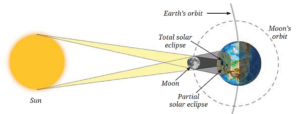
- Total Solar Eclipse: The Moon completely covers the Sun; the area becomes dark for a few minutes.
- Partial Solar Eclipse: Only a portion of the Sun is obscured.
- Diamond Ring Effect: A bright shining ring formed just before or after a total eclipse.
- Viewing Safety: Solar eclipses should never be viewed with the naked eye; special protective glasses or projection methods are required.
Lunar eclipse
A lunar eclipse occurs when the Earth passes between the Sun and the Moon, casting Earth's shadow onto the Moon. This only happens on a Full Moon day.
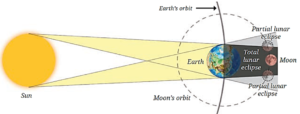
- Total Lunar Eclipse: The Earth's shadow covers the entire Moon, often giving it a dark red appearance.
- Partial Lunar Eclipse: Only part of the Moon enters the Earth's shadow.
- Visibility: Unlike solar eclipses, lunar eclipses are visible from the entire night side of the Earth and are safe to view without protection.
Comparative Summary of Eclipses :
| Feature | Solar Eclipse | Lunar Eclipse |
| Alignment | Sun — Moon — Earth | Sun — Earth — Moon |
| Moon Phase | New Moon | Full Moon |
| Duration | Short (Minutes) | Long (Up to 107 minutes) |
| Visibility | Small area of Earth | Large part of Earth |
Apparent Size and Planetary Transits :
A common question in celestial mechanics is how the small Moon can block the much larger Sun.
- Distance vs. Size: While the Sun is much larger than the Moon, it is also much farther away. Because the Moon is closer to Earth, they appear to be roughly the same size in the sky, allowing for total eclipses.
- Transits: Planets like Mercury and Venus also pass between the Earth and the Sun. However, because they are much farther from Earth than the Moon, they appear as tiny black dots crossing the Sun's surface. This rare phenomenon is called a transit and does not block enough light to be considered an eclipse.
| ⚠ Safety Warning —
Never Look Directly at a Solar Eclipse · Even during an eclipse, the Sun remains intense enough to cause permanent eye damage or blindness. Never view a solar eclipse directly, and never use sunglasses, binoculars, or telescopes to view it without proper certified solar filters. · The safest way to observe a solar eclipse is to attend an organised viewing event run by a planetarium or astronomy club, where trained organisers provide specialised eye protection and scientific explanations. · A simple safe method: project the Sun's image using a small mirror reflecting onto a wall or screen — but this activity must be supervised by a teacher, and the reflected beam must never be pointed at anyone's eyes. Unlike a solar eclipse, it is completely safe to watch a lunar eclipse directly with the naked eye, since we are simply looking at the Moon as usual — no intense direct sunlight is involved. |
We reply to valid query.