Notes
Introduction :
In our daily life, we see some objects that attract iron. Such objects are called magnets. Magnets can also attract or repel other magnets. Playing with magnets is fun and interesting.
Magnets are very useful in our daily life. They help us in many simple and advanced tasks. Learning about magnets helps us understand how many things around us work.
Magnet : A magnet is a substance that attracts iron.
We see magnets in many places around us:
- Stickers on refrigerator doors
- Dusters sticking to white boards in schools
- Pin holders holding many pins
- Cranes lifting iron pieces from scrap
Magnets are also used in devices like:
- Mobile phones
- Telephones
- Televisions
Types of Magnets :
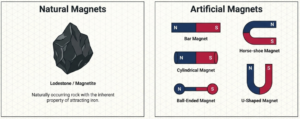
(1) Natural Magnets : Magnets found in nature are called natural magnets.
- Examples: Magnetite, Lodestone
(2) Artificial Magnets : Magnets made by humans are called artificial magnets.
- They are made by magnetising materials like iron, cobalt, and nickel.
These magnets are made in different shapes, such as:
- Bar magnet
- Horse-shoe magnet
- Cylindrical magnet
- Ball-ended magnet
- U-shaped magnet
Magnetic and Non-magnetic Materials
- All materials are not attracted by magnets.
- Magnets attract only some special materials.
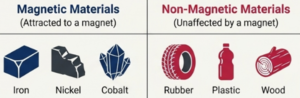
Magnetic Materials : Substances that are attracted by a magnet are called magnetic materials.
- Examples: Iron, Steel, Nickel, Cobalt
Non-Magnetic Materials : Substances that are not attracted by a magnet are called non-magnetic materials.
- Examples: Rubber, Plastic, Stainless steel, Feather, Leather
Uses of Magnets : Magnets help us in many simple tasks.
- Example: If a needle falls on the floor, we can find it using a magnet. This is because the needle is made of iron and gets attracted to the magnet.
Important Point :
- Non-magnetic materials cannot be magnetised.
- This means they cannot be turned into magnets.
Poles of Magnet :
- When a magnet is brought near iron filings, they get attracted to it.
- Most of the iron filings stick to the two ends of the magnet.
- These ends are called the poles of a magnet.
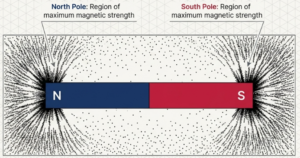
Strongest Parts of a Magnet : The poles are the strongest parts of a magnet. Maximum attraction happens at the poles.
Types of Poles : Every magnet has two poles:
- North Pole (N)
- South Pole (S)
These poles are usually marked on the magnet.
Important Facts :
- Poles of a magnet always exist in pairs.
- A single pole cannot exist alone.
- If a magnet is broken into pieces: Each piece will still have a north pole and a south pole.
- No matter the shape or size, every magnet always has two poles.
Finding Directions :
- Magnets help us find directions easily. The magnetic compass is a very useful and simple tool.
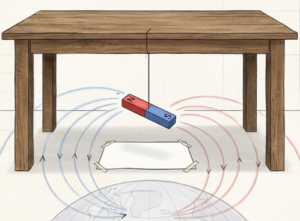
- A special property of a magnet is that a freely suspended bar magnet always points in the north-south direction. This property helped people to find directions in olden times.
North and South Poles :
- The end of the magnet that points towards the north is called the north pole.
- The other end that points towards the south is called the south pole.
Use in Olden Days :
- In earlier times, travellers used magnets to find directions.
- They tied a natural magnet with a thread and allowed it to hang freely.
- It always pointed in the north-south direction, helping them travel correctly.
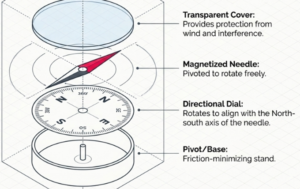
Magnetic Compass : A magnetic compass is a small device used to find directions.
It has:
- A small needle-shaped magnet
- A pin so the needle can rotate freely
- A circular box with a transparent cover
- A dial showing directions (N, S, E, W)
- The north end of the needle is usually painted red.
How to Find Directions Using a Compass :
- Place the compass on a flat surface.
- Wait until the needle stops moving.
- The needle will point in the north-south direction.
- Turn the dial to match the needle direction.
- Now you can easily find all directions.
Wonder Fact : The Earth behaves like a giant magnet. The compass needle aligns with the Earth’s magnetic field. So, the needle always points in the north-south direction.
Must Know ! : There are other methods which can help to find directions. e.g. By using the direction of rising sun in the morning, we can find out the rough direction
towards east. If we stand facing east, then our left will be towards north. It may not be very exact but it will help to make out all the directions.
Historical Context: In ancient India, a device called the matsya-yantra (or machchh-yantra), featuring a magnetized fish-shaped iron piece in oil, was used for sea navigation.
Attraction and Repulsion between Magnets :
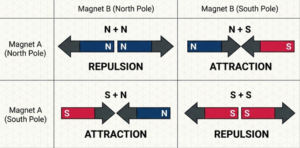
- Magnets show both attraction and repulsion.
- When same poles (north-north or south-south) are brought close, they repel (push away) each other. This means like poles repel each other.
- When different poles (north-south) are brought close, they attract (pull) each other. This means unlike poles attract each other.
- The force between magnets is called magnetic force.
Important Points to Know :
- The compass needle is also a magnet.
- If the north pole of a magnet is brought near the north pole of the compass, it moves away.
- If the south pole is brought near the north pole of the compass, it moves closer.
- Magnetic force can pass through thin materials like: Paper, Glass, Wood
- Poles of a magnet are usually marked as: N (North), S (South)
- Sometimes: North pole is shown with a white dot or red colour. South pole is shown with blue colour
How to Keep Magnets Safe :
- Store magnets in pairs with unlike poles together.
- Keep a piece of wood between them.
- Place soft iron pieces across the ends.
- Do not: Heat the magnets, Hammer them, Drop them from a height
- Keep magnets away from: Mobile phones, Computers, Televisions, Music systems
Taking proper care helps magnets work for a long time.
Fun with Magnets :
Magnets can move some objects without touching them.
Some of the fun experiments are given below
- Make a magnetic garland: You can use magnets to create a garland by seeing how many magnetic objects can be linked together.
- Move steel balls through a maze: By placing steel balls in a cardboard tray and moving a magnet underneath the tray, you can navigate the balls through a maze without touching them directly.
- Retrieve a paper clip from water: You can pick up a steel paper clip that has fallen into a glass of water by moving a magnet along the outside of the glass, allowing you to get the clip out without getting the magnet or your fingers wet.
- Race magnet-powered cars: You can attach magnets to matchbox cars to see if they speed toward each other or run away, depending on whether you bring like or unlike poles together.
- Making a "Hopping Frog" toy by gluing ring magnets in an alternating North-South fashion along a scale and attaching a magnet to a paper frog so it "hops" as you slide it along.
Experimental and Practical Applications :
Various activities to create and test magnets, as well as fun applications for the classroom.
Making a Magnet: An iron needle can be magnetized by rubbing it with one pole of a permanent magnet in a consistent, single direction (from one end of the needle to the other) approximately 30 to 40 times.
Field Penetration: Magnetic force can act through non-magnetic barriers. Experiments show a magnet can deflect a compass needle even when materials like wood, cardboard, glass, or plastic are placed between them.
Practical Uses:
- Magnetic dusters for school writing boards.
- Magnetic closures for purses and pencil boxes.
- Mechanics using magnetized screwdrivers to prevent steel screws from falling.
- Advanced technology such as Maglev (Magnetic Levitation) trains.
We reply to valid query.