Solutions (Exercise + Intext)
Intext Questions :
Question 1. Do magnets stick to objects made of certain materials only? (Page 62)
- Yes, magnets only stick to certain materials which are known as magnetic materials. Common examples of these materials include iron, nickel, and cobalt.
- Objects made from non-magnetic materials, such as plastic, rubber, or wood, will not stick to a magnet.
Question 2. Do all parts of a magnet attract magnetic materials equally? (Page 64)
- No, the magnetic strength is not distributed evenly across the magnet.
- The attraction is most powerful at the two ends, which are known as the poles (the North pole and the South pole).
Question 3. Can we find a magnet with a single pole? (Page 65)
- No, it is impossible to have a magnet with only one pole.
- Magnetic poles always exist in pairs; even if a magnet is broken into smaller pieces, every single piece will still have its own North and South pole.
Question 4. What happens when we bring two magnets closer to each other? (Page 67)
The reaction depends on which poles are facing each other:
- Like poles (North-North or South-South) will repel or push each other away.
- Unlike poles (North-South or South-North) will attract or pull towards each other.
Question 5. The compass needle is also a magnet. Will it show the same behaviour if a magnet is brought closer to it? (Page 69)
Yes, because a compass needle is a small, pivoted magnet, it reacts to other magnets.
- For example, if you bring the North pole of a bar magnet toward the North pole of the compass needle, the needle will move away (repel).
- If you bring the South pole near the needle's North pole, they will be drawn together (attract).
Question 6. Suppose we place a piece of wood between the compass needle and the magnet. Will this affect the deflection of the compass needle? (Page 70)
- No, placing a piece of wood between them will not affect the deflection.
- Magnetic forces are capable of passing through thin sheets of non-magnetic materials like wood, glass, or paper without being blocked.
Let Us Enhance Our Learning : Exercise Questions
Question 1. Fill in the blanks
(i) Unlike poles of two magnets ________ each other, whereas like poles ________ each other.
Unlike poles of two magnets attract each other, whereas like poles repel each other.
(ii) The materials that are attracted towards a magnet are called ________.
The materials that are attracted towards a magnet are called magnetic materials.
(iii) The needle of a magnetic compass rests along the ________ direction.
The needle of a magnetic compass rests along the north-south direction.
(iv) A magnet always has ________ poles.
A magnet always has two poles.
Question 2. State whether the following statements are True (T) or False (F).
(i) A magnet can be broken into pieces to obtain a single pole. [ ]
[False] (Poles always exist in pairs).
(ii) Similar poles of a magnet repel each other. [ ]
[True]
(iii) Iron filings mostly stick in the middle of a bar magnet when it is brought near them. [ ]
[False] (They stick mostly at the ends/poles).
(iv) A freely suspended bar magnet always aligns with the north-south direction. [ ]
[True]
Question 3. Column I shows different positions in which one pole of a magnet is placed near that of the other. Column II indicates the resulting interaction between them for different situations. Fill in the blanks.
| Column I | Column II |
| N - N | _____ |
| N -____ | Attraction |
| S - N | ______ |
| ____ - S | Repulsion |
| Column I | Column II |
| N - N | Repulsion |
| N - S | Attraction |
| S - N | Attraction |
| S - S | Repulsion |
Question 4. Atharv performed an experiment in which he took a bar magnet and rolled it over a heap of steel U-clips (Fig.). According to you, which of the options given in Table is likely to be his observation?
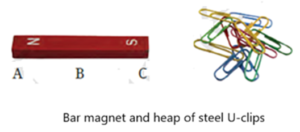
Table : Number of pins attracted by the magnet at its various positions
| Position A | Position B | Position C | |
| (i) | 10 | 2 | 10 |
| (ii) | 10 | 10 | 2 |
| (iii) | 2 | 10 | 10 |
| (iv) | 10 | 10 | 10 |
The correct observation is (i) A: 10, B: 2, C: 10.
This is because position A and C are at the poles of the magnet where attraction is strongest, while position B is in the middle where attraction is minimal.
Question 5. Reshma bought three identical metal bars from the market. Out of these bars, two were magnets and one was just a piece of iron. How will she identify which two amongst the three could be magnets (without using any other material)?
Reshma can identify the magnets using the property of repulsion.
She should bring the ends of the bars together in different combinations; if any two bars repel each other, those two are definitely magnets.
If a bar is attracted to both ends of another bar without ever being repelled, that bar is likely the piece of iron.
Question 6. You are given a magnet which does not have the poles marked. How can you find its poles with the help of another magnet which has its poles marked?
Bring the North pole of the marked magnet near one end of the unmarked magnet.
- If that end is repelled, it is the North pole.
- If it is attracted, it is the South pole.
Question 7. A bar magnet has no markings to indicate its poles. How would you find out near which end its North pole is located without using another magnet?
- Suspend the bar magnet freely from a thread so it can rotate horizontally.
- Once it comes to rest, the end that points toward the geographic north of the Earth is the magnet's North pole.
Question 8. If the earth is itself a magnet, can you guess the poles of earth’s magnet by looking at the direction of the magnetic compass?
- The north pole of a compass needle points towards the earth's geographic north pole.
- Since, opposite poles attract, the earth's geographic north pole is actually the magnetic south pole of the earth's magnet.
- And the earth's geographic south pole is the magnetic north pole of the earth's magnet.
Question 9. While a mechanic was repairing a gadget using a screw driver, the steel screws kept falling down. Suggest a way to solve the problem of the mechanic on the basis of what you have learnt in this chapter.
- The mechanic can solve this by magnetizing the tip of the screwdriver.
- By stroking the steel screwdriver with a permanent magnet, it will become a temporary magnet and hold onto the steel screws so they do not fall.
Question 10. Two ring magnets X and Y are arranged as shown in Fig. It is observed that the magnet X does not move down further. What could be the possible reason? Suggest a way to bring the magnet X in contact with magnet Y, without pushing either of the magnets.
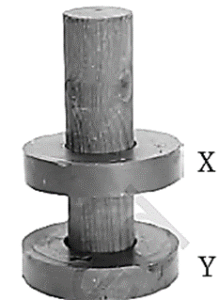
- Reason: Magnet X does not move down because the poles of X and Y facing each other are like poles (e.g., North-North), causing repulsion.
- Solution: Flip one of the magnets upside down so that unlike poles face each other, which will cause them to attract and come into contact.
Question 11. Three magnets are arranged on a table in the form of the shape shown in Fig. What is the polarity, N or S, at the ends 1, 2, 3, 4 and 6 of the magnets? Polarity of one end (5) is given for you.
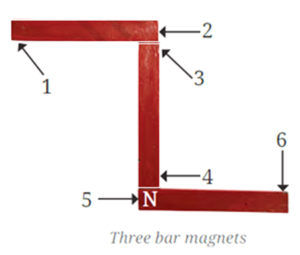
Consider ,
- End 1 & 2 is of Magnet A
- End 3 & 4 is of Magnet B
- End 5 & 6 is of Magnet C
Based on the principle that magnets in such an arrangement must attract at their contact points:
- Magnet C - End 5: North (Given)
- Magnet C - End 6: South (Other end of Magnet C)
- Magnet B - End 4: South (Must attract End 5)
- Magnet B - End 3: North (Other end of Magnet B)
- Magnet A - End 2: South (Must attract End 3)
- Magnet A - End 1: North (Other end of Magnet A)
We reply to valid query.