Notes
|
Topics to be Learn :
|
Introduction :
- In our daily life, we see that some objects are at rest while others are moving. For example, birds flying, fish swimming, and planets moving around the Sun are all in motion.
- When an object changes its position with time, it is said to be in motion. For example, when a car changes its position with time, we say that the car is moving or is in motion.
Measurement of Time :
Time is a measure of the interval between events. Historically, humans relied on regular natural phenomena to define these intervals.
Natural Time Intervals
- Day: The interval between one sunrise and the next.
- Month: The time from one full moon to the succeeding full moon.
- Year: The duration required for the Earth to complete one full revolution around the sun.
Historical Measuring Devices :
Before the advent of modern clocks, several mechanical devices were utilized to track time:
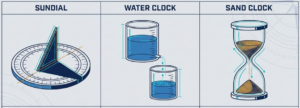
- Sundials: Time was determined by the changing position of a shadow cast by the Sun.
- Example: The Samrat Yantra in Jaipur, Rajasthan, is the world's largest stone sundial. Standing 27 metres tall, its shadow moves at 1 millimetre per second, allowing for time measurement intervals as short as 2 seconds.
- Water Clocks: These used the flow of water into or out of a vessel. The Indian Ghatika-yantra used a floating bowl with a hole that took exactly 24 minutes to sink, a unit of time known as a ghatika.
- Hourglasses: Time was measured based on the flow of sand between two bulbs.
- Candle Clocks: Marked candles indicated time passage as they burned down.
A simple pendulum :
The development of mechanical devices using weights and gears began in the 14th century, but a major breakthrough occurred in the 17th century.
- Galileo’s Discovery: Galileo Galilei observed that a swinging lamp took the same amount of time for every swing, regardless of the arc's width. He used his pulse to verify that the time taken for one oscillation was constant for a pendulum of a given length.
- Huygens’ Invention: In 1656, Christiaan Huygens invented the first pendulum clock, applying Galileo’s principles to create a reliable timekeeping instrument.
Physics of the Simple Pendulum :
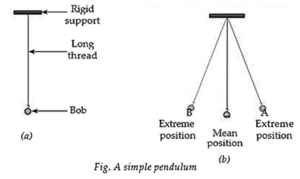
A simple pendulum consists of a small metallic ball or stone (the bob) suspended from a rigid support by a long thread.
- Mean Position: The position of the pendulum when it is at rest.
- Oscillation: The complete back-and-forth motion of the bob from its mean position to one extreme, then to the other extreme, and back to the mean position.
- Time Period: The time taken by the pendulum to complete one single oscillation.
Time Period = \(\frac{\text{Total time taken}}{\text{Number of Oscillations}}\)
One Oscillation of a Pendulum (Fig.) :
- A pendulum completes one oscillation when the bob starts from the mean position O, moves to one extreme position A, then to the other extreme position B, and finally comes back to O.
- It also completes one oscillation when the bob moves from extreme position A to extreme position B and returns back to A.
Variables Affecting Time Period :
Experiments involving pendulums reveal specific physical laws:
- Length: The time period of a pendulum depends directly on its length. Changing the length of the string alters the time it takes to complete an oscillation.
- Mass: The mass of the bob does not affect the time period. Pendulums of the same length will have the same time period at a given location, regardless of whether the bob is heavy or light.
- Constancy: At any fixed location, the time period for a pendulum of a specific length remains constant.
SI unit of time :
The standard unit of time is second. It is denoted by symbol 's'.
In order to express longer time intervals, we use minutes (min) or hours (h) as the unit of time.
60 s = 1 min, 60 min =1 h
Motion :
- When a body changes its position with time, it is said to be in motion.
- Examples of motion are a moving ant, the hands of a clock, a running car, and the revolution of the Earth around the Sun.
Slow and Fast Motion :
- The motion of an object can be slow or fast when compared with another object.
- The distance covered in a given time helps us decide which object is faster or slower.
- An object that takes more time to cover a certain distance is called slow.
- An object that takes less time to cover the same distance is called fast.
Example :
- Suppose your school is 6 km away from your home.
- If you go by bicycle, it may take about 30 minutes to reach school.
- If you go by school bus, the same distance may be covered in 10 minutes.
- This shows that the bicycle is slower than the bus.
The easiest way to know which object is moving faster is to compare the distance covered by them in one unit of time. This is called speed.
Speed :
Speed is the distance covered by an object in a unit of time. It is a critical metric for determining how fast an object is moving.
Mathematical Formulas :
Speed = \(\frac{\text{Distance travelled }}{\text{Time taken}}\)
Example :
Suppose a car travels a distance of 120 km in 2 h, then the speed of car is given by
Speed = \(\frac{120\,km}{2\,h}\) = 60 km/h
Average Speed = \(\frac{\text{Total distance travelled }}{\text{Total time taken}}\)
Relationship between speed, distance, and time :
Standard Speed:
Speed = \(\frac{\text{Distance travelled }}{\text{Time taken}}\)
Average Speed: Total distance divided by total time
Average Speed = \(\frac{\text{Total distance travelled }}{\text{Total time taken}}\)
Distance:
Distance = Speed × Time
Time:
Time = \(\frac{Distance Travelled}{Speed}\)
Units and Conversions :
- Standard (SI) Unit of Time: Second (s).
- Standard Unit of Speed: Metre per second (m/s).
- Common Unit of Speed: Kilometre per hour (km/h).
- Conversion Factor: To convert km/h to m/s, multiply by 5/18.
Universal Constants : The fastest possible speed in the universe is the speed of light, which is approximately 300,000,000 m/s or 3 ×10⁸ m/s.
Measurement Devices and Practical Application :
Vehicles are equipped with specific instruments to monitor motion parameters.
Speedometer: A device that records the speed of a vehicle directly in km/h.
Odometer: An instrument used to measure the total distance travelled by a vehicle.
High-Precision Clocks:
- Quartz Clocks: Use the rapid vibrations of a quartz crystal for measurement.
- Atomic Clocks: Use the vibrations of specific atoms. These are the most accurate timekeepers in existence, losing only one second in millions of years.
Key Observational Data :
- Smallest Interval: The smallest interval of time measurable by standard wall clocks is typically one second (indicated by the second hand).
- Precision: Stopwatches and digital quartz clocks provide higher precision for measuring short intervals or fractions of a second compared to traditional mechanical clocks.
Uniform and Non-uniform Linear Motion :
Linear motion occurs when an object moves along a straight line. It is categorized based on the consistency of the object's speed.
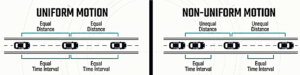
- Uniform Linear Motion: An object moves along a straight line at a constant speed, covering equal distances in equal intervals of time. This is considered an "idealization" and is rare in everyday life.
- Non-uniform Linear Motion: The speed of an object changes as it moves along a straight line, covering unequal distances in equal intervals of time. This is the most common type of motion (e.g., a train starting, accelerating, and then slowing down for a station).
We reply to valid query.