Notes
|
Topics to be Learn :
|
Introduction :
Every living animal needs energy to grow, move and do daily activities. This energy comes from food. Inside the body, food is changed into energy through special life processes. Two important processes are nutrition and respiration.
- In nutrition, animals take in food to get nutrients.
- In respiration, the body breaks down these nutrients to release energy.
Both processes are necessary for survival.
Different Ways of Taking Food :
Different animals take in food in different ways according to their body structure and feeding habits.
- Bees and sunbirds suck nectar from flowers.
- Human babies and many young animals feed on their mother’s milk.
- Snakes like pythons swallow their food whole.
- Some aquatic animals filter tiny food particles from water.
These examples show that animals use different methods to obtain food.
Nutrition in Animals :
Definition : Nutrition is the process by which living organisms take in and utilize food substances to grow, stay healthy, and maintain energy.
- Animals need food for energy, growth and repair of the body. Food contains complex substances like carbohydrates, proteins and fats. The body cannot use these substances directly.
- These complex substances are broken down into simpler substances by a process called digestion. The simple substances are then absorbed by the body and used by the cells.
Digestion in human beings :
Digestion in humans takes place in a long tube-like structure called the alimentary canal.
Food moves through different parts of this canal and gets broken down into simpler substances. Digestive juices help in this process.
The simple nutrients are then absorbed into the blood and carried to all parts of the body for energy, growth and repair.
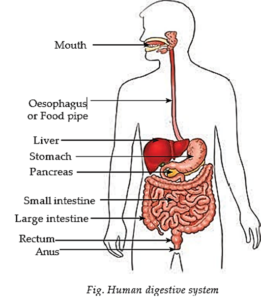
Parts of the Alimentary Canal :
The alimentary canal has different parts that help in digestion:
- Mouth (Buccal Cavity)
- Oesophagus (Food Pipe)
- Stomach
- Small Intestine
- Large Intestine
- Rectum and Anus
Digestive glands like the salivary glands, liver and pancreas also help by secreting digestive juices.
(1) Mouth :
Digestion begins in the mouth.
- Teeth chew and crush food into smaller pieces. This is called mechanical digestion.
- Salivary glands produce saliva.
- Saliva contains enzymes that help break down starch into sugar.
Food becomes partially digested in the mouth before moving to the food pipe.
(2) Oesophagus (Food Pipe) :
The oesophagus is a tube that connects the mouth to the stomach.
- It carries food from the mouth to the stomach.
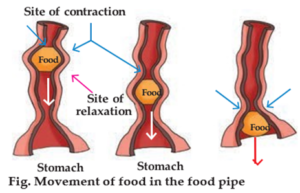
- Food moves downward by wave-like movements called peristalsis.
- These movements happen because of contraction and relaxation of muscles.
(3) Stomach :
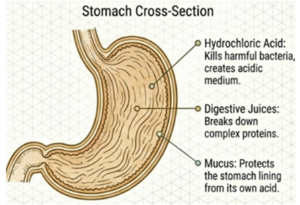
The stomach is the widest part of the alimentary canal.
- The stomach churns and mixes food with digestive juices.
- Digestive juice helps break down proteins.
- Acid helps in digestion and kills harmful bacteria.
- Mucus protects the stomach lining from acid.
- Food becomes a semi-liquid mass in the stomach.
(4) Small Intestine :
The small intestine is a long, coiled tube where complete digestion and absorption take place.
It receives digestive juices from:
- Its own walls
- Liver
- Pancreas
Functions of Digestive Juices :
- Bile from the liver neutralizes acid and breaks fats into tiny droplets.
- Pancreatic juice helps digest carbohydrates, proteins and fats.
- Juice from the small intestine completes digestion.
Absorption of Food :
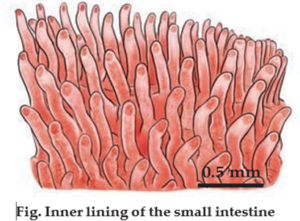
- The inner lining has thousands of finger-like projections called villi.
- Villi increase the surface area for absorption.
- Digested nutrients pass into the blood.
The blood carries nutrients to all parts of the body.
(5) Large Intestine :
The large intestine absorbs water and some salts from undigested food.
- The remaining waste becomes semi-solid stool.
- Stool is stored in the rectum.
- It is removed through the anus.
This process is called egestion.
Eating fruits, vegetables and whole grains helps the large intestine work properly.
Do all animals digest food the same way as humans do?
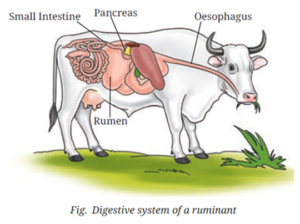
Digestion in Grass-Eating Animals
- Grass-eating animals like cows and buffaloes first chew the grass only partly.
- They swallow the food into their stomach.
- In the stomach, partial digestion takes place.
- The partly digested food comes back to the mouth.
- The animals chew the food again slowly and properly.
- This process is called rumination.
- Animals that do this are called ruminants.
- A cow spends nearly 8 hours a day chewing its food.
- After thorough chewing, the food moves again through the alimentary canal for further digestion.
Digestion in Birds :
- Birds do not have teeth.
- They have a special chamber called a gizzard.
- The gizzard helps in breaking down food.
- Its walls contract and relax to crush the food.
- Birds also swallow small stones called grit.
- These stones help the gizzard grind the food properly.
Different Ways of Digestion in Animals :
- Different animals have different digestive systems.
- The structure and function of the alimentary canal vary from animal to animal.
- These changes help animals digest different kinds of food.
Respiration :
- Digested nutrients are carried to all parts of the body.
- Some nutrients help in growth and repair of the body.
- Other nutrients, like sugar, release energy inside the body.
- The process of releasing energy from food is called respiration.
Ancient and Modern Insights on Digestion :
- Ancient Wisdom: Thirukkural 942 states that if food is fully digested before eating again, medicine for pain is unnecessary. The Charaka Samhita emphasizes easily digestible foods and spices like ginger and black pepper.
- Scientific Discovery: Dr. William Beaumont discovered stomach functions in 1822 by observing a permanent hole in the stomach of Alexis St. Martin.
- Celiac Disease: An immune reaction to gluten (found in wheat/barley) that damages the small intestine, requiring alternatives like millets.
Respiration in Animals :
Respiration in humans :
- Humans continuously inhale oxygen and exhale carbon dioxide.
- Oxygen is used by the body to release energy from food.
- Breathing and respiration are related but different processes.
Breathing :
- The process of inhaling and exhaling air is called breathing.
- We cannot survive for more than a few minutes without breathing.
- Humans, plants, and animals all breathe to stay alive.
Respiratory System :
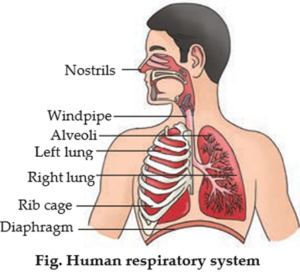
- The body has a special system for breathing called the respiratory system.
- It helps in breathing and exchange of gases.
- Air moves through a fixed pathway in this system.
Pathway of Air in the Body :
Nostrils and Nasal Passages :
- Breathing begins through a pair of openings called nostrils.
- Air passes through small tubes called nasal passages.
- Tiny hairs and mucus inside the nose trap dust and dirt.
- Therefore, we should breathe through the nose and not through the mouth.
Windpipe :
- From the nasal passages, air moves through the windpipe.
- The windpipe carries air to the lungs.
- It divides into two branches, one for each lung.
Lungs and Alveoli :
- Inside the lungs, the branches divide into smaller tubes.
- These tubes end in tiny balloon-like sacs called alveoli.
- Alveoli help in the exchange of oxygen and carbon dioxide.
- The lungs are protected by the rib cage.
Mechanism of Breathing :
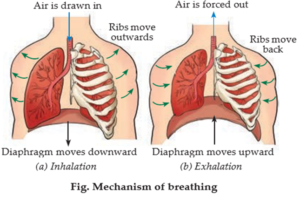
Breathing is a physical process that consists of two steps: inhalation and exhalation.
Inhalation and Exhalation :
Inhalation (Breathing In) :
- During inhalation, the chest expands.
- The ribs move upwards and outwards.
- The diaphragm moves downwards.
- This increases the space inside the chest.
- Air enters the lungs.
Exhalation (Breathing Out) :
- During exhalation, the ribs move downwards and inwards.
- The diaphragm moves upwards.
- The space inside the chest becomes smaller.
- Air is pushed out of the lungs.
Exchange of Gases :
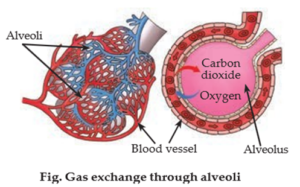
- Fresh air enters the lungs and fills the alveoli.
- The alveoli have thin walls and are surrounded by blood vessels.
- Blood brings carbon dioxide from the body to the alveoli.
- Carbon dioxide passes from the blood into the alveoli.
- Oxygen from the alveoli passes into the blood.
- Blood carries oxygen to all parts of the body.
Respiration :
- Food is broken down into simple substances like glucose.
- Oxygen helps break down glucose to release energy.
- This process is called respiration.
Word Equation of Respiration :
Glucose + Oxygen → Carbon dioxide + Water + Energy
Gas Composition in Breathing :
The body does not use all inhaled oxygen; a significant portion is exhaled.
| Gas | Inhaled Air | Exhaled Air |
| Oxygen | ~21% | ~16–17% |
| Carbon Dioxide | ~0.04% | ~4–5% |
Importance of Breathing and Respiration :
- During breathing, we inhale oxygen-rich air and exhale carbon dioxide-rich air.
- Not all inhaled oxygen is used by the body.
- Respiration releases energy needed for daily activities.
- This energy helps us walk, run, play, and think.
Difference Between Breathing and Respiration :
| Breathing | Respiration |
| Breathing is a physical process. | Respiration is a chemical process. |
| It involves inhaling oxygen and exhaling carbon dioxide. | It uses oxygen to break down food and release energy. |
Both breathing and respiration are essential for survival.
Circulatory System :
- The body has a transport system called the circulatory system.
- It includes the heart, blood, and blood vessels.
- The heart pumps blood throughout the body.
- Blood carries nutrients, oxygen, and other substances to all body parts.
- Waste products are also carried away by the blood.
Health and Respiratory Practices :
- Hazards: Smoking damages lungs, increases cancer risk, and affects non-smokers through passive smoking. The COVID-19 virus (SARS-CoV-2) specifically targets the respiratory system.
- Wellness: Traditions like Pranayama (India) and Tummo (Ladakh) use rhythmic breath control to improve lung function, mental clarity, and body temperature regulation.
Do other animals breathe the same way as humans do? :
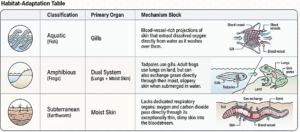
Different animals live in different habitats. Animals use different organs for breathing according to their habitat.
Animals that Breathe Through Lungs :
- Birds, elephants, lions, cows, goats, lizards, and snakes breathe through lungs.
- The structure of lungs is different in different animals.
- Lungs help in taking in oxygen and giving out carbon dioxide.
Breathing in Fish :
- Most aquatic animals, like fish, breathe through gills.
- Gills are rich in blood vessels.
- Fish take oxygen dissolved in water through their gills.
- Carbon dioxide is released back into the water through the gills.
Breathing in Amphibians :
Amphibians, like frogs, live both on land and in water. They use different body parts for breathing at different stages of life.
- Tadpoles : Tadpoles breathe through gills.
- Adult Frogs : Adult frogs breathe through lungs on land. In water, they exchange gases through their skin. These adaptations help frogs survive both on land and in water.
Breathing in Earthworms :
- Earthworms breathe through their moist skin.
- Oxygen and carbon dioxide are exchanged through the skin.
Breathing in Insects: Breathe through a network of tiny tubes called tracheae connected to openings called spiracles.
We reply to valid query.