Solutions (Exercise + Intext)
Intext Questions :
Think It Over :
Question 1. How is the study of cells and tissues significant for understanding the life processes and human welfare?
- The study of cells and tissues helps us understand how living organisms are built and how their life processes occur.
- Cells are the basic structural and functional units of life, while tissues are groups of similar cells performing a specific function.
- Studying them helps us understand processes such as growth, respiration, nutrition, excretion, reproduction and repair.
- It also helps scientists and doctors understand diseases and develop medicines and treatments.
Therefore, the study of cells and tissues is important for human health, medicine, agriculture and overall human welfare.
Question 2. How are tissues in plants and animals different, and why?
Plant and animal tissues differ because plants and animals have different ways of living and performing functions.
- Plants are generally fixed in one place, so they need tissues mainly for support, transport and growth. Their tissues often have thick cell walls and may contain dead cells that provide mechanical strength.
- Animals can move from one place to another and have more complex functions, so their tissues are specialised for movement, coordination, protection and transport.
Thus, the structure of tissues in plants and animals is suited to their respective needs and lifestyles.
Question 3. How is the division of labour at various levels of organization in multicellular organisms correlated with their structure and function?
- In multicellular organisms, there is a division of labour, where different groups of cells perform different functions.
- Similar cells form tissues, different tissues combine to form organs, and organs work together as organ systems.
- For example, in humans, muscle tissue helps in movement, nerve tissue carries messages, and blood transports substances.
- In plants, xylem transports water and minerals, while phloem transports food.
Thus, the structure of each level of organisation is closely related to its function, allowing the organism to perform life processes efficiently.
Pause and Ponder :
Question 1. You may have noticed that fibres of coconut husk are hard and brittle, whereas the leaf stalks of coriander are soft and flexible. Find out the reason.
- The fibres of coconut husk are hard and brittle because they contain a large amount of sclerenchymatous tissue. The cells of this tissue have thick, lignified walls and are mostly dead, giving the coconut husk strength and rigidity.
- The leaf stalks of coriander are soft and flexible because they contain more collenchymatous tissue. The cells of collenchyma have unevenly thickened walls and remain living, which provides flexibility and allows the stalk to bend without breaking.
Therefore, the difference is due to the type and structure of tissues present in them.
Question 2. Why do you think that a thick cuticle on the outer wall of epidermis is advantageous for a plant living in the desert but disadvantageous for a plant living underwater?
- A thick cuticle is advantageous for a desert plant because it reduces water loss from the leaves and protects the plant from drying out in the hot, dry conditions.
- However, for an underwater plant, a thick cuticle is disadvantageous because water is already available around the plant. It may reduce the exchange of gases and substances needed for photosynthesis and other life processes.
Therefore, a thick cuticle is useful in deserts to prevent water loss but is not suitable for plants living underwater.
Question 3. Once water is absorbed by plant roots, it has to travel against gravity through xylem. How do the dead cells of the xylem work together with the living cells of leaves at the top to keep the water moving?
- The dead cells of xylem have thick, hollow and continuous tubes that provide a pathway for water to move upward from the roots. They do not use energy themselves, but they allow water to pass through easily.
- The living cells of the leaves continuously lose water through transpiration. This creates a pulling force called transpiration pull, which draws water upward through the xylem.
- Cohesion between water molecules and adhesion between water and xylem walls help maintain the continuous column of water.
Thus, the dead xylem cells provide the pathway, while the living leaf cells create the pull, together keeping water moving from roots to leaves.
Question 4. What do you think will happen if there were no stomata in the epidermis of the stem or leaves?
If there were no stomata in the epidermis of stems and leaves:
- Gas exchange would be greatly reduced, so carbon dioxide could not enter easily for photosynthesis.
- Oxygen produced during photosynthesis would not be released efficiently.
- Transpiration would be greatly reduced, affecting the movement of water and minerals from roots to leaves.
- As a result, photosynthesis and other life processes would be affected, and the plant would not grow normally.
Therefore, stomata are essential for gas exchange and transpiration in plants.
Question 5. Look at the picture of classical and folk dances of India. Can you identify which joints are involved? Also, what type of movement each joint allows?
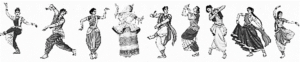
Looking at the various poses of classical and folk dances of India, the following joints and movements can be identified
- Shoulder joint (Ball and socket joint) : Allows the arms to swing forward, backward, sideways and in circular movements. Seen when dancers raise, extend or rotate their arms.
- Hinge joint (Elbow joint) : Allows bending and straightening of the arm in one direction. Seen when dancers fold or extend their arms.
- Wrist joint (Partial rotation joint) : Allows circular and side to side movements of the hand. Seen in the graceful hand gestures (mudras) of classical dance.
- Hip joint (Ball and socket joint) : Allows wide circular and sideways movements of the legs. Seen when dancers spread or rotate their legs.
- Knee joint (Hinge joint) : Allows bending and straightening of the leg. Seen when dancers squat, bend or extend their knees.
- Neck joint (Pivot joint) : Allows the head to turn from side to side. Seen in the characteristic neck movements of classical dance forms like Bharatanatyam.
- Ankle joint (Hinge joint) : Allows up and down movement of the foot. Seen in footwork and stamping movements in folk dances.
Exercise Questions:
Revise, Reflect, Refine :
Question 1. Meristematic tissues divide repeatedly. What property of their cells allows them to do this?
(i) They have thick walls for protection.
(ii) They contain large vacuoles that store nutrients.
(iii) They have thin walls, dense cytoplasm and large prominent nucleus.
(iv) They are functionally differentiated cells.
(iii) They have thin walls, dense cytoplasm and large prominent nucleus.
Explanation :
- Meristematic tissue cells can divide repeatedly because they are young, living cells with dense cytoplasm and a prominent nucleus.
- They have thin cell walls, little or no vacuole, and a high capacity for cell division. Their active nuclei control the process of cell division and help produce new cells for plant growth.
- Therefore, their ability to divide continuously is due to their young and actively dividing nature.
Question 2. If a plant is unable to transport food from leaves to roots which tissue is malfunctioning?
(i) Xylem
(ii) Phloem
(iii) Epidermis
(iv) Sclerenchyma
(ii) Phloem
Explanation :
- The phloem is the tissue that transports food from the leaves to the roots and other parts of the plant.
- Therefore, if food cannot move from the leaves to the roots, the phloem is malfunctioning.
Question 3. Why are the epithelial tissues that line an animal’s internal organs usually only one or a few cells thick?
(i) To store food efficiently.
(ii) To provide maximum strength.
(iii) To allow quick exchange of materials across them.
(iv) To reduce friction.
(iii) To allow quick exchange of materials across them.
Explanation :
Epithelial tissues lining internal organs are usually one or a few cells thick because they need to allow substances to pass through them easily.
- Thin epithelial layers help in the quick exchange of gases, nutrients and waste materials.
- They also provide a protective covering without forming a thick barrier.
- For example, the thin lining of the intestine helps in the absorption of nutrients, while the thin lining of the lungs helps in gas exchange.
Therefore, their thin structure is well suited to their functions of protection, absorption and exchange of substances.
Question 4. You can perform these two jumps (Fig.):
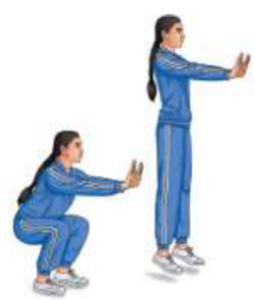
- Straight-leg jump — keep knees and ankles stiff.
- Normal jump — bend knees and ankles naturally.
How did your ankle, knee and hip positions differ between the two jumps?
- In the straight-leg jump, the ankle, knee, and hip joints remain stiff/extended and do not bend, so the force of landing is transmitted directly through the rigid limb — making the landing harder and providing little shock absorption.
- In the normal jump, the ankle, knee, and hip joints bend (flex) on landing and take off, allowing the hinge joints (knee, ankle) to absorb shock and giving a smoother, more controlled and cushioned movement.
Question 5. Which type of joint is involved when you bend your knees and ankles?
(i) Ball and socket
(ii) Hinge
(iii) Pivot
(ii) Hinge joint — it allows bending/straightening in one direction only, like a door hinge.
Question 6. In each of the following cases (A, B, C and D), choose the correct option as given below:
(i) Both (A) and (R) are true, and (R) is the correct explanation of (A).
(ii) Both (A) and (R) are true, but (R) is not the correct explanation of (A).
(iii) (A) is true, but (R) is false.
(iv) (A) is false, but (R) is true.
(A) Assertion: Epithelium is well-suited for gas exchange in the lungs.
Reason: It consists of multiple layers of tall cells that slow down diffusion.
(iii) (A) is true, but (R) is false.
- The epithelium in the lungs is indeed well-suited for gas exchange, so the Assertion is true. However, the Reason is false — the epithelium here is actually a SINGLE layer of thin, flat cells (not multiple layers of tall cells); a single thin layer is precisely what speeds up diffusion, not slows it down.
(B) Assertion: Cardiac muscle can contract continuously without fatigue.
Reason: Cardiac muscle cells have a high number of mitochondria and an abundant blood supply.
(i) Both (A) and (R) are true, and (R) is the correct explanation of (A)
- The abundant mitochondria and rich blood/oxygen supply provide the continuous energy cardiac muscle needs to work tirelessly.
(C) Assertion: Tendons connect bone to bone and allow joint movement.
Reason: Tendons are made of tough connective tissue that transmits force from muscle to bone.
(iv) (A) is false, but (R) is true
- Tendons actually connect MUSCLE to BONE (not bone to bone — that is the job of ligaments). The Reason correctly describes tendon composition and function (transmitting force from muscle to bone), so R is true while A is false.
(D) Assertion: In a hinge joint, movement occurs primarily in one plane.
Reason: The bone ends are shaped to allow sliding in all directions.
(iii) (A) is true, but (R) is false
- A hinge joint does restrict movement to one plane (true), but this is because the bone ends are shaped to allow movement in only one direction (like a door hinge), NOT to allow sliding in all directions. So R is false.
Question 7. Plot a graph between the age of a tree (in years) on the x-axis and the diameter of the tree (in cm) along with the number of annual rings formed over time on the y-axis, using the data given in the Table.
Table : Data related to the age of a teak tree, and corresponding increase in the diameter of stem and number of annual rings
| S. No. | Age of the teak tree (Years) |
DBH (Diameter at Breast Height) of tree (cm) |
Number of annual rings formed |
| 1. | 5 | 4 | 5 |
| 2. | 10 | 8 | 10 |
| 3. | 20 | 24 | 20 |
| 4. | 25 | 28 | 25 |
| 5. | 30 | 32 | 30 |
| 6. | 40 | 40 | 40 |
(i) Analyse the graph in terms of the diameter of the stem over time and share the interpretation.
(ii) What is the relation between the diameter of the teak tree to the annual rings formed?
(iii) Which specialised tissue is responsible for the girth of the stem and where is it located?
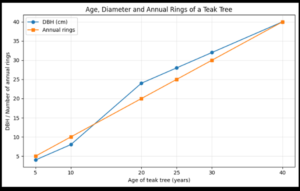
Graph
The graph is plotted using the given data.
- X-axis: Age of teak tree (years)
- Y-axis: DBH (diameter in cm) and number of annual rings
(i) Interpretation of the graph :
- The diameter of the teak tree increases as its age increases. The increase is not uniform; the stem grows more rapidly during some periods than others. Overall, the graph shows that the tree's girth increases continuously with age.
(ii) Relation between diameter and annual rings
- The number of annual rings increases with the age of the tree. In the given data, the number of annual rings is equal to the age of the tree. As more annual rings are formed year after year, the diameter of the stem also increases.
(iii) Tissue responsible for the girth of the stem
- The lateral meristem (a ring of actively dividing cells around the stem) is responsible for the increase in girth.
- It is located as a cylindrical layer running around the circumference of the stem, between the xylem and phloem (the vascular cambium region).
Question 8. In a forest, it was observed that one of the trees was severely debarked by an elephant to meet its food requirements, as the bark is a rich source of nutrients (Fig.). Based on your learning, answer the following:
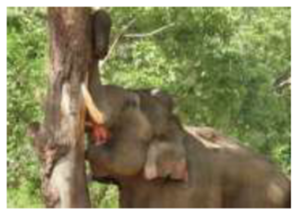
(i) Which function(s) of the tree is/are hampered by debarking?
Debarking removes the epidermis/bark, hampering the tree's protective function (loss of the waterproof, protective outer covering) and can damage the phloem, which lies just beneath the bark — hampering the transport of food (prepared by leaves) to the rest of the plant, especially the roots.
(ii) Which plant tissue would be affected by further damage to the tree trunk even after debarking?
Further damage to the trunk (deeper than the bark) would affect the vascular tissue beneath — primarily the xylem, which conducts water and minerals upward from the roots and also provides mechanical strength to the trunk.
(iii) Which function of the tree would be hampered if the tissues beneath the bark were severely damaged?
If tissues beneath the bark (phloem, and deeper, the xylem) are severely damaged, both food transport (phloem) and water/mineral transport (xylem) would be disrupted — this can starve the roots of food and/or stop water reaching the leaves, potentially killing the tree (this process is sometimes called 'girdling').
(iv) What assumptions are you making to answer the questions above? How would the answer change if your assumptions are also changed?
Assumption: That the debarking is severe/complete enough to remove or damage the phloem layer (which lies just under the bark) and does not merely scrape the outer dead cork layer.
If the damage were only superficial (only cork/outer bark, not reaching the phloem), the tree's transport functions would remain largely unaffected and it could recover; if damage extends deep enough to girdle the trunk fully (encircling it), the effect on transport would be much more severe and could be fatal.
Question 9. Aamrapali observed that a young mango sapling’s stem bends flexibly during monsoon winds and does not break. Which tissue is responsible for this flexibility? Predict and provide your explanation of the impact if the existing tissue was replaced by sclerenchyma.
- The collenchyma tissue is responsible for this flexibility — its living cells have unevenly thickened corners (due to pectin deposition), giving both support and flexibility, allowing the stem to bend without breaking.
- If collenchyma were replaced by sclerenchyma: The stem would become rigid and hard (due to lignified, thick, dead cell walls) but would lose flexibility. As a result, instead of bending safely in strong monsoon winds, the stem would be more likely to snap/break under similar stress, since sclerenchyma provides strength but not bending flexibility.
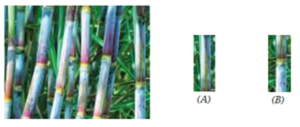
Question 10. Sohan designed an experiment for the regeneration of sugarcane, where he used cuttings to grow sugarcane. He used two types of cuttings, type ‘A’ and type ‘B’ (Fig.). After a few weeks, type ‘B’ cuttings sprouted and developed into sugarcane plants, whereas the type ‘A’ cuttings did not sprout.
(i) Why were the type ‘B’ cuttings able to grow as sugarcane but type ‘A’ could not?
Type 'B' cuttings sprouted because they included a node (containing intercalary/axillary meristematic tissue capable of producing new shoots and roots), while Type 'A' cuttings likely consisted only of internode tissue (mature, non-dividing tissue) with no node/bud, so they could not sprout.
(ii) What difference was present in type ‘B’ compared to type ‘A’?
Type 'B' cuttings contained at least one node (with a bud and meristematic tissue), whereas Type 'A' cuttings lacked a node/bud.
(iii) What observation or measurement was made to determine whether this change had an effect?
Whether or not the cuttings sprouted (produced shoots/roots) after being planted for a few weeks — presence or absence of new growth was recorded as the outcome.
(iv) What parameters should be kept the same for both types of cuttings to ensure a fair comparison?
Parameters to keep the same for a fair comparison:
- same species/variety of sugarcane,
- same cutting length/thickness,
- same soil type and nutrients,
- same watering,
- same amount of sunlight/temperature,
- same time period of observation,
- cuttings taken from plants of the same age/health.
Question 11. During the discussion in class, Rohan gives a statement that, “A tissue is a group of similar cells performing similar functions”. But Rajiv counter argues that, “this is true in case of simple tissues but little different in case of complex tissues”. Provide your explanation in view of the discussion in class.
Rajiv's counter-argument is correct.
- Rohan's statement is correct for simple tissues such as parenchyma, collenchyma and sclerenchyma.
- Simple tissues are made up of one type of similar cells that perform a particular function.
- However, complex tissues like xylem and phloem contain different types of cells.
- For example, xylem contains tracheids, vessels, xylem parenchyma and xylem fibres.
- These cells are different in structure, but they work together to perform a common function, mainly the transport of water and minerals.
- Therefore, a tissue can be defined as a group of cells that work together to perform a common function.
- The cells in a tissue may be similar or different, depending on the type of tissue.
Question 12. Coconut husk fibres are used for mats which are tough and fibrous. Which tissue has structural features suitable for providing this strength? Explain why living parenchyma couldn’t serve the same purpose.
Sclerenchyma tissue has the structural features suitable.
- Sclerenchyma cells have thick, lignified walls, which make the tissue hard, strong, and tough.
- Most sclerenchyma cells are dead at maturity, but their thick walls provide mechanical strength.
- Sclerenchyma is fibrous and resistant to wear, so it is suitable for making mats and ropes.
Parenchyma cannot serve this purpose because
- Its cells have thin walls and are loosely packed.
- Parenchyma mainly helps in storage and photosynthesis, not in providing mechanical strength.
Therefore, sclerenchyma is better suited for making strong and durable mats.
Question 13. Vibha claims to her friend Neha that, “Meristematic cells are located only at the root and shoot apices”. What do you think about this statement? What question can Neha ask Vibha to help her understand further if the statement is incorrect?
Vibha's statement is incorrect because meristematic cells are not found only at the root and shoot apices.
- Apical meristem is found at the tips of roots and shoots and helps the plant grow in length.
- Lateral meristem is found along the sides of stems and roots and helps the plant increase in thickness.
- Intercalary meristem is found near the nodes or bases of leaves in some plants and helps in the growth of parts such as grasses.
Question Neha can ask Vibha
- "How does grass regrow so quickly after mowing, or how does a tree trunk increase in thickness over the years, if meristematic cells are only at the tips?"
This would prompt Vibha to reconsider and recognise the existence of intercalary and lateral meristems.
Question 14. A plant cell and an animal cell are of the same size.
(i) Which cell will have a larger vacuole? Give reasons.
(ii) What assumptions are you making to answer the question above?
(i) The plant cell will have a larger vacuole.
Reason:
- Plant cells usually have a large central vacuole that occupies a major part of the cell.
- It stores cell sap, water, minerals, and other substances.
- Animal cells usually have small and temporary vacuoles, if present.
(ii) To answer this question, we assume that:
- Both cells are typical plant and animal cells.
- They are at a similar stage of development.
- Their size refers to the overall size of the cells, not the size of individual organelles.
- We are comparing a normal mature plant cell with a normal animal cell.
Question 15. A textbook states, “Each plant tissue performs only one specific function”. What questions would you ask to critically examine the correctness of this statement? What examples of tissues would you take to find out the answers to these questions?
Questions to ask:
- Does xylem perform only water transport, or does it also provide mechanical support to the plant?
- Does epidermis only protect, or does it also help control water loss (via cuticle/stomata) and gas exchange?
- Does parenchyma only store food, or does it also carry out photosynthesis (in green parts) and help aquatic plants float (via air spaces)?
Examples to test the statement:
- Xylem — transports water/minerals AND provides mechanical strength to the plant (two functions).
- Parenchyma — stores food, performs photosynthesis, and can form air spaces for buoyancy (multiple functions).
- Epidermis — protects against injury/microbes, reduces water loss via cuticle, and (through stomata) enables gas exchange and transpiration.
Conclusion: The statement is generally FALSE — many plant tissues (especially xylem, parenchyma, and epidermis) perform more than one function simultaneously, rather than just a single specific function.
We reply to valid query.