Solutions
Question 1. State whether the following statements are true or false and give reasons.
(1) A person bitten by a snake should be made to run quickly to the hospital.
False.
Reason :
- The person should minimise movement. Running or excessive movement makes the heart pump faster and spreads the poison through the body more quickly.
- The person should be carried or taken to a medical centre as quickly as possible while being kept calm and still.
(2) The body of a person suffering from sunstroke should be wiped with cold water.
True (wet cloth / water).
Reason :
- In sunstroke the body temperature is very high, so the body should be wiped with a wet cloth or lightly sprayed with water to lower the temperature quickly.
- The person should be moved to a cool, shaded place and taken to hospital. (Use cool water, not ice-cold water.)
Question 2. Suggest appropriate first aid for the following situations. Explain your answer with reason.
(1) Boiling water falls on your colleague's hand. The hand has turned red and
is causing severe pain.
- Quickly take the person away from the hot source and hold the hand under clean, cool running water for several minutes. Reason: this lowers the temperature of the skin, reduces pain and limits the damage.
- Gently remove rings/bangles before swelling starts.
- Do not burst any blisters that form and do not pull off any cloth stuck to the skin. Reason: bursting blisters or pulling cloth tears the skin and invites infection.
- Cover loosely with a clean cloth or a sterile bandage; apply burn ointment from the first aid kit only if skin is not broken.
- Take the person to a doctor/hospital; call 102/108 if the burn is large.
(2) A person’s clothes on the street have caught fire and he started running in panic.
- Stop him from running – shout to him to stop. Reason: running supplies more air (oxygen) and makes the fire flare up and spreads it.
- Make him roll quickly on the ground (or cover him with a thick blanket/cloth). Reason: rolling smothers the flames and extinguishes the fire faster.
- Do not pull off clothes stuck to the burnt skin and do not burst blisters.
- Call 108/102 (ambulance) or 101 (fire brigade) and take him to hospital; comfort him.
Question 3. Some wells in a village that had plenty of water suddenly started drying up. At the same time, water levels began to rise in wells that were previously dry. Yash thought this was a miracle. Priya thought this happened because of underground movements caused by an earthquake. Whom do you agree with? Give reasons for your answer.
I agree with Priya.
- An earthquake is caused by movement of deep underground rocks along cracks and weak sections of the crust.
- This movement can block old underground water channels (springs) so wells that had plenty of water dry up, and open new channels so wells that were dry fill with water.
It is a natural, scientific effect – not a miracle. Believing in miracles or rumours can mislead people; we should look for scientific reasons and listen to experts.
Question 4. Answer the following questions.
(a) What are the various effects of earthquakes on human life?
- Many houses and buildings collapse, causing death and injury and leaving people homeless.
- Roads and bridges are destroyed, so rescue and relief cannot reach affected areas.
- It is difficult to take the injured to hospital; electricity cables snap and power is cut off.
- Underground cables and pipes break and finding the damage is difficult – electricity and water supply stop.
- Railway tracks twist and bend, stopping trains.
- The course of a river may change, causing floods in some areas and drought in others (a double disaster).
- Cracks appear in the ground; massive loss of life and property (e.g., Killari 1993 – about 10,000 deaths).
(b) Write the harmful effects of war.
- Buildings collapse because of bomb blasts; massive fires break out.
- Water bodies get contaminated.
- Treatment and medical help are hard to get.
- Many people die and property is destroyed.
- Thousands of people are forced to migrate.
- Farming becomes difficult.
- Pollution increases due to weapons like poisonous gases and chemicals.
- Fear and mental stress spread among people.
(c) What will you do if you receive a call from an unknown number asking for an OTP?
- I will never share the OTP (or any password, PIN or personal information) with anyone, because it can be used to steal money or take over my accounts.
- I will cut the call immediately and not click on any link sent by the caller.
- I will tell my parents/teacher and inform my bank if it concerns a bank account.
- I will report the number to the cyber crime helpline (1930) or the police, as cyber crimes are punishable under the IT Act.
Question 5. Find information about the risks involved in pulling off clothes that are stuck to the skin of a person injured in a fire accident. Write it down in your notebook.
- The cloth is stuck to burnt, damaged skin; pulling it off tears the skin and flesh along with it and makes the wound deeper and larger.
- It causes severe pain and bleeding, and may burst blisters.
- The open wound is exposed to germs, giving a high risk of infection.
- It can cause shock and delay healing and leave bad scars.
- Therefore the clothes should be left in place and removed only by doctors at the hospital; meanwhile cover the area loosely with a clean cloth.
Question 6. Why should people avoid crowding at the site of a major accident, fire or river flood just to watch the situation or take videos and photos?
- A crowd blocks the way of ambulances, fire engines and rescue teams, delaying help and costing lives.
- The injured need space, air and calm; crowding makes it difficult to give first aid.
- Onlookers themselves can be injured – a wall may collapse, fire or flood may spread, or a stampede may occur.
- Taking photos and videos wastes precious time, hurts the dignity of victims, and spreads rumours and panic.
- Instead we should call 100/101/102/108, help if trained, and keep the area clear.
Question 7. List the ways in which we can help during a railway or vehicle accident.
- Inform the police (100), ambulance (102/108) or fire brigade (101) at once and give the exact location.
- Stay calm and keep the crowd away so rescue vehicles can reach the spot.
- Give first aid – stop bleeding by pressing with a clean cloth; comfort the injured.
- Help trained rescuers to bring people out safely; do not move seriously injured people unnecessarily.
- Take the injured to hospital quickly; give water/food/blankets to uninjured survivors.
- Do not spread or believe rumours; do not take photos and videos instead of helping.
- Inform and comfort the families; donate blood if needed (if eligible).
Question 8. Now a days, air-conditioned buses and trains are available for comfortable travel. These vehicles have large glass windows, but why are these windows always kept completely closed? Also, a large hammer is kept in a prominent, easily visible place in such vehicles. What could be its purpose?
- Why windows are kept completely closed: air-conditioning works only in a sealed space – opening windows lets the cool air escape and hot, dusty air enter; closed glass windows also stop people from leaning out and falling.
- Purpose of the hammer: in an emergency (fire, accident, vehicle overturned, doors jammed) the glass window can be broken with the hammer so passengers can escape quickly. It is kept in a prominent, easily visible place so that anyone can find it quickly.
Question 9. Some words related to disasters are hidden in the grid below. Identify these words and write them in your notebook.
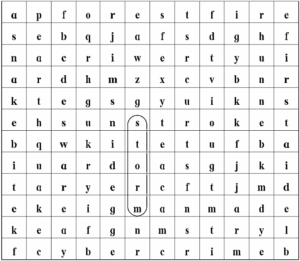
The grid hides these words (the example ‘storm’ is circled in the book, running down column 6):
| Word | Where to find it in the grid |
| forest fire | Row 1, left to right (columns 3–12) |
| earthquake | Column 2, top to bottom (rows 2–11) |
| snakebite | Column 1, top to bottom (rows 2–10) |
| firstaid | Column 12, top to bottom (rows 2–9) |
| sunstroke | Row 6, left to right (columns 3–11) |
| storm | Column 6, top to bottom (rows 6–10) – circled example |
| manmade | Row 10, left to right (columns 6–12) |
| cybercrime | Row 12, left to right (columns 2–11) |
We reply to valid query.