Solutions
Question 1. Fill in the blanks.
(1) The ………… is the major natural source of light for the Earth.
Sun
(2) When light falls on opaque objects, the ………… of light occurs.
reflection
(3) The functioning of a ………… camera depends on the straight-line propagation of light.
pinhole
(4) A beam of light coming through a window is visible due to …………
dust particles in the air
(5) Reflection of light from still water is of the …………type.
regular
Question 2. Choose the correct option.
(1) If the angle of incidence is 30°, then the angle of reflection is ………… degrees.
(a) 0 (b) 60 (c) 30 (d) 90
(c) 30 Explanation: According to the 2nd Law of Reflection, the angle of incidence equals the angle of reflection (∠ i = ∠ r). Thus, if ∠ i = 30°, then ∠ r = 30°.
(2) A clear image is seen in a plane mirror because …………
(a) regular reflection of light occurs.
(b) the surface of the mirror is rough.
(c) the mirror is transparent.
(d) irregular reflection of light occurs from the mirror
(a) regular reflection of light occurs. Explanation: Plane mirrors have smooth polished surfaces where parallel incident rays reflect uniformly in one direction as parallel rays.
(3) We can see the moon because-
(a) The moon is self-luminous.
(b) The moon is a satellite of the earth.
(c) Sunlight is reflected from the surface of the moon.
(d) The moon is close to the earth.
(c) Sunlight is reflected from the surface of the moon. Explanation: The moon is a non-luminous object that becomes visible when it reflects incident sunlight toward Earth.
(4) When the angle of incidence and the angle of reflection are equal during reflection of light ?
(a) Always
(b) Sometimes
(c) Under specific conditions
(d) Never
(a) Always Explanation: The equality of angle of incidence and angle of reflection (∠ i = ∠ r) is a universal physical law that holds true for every reflection event on both smooth and rough surfaces.
Question 3. The moon is approximately four lakh kilometers away from the earth. The moon is visible from earth, but any sounds produced there cannot be heard on earth. Why is this so?
Hence the Moon can be seen but any sound there cannot be heard on Earth.
Question 4. Identify whether the following statements are true or false. Rewrite the false statements after correcting them.
(1) The incident ray is called the normal.
Status: False. Correction: A line perpendicular to the surface at the point of incidence is called the normal. The incoming light ray is called the incident ray.
(2) We can see an object placed in front of us through a bent pipe.
Status: False. Correction: Light travels in a straight line (rectilinear propagation), so we CANNOT see an object through a bent pipe.
(3) Objects are clearly visible to us in a dark room.
Status: False. Correction: Objects are NOT visible in a dark room because vision requires light to fall on objects and enter our eyes.
(4) The image obtained in a pinhole camera is inverted.
Status: True. Explanation : The image formed in a pinhole camera is inverted (upside down) because light rays travel in straight lines across the tiny aperture.
Question 5. Who will be able to see the candle flame?
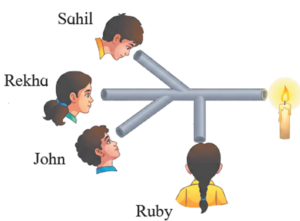
Only Rekha can see the flame.
Question 6. Label the diagram.
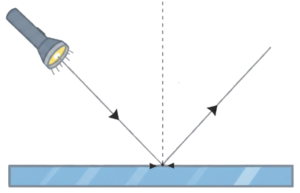
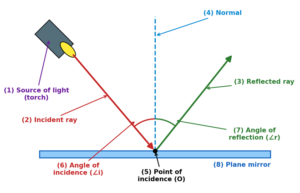
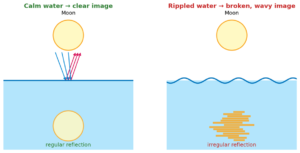
Question 7. An image of the moon is visible on calm water. If there are ripples on the water, does the image remain the same? What is the difference and what is the reason for it?
No, the image does not remain the same. Fig.: Moon’s image on calm water and on rippled water
Question 8. Classify the following into two groups: Self-luminous and Non-luminous.
An aeroplane visible in the sky, a book, the sun, gold, fire, the moon, the flame of an oil lamp, the oil lamp itself, the oil in the oil lamp.
Group 1: Self-Luminous Objects
Group 2: Non-Luminous Objects
Objects that produce their own light:
• The Sun
• Fire
• Flame of an oil lampObjects that do NOT produce their own light:
• An aeroplane visible in the sky
• A book
• Gold
• The Moon
• The oil lamp itself
• The oil in the oil lamp
Key Distinction Note: Self-luminous objects generate light internally. Non-luminous objects become visible only when they reflect light from a self-luminous source (such as the Sun or lamp flame) into our eyes.
We reply to valid query.