Notes
|
Topics to be learn :
|
Seeing, Light and Darkness :
Seeing needs two things working together: the eyes and light. Eyes alone are not enough.
In a completely dark room the objects are exactly where they were, yet we cannot see them. The moment a candle is lit or a lamp is switched on, everything becomes visible.
- Light is a form of energy that makes objects visible to us.
- Darkness is the absence of light.
Conditions for seeing an object :
- Seeing = Eyes + Light. If either one is missing, we cannot see.
- Objects in a dark room do not disappear; they simply cannot be seen because no light comes from them to our eyes.
Sources of Light :
Source of light (luminous object): Any object or instrument that generates and emits its own light is defined as a source of light.
- Some sources give bright, intense light (the Sun, a floodlight); others give very dim light (a firefly, a tiny oil lamp).
- Every object that produces its own light is a source of light, whether the light is strong or weak.
- A source means an origin. Light spreads out from a source in all directions.
Natural and Man-made Sources :
Sources of light are classified into two primary categories based on their origin:
- Natural Sources of Light: Light sources created by nature without human intervention.
- Man-Made (Artificial) Sources of Light: Light-emitting devices created by human technology.
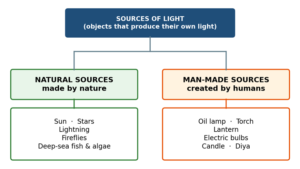
Fig. : Classification of sources of light
The Sun: Earth's Primary Energy Source :
- The Sun is the largest and most crucial natural source of light for the Earth.
- Sunlight provides the essential energy required for plants to perform photosynthesis and manufacture their own food.
- Plants use some of this food for their own growth; the rest is available for animals.
- Sunlight is necessary for flowers to bloom and trees to grow.
- Light is essential for the lives of humans, micro-organisms and animals.
Biological Light Emission (Bioluminescence) :
In nature, certain living organisms generate light through internal biochemical processes, a phenomenon known as bioluminescence:
- Fireflies: During dark rainy nights near ponds, streams, or forests, fireflies fly and emit rhythmic green light flashes. This light emission serves as an active communication signal sent to other nearby fireflies.
- Deep-Sea Organisms: In the pitch-black ocean depths where sunlight cannot penetrate, specific species of deep-sea fish and marine algae generate their own light to navigate, attract prey, or signal mates.
Summary Table: Classification of Light Sources Visible even in a dark place. Visible only when light from some source falls on them and reflects into the eye
Category
Key Characteristics
Examples
Natural Sources
Occur naturally in the universe; produce light without human technology.
Sun, stars, lightning, fireflies, deep-sea fish & algae
Man-Made Sources
Engineered by humans to provide illumination.
Oil lamp, torch, electric bulb, lantern, candle
Self-Luminous Objects
Objects that produce and emit their own light.
Sun, stars, lit candle flame, oil lamp flame, fireflies
Non-Luminous Objects
Objects that do not emit light of their own;
Book, moon, gold, aeroplane, unlit oil lamp, oil
| Know This :
Light produced by living things is called bioluminescence. Fireflies, glow-worms, some jellyfish and deep-sea anglerfish use it to attract mates, find food or warn enemies. Because the animal makes the light itself, it counts as a natural source. |
| EXAM REMINDER
· The Moon is NOT a source of light. It shines only because it reflects sunlight. · A lit oil lamp is a source because of its flame; the lamp (vessel) and the oil itself are non-luminous. |
Light Is Never Seen – Only Objects Are :
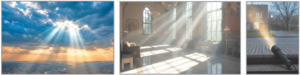
- What we actually see in a beam are the dust particles floating in the air along the path of light.
- Objects are visible because of light, but light itself is never seen.
Linear Propagation of Light :
Light always travels along a straight-line path, this fundamental property is called the linear propagation of light (or rectilinear propagation of light).
Experimental Proof (Cardboard Activity):
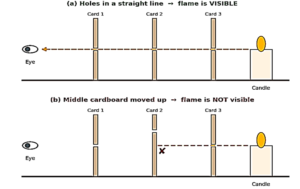
Everyday proofs of straight-line travel:
- sharp-edged beams from torches and headlights,
- the straight sunbeams through a window or cloud gaps,
Propagation of Light :
Sound Needs a Medium : Sound needs a material medium to travel. It can travel through solids, liquids, and gases. Examples: Sound can travel through railway tracks, wooden planks, and water.
Light Does Not Need a Medium : Light can travel through a vacuum, which is an empty space without matter. It does not need air, water, or any other material medium to travel.
- Example: Sunlight travels through the vacuum of space to reach the Earth. The Sun is about 15 crore kilometres (150 million kilometres) away from the Earth. Even though most of the space between them is a vacuum, sunlight reaches us.
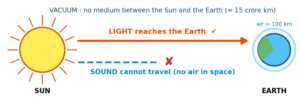
Conclusion: Sound needs a medium to travel, but light does not need a medium.
The Pinhole Camera :
Pinhole camera: a simple device with a tiny hole (no lens) that forms an image of an object on a screen. It is based on the straight-line propagation of light.
Construction & Working Principle: A large cardboard box is fitted with a translucent butter paper screen on one side and a tiny needle hole on the opposite face. When a lit candle flame is placed in front of the pinhole: How the image is formed : Fig. : Formation of an inverted image in a pinhole camera
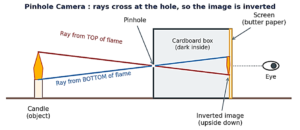
SAFETY APPLICATION: Looking directly at the Sun during a solar eclipse causes severe, irreversible eye damage. Pinhole cameras provide a completely safe indirect method to project and view the Sun's image during solar eclipses.
Reflection of Light & The Fundamental Laws of Reflection
What happens when light meets an obstacle? Fig. : Behaviour of light at different materials
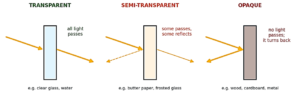
Type of obstacle
What light does
Examples
Transparent
Passes through completely
Clear glass, clean water, air
Semi-transparent
Some light passes through, some is reflected back
Butter paper, frosted glass
Opaque
Does not pass; it turns back from the surface
Wood, cardboard, metal, stone
Reflection of Light : When light rays traveling through space hit an opaque obstacle or reflecting surface, they bounce back into the original medium. The turning back of light rays from the surface of an object is defined as the Reflection of Light.
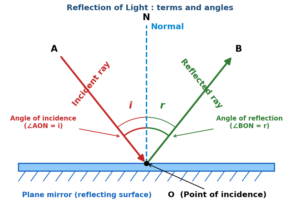
Figure: Ray diagram illustrating the Incident Ray, Normal, Reflected Ray, Angle of Incidence (∠ i), and Angle of Reflection (∠ r).
Key Terminology in Reflection :
- Incident Ray (AO): The incoming light ray that falls upon a reflecting surface.
- Point of Incidence (O): The exact point on the surface where the incident ray strikes.
- Normal (ON): An imaginary perpendicular line (90° angle) drawn to the surface at the point of incidence.
- Reflected Ray (OB): The light ray that turns back and leaves the surface from the point of incidence.
- Angle of Incidence (∠ AON or ∠ i): The angle enclosed between the incident ray and the normal.
- Angle of Reflection (∠ BON or ∠ r): The angle enclosed between the reflected ray and the normal.
| EXAM REMINDER
• Angles are always measured from the normal, never from the mirror surface. • The normal is not the incident ray. (Exercise 4, Q1 is based on this confusion.) |
The Three Fundamental Laws of Reflection :
Whenever a ray of light is reflected from any surface, it strictly obeys three universal rules known as the Laws of Reflection:
- Law 1: The incident ray and the reflected ray always lie on opposite sides of the normal.
- Law 2: The angle of incidence (∠ i) and the angle of reflection (∠ r) are always equal in measure (∠ i = ∠ r).
- Law 3: The incident ray, the reflected ray, and the normal all lie in the exact same physical plane.
Regular vs. Irregular (Diffused) Reflection
Depending on the microscopic smoothness or roughness of the reflecting surface, reflection manifests in two distinct operational types.
Regular Reflection
When a beam of parallel light rays falls upon a smooth, highly polished, and flat surface (such as a plane mirror, calm still water, or new shiny stainless steel utensils):
- All reflected rays remain perfectly parallel to each other and travel together in a single unified direction.
- This unified reflection creates a sharp, clear image of surrounding objects. For example, holding a plane mirror in sunlight allows casting a concentrated beam of light onto a wall.
Irregular (Diffused) Reflection :
When parallel light rays fall upon a rough, uneven, or unpolished surface (such as wood, paper, stone, walls, or cloth):
- The light rays bounce off in many different scattered directions.
- Universal Rule: Even in irregular reflection, the Laws of Reflection (∠ i = ∠ r) are strictly followed at every single individual point of incidence! The scattering occurs because the normals drawn at microscopic rough points point in different directions.
- Ecosystem Importance: Irregular reflection is the reason why we are able to see most non-luminous objects around us (such as stones, trees, furniture, and books) from any angle or direction in a room.
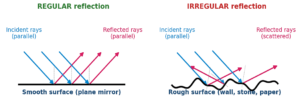
Fig. Regular reflection from a smooth surface and irregular reflection from a rough surface
Regular reflection v/s Irregular reflection :
Feature
Regular reflection
Irregular (diffused) reflection
Surface
Smooth and flat (plane mirror, still water, shiny new metal utensil)
Rough (wall, paper, stone, wood, cloth)
Parallel incident rays become
Parallel reflected rays – all go in one direction
Reflected rays go in many different directions
Laws of reflection
Obeyed
Also obeyed at every point
Result
Clear image is formed; mirror-like shine; can cast a beam on a wall
No image; object is visible from all directions
Examples
Mirror, calm water, polished metal
Stone on road, trees, furniture, book, wall
We reply to valid query.