Notes
|
Topics to be learn :
|
Investigating Water’s Disappearing Act :
On a rainy morning we see many puddles in the playground. In the evening some of the water has disappeared.
Where did it go? :
- Absorbed by the soil of the playground (seeping into the ground).
- Water seeping through a surface.
- Evaporation — water changing into an invisible gas in the air
Evaporation is often described as the 'self-disappearing act of water' because water left in puddles or open vessels gradually turns into invisible water vapour and vanishes into the atmosphere even without boiling.
| DEFINITION :
Water vapour : The gaseous state of water is called water vapour. Evaporation : The process of conversion of water into its vapour state is called evaporation. Evaporation takes place continuously, even at room temperature. |
Everyday examples of evaporation :
- Water left on washed utensils dries up; puddles shrink.
- Drying of wet clothes; a mopped floor drying.
- Sweat on our body drying; hand sanitiser disappearing as you rub it on your hands.
- Water sprinkled on a hot dosa pan disappears (some turns to steam).
| KNOW THIS | Steam vs water vapour :
- Water vapour is actually invisible. - Steam is water vapour, but the tiny droplets of water present in steam make it visible. - Some of the vapour condenses into droplets. |
Another Mystery :
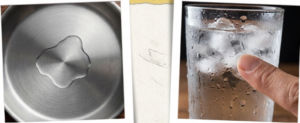
Water droplets are seen in other places too: dew drops on plants (more in the morning), and drops on the inner side of a steel plate covering a vessel of boiling water.
Condensation : When water vapour present in the air comes in contact with a cold surface, it forms water droplets. The process of conversion of water vapour into its liquid state is called condensation
- During the night, surfaces such as leaves cool down. Water vapour in the air condenses on these cold surfaces, so dew is seen most in the early morning.
Same idea, three places :
- Cold tumbler (vapour in room air → drops outside)
- Steel plate over boiling water (hot vapour → drops on the cooler plate)
- Dew on leaves (vapour in night air → drops on cold leaves).
| KNOW THIS : Humidity :
The amount of water vapour in the air is called humidity. |
What are the different States of Water?
The Three Physical States of Water :
Water exists in three physical states: solid, liquid, and gas. Each state has different properties.
(1) Solid State (Ice) : Water changes into ice when it is cooled below 0°C.
- Ice has a fixed shape and a fixed volume.
- It does not flow or spread like liquid water.
- Example: Ice cubes and frost.
(2) Liquid State (Water) : Ice changes into liquid water when heated and melted.
- Water has a fixed volume but no fixed shape.
- It takes the shape of the container in which it is kept.
- It flows freely from higher to lower levels.
- Example: Water in a glass, river, or bottle.
(3) Gaseous State (Water Vapour) : Water changes into water vapour when it evaporates or boils.
- Water vapour has no fixed shape or volume.
- It spreads in all directions and fills the available space.
- Water evaporates from wet clothes and mopped floors.
- Pure water vapour is invisible. The visible mist above boiling water consists of tiny water droplets.
Summary of the Three States :
| Property | Solid (Ice) | Liquid (Water) | Gas (Water Vapour) |
| Shape | Fixed | Not fixed | Not fixed |
| Volume | Fixed | Fixed | Not fixed |
| Movement | Does not flow | Flows freely | Spreads in all directions |
| Example | Ice cubes | River water | Water vapour |
| KNOW THIS | Other substances show these states too
Wax, oil and ghee can also be solid, liquid or gas-like depending on temperature (the textbook lists them as substances that exhibit these states). |
How can we change the States of Water? :
Water can change from one physical state to another by heating or cooling. This process is called interconversion of states.
(1) Melting : Melting is the process in which a solid changes into a liquid on heating. Example: Ice melts and changes into water when heated.
(2) Freezing : Freezing is the process in which a liquid changes into a solid on cooling. Example: Water changes into ice when kept in a freezer.
(3) Evaporation : Evaporation is the process in which liquid water changes into water vapour. It can take place at room temperature or on heating. Example: Wet clothes dry because water evaporates into the air.
(4) Condensation : Condensation is the process in which water vapour changes into liquid water on cooling. Example: Water droplets form on the outside of a cold water bottle.
Interconversion of the Three States of Water :
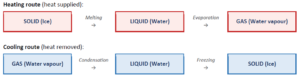
Conclusion: Heating changes ice into water and water into water vapour. Cooling changes water vapour into water and water into ice.
| KNOW THIS — Atmospheric Water Generator (AWG)
· AWG machines collect water from humid air to produce drinkable water. · They cool the air so that water vapour condenses — the same idea as drops forming on a glass of ice-cold water. |
How can Water be Evaporated Faster or Slower?
Four Factors Affecting the Rate of Evaporation :
(1) Temperature : Higher temperature increases the rate of evaporation.
- Water evaporates faster in hot conditions than in cool conditions.
- Example: Water in a puddle evaporates faster in sunlight than in the shade.
(2) Surface Area : A larger surface area increases the rate of evaporation.
- More water is exposed to the air, so evaporation takes place faster.
- Example: Water in a wide plate evaporates faster than the same amount of water in a narrow bottle.
(3) Wind Speed : Higher wind speed increases the rate of evaporation.
- Wind carries away water vapour from the surface, allowing more water to evaporate.
- Example: Wet clothes dry faster on a windy day.
(4) Humidity : Humidity is the amount of water vapour present in the air. Higher humidity decreases the rate of evaporation.
- Water evaporates faster when the air is dry.
- Example: Clothes take longer to dry on humid, rainy days.
| MNEMONIC | Factors of evaporation: “S T A H”
Surface area • Temperature • Air movement • Humidity — “Some Teachers Always Help.” · Larger S, higher T and more A → faster. · Higher H → slower. |
Cooling Effect :
Cooling Effect of Evaporation :
When water evaporates, it absorbs heat from its surroundings. This lowers the temperature of the surroundings and produces a cooling effect.
(1) Sweating in Humans :
- When our body becomes hot, sweat comes out through the skin.
- Sweat absorbs heat from our body when it evaporates.
- This helps to keep our body cool.
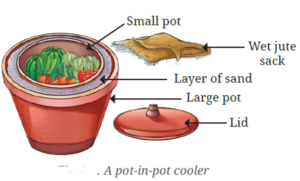
(2) Earthen Pots (Matka and Surahi) :
- Earthen pots have tiny holes in them.
- A small amount of water comes to the outer surface through these holes and evaporates.
- During evaporation, heat is taken from the pot and the water inside it.
- Therefore, water stored in an earthen pot becomes cool.
(3) Transpiration in Plants :
- Plants absorb water through their roots.
- Some of this water reaches the leaves and evaporates through tiny pores called stomata.
- This process is called transpiration.
- Transpiration helps to keep plants cool on hot days.
Examples of the cooling effect :
- Matka and surahi (clay pot used in summer to keep water cold).
- Sitting under a fan: wind helps sweat evaporate, which cools us.
- Sprinkling water on the floor or roof in summer.
- Rubbing sanitiser on the hands: it evaporates and the hands feel cool.
How do Clouds give us Rain? :
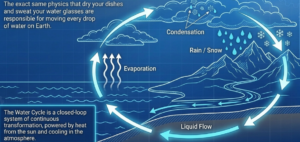
The water cycle is the continuous movement of water between the Earth's surface and the atmosphere. It helps to provide water to plants, animals, and humans.
How Are Clouds Formed? :
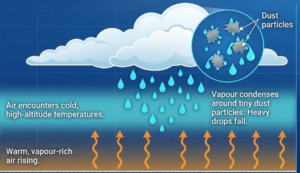
- Evaporation: The Sun heats water in oceans, rivers, and lakes. The water changes into water vapour and rises into the air.
- Cooling: As water vapour rises higher, it cools down.
- Condensation: The water vapour changes into tiny water droplets around dust particles.
- Cloud Formation: Millions of tiny water droplets come together to form clouds.
- Precipitation: The droplets combine to form larger drops. When they become heavy enough, they fall to the Earth as rain. Water can also fall as snow or hail.
Four Stages of the Water Cycle :
(1) Evaporation and Transpiration : The Sun heats water in rivers, lakes, and oceans, changing it into water vapour. Plants also release water vapour through their leaves. This process is called transpiration.
(2) Condensation : Water vapour rises, cools, and changes into tiny water droplets. These droplets form clouds.
(3) Precipitation : Water falls from clouds to the Earth as rain, snow, or hail.
(4) Collection : Water collects in rivers, lakes, and oceans. Some water enters the soil and replenishes groundwater.
Importance of the Water Cycle :
- It provides water for plants, animals, and humans.
- It replenishes rivers, lakes, and groundwater.
- It helps maintain the balance of water in nature.
- It supports plants and other living things.
- It helps regulate the Earth's climate.
Conclusion: The water cycle is a continuous process in which water evaporates, condenses to form clouds, falls as precipitation, and collects on the Earth. The cycle then repeats.
Using water wisely :
- Only a small portion of Earth’s water is fit for use by plants, animals and humans; most is in the oceans and cannot be used directly.
- Population is rising, so demand for water increases, causing shortage in many parts of the world.
- Use water wisely, avoid wasting it and keep water bodies free from pollution.
We reply to valid query.