Solutions (Exercise + Intext)
Intext Questions :
Think It Over :
Question 1: Why do suspended particles settle in muddy water over time but not in milk?
- Muddy water is a suspension, which is a heterogeneous mixture containing relatively large solid particles (greater than 1000 nm in diameter). Because these particles are large and heavy, gravity overcomes their thermal kinetic motion, causing them to settle at the bottom over time.
- In contrast, milk is a colloid (an emulsion of fat droplets in water). The dispersed fat particles in milk are much smaller (1 nm to 1000 nm) and remain suspended continuously due to rapid Brownian motion and electrostatic repulsion, preventing them from settling out.
Question 2: How is evaporation different from boiling?
Evaporation and boiling are both vaporisation processes, but they differ fundamentally in the following ways:
- Surface vs. Bulk Phenomenon: Evaporation is a surface phenomenon occurring only at the liquid surface, whereas boiling is a bulk phenomenon occurring throughout the entire liquid volume.
- Temperature Requirement: Evaporation occurs naturally at any temperature below the boiling point, whereas boiling takes place only at a specific fixed temperature (the boiling point).
- Rate & Bubbles: Evaporation is a slow process without bubble formation. Boiling is a rapid process characterized by the formation and movement of vapour bubbles throughout the liquid.
Question 3: Why do you see bright rays of sunlight when it passes through small gaps between the leaves of a dense tree?
This phenomenon occurs due to the Tyndall Effect.
- The atmosphere in a dense forest contains mist, fog, and suspended dust particles, which act as colloidal particles dispersed in air.
- When sunlight passes through small gaps between leaves, these tiny particles scatter the light rays in all directions, making the path of the light beam clearly visible to our eyes.
Question 4: Is the mixture of oil and water homogeneous or heterogeneous? Can you think of some other heterogeneous mixtures?
The mixture of oil and water is a heterogeneous mixture.
Reason: Oil and water are immiscible liquids. They do not dissolve in each other and form two visibly distinct layers with a sharp boundary, maintaining a non-uniform composition throughout.
Other Examples of Heterogeneous Mixtures:
- Sand stirred in water
- Chalk powder suspended in water
- Sawdust mixed with water
- Smoke (solid carbon particles suspended in air)
Pause and Ponder : Numerical Questions :
Question 1: A common talcum powder contains 4 % m/m zinc oxide, which acts as an antiseptic. How much zinc oxide is present in 300 g of the talcum powder?
Formula: Mass % (m/m) = \(\frac{\text{Mass of solute}}{\text{Mass of solution}}\) × 100
Step 1: Identify given quantities.
- Mass percentage (% m/m) of Zinc Oxide = 4%
- Total mass of talcum powder (solution/mixture) = 300 g
Step 2: Apply the Mass by Mass Percentage Formula.
- % m/m = (Mass of solute / Total mass of mixture) × 100
Step 3: Substitute values and calculate.
- 4 = (Mass of Zinc Oxide / 300 g) × 100
- Mass of Zinc Oxide = (4 × 300) / 100 = 12 g
Conclusion: There are 12 grams of zinc oxide present in 300 g of the talcum powder.
Question 2: Your mother gives you a bottle of orange juice concentrate to mix with water and serve it to your visiting friends. She asks you to mix two tablespoons of the concentrate with water in a glass tumbler. If each tablespoon measures 15 mL and you make 150 mL of juice per person, what is the % v/v of orange juice concentrate in the mixture you prepared?
Formula: Volume % (v/v) = \(\frac{\text{Volume of solute}}{\text{Volume of solution}}\) × 100
Step 1: Calculate the total volume of solute (orange juice concentrate).
- Volume of 1 tablespoon = 15 mL
- Volume of 2 tablespoons (solute) = 2 × 15 mL = 30 mL
Step 2: Identify the total volume of solution.
- Total volume of orange juice per glass (solution) = 150 mL
Step 3: Apply the Volume by Volume Percentage Formula.
- % v/v = (Volume of solute / Total volume of solution) × 100
- % v/v = (30 mL / 150 mL) × 100 = (1 / 5) × 100 = 20%
Conclusion: The concentration of orange juice concentrate in the prepared drink is 20% v/v.
Question 3: Vinegar, used as a food preservative and additive, contains 5 % v/v acetic acid. Glacial acetic acid is a liquid, i.e., 100% acetic acid. If you want to make vinegar from glacial acetic acid, how would you proceed?
Step 1: Understand the target concentration.
- Commercial vinegar requires a 5% v/v concentration of acetic acid in water.
Step 2: Calculate required volumes for standard 100 mL batch.
- To make 100 mL of 5% v/v vinegar, you need 5 mL of pure (glacial) acetic acid.
Step 3: Procedure for preparation.
- Measure accurately 5 mL of liquid glacial acetic acid using a calibrated pipette.
- Transfer it into a 100 mL volumetric flask containing approximately 50 mL of distilled water.
- Mix gently and add water until the total volume reaches the 100 mL mark.
General Rule: Mix 5 parts by volume of glacial acetic acid with 95 parts by volume of water.
Solubility Curves & Graph Analysis Questions
Question 1: Based on Figure 5.6 (Solubility curves of compounds 'A' and 'Bin water), fill in the blanks in the following statements:

(i) The solubility of compound 'A' in water at 20 °C is ____________ (less than/more than/similar to) its solubility at 60 °C.
(ii) The solubility of compound 'B' at 20 °C is ____________ (less than/more than/similar to) its solubility at 60 °C.
(iii) The solubility of _____________ increases more than that of ______________ with an increase in temperature.
(i) Answer: less than
- Explanation: As temperature increases from 20 °C to 60 °C, the solubility curve for Compound A rises, showing higher solubility at 60 °C.
(ii) Answer: less than
- Explanation: The solubility curve for Compound B rises significantly as temperature increases from 20 °C to 60 °C.
(iii) Answer: Compound 'B' ; Compound 'A'
- Explanation: Compound B's curve has a much steeper upward slope (rising from ~100 g to 350 g/100 g water) than Compound A's curve, indicating a far greater increase in solubility per degree rise in temperature.
Question 2: Refer to the solubility curves given in Activity 5.2. If equal masses of hot, saturated solutions of compounds 'A' and 'B' are cooled from 80 °C to 60 °C, which solution is likely to deposit more solid?
Compound 'B' will deposit significantly more solid.
Reasoning & Analysis:
- The solubility of a substance represents the maximum amount that can remain dissolved in 100 g of solvent at a given temperature.
- Between 80 °C and 60 °C, the solubility of Compound B drops rapidly (steep decrease on graph).
- Because Compound B's solubility decreases by a much larger margin than Compound A's over the same temperature interval, the excess solute that can no longer stay dissolved precipitates out as crystals, depositing a greater mass of solid Compound B.
Question 3: Will there be any change in the size of common salt crystals if the rate of evaporation is increased or decreased? Explain.
Yes, the rate of evaporation directly determines the size of the resulting salt crystals.
Slower Evaporation (Decreased Rate): When water evaporates slowly (e.g., at room temperature), solute particles have ample time to migrate and lock into organized crystalline lattice positions.
This slow, undisturbed growth results in larger, well-shaped, shiny crystals.
Faster Evaporation (Increased Rate): Rapid heating or high evaporation forces fast precipitation of solute particles.
The particles assemble rapidly and haphazardly, giving rise to numerous smaller, finer crystals.
Separation Methods Intext Questions
Question 1: State whether the following statements are True or False. Also, correct the False statements:
(i) Salt can be separated from a salt solution by evaporation or distillation.
(ii) Distillation can be used for separation of two liquids even when these have the same boiling point.
(iii) In paper chromatography, the solvent level should be above the sample spot at the beginning of the experiment.
(iv) Evaporation and crystallization are the same processes.
(i) True.
- Explanation: Evaporation leaves solid salt in the dish, while distillation recovers pure water distillate while leaving salt behind in the flask.
(ii) False.
- Correction: Distillation requires a significant difference in boiling points (at least 25 °C) between miscible liquids so that one vaporises distinctly before the other.
(iii) False.
- Correction: In paper chromatography, the solvent level MUST be below the sample spot so that the sample is not washed directly into the solvent pool, but instead travels up the paper via capillary action.
(iv) False.
- Correction: Evaporation drives off liquid completely to leave crude/amorphous residue, whereas crystallization forms highly pure, geometrically structured crystals from a cooled saturated solution.
Question 2: Why do immiscible liquids form two separate layers in a separating funnel?
Reason 1: Chemical Immiscibility
- Immiscible liquids (like mustard oil and water) have different molecular polarities and cannot dissolve in each other.
Reason 2: Density Difference
- Driven by gravity, the denser liquid (water, density ~1.0 g/cm³) settles at the bottom, while the less dense liquid (mustard oil, density ~0.9 g/cm³) floats to the top, creating two distinct liquid layers.
Question 3: Is sublimation different from evaporation? Justify.
Yes, sublimation is distinctly different from evaporation:
- Sublimation is the direct transition of a solid into gas/vapour phase (and vice-versa upon cooling as deposition) without passing through an intermediate liquid state.
- Evaporation is the transition of a liquid into vapour phase occurring at temperatures below its boiling point.
Examples:
- Sublimation: Heating camphor, ammonium chloride, or naphthalene.
- Evaporation: Drying wet clothes or recovering salt from seawater.
Colloids & Tyndall Effect Intext Questions
Question 1: Clouds are made up of tiny water droplets or ice crystals floating in the air. Based on what you know about solutions, suspensions and colloids, what type of mixture do you think clouds are and why?
Clouds are colloids (specifically aerosols).
Justification:
- Particle Size: The tiny water droplets or ice crystals have diameters within the colloidal range (1 nm to 1000 nm).
- Non-settling Behavior: They do not settle rapidly under gravity (unlike suspensions), but remain uniformly dispersed throughout the atmospheric air medium.
- Light Scattering: Clouds scatter sunlight efficiently (Tyndall Effect), making them appear white or gray.
Question 2: Why do cities with a lot of smoke and dust in the air often look hazy?
The hazy appearance is caused by the Tyndall Effect.
Explanation: Smoke and dust particles suspended in urban air act as colloidal particles dispersed in a gas medium. When sunlight passes through this polluted air, these microscopic particles scatter light in all directions, obscuring distant objects and creating a visible, cloudy haze.
Exercise Solutions :
Revise, Reflect, Refine :
Question 1. Which of the following mixtures are correctly classified as homogeneous (Hm) and heterogeneous (Ht)? Choose the correct option.
(i) Air — Hm, Milk — Ht, Sugar solution — Hm, Smoke — Hm
(ii) Brass — Ht, Fog — Ht, Vinegar — Ht, Muddy water — Hm
(iii) Copper sulfate solution — Hm, Salt solution — Hm, Milk — Hm, Bronze — Hm
(iv) Muddy water — Ht, Milk — Ht, Blood — Ht, Brass — Hm
Correct option : (iv) Muddy water — Ht, Milk — Ht, Blood — Ht, Brass — Hm
Why the others are wrong:
(i) smoke is heterogeneous (solid particles in air);
(ii) brass is homogeneous (an alloy), vinegar is homogeneous, muddy water is heterogeneous;
(iii) milk is not a solution.
Question 2. Choose the correct options, and explain the reason for the correct and incorrect options. Which among the following mixtures show the Tyndall Effect? A mixture of:
(a) air and dust particles
(b) copper sulfate and water
(c) starch and water
(d) acetone and water
(i) a and b (ii) b and d (iii) a and c (iv) c and d
Correct option : (iii) a and c
Why the others are incorrect ?:
(a) air with dust particles scatters light, and (c) starch in water is a colloid, so it scatters light.
(b) copper sulfate solution and (d) acetone–water are true solutions with particles < 1 nm: no scattering.
So (i), (ii) and (iv) are incorrect.
Question 3. A mixture can be categorised as a solution, a suspension, or a colloid, each possessing distinct properties. Utilise the words or phrases provided in the box to fill in the Table 5.2. Words and phrases may be used more than once.
Words and Phrases :
Large-sized particles; Particles remain evenly distributed; Small-sized particles (less than 1 nm diameter); Moderate-sized particles (1 – 1000 nm); Settles down when left undisturbed (more than 1000 nm in diameter); Does not settle down; Scatters light; Separates by filtration; Transparent; Salt solution; Milk; Sand in water; Smoke; Heterogeneous mixture; Cannot be separated by filtration; Mud; Butter; Brass.
Complete the Table.
| Solution | Suspension | Colloid | |
| Properties | |||
| Examples |
| Solution | Suspension | Colloid | |
| Properties | Small-sized particles (< 1 nm)
Particles remain evenly distributed Transparent Does not settle down Cannot be separated by filtration |
Large-sized particles (> 1000 nm)
Heterogeneous mixture Settles down when left undisturbed Separates by filtration Scatters light |
Moderate-sized particles (1–1000 nm)
Particles remain evenly distributed Does not settle down Cannot be separated by filtration Scatters light |
| Examples | Salt solution
Brass |
Sand in water
Mud |
Milk
Smoke Butter |
Question 4. Solve the following problems:
(i) A cake recipe uses dry ingredients, namely 75 g of sugar for 420 g of all-purpose flour and 5 g of sodium hydrogencarbonate. Express the concentration of each component in the mixture using an appropriate method.
- Calculate Total Mass of Solution/Mixture:
Total Mass = Mass(Sugar) + Mass(Flour) + Mass(Sodium Hydrogencarbonate)
Total Mass = 75 g + 420 g + 5 g = 500 g
- Apply Mass Percentage Formula (% m/m):
% m/m = \(\frac{\text{Mass of component}}{\text{Mass of mixture}}\) × 100
- Calculate Individual Concentrations:
- Sugar (% m/m) = \(\frac{75\,g}{500\,g}\) × 100 = 15.0% m/m
- All-purpose Flour (% m/m) = \(\frac{420\,g}{500\,g}\) × 100 = 84.0% m/m
- Sodium Hydrogencarbonate (% m/m) = \(\frac{5\,g}{500\,g}\) × 100 = 1.0% m/m
Verification: 15.0% + 84.0% + 1.0% = 100.0%
(ii) A brass alloy contains 70% copper by mass. Calculate the quantities of copper and zinc present in 120 g of brass.
Identify Given Data:
- Total mass of Brass alloy = 120 g
- % m/m of Copper (Cu) = 70%
Calculate Mass of Copper:
- Mass of Copper = \(\frac{70}{100}\) × 120 g = 84.0 g
Calculate Mass of Zinc (Zn):
- Method A (% remaining): % Zinc = 100% - 70% = 30%
Mass of Zinc = \(\frac{30}{100}\) × 120 g = 36.0 g
- Method B (Difference): Mass of Zinc = Total Mass - Mass of Copper = 120 g - 84 g = 36.0 g
Final Answer: Copper = 84 g, Zinc = 36 g
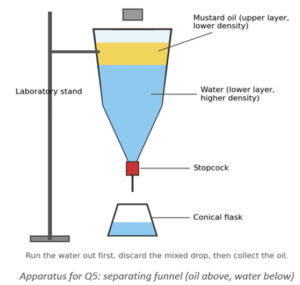
Question 5. The label on a cooking oil pack says one litre (910 g). If this oil is mixed with water, will it form a separate layer? If so, which substance will be on top? How will you separate the two layers? Also, draw the diagram of the apparatus used.
Layer Formation: Yes, oil and water are immiscible liquids and will form two separate, distinct layers when mixed.
Top Layer Determination:
- Density of Water = 1.00 g/mL (or 1000 g/L).
- Density of Cooking Oil = \(\frac{mass}{volume}\) = \(\frac{910}{1000}\) = 0.91 g/mL.
- Since 0.91 g/mL < 1.00 g/mL, cooking oil is less dense than water and will float on top (forming the upper layer).
Separation Method & Procedure:
Apparatus: Separating Funnel.
Procedure: Pour the oil-water mixture into a separating funnel and let it stand undisturbed until two clear layers form. Open the stopcock at the bottom of the funnel to carefully drain the denser bottom water layer into a receiving beaker. Close the stopcock immediately when the interface reaches the stopcock, leaving pure oil inside the funnel.
Question 6. Assertion (A): Solutions do not exhibit the Tyndall effect.
Reason (R): The particles in solutions are larger than 100 nm, so they cannot scatter light.
Choose the correct option:
(i) Both A and R are true, and R is the correct explanation of A.
(ii) Both A and R are true, but R is not the correct explanation of A.
(iii) A is true, but R is false.
(iv) A is false, but R is true.
Correct Answer: Option (iii) — A is true, but R is false.
Detailed Scientific Analysis:
- Assertion (A) is TRUE: True solutions do not scatter light, so the path of a laser beam remains invisible inside the solution.
- Reason (R) is FALSE: Solute particles in a true solution are extremely small — less than 1 nanometre (< 1 nm or 10⁻⁹ m) in diameter — NOT larger than 100 nm. Because their dimensions are far smaller than the wavelength of visible light, they cannot scatter light rays.
Question 7. How would you separate the mixtures given in Table 5.3? Mention the reason for choosing your method. If a mixture cannot be separated, explain why.
| Mixture | Method | Reason |
| Mud from muddy water | ||
| Plasma from other components of blood | ||
| Naphthalene and sand | ||
| Chalk powder and common salt | ||
| Common salt and water | ||
| Oil from water | ||
| Pigments of the flower |
| Mixture | Method | Reason |
| Mud from muddy water | Sedimentation and decantation / filtration; for fine particles centrifugation or coagulation with alum | Mud is a suspension: large particles that settle; alum clumps fine particles |
| Plasma from other components of blood | Centrifugation | Heavier cells move outward and settle; lighter plasma stays on top |
| Naphthalene and sand | Sublimation | Naphthalene changes directly to vapour on heating; sand does not |
| Chalk powder and common salt | Add water, stir, filter; chalk stays on filter paper; evaporate/crystallize the filtrate to get salt | Salt dissolves in water, chalk does not (solubility difference) |
| Common salt and water | Evaporation / crystallization (salt); distillation if water is also wanted | Water vaporises, salt does not |
| Oil from water | Separating funnel | Immiscible liquids with different densities |
| Pigments of the flower | Paper chromatography (alcohol may be needed as solvent) | Pigments move at different speeds on paper |
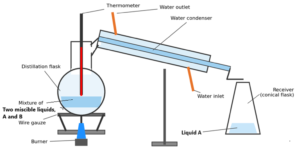
Question 8. Two miscible liquids, A and B, are present in a mixture. The boiling point of A is 60 °C and the boiling point of B is 90 °C. Suggest a method to separate them. Also, draw a labelled diagram of the method suggested.
Suggested Method: Simple Distillation
Justification: The boiling point difference between Liquid A (60 °C) and Liquid B (90 °C) is ΔT = 90 °C - 60 °C = 30 °C. Since the difference exceeds the threshold of 25 °C, simple distillation effectively separates them without requiring a fractionating column.
Process & Apparatus Setup:
- The mixture is placed in a round-bottom distillation flask fitted with a thermometer and connected to a Liebig water condenser.
- Upon heating, Liquid A (lower B.P. 60 °C) vaporizes first at 60 °C. Its vapours rise, pass through the water-cooled condenser, condense back into liquid distillate, and collect in a receiving flask.
- Liquid B (higher B.P. 90 °C) remains unchanged in the distillation flask until Liquid A is completely separated.
Question 9. Compare evaporation, crystallization and distillation. In which situation, would you prefer each of these over the others?
Comparison of Evaporation, Crystallization, and Distillation :
| Parameter | Evaporation | Crystallization | Distillation |
| Core Mechanism | Heating solution to dryness to drive off solvent as vapour. | Slow cooling of a hot saturated solution to form pure solid crystals. | Vaporizing liquid followed by cooling & condensing vapours in a condenser. |
| Substances Recovered | Only non-volatile solid solute (solvent is lost to air). | Pure solid solute in crystalline form with high purity. | Both solvent (as liquid distillate) and solid/liquid residue. |
| When Preferred Over Others | Preferred when only the solid is needed quickly and thermal decomposition is not a concern (e.g., salt from seawater). | Preferred when purifying solids or heat-sensitive compounds without charring/decomposition (e.g., copper sulfate crystals). | Preferred when recovering the liquid solvent or separating miscible liquids with ΔBP ≥ 25 °C (e.g., acetone & water). |
Question 10. Blood is an example of a colloidal mixture. (i) What would happen if blood behaved like a true suspension inside the body? (ii) In a blood sample, identify the dispersed phase and the dispersion medium.
(i) If blood behaved like a true suspension inside the body:
- In a suspension, large particles settle down at the bottom due to gravity whenever the system is left undisturbed.
- If blood were a suspension, blood cells (RBCs, WBCs, platelets) would settle out of plasma inside blood vessels whenever a person sleeps or sits still.
- This settling would clog arteries and veins, stop blood circulation, prevent oxygen delivery to vital organs, and cause fatal blockages.
(ii) Identification of Colloidal Components in Blood:
- Dispersed Phase (Solid components): Red Blood Cells (RBCs), White Blood Cells (WBCs), and Platelets.
- Dispersion Medium (Liquid medium): Blood Plasma (aqueous solution containing dissolved proteins, electrolytes, glucose, and waste).
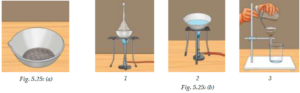
Question 11. You are given a mixture of sand, common salt and naphthalene (Fig. 5.25a). The Fig. 5.25b depicts various steps used to separate the components of this mixture. Identify and write down the correct sequence of separation techniques.
Correct Sequence of Separation Techniques:
Step 1 – Sublimation: heat the mixture in a china dish under an inverted, cotton-plugged funnel; naphthalene sublimes and deposits on the funnel.
Step 2 – Dissolving (with heating): add water to the residue (sand + salt) and stir/heat; salt dissolves, sand does not.
Step 3 – Filtration: filter; sand stays on the filter paper, salt solution is the filtrate. (Evaporating the filtrate then gives salt.)
Question 12. Why is distillation an effective method for separating a mixture of water and acetone?
Distillation is highly effective for separating water and acetone because:
- Miscibility: Acetone and water dissolve completely in each other to form a single homogeneous liquid phase.
- Large Boiling Point Difference: Acetone boils at 56 °C, whereas Water boils at 100 °C. The boiling point difference ΔT = 100 °C - 56 °C = 44 °C, which is well above the required 25 °C threshold for simple distillation.
- Clean Separation: Upon heating to ~56 °C, acetone vaporizes completely while water stays liquid. Condensed acetone is collected as pure distillate.
Question 13. Answer the following questions with the help of the data given in Table.
Table : Solubility of various salts (in g per 100 g of water) at different temperatures
| Salt | 10 °C | 20 °C | 30 °C | 40 °C | 60 °C | 80 °C |
| Potassium nitrate | 21 | 32 | 45 | 62 | 106 | 167 |
| Sodium chloride | 36 | 36 | 36.3 | 36.5 | 37 | 37 |
| Potassium chloride | 35 | 35 | 37.4 | 40 | 46 | 54 |
| Ammonium chloride | 24 | 37 | 41 | 41 | 55 | 66 |
(i) What mass of potassium nitrate would be needed to prepare its saturated solution in 50 g of water at 40 °C?
(ii) A student makes a saturated solution of potassium chloride in water at 80 °C and leaves the solution to cool at room temperature (25 °C). What would she observe as the solution cools? Explain.
(iii) What is the effect of a change in temperature on the solubility of salts? Also, compare the changes in the solubility of the four given salts with increasing temperature from 10 °C to 80 °C.
Part (i): Saturated Solution of Potassium Nitrate at 40°C in 50 g Water
- From Table, solubility of Potassium Nitrate (KNO₃) at 40 °C = 62 g per 100 g water.
- Mass of KNO₃ needed for 50 g water = (62 g / 100 g) × 50 g = 31.0 g.
Part (ii): Cooling Saturated Potassium Chloride Solution from 80°C to Room Temperature
- At 80 °C, solubility of KCl = 54 g per 100 g water.
- At room temperature (25 °C), solubility of KCl = ~36.2 g per 100 g water.
Observation & Explanation: As the solution cools from 80 °C to 25 °C, water can no longer hold 54 g of dissolved KCl. The excess dissolved salt (~17.8 g per 100 g water) will separate out of the liquid phase and form solid shiny crystals of potassium chloride (Crystallization).
Part (iii): Temperature Effect & Comparative Salt Analysis (10°C to 80°C)
General Effect: The solubility of solid salts in water generally increases with an increase in temperature.
Comparative Increase (10 °C → 80 °C):
- Potassium Nitrate (KNO₃): Massive increase from 21 g to 167 g (Δ = +146 g / 100 g water) — most temperature-sensitive.
- Ammonium Chloride (NH₄Cl): Substantial increase from 24 g to 66 g (Δ = +42 g / 100 g water).
- Potassium Chloride (KCl): Moderate increase from 35 g to 54 g (Δ = +19 g / 100 g water).
- Sodium Chloride (NaCl): Minimal increase from 36 g to 37 g (Δ = +1 g / 100 g water) — practically independent of temperature.
Question 14. Three students, A, B and C, are preparing sugar solutions for an experiment:
- Student A dissolves 20 g of sugar in 80 g of water.
- Student B dissolves 20 g of sugar in 100 g of water.
- Student C dissolves 30 g of sugar in 80 g of water.
(i) Calculate the mass percentage (% m/m) concentration of sugar in each student’s solution.
(ii) Whose solution is the most concentrated? Explain why.
Part (i): Mass Percentage (% m/m) Calculations
Student A (20 g sugar in 80 g water):
• Total mass = 20 g + 80 g = 100 g
• % m/m = \(\frac{20}{100}\) × 100 = 20.0% m/m
Student B (20 g sugar in 100 g water):
• Total mass = 20 g + 100 g = 120 g
• % m/m = \(\frac{20}{120}\) × 100 = 16.67% m/m
Student C (30 g sugar in 80 g water):
• Total mass = 30 g + 80 g = 110 g
• % m/m = \(\frac{30}{110}\) × 100 = 27.27% m/m
Part (ii): Most Concentrated Solution Determination
Student C's solution is the most concentrated (27.27% m/m).
Explanation: Concentration measures the mass of solute per unit total mass of solution. Student C dissolved the largest amount of solute (30 g) in the smallest relative amount of solvent (80 g), resulting in the highest proportion of dissolved sugar compared to A (20.0%) and B (16.67%).
Question 15. Examine Fig.
(i) Identify the separation technique marked as ‘S’.
(ii) Label the apparatus A, B and C.
(iii) Which of the following mixtures can be separated by the technique identified above? Use the data given in Table. Mixtures:
(a) water — acetone
(b) water — salt
(c) acetone — alcohol
(d) sand — salt
(e) alcohol — chloroform
(f) alcohol — benzene
Table : Boiling points of some compounds
| Solvent | Water | Acetone | Alcohol | Chloroform | Benzene |
| Temperature (℃) | 100 ℃ | 56 ℃ | 78 ℃ | 61 ℃ | 80 ℃ |
(i) Technique Marked as 'S': Simple Distillation.
(ii) Labelled Apparatus Components:
• A: Thermometer
• B: Water Condenser (Liebig Condenser)
• C: Conical Flask (Receiving Flask / Distillate Collector)
(iii) Mixture Selection for Simple Distillation (using Table BP data):
Simple distillation requires either a dissolved solid in liquid or two miscible liquids with a boiling point difference ΔT ≥ 25 °C.
• (a) Water (100 °C) — Acetone (56 °C): ΔT = 44 °C (≥ 25 °C) → YES, CAN BE SEPARATED BY DISTILLATION S.
• (b) Water — Salt: Salt is a non-volatile solid, water boils at 100 °C → YES, CAN BE SEPARATED BY DISTILLATION S.
• (c) Acetone (56 °C) — Alcohol (78 °C): ΔT = 22 °C (< 25 °C) → NO (requires fractional distillation).
• (d) Sand — Salt: Both are solids → NO (requires dissolution, filtration, evaporation).
• (e) Alcohol (78 °C) — Chloroform (61 °C): ΔT = 17 °C (< 25 °C) → NO (requires fractional distillation).
• (f) Alcohol (78 °C) — Benzene (80 °C): ΔT = 2 °C (< 25 °C) → NO (requires fractional distillation).
Final Answer for (iii): Mixtures (a) water–acetone and (b) water–salt.
We reply to valid query.