Notes
|
Topics To be Learned:
|
What is an Empire?
- The word 'empire' comes from the Latin word imperium, which means 'supreme power'.
- An empire is a group of many smaller kingdoms or territories ruled by one powerful emperor.
- Most empires were formed after the emperor won wars against smaller kingdoms.
- The smaller kingdoms kept their own local rulers, but they accepted the authority of the emperor.
- The emperor ruled the entire empire from a capital city, which was usually an important centre for administration and trade.
Sanskrit Words for 'Emperor'
- Samrāj – The lord of all or supreme ruler.
- Adhirāja – Overlord.
- Rājādhirāja – King of kings.
Tributary (Vassal) :
- A tributary or vassal is a ruler or state that accepts the authority of an emperor.
- It pays tribute, such as money, gold, grain, livestock, elephants, or other valuable goods.
- Paying tribute is a sign of loyalty, respect, and submission to the emperor's rule.
Features of an Empire :
(1) Maintains a Strong Army :
- An empire keeps a strong army to protect its borders.
- The army controls tributary states and helps expand the empire.
- It also defends the empire from enemy attacks.
(2) Has an Efficient Administration :
- The emperor appoints officials to manage different regions.
- They collect taxes and maintain law and order.
- They also help in running the empire smoothly.
(3) Makes Laws and Regulates Trade
- The emperor makes laws for the whole empire.
- The empire issues its own coins, weights, and measures.
- It also controls and promotes trade.
(4) Controls Resources :
- The empire manages important resources like forests, mines, farmland, and manpower.
- These resources help in the growth and development of the empire.
(5) Promotes Culture and Education :
- The empire supports art, literature, and different religions.
- It encourages schools of thought and centres of learning.
- This helps in the cultural and intellectual development of society.
(6) Develops Transport and Communication :
- The empire builds and maintains roads, rivers, and sea routes.
- Good communication helps in administration, trade, and the welfare of the people.
- Better infrastructure keeps the empire connected and strong.
Why Did Kings Want to Become Emperors?
- Kings wanted to rule over large territories and become powerful rulers.
- They wished to expand their kingdoms and gain control over valuable resources.
- More resources made the empire stronger in wealth and military power.
- They also wanted to earn great wealth for themselves and their empire.
- Many kings hoped to be remembered in history as great emperors.
How Did Kingdoms Expand into Empires?
- Kings fought wars to conquer neighbouring kingdoms.
- They built strong forts at important places, especially along the borders.
- They controlled rivers and trade routes to increase trade, resources, and tax income.
- Kingdoms with stronger armies and more resources became more powerful and turned into empires.
- After accepting the emperor's authority and paying tribute, local kings were usually allowed to continue ruling their own regions.
Trade, Trade Routes and Guilds :
Importance of Trade :
- A large army needed food, clothes, weapons, animals, and salaries.
- This required a strong economy and good control over resources.
- Production and trade were important for maintaining a powerful empire.
- Trade increased the ruler's income through taxes and helped the empire grow.
Goods Traded
- Textiles
- Spices
- Agricultural produce
- Gems and handicrafts
- Different kinds of animals
Indian goods were traded not only within India but also with many foreign countries by land and sea.
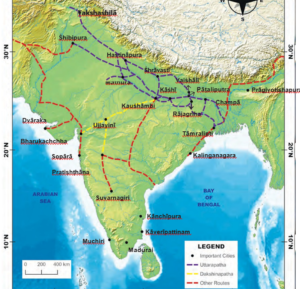
Major Trade Routes :
- Uttarapatha – The great northern trade route.
- Dakshinapatha – The great southern trade route.
- Other trade routes connected important cities like Takshashila, Pataliputra, Ujjayini, Tamralipti, and Kaveripattinam.
Guilds (Shrenis) :
Traders in ancient India often worked together rather than alone. They formed guilds, called Shrenis.
- Guilds (Shrenis) were groups of traders, craftsmen, moneylenders, or farmers.
- Each guild had an elected leader and other officers.
- Guilds existed across many parts of India for hundreds of years and showed the strong self-management of Indian society.
Traders' guilds became remarkable institutions for two main reasons :
- Guild members shared resources, skills, and market information to help one another.
- Guilds made their own rules and managed their own work. Kings usually did not interfere because guilds helped trade and the economy grow
The Rise of Magadha :
Rise of Magadha :
- Between the 6th and 4th centuries BCE, Magadha became the most powerful of the sixteen Mahajanapadas.
- It was located in present-day south Bihar and nearby areas.
- Magadha's rise led to the formation of India's first empire.
Why Did Magadha Rise to Power?
- Magadha was located in the fertile Ganga plains, which were rich in forests, timber, and elephants.
- Nearby hills provided iron ore and other minerals.
- Iron ploughs increased agricultural production, while iron weapons made the army stronger.
- Surplus food allowed more people to work as craftsmen and artisans.
- The Ganga and Son rivers made trade and transport easier, increasing the kingdom's wealth.
- Strong rulers like Ajatashatru helped Magadha become a powerful kingdom.
The Nanda Dynasty (c. 5th Century BCE)
- The Nanda Dynasty was founded by Mahapadma Nanda.
- He united many smaller kingdoms and expanded his empire across eastern and northern India.
- The Nandas issued coins, showing that their economy was strong.
- Greek accounts mention that the Nandas had a large and powerful army.
- The last Nanda ruler, Dhana Nanda, became unpopular because he oppressed and exploited the people.
- His unpopularity made it easier for the Mauryas to conquer the Nanda Empire.
| Know This :
● The Buddha (Siddhārtha Gautama) and Mahāvīra (Vardhamānan) lived in the time of King Ajātaśhatru. ● Pāṇini, the famed Sanskrit grammarian, lived around the 5th century BCE (time of the Nandas) and composed the Aṣhṭādhyāyi — rules of Sanskrit grammar in 3,996 short sūtras. |
The Arrival of the Greeks :
Alexander's Conquest :
- While Magadha was becoming powerful in eastern India, many small kingdoms existed in northwestern India.
- One of these kingdoms was ruled by King Porus (Paurava).
- Alexander of Macedonia defeated the Persian Empire between 334–331 BCE and built one of the largest empires in history.
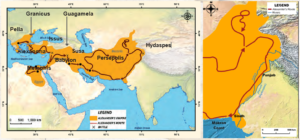
Alexander Enters India (327–325 BCE)
- Alexander entered northwestern India to expand his empire.
- He defeated King Porus in Punjab.
- Many local tribes strongly resisted his army, and some women also fought in the battles.
- Alexander was seriously wounded during the campaign.
- His tired and homesick soldiers refused to march further towards the Ganga.
- Alexander was forced to return through the harsh Makran Desert, where many soldiers died due to thirst, hunger, and disease.
Alexander's Death (324–323 BCE)
- After returning to Persia, Alexander faced rebellions in his empire.
- He fell ill and died in Babylon at the age of 32.
- After his death, his empire was divided among his generals and governors.
Alexander and King Porus :
- After defeating Porus, Alexander asked him how he wished to be treated.
- Porus replied, "Like a king."
- Impressed by his courage and dignity, Alexander allowed Porus to continue ruling his kingdom as a satrap.
Key Term: Satrap : A satrap was a governor appointed to rule a province in the Persian or Greek Empire. Satraps managed distant regions on behalf of the emperor and had considerable powers.
Alexander and the Gymnosophists :
- Alexander met a group of Indian sages called the Gymnosophists or "naked philosophers."
- He tested their wisdom by asking them difficult riddles.
- Their intelligent and calm answers impressed him.
- Alexander spared their lives, and this meeting became an important example of the exchange between Greek and Indian philosophy.
The Mighty Mauryas :
Rise of the Maurya Empire
- Around 321 BCE, Chandragupta Maurya founded the Maurya Empire.
- He conquered the Nanda Empire and expanded his kingdom further.
- He was guided by his wise teacher and advisor, Kautilya (Chanakya).
The Story of Kautilya :
- Kautilya, also known as Chanakya or Vishnugupta, was a teacher at Takshashila University.
- He was insulted and removed from the court of Dhana Nanda.
- Kautilya then decided to end the Nanda rule.
- With his guidance, Chandragupta Maurya defeated the Nandas and established the Maurya Empire.
Rise of Chandragupta Maurya :
- Chandragupta defeated the Nandas and made Pataliputra his capital.
- He used Magadha's rich resources, strong economy, and trade to strengthen the empire.
- Following Kautilya's advice, he expanded his empire successfully.
- He defeated the Greek governors (satraps) left behind by Alexander in northwestern India.
- Chandragupta also maintained friendly relations with the Greeks.
- The Greek ambassador Megasthenes visited his court and wrote Indika, the earliest account of India by a foreign visitor.
Kautilya's Saptanga Theory (Seven Limbs of a Kingdom)
According to Kautilya, a strong kingdom has seven important parts:
| Element | Meaning |
| Swami | The King |
| Amatya | Ministers and high officials |
| Janapada | The land and its people |
| Durga | Forts and fortified cities |
| Kosha | Treasury or wealth of the kingdom |
| Danda | Army and law enforcement |
| Mitra | Allies or friendly kingdoms |
Kautilya's Philosophy of Governance
- Kautilya explained his ideas in the Arthashastra, a book on governance, economics, and administration.
- He believed that a king should always work for the welfare of the people.
- A strong economy, good administration, justice, agriculture, and defence were essential for a successful kingdom.
- According to Kautilya, the happiness and prosperity of the people are the true strength of a ruler.
- He believed that a good king should always put the interests of the people before his own.
Aśhoka – The King Who Chose Peace
Aśhoka :
- Aśhoka (268–232 BCE) was the grandson of Chandragupta Maurya.
- He was one of the greatest rulers of the Maurya Empire.
- He is remembered for his good administration and for spreading the message of peace.
Early Rule and Expansion
- Aśhoka expanded the Maurya Empire across almost the entire Indian subcontinent.
- His empire included present-day India, Bangladesh, Pakistan, and parts of Afghanistan.
- Only the southernmost part of India remained outside his empire.
The Kalinga War
- Aśhoka fought a fierce war against Kalinga (present-day Odisha).
- The war caused great loss of life and destruction.
- Seeing the suffering, Aśhoka deeply regretted the war.
- He decided to give up violence and follow the teachings of Lord Buddha.
- After this, he promoted peace and non-violence.
Spreading Buddhism :
- Aśhoka sent emissaries (messengers) to countries like Sri Lanka, Thailand, and Central Asia.
- They spread the teachings of Buddhism and the message of peace.
Aśhoka – The Great Communicator :
- Aśhoka issued edicts (official orders) on rocks and pillars across his empire.
- These edicts encouraged people to follow Dharma.
- Most edicts were written in Prakrit using the Brahmi script.
- Aśhoka called himself "Devanampiya Piyadasi," meaning "Beloved of the Gods" and "One who looks upon others with kindness."
Welfare Measures by Aśhoka :
- He provided medical care for both people and animals.
- He banned unnecessary hunting and cruelty to animals.
- He built wells, rest houses, and planted shade and fruit trees along roads.
- He encouraged people of different religions to respect one another.
- He sent officers to check that people were treated fairly and not punished unjustly.
Key Term: Dharma
- Dharma means moral duty, righteousness, and ethical behaviour.
- It teaches people to fulfil their responsibilities towards their family, society, and country.
- It also means living with truth, justice, and respect for others.
Decline of the Maurya Empire :
- The Maurya Empire lasted for about 50 years after Aśhoka's death.
- His successors were unable to keep the empire united.
- Many smaller kingdoms became independent.
- Around 185 BCE, the Maurya Empire came to an end, marking the beginning of a new phase in Indian history.
Life in the Mauryan Period :
Cities and Administration
- Cities like Pataliputra were important centres of government and trade.
- They had palaces, public buildings, and well-planned streets.
- A well-organised tax system and active trade made the empire rich.
- Officials, merchants, and artisans played an important role in city life.
Agriculture and Food Security
- Agriculture was the main occupation of many people.
- Farmers usually grew two crops each year because of the summer and winter rains.
- Good harvests made famines rare.
- Large granaries stored food for times of need.
- The Sohagaura Copper Plate Inscription mentions the construction of a granary to protect people from famine.
Urban Life and Occupations
- Skilled workers such as blacksmiths, potters, carpenters, and jewellers lived in cities.
- Cities had well-planned streets with signboards.
- Couriers carried messages from one place to another.
- Most houses were made of wood and were up to two storeys high.
- Water pots were kept along the streets to help control fires.
Clothing
- People usually wore cotton clothes.
- Men commonly wore a lower garment reaching between the knee and ankle and an upper cloth over the shoulders.
- Some people wore decorated leather shoes with thick soles.
Mauryan Art, Architecture, and Legacy :
The Sarnath Lion Capital :
- The Sarnath Lion Capital was placed on top of a pillar built by Aśhoka at Sarnath, near Varanasi.
- Sarnath is the place where Buddha gave his first sermon.
- The capital has four lions, which represent power and authority.
- The circular base below shows an elephant, bull, horse, and lion, along with the Dharmachakra (Wheel of Dharma).
- It was adopted as the National Emblem of India.
- The motto "Satyameva Jayate" means "Truth alone triumphs".
- The Dharmachakra is also found at the centre of the Indian National Flag.
Mauryan Architecture :
- The Great Stupa at Sanchi is one of the oldest stone structures in India.
- It was first built with brick and later enlarged using stone.
- Aśhoka built many stupas, chaityas, and viharas for worship, study, and meditation.
- The Dhauli elephant sculpture in Odisha is a famous rock-cut sculpture.
- It represents qualities such as intelligence, strength, patience, and calmness.
- Aśhoka's edicts are engraved near the sculpture.
- The Barabar Hills caves in Bihar were carved out of rock for monks.
Terracotta Art :
- Mauryan artists made beautiful terracotta figurines.
- These included dancing girls and female deities with detailed jewellery and headdresses.
- Yakshi figures holding fly whisks were also popular.
- Saptamatrikas represented the seven mother goddesses.
- Terracotta horse heads with decorated bridles have also been found.
Coinage :
- The Mauryan period used punch-marked silver coins.
- Coins were issued by rulers such as Mahapadma Nanda and Aśhoka.
- These coins show the strong economy and organised administration of the empire.
Legacy of the Mauryas :
- The Maurya Empire created one of the earliest large empires in Indian history.
- It developed strong administration, trade, roads, and communication systems.
- Aśhoka's message of peace, Dharma, and welfare became famous across India and beyond.
- Mauryan art and architecture continue to be important symbols of India's cultural heritage.
- The Sarnath Lion Capital and the Dharmachakra remain national symbols of India today.
The Fragile Nature of Empires :
Why Do Empires Decline?
- Many great empires in history, such as the Roman, Persian, Ottoman, Spanish, Russian, and British Empires, eventually came to an end.
- Historians have different views about the reasons for their decline.
Common Causes of Decline :
- Some regions wanted to become independent when emperors demanded more taxes or tribute.
- Weak rulers often failed to control the empire after a strong emperor.
- Local kings sometimes stopped obeying the emperor or paying tribute.
- Large empires were difficult to govern, especially distant regions.
- Natural disasters like droughts and floods could weaken the economy and reduce the empire's strength.
The Paradox of Empires :
Positive Effects :
- Empires brought political unity by joining many kingdoms under one ruler.
- They reduced wars between smaller kingdoms.
- Peace and stability encouraged trade, agriculture, and economic growth.
Negative Effects :
- Most empires were created through wars and conquest.
- They were often maintained by military force and strict control.
- Because of these challenges, many empires became unstable and eventually declined.
Quick Timeline :
| Period / Date | Event |
| c. 600–400 BCE | Age of the sixteen mahājanapadas; Ajātaśhatru strengthens Magadha. |
| c. 5th century BCE | Mahāpadma Nanda founds the Nanda dynasty; Pāṇini composes the Aṣhṭādhyāyi. |
| 334–331 BCE | Alexander campaigns against and conquers the Persian Empire. |
| 327–325 BCE | Alexander invades north-west India, defeats Porus, then retreats. |
| 324–323 BCE | Alexander dies in Babylon; his empire divided among generals and satraps. |
| 321 BCE | Chandragupta Maurya founds the Maurya Empire, guided by Kauṭilya. |
| 268–232 BCE | Reign of Aśhoka; Kalinga War and adoption of Buddhist principles of peace. |
| c. 185 BCE | Decline and end of the Maurya Empire. |
We reply to valid query.