Solutions (Exercise + Intext)
Intext Questions :
Question 1. Can it always be correctly judged that a person has fever, only by touching the person?
No. Our sense of touch is unreliable — the same object can feel hot to one hand and cool to another, depending on what temperature that hand was exposed to before. Touch can give a rough idea, but it cannot reliably confirm fever. A thermometer is needed for an accurate measurement.
Question 2. Do small children generally have slightly higher body temperatures as compared to adults?
Yes, generally. Small children tend to have slightly higher body temperatures than adults. This is mainly because children have a higher metabolic rate and their body's temperature-regulating system is still maturing, so their body temperature can run a little warmer and fluctuate more easily.
Question 3. Do old people, even when healthy, generally have lower body temperatures than young adults?
Yes, generally. As people age, metabolic rate tends to slow down and the body's ability to regulate temperature becomes less efficient, so healthy older people often show a slightly lower average body temperature than healthy young adults.
Question 4. Why does a digital thermometer show normal body temperature as 98.6 °F instead of 37.0 °C?
Because the thermometer is simply using a different temperature scale — the Fahrenheit scale instead of the Celsius scale. Both values represent the exact same physical temperature; 37.0 °C and 98.6 °F are two different ways of expressing the same normal body temperature, just as a distance can be given in kilometres or miles.
Question 5. Can a clinical thermometer be used to measure the temperature of boiling water or ice?
No. A clinical thermometer is designed only for the narrow range of human body temperature (roughly 35 °C to 42 °C). The temperatures of boiling water (about 100 °C) and ice (0 °C) both fall well outside this range, so a clinical thermometer cannot measure them.
Question 6. How can we measure temperatures beyond the range of a clinical thermometer?
By using a laboratory thermometer, which has a much wider range — typically −10 °C to 110 °C. This makes it suitable for measuring temperatures like boiling water, ice, or other substances that fall outside the human body range.
Question 7. Can we use a laboratory thermometer to measure body temperature of a person?
It is not practical to do so. A laboratory thermometer has a wide range and a larger bulb, so it is not sensitive or quick enough to give a precise reading in the narrow body-temperature range. It's also bulkier and less hygienic for placing in the mouth or armpit compared to a clinical thermometer, which is specially designed and calibrated for measuring human body temperature.
Let Us Enhance Our Learning : Exercise Questions
Question 1. The normal temperature of a healthy human being is close to .
(i) 98.6 °C
(ii) 37.0 °C
(iii) 32.0 °C
(iv) 27.0 °C
(ii) 37.0 °C
Question 2. 37 °C is the same temperature as .
(i) 97.4 °F
(ii) 97.6 °F
(iii) 98.4 °F
(iv) 98.6 °F
(iv) 98.6 °F
Question 3. Fill in the blanks:
(i) The hotness or coldness of a system is determined by its ___________
(ii) The temperature of ice-cold water cannot be measured by a ___________ thermometer.
(iii) The unit of temperature is degree ___________.
(i) temperature
(ii) clinical (its range, about 35 °C–42 °C, does not cover ice-cold water)
(iii) Celsius (degree Celsius, °C — one of the standard units of temperature; the SI unit itself is kelvin, which does not use 'degree')
Question 4. The range of a laboratory thermometer is usually .
(i) 10 °C to 100 °C
(ii) –10 °C to 110 °C
(iii) 32 °C to 45 °C
(iv) 35 °C to 42 °C
(ii) –10 °C to 110 °C
Question 5. Four students used a laboratory thermometer to measure the temperature of water as shown in Fig.:
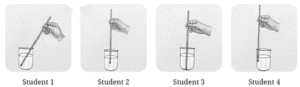
Who do you think followed the correct way for measuring temperature?
(i) Student 1
(ii) Student 2
(iii) Student 3
(iv) Student 4
(ii) Student 2
Explanation : The student who held the thermometer VERTICALLY with the bulb fully immersed in the water (not touching the sides/bottom of the container, and not tilted) followed the correct method.
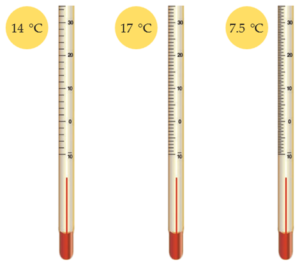
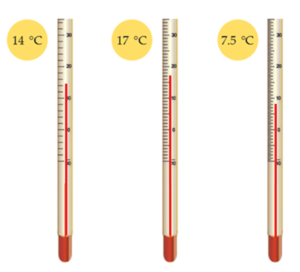
Question 6. Colour to show the red column on the drawings of thermometers (Fig.) as per the temperatures written below:
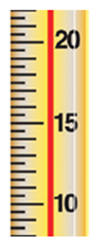
Question 7. Observe the part of thermometer shown in Fig. and answer the following questions:

(i) What type of thermometer is it?
(ii) What is the reading of the thermometer?
(iii) What is the smallest value that this thermometer can measure?
(i) It is a laboratory thermometer.
(il) 26 °C
(ill) There are 10 divisions between 10 °C and 20 °C. So, on dividing the value by the no. of divisions, the smallest value that this thermometer can measure will be, 10/10 = 1 °C.
Question 8. A laboratory thermometer is not used to measure our body temperature. Give a reason.
- A laboratory thermometer has a wide range (about −10 °C to 110 °C) and a larger bulb, so it is not sensitive enough to give a quick, precise reading in the narrow human body-temperature range (35 °C–42 °C).
- It is also bulkier, less hygienic to place in the mouth/armpit, and takes longer to give a stable, accurate reading compared to a clinical thermometer specially designed for the human body range.
Question 9. Vaishnavi has not gone to school as she is ill. Her mother has kept a record of her body temperature for three days as shown in Table.
Table : Body temperature record of Vaishnavi
| Temperature at | ||||||
| DAY | 7am | 10am | 1 pm | 4pm | 7pm | 10pm |
| One | 38.0 °C | 37.8 °C | 38.0 °C | 38.0 °C | 40.0 °C | 39.0 °C |
| Two | 38.6 °C | 38.8 °C | 39.0 °C | 39.0 °C | 39.0 °C | 38.0 °C |
| Three | 37.6 °C | 37.4 °C | 37.2 °C | 37.0 °C | 36.8 °C | 36.6 °C |
(i) What was Vaishnavi’s highest recorded temperature?
(ii) On which day and at what time was Vaishnavi’s highest temperature recorded?
(iii) On which day did Vaishnavi’s temperature return to normal?
(i) 40.0 °C.
(ii) Day One, at 7 pm.
(iii) Day Three — all readings on Day Three (37.6 °C down to 36.6 °C) are close to/at the normal range (~37.0 °C), showing her temperature had returned to normal.
Question 10. If you have to measure the temperature 22.5 °C, which of the following three thermometers will you use (Fig.)? Explain.
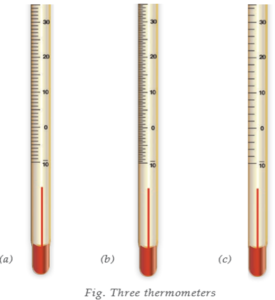
Thermometer (b) can be used to measure the temperature 22.5 °C appropriately.
The least temperature that can be measured by using thermometer (b) is 0.5 °C. While for (a) and (c), it is 1 °C and 2 °C respectively. Therefore, to measure a temperature having 0.5 °C of preciseness, thermometer (b) is appropriate.
Question 11. The temperature shown by the thermometer in Fig. is

(i) 28.0 °C
(ii) 27.5 °C
(iii) 26.5 °C
(iv) 25.3 °C
(ii) 27.5 °C
Question 12. A laboratory thermometer has 50 divisions between 0 °C and 100 °C. What does each division of this thermometer measure?
Least count = (temperature difference) ÷ (number of divisions) = 100 °C ÷ 50 = 2 °C.
So, each division of this thermometer measures 2 °C.
Question 13. Draw the scale of a thermometer in which the smallest division reads 0.5 °C. You may draw only the portion between 10 °C and 20 °C.
Question 14. Komal tells you that she has a fever of 101 degrees. Does she mean it on the Celsius scale or Fahrenheit scale?
She means Fahrenheit (°F).
Reasoning: Normal human body temperature is 37 °C, and human body temperature never normally exceeds 42 °C. So '101' cannot be on the Celsius scale (that would be far too high — almost boiling water).
On the Fahrenheit scale, normal body temperature is 98.6 °F, and 101 °F is only slightly above normal — a realistic, mild fever reading. So Komal means 101 °F.
We reply to valid query.