Notes
|
Topics To be Learned:
|
From First to Second Urbanisation :
First Urbanisation :
- The Indus Valley Civilization is known as India's First Urbanisation.
- It declined in the early 2nd millennium BCE (after 2000 BCE).
- Some cities were abandoned, while people in other places continued to live there but followed a village or rural lifestyle.
Features That Disappeared :
After the decline of the Harappan civilisation, many features of city life disappeared:
- Large public and private buildings
- Crowded streets and busy markets
- Skilled workers such as metalsmiths, potters, builders, weavers, and other craftspeople
- A writing system
- A proper sanitation system
- A well-organised administration and a larger state ruled by a governing class
A Long Gap in Urban Life :
- For about 1,000 years, there were very few cities in India.
- Some small towns and regional cultures existed, especially in northern India, but large urban centres were mostly absent.
Second Urbanisation :
- In the 1st millennium BCE, cities began to develop again.
- This new phase started in the Ganga plains, parts of the Indus basin, and nearby regions.
- It gradually spread across the Indian subcontinent.
- This period is called India's Second Urbanisation.
- The process of urbanisation that began during this period has continued up to the present day.
| How do we know this?
From two main sources — (1) archaeological excavations confirming ancient urban centres, and (2) ancient literature (late Vedic, Buddhist, and Jain texts) describing these new urban centres. |
Janapadas and Mahājanapadas :
Janapada : Janapada is a Sanskrit word that means "the place where people (jana) have settled (pada)."
- Towards the end of the 2nd millennium BCE, people who shared the same language and customs formed territories called janapadas.
- Each janapada was ruled by a rājā (king or ruler).
Growth of Janapadas :
- As trade increased, janapadas became larger and stronger.
- They developed connections with other janapadas through trade and communication.
- By the 8th–7th centuries BCE, some smaller janapadas joined together to form larger states.
Mahājanapada : A Mahājanapada was a large state formed by the merger of smaller janapadas.
- Ancient texts mention 16 Mahājanapadas.
- They stretched from Gandhāra in the northwest to Anga in the east, and to Aśhmaka in central India.
- Some smaller janapadas continued to exist independently.
Four Powerful Mahājanapadas :
The four strongest Mahājanapadas were:
- Magadha (part of present-day Bihar)
- Kosala (part of present-day Uttar Pradesh)
- Vatsa
- Avanti (part of present-day Madhya Pradesh)
Capitals of the Mahājanapadas :
- Most Mahājanapada capitals were large and well-fortified cities.
- They were protected by strong walls and a moat around the city.
- The gateways were kept narrow so guards could easily control the movement of people and goods.
- Many of these ancient capitals have survived and continue to exist as cities even today, with a history of about 2,500 years.
The Sixteen Mahājanapadas (with capitals) :
| Mahājanapada | Capital City |
| Kamboja | (region — northwest) |
| Gāndhāra | Takṣhaśhilā / Pushkalavati |
| Kuru | Indraprastha |
| Pāñchāla | Ahichchhatra |
| Matsya | Virāṭa |
| Śhūrasena | Mathurā |
| Vatsa | Kauśhāmbī |
| Kosala | Śhrāvastī |
| Malla | Kushīnāra |
| Vṛijji (Vajji) | Vaiśhālī |
| Chedi | Tripuri |
| Magadha | Rājagṛiha |
| Anga | Champā |
| Avanti | Ujjayinī |
| Aśhmaka | (central India, near Godavari) |
Early Democratic Traditions :
Assemblies in the Janapadas
- Every janapada had an assembly or council called the sabhā or samiti.
- These assemblies are first mentioned in the Vedas.
- They discussed important matters related to the clan and the kingdom.
- Most members of these assemblies were probably clan elders.
Role of the Rājā (King) :
- The rājā was not expected to rule alone or make unfair decisions.
- A good ruler took advice from the assembly, ministers, and administrators.
- Some ancient texts mention that an inefficient ruler could even be removed by the assembly, although this was not a fixed law.
Two Systems of Governance
(1) Monarchies :
- In a monarchy, the rājā had the highest authority.
- He was supported by ministers and an assembly of elders.
- The position of the king was usually hereditary (passed from parent to child).
- The king collected taxes, maintained law and order, built forts, and kept an army.
- Examples: Magadha, Kosala, and Avanti.
(2) Gaṇas or Sanghas (Early Republics) :
- In Gaṇas or Sanghas, the sabhā or samiti had greater power than the king.
- Important decisions were taken through discussion and, when needed, voting.
- The assembly also selected the rājā.
- Examples: Vajji and Malla. Historians consider these to be among the earliest republican and democratic systems in the world.
- Scholars refer to these as "early republics" because power was held by assembly members rather than a single hereditary monarch.
Checks on Power: Even in monarchies, a "good ruler" was expected to consult assemblies and ministers. Incompetent rulers could potentially be removed by these assemblies.
More Innovations of the Age :
(a) Intellectual and Artistic Growth :
- During this period, many new schools of thought developed.
- These included the Late Vedic, Buddhist, and Jain traditions.
- Their ideas spread through scholars, monks, nuns, and pilgrims who travelled across India.
- Indian art also developed and later flourished during the age of great empires.
(b) Iron Metallurgy :
- The Indus Valley Civilization was skilled in using copper and bronze.
- During the Second Urbanisation, iron became widely used.
- Iron-working techniques were developed from the early 2nd millennium BCE, but became common only after many centuries.
- By the late 2nd millennium BCE, iron tools were widely used for farming, helping increase agricultural production.
- Iron was also used to make stronger, lighter, and sharper weapons, such as swords, spears, arrows, and shields.
- There were wars as well as alliances between neighbouring Mahājanapadas, leading to the rise of new kingdoms and empires.
(c) First Coins :
- As trade increased, the first coins were introduced in India.
- The earliest coins were silver punch-marked coins, with symbols stamped onto the metal.
- Later, coins made of copper, gold, and other metals were also used.
- Most Mahājanapadas issued their own coins.
- Coins from neighbouring regions were also accepted and used in trade.
The Varṇa–Jāti System :
Organisation of Society
- As societies grow, people are organised into different groups based on their work and responsibilities.
- These groups may include people involved in governance, religion, trade, farming, and crafts.
- Although these groups are meant to support one another, they can sometimes lead to inequality in wealth, power, and social status.
- In ancient India, society was organised through the Varṇa–Jāti system.
Jāti :
- Jāti was a community of people who usually followed the same occupation.
- Occupations included farming, trade, metalwork, and different crafts.
- Skills and occupations were generally passed down from one generation to the next.
- A jāti could be divided into sub-jātis, each with its own customs, marriage rules, rituals, and food habits.
Varṇa : Varṇa is a concept mentioned in the Vedic texts.
It divided society into four broad groups based on duties and occupations.
| Varṇa | Main Role |
| Brahmins | Preserved and spread knowledge and performed religious rituals. |
| Kshatriyas | Protected society and the kingdom and fought in wars. |
| Vaishyas | Increased wealth through trade, business, and agriculture. |
| Shudras | Worked as artisans, craftspeople, workers, and servants. |
Meaning of "Caste"
- The English word "caste" comes from the Portuguese word casta.
- It was used by Portuguese travellers in the 16th century CE to describe Indian society.
- Historians differ on whether the word "caste" refers to Varṇa, Jāti, or the entire Varṇa–Jāti system.
Changes Over Time :
- In the early period, people could change their occupations when needed.
- For example, a farmer affected by drought might become a trader or craftsperson.
- Some Brahmins also took up trade or military service.
- The Varṇa–Jāti system helped organise society and provided stability.
- Over time, however, it became more rigid, leading to inequality and discrimination, especially against lower jātis and excluded communities.
- These inequalities became even more severe during British rule.
Developments Elsewhere in India :
Important Trade Routes :
- Two major trade routes connected different parts of ancient India:
- Uttarapatha connected the northwestern regions with the Ganga plains and extended to eastern India.
- Dakṣhiṇapatha started from Kauśhāmbī, crossed the Vindhya Range, and continued towards southern India.
- Many smaller roads connected these routes to ports on the eastern and western coasts, which were busy centres of trade.
Eastern India :
- A major city called Śhiśhupalgarh developed in eastern India.
- It was the capital of the Kalinga region.
- The city had a square layout, strong fortifications, and wide streets.
Southern India
- Cities started developing in southern India from around 400 BCE.
- Three important kingdoms emerged:
Chola Kingdom
Chera Kingdom
Pandya Kingdom
- Information about these kingdoms comes from archaeological discoveries and ancient Tamil literature.
- Southern India was rich in gold, precious and semi-precious stones, and spices.
- These resources helped the southern kingdoms trade with other parts of India and with overseas kingdoms and empires.
A Connected Subcontinent :
- By around 300–200 BCE, almost the entire Indian subcontinent, including the Northeast, was well connected.
- Goods, people, and ideas travelled freely across different regions.
- Indian trade and culture also spread to Central Asia and Southeast Asia.
- Around this time, the Mahājanapadas disappeared and were replaced by new empires.
First vs Second Urbanisation — Comparison
| Feature | First Urbanisation | Second Urbanisation |
| Ganga plains | No | Yes |
| Monasteries | No | Yes |
| Literature | No (undeciphered script) | Yes |
| Trade | Yes | Yes |
| Warfare | Evidence limited | Yes (evidence of inter-state warfare) |
| Copper/Bronze | Yes | Yes (continued) |
| Iron | No | Yes |
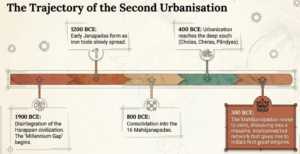
Timeline at a Glance :
| Period (BCE) | Development |
| 1900 BCE onward | Decline of the Harappan (First Urbanisation) civilisation |
| 1200 – 800 BCE | Rise of janapadas in north/central India |
| 800 – 400 BCE | Formation and growth of the 16 mahājanapadas (Second Urbanisation) |
| 400 BCE onward | Emergence of cities and kingdoms (Cholas, Cheras, Pāṇḍyas) in south India |
| 300 BCE | Mahājanapadas cease to exist; Subcontinent becomes one interconnected trade network |
We reply to valid query.