Solutions (Exercise + Intext)
Intext Questions :
Q.1. Moti grew up, but during that time, his dog collar, his leash and his toys have all remained the same size. They did not grow like Moti. Why this must have happened? (Page 1)
Moti grew because he is a living organism, but his collar, leash, and toys did not grow because they are non-living objects.
- Living things grow by taking in food and water.
- Growth happens because new cells are formed in their bodies.
- As Moti grew, he also learned new skills like running, jumping, and catching biscuits.
- Non-living objects do not need food, are not made of living cells, and cannot grow or learn new skills.
Q.2. Many things are shown in the picture. Which of them need food? Which things in the picture don’t grow? Make lists of both separately. (Page 1)
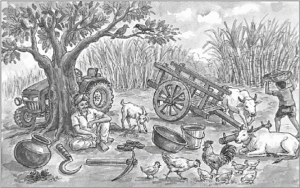
| Need Food | Don’t Grow |
| Farmer | Tractor |
| Dog (Moti) | Wooden Cart |
| Cows & Goats | Metal Bucket |
| Chickens | Tools |
| The Giant Tree |
Q.3. Find out the differences in the growth patterns of the trees like Peepal, Banyan, Bamboo, Coconut and Mango. (Page 2)
- Peepal: Grows into a tall tree with a thick trunk and wide spreading branches. Its trunk becomes thicker as it grows.
- Banyan: Grows very large with a thick trunk. It develops aerial roots that reach the ground and become supporting trunks, helping the tree spread widely.
- Mango: Grows into a large tree with a thick woody trunk and many branches. It continues to increase in height and thickness.
- Coconut: Grows as a tall, straight tree with a single unbranched trunk. It grows mainly in height, and its trunk does not become much thicker after maturity.
- Bamboo: It is a giant grass that grows very fast. Its stems reach full thickness when they emerge and grow only in height. New shoots grow from underground stems (rhizomes).
Q.4. What Will Happen, if… (Page 2)
(1) There is a large beehive on a tree branch. Some children light a fire under that tree.
(2) A hen and her chicks are picking grains. A cat or a snake approaches them.
(3) Water is poured on one side of a mound of dry soil. A live earthworm is then placed on the dry soil near the moist edge of the mound.
(4) Many pigeons have gathered on the ground near a building and on wires. Suddenly, there is a loud noise of firecrackers.
(5) A small baby in a cradle feels hungry or its clothes get wet.
(6) Lotus buds were closed during the night. After sunrise, sunlight fell upon those buds.
(7) The sun set. Many birds returned to their nests. They slept quietly on the tree throughout the night. It is now dawn and a reddish glow is visible near the eastern horizon.
(1) The bees may fly out of the hive and attack to protect it.
(2) The hen will become alert and make warning sounds. She will try to protect her chicks by hiding them or attacking the predator.
(3) The earthworm will move towards the moist soil. Earthworms need moisture to survive and avoid dry places.
(4) The pigeons will get frightened. They will quickly fly away to a safer place.
(5) The baby will cry. Crying is the baby's way of expressing discomfort and attracting attention.
(6) The lotus buds will gradually open into flowers. Sunlight stimulates the blooming of lotus flowers.
(7) The birds will wake up. They will start chirping and fly out of their nests in search of food.
These examples show that living organisms respond to changes in their surroundings (stimuli) such as light, sound, heat, moisture, hunger, and danger. This ability to respond is one of the important characteristics of living things.
Q.5. Find out where and when the Turtle Festival (Kasav Mahotsav) is held in Konkan Why is this care taken for sea turtles? (Page 4)
- The Kasav Mahotsav (Turtle Festival) is mainly held at Velas village in Ratnagiri district, Konkan, from February to April.
- It is organized to protect the endangered Olive Ridley sea turtles, conserve their eggs and hatchlings, create awareness about wildlife conservation, and promote eco-tourism.
Q.6. Are there any living organisms that can never leave their place? (Page 5)
Yes. Many living organisms remain fixed in one place throughout most or all of their lives. Such organisms are called sessile organisms.
Examples
- Plants such as trees, grasses, shrubs, and flowering plants remain rooted in the soil and cannot move from one place to another.
- Some animals, such as sponges, corals, and sea anemones, are attached to rocks or the seabed and stay in one place as adults.
Although they cannot move from place to place, they:
- Grow towards sunlight and water.
- Respond to changes in their surroundings.
- Obtain food and water from their environment.
- Reproduce and produce new individuals.
Q.7. When do the buds on plants bloom? (Page 5)
Buds on plants bloom during both the day and night, depending on the type of plant.
- Response to Sunlight: A notable example is the lotus bud, which remains closed during the night and blooms after sunrise once sunlight falls upon it.
- Mechanism of Blooming: When buds bloom, their petals separate from each other; this is considered a form of plant movement.
- Movement and Stimuli: While plants cannot change their location, blooming is one of the various movements they exhibit as a response to stimuli from their surroundings.
Q.8. Why are there so many mosquitoes in puddles or near the edges of a pond? (Page 7)
- Mosquitoes are commonly found in puddles and near the edges of ponds because they lay their eggs in stagnant (still) water.
- The eggs hatch into larvae and then pupae, both of which live and develop in water before becoming adult mosquitoes.
- Stagnant water provides a safe place with enough food for their young to grow. Therefore, places with standing water have a large number of mosquitoes.
Exercises
Question (1): Suggest the appropriate word for the blanks.
(a) Every living organism produces another living organism like itself is called as …………. .
Reproduction
(b) …….. and ………… are the main characteristics of living organisms.
Growth and Reproduction
(c) The growth and development of living organisms due to food is called the …….. of living organisms.
Nutrition (intake of food resulting in growth)
(d) The body of living organism is made up of ……….
Cells
Question (2): Birds, fish and animals can move and change their position on their own. Shed leaves, as well as vehicles like tractors and bullock carts can also change their position. What are the important differences between these two types of movements?
- Birds, fish, and animals can move on their own using their own energy and body parts (legs, wings, fins) because they are living things. They move to find food, escape from danger, and search for shelter.
- Shed leaves, tractors, and bullock carts are non-living things. They cannot move by themselves. Shed leaves move only because of the wind force, while tractors and bullock carts move only when driven by people or pulled by animals.
Important Difference: Living things move on their own, whereas non-living things move only when an external force acts on them.
Question (3): Germs of many diseases are extremely microscopic. They are so small that they cannot be seen with the naked eye. Do such living organisms reproduce? What do you think? Explain how you decided this.
Yes, disease-causing germs (microorganisms) do reproduce.
- We know this because an infection caused by even a few germs entering the body can spread and multiply rapidly, making a person increasingly ill and able to infect others. This rapid increase in number is only possible if the germs are reproducing.
- Since reproduction is one of the main characteristics of all living organisms, and germs show this characteristic, they must be considered living organisms too, even though they are microscopic.
Question (4): Explain that animals like rats, cats and dogs show awareness of their surroundings through their behaviour? Write down your experiences about it and observations of how they behave in different situations.
Rats, cats and dogs constantly sense (stimulus) changes around them and react (response) accordingly, showing they are aware of their surroundings.
For example:
- A dog barks and becomes alert when it hears an unfamiliar footstep or sound outside the house;
- A cat's ears turn and its body becomes tense the moment it hears a sudden noise;
- A rat quickly runs and hides in a hole the instant it senses light or movement nearby.
Pets like dogs also recognise their owner's voice or footsteps and respond with excitement (wagging tail, running towards them), which shows they are aware of and respond to their environment.
Question (5): Make a list of different types of animal movements along with the animals that move in those ways.
| Type of Movement | Animals |
| Walking/Running | Dog, cat, horse, human, tiger |
| Jumping/Hopping | Frog, kangaroo, rabbit, grasshopper |
| Swimming | Fish, duck, turtle, frog |
| Flying | Birds (sparrow, crow), butterfly, bee, bat |
| Crawling/Slithering | Snake, lizard, earthworm |
| Climbing | Squirrel, monkey, ant |
Question (6): Plants respond to stimuli. Write down as many observations and experiences as you can which demonstrate this.
Several everyday observations show that plants respond to stimuli:
- roots always grow downward and towards moisture in the soil, even if the seed is planted at an angle;
- the branches and leaves of a plant kept near a window bend and grow towards the sunlight;
- the touch-me-not plant (Mimosa/Lajwanti) folds up its leaves immediately when touched;
- the leaves of certain trees (like the tamarind or 'rain tree') fold together at night and open again at sunrise;
- flower buds open (bloom) only at a particular time of day when conditions of light and temperature are right,
showing that the plant is sensing and responding to its environment.
Question (7): Turtles stay in water for a long time. Why do they come to the surface repeatedly and poke their heads out of the water? Fish, however, do not try this. Why?
- Turtles are reptiles that breathe using lungs, not gills, so they must come to the water's surface and poke their heads out from time to time to inhale air (oxygen) and exhale carbon dioxide.
- Fish, on the other hand, breathe using gills, which can take in dissolved oxygen directly from the water. Since fish do not need atmospheric air to respire, they never need to come to the surface to breathe.
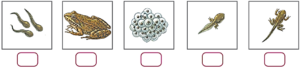
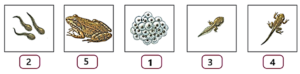
Question (8): The life cycle of a frog is given below in a jumbled order. Give the correct number in the boxes to put them in the proper sequence.
Question (9): Classify the following into living and non-living groups based on their characteristics.
(Stone, butterfly, bicycle, book, fish, air, tree, kite, bus)
| Living | Non-Living |
| Butterfly, Fish, Tree | Stone, Bicycle, Book, Air*, Kite, Bus |
*Note: Air itself is a non-living mixture of gases. (Air is essential FOR living organisms to survive, but air does not show characteristics like growth, reproduction, etc., so it is classified as non-living.)
Question (10) Write answers to the following questions.
(A) What are the effects on the animals when there is a drought and there is no food or water available for them?
- During a drought, animals face severe hardship: without water, they suffer from dehydration and thirst, and without food, they become weak and lose body weight.
- Many animals are forced to migrate long distances in search of food and water.
- Young ones and weaker animals may fall sick or die due to starvation and lack of water.
- Overall growth, reproduction and normal life processes of animals slow down or stop, and in severe cases, large numbers of animals can die if the drought continues for long.
(B) A tiger cub grows; does it also develop? Explain this statement.
Yes, a tiger cub both grows and develops.
- Growth refers to the increase in its size, height and weight as it becomes a bigger, heavier tiger.
- Development refers to the improvement in its abilities alongside this physical growth — the cub gradually learns to walk steadily, stalk prey, hunt, climb, and behave like an adult tiger, and its senses, muscles and intelligence become sharper and more capable.
So growth (bigger body) and development (better skills and abilities) happen together as the cub matures into an adult tiger.
We reply to valid query.