Notes
|
Topics to be learn :
|
Fundamentals of Mixtures and Separation Principles :
Mixtures :
In our daily life, we see many substances mixed together. When two or more substances are combined, the combination is called a mixture.
Components of a Mixture : The individual substances present in a mixture are called its components.
For example:
- Bhel contains sev, vegetables, and other ingredients.
- Chivda contains different ingredients.
These ingredients are the components of the mixture.
Separating Mixtures :
- Some mixtures have large and easily visible components. They can be separated by handpicking. g. In mixtures such as chivda, farsan or bhel, the components can be picked out easily by hand because they are visibly different in size and shape.
- However, many mixtures — such as oil and water, or salt dissolved in water — cannot be separated so simply, which is why specific separation techniques are needed.
Methods of Separation: By identifying the differences in the properties of the components (such as size, weight, density, or solubility), a suitable trick or technique can be planned to separate them. Such techniques are called methods of separation
Solid-Solid Separation Methods :
(1) Handpicking : This method involves manually identifying and picking out unwanted substances from a mixture. It is based on visible differences in shape, size, and color of the components.
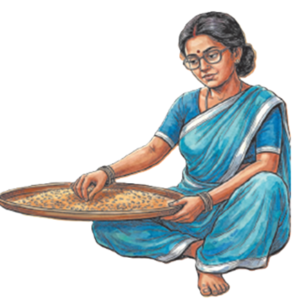
- Primary Application: Small stones, pieces of trash, or weed seeds found in grains can be separated by picking them out by hand.
- Key Constraint: This manual task is highly practical and easy only if the quantity of the grain is manageable and the trash components to be removed are relatively few in number.
- Everyday Example: While eating tiffin during a school break, children naturally use handpicking to separate chilies from their vegetables.
(2) Winnowing : Winnowing is the method of separating heavy and light solid substances with the help of wind or a strong air current. It relies on density and weight differences between the components.
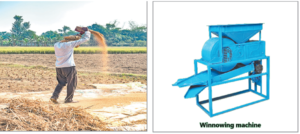
- Working Mechanism: Farmers drop a mixture of harvested grains and chaff from a height. The heavy grains fall straight down to form a pile, while the chaff, dust, and dried leaves are lighter in weight and are carried away by the wind.
- Modern Adaptation: To save labor and eliminate dependency on natural wind, modern farms use winnowing machines. These machines use a large mechanical fan to generate a constant, strong flow of air, allowing farmers to accomplish the task in much less time.
(3) Sieving : Sieving is used when the components of a mixture of solid substances differ in particle size. It utilizes a suitable mesh (sieve) to separate particles.
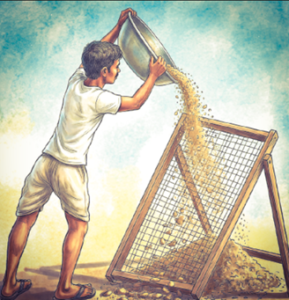
- Grain Cleaning: Stones that are smaller than grain can be separated using a coarse sieve. Once cleaned, grains are ground into flour.
- Flour Sieving: To separate coarse particles (bran) from flour, a sieve with a very fine mesh is used. Flour particles that are smaller than the holes of the sieve fall through, while larger bran particles remain on top of the mesh.
- Construction Sites: At construction sites, sand and gravel are separated using large, angled wire screens. Coarse sand and gravel are held back, while fine sand falls through for concrete mixing.
Solid-Liquid Separation Methods :
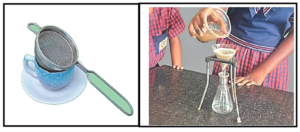
(1) Filtration : Filtration is the method used to separate insoluble solid substances from a liquid by passing the mixture through a barrier containing fine, microscopic pores.
(i) Tea Strainer : A tea strainer works like a filter.
- Tea leaves are trapped by the strainer.
- Liquid tea passes through.
- Thus, tea leaves are separated from tea.
(ii) Filter Paper : In laboratories, filter paper is used for filtration.
- The filter paper is folded into a cone.
- It is placed inside a funnel.
- Muddy water or buttermilk is poured through it.
- The liquid passes through the tiny pores.
- Solid particles remain on the filter paper.
Muddy water → Filter → Clearer water + solid mud
(iii) Filtration of Wastewater :
- Filtration can also be used to clean industrial wastewater.
- Scientists have developed special porous filters using ash from agricultural crop waste.
- Such filters can help remove unwanted solid particles from wastewater before it enters rivers.
(iv) Filtration in Masks :
- Masks also work partly on the principle of filtration.
- They can trap many dust particles and respiratory droplets in the air, reducing the amount that reaches the nose and mouth.
(2) Sedimentation and Decantation : Sedimentation and decantation are two steps used to separate heavy, insoluble solid particles from a liquid.
(i) Sedimentation : When muddy water is left undisturbed, the heavy soil particles slowly settle at the bottom due to gravity. This process is called sedimentation.
Example: Mud settling at the bottom of a glass of muddy water.
(ii) Decantation : After the mud settles, the vessel is gently tilted. The clear water at the top is slowly poured into another container without disturbing the mud at the bottom. This process is called decantation.
Alum Treatment : Alum can help muddy water become clear more quickly.
- A small amount of alum is added to the muddy water.
- Alum sticks to the tiny soil particles.
- The particles become heavier.
- They settle at the bottom faster.
Thus, alum helps in faster sedimentation.
In Simple Words,
- Sedimentation: Heavy particles settle at the bottom.
- Decantation: Clear liquid is carefully poured out.
- Alum: Helps suspended particles settle faster.
(3) Churning : Churning is a method of mixing or stirring a liquid mixture to separate its components based mainly on their density and texture.
(i) Separating Butter from Curd : Curd can be churned using a wooden churner (ravi) or a machine.
- Churning causes the butter particles to come together.
- They stick together and form a larger lump.
- Butter is lighter than buttermilk, so it floats on top.
- The butter can then be collected easily.
Example: Separating butter from curd.
(ii) Churning in Industries : Large dairies use machines and centrifuges to separate cream from milk.
Centrifugation separates substances by rapidly rotating them. Components with different densities separate into different layers.
It is also used in blood banks to separate blood into components such as:
- Plasma
- Red blood cells
- Platelets
In Simple Words, Churning helps separate lighter components, such as butter or cream, from heavier liquids.
(4) Liquid-Liquid Separation (Layering) : Sometimes, two liquids do not mix with each other. Such liquids are called immiscible liquids.
For example, oil and water do not mix. They form two separate layers.
- Oil is lighter, so it forms the top layer.
- Water is heavier, so it stays at the bottom.
This separation happens because the two liquids have different densities.
(i) Decantation :
- The mixture is left undisturbed until two layers are formed.
- The top layer can be slowly poured into another container.
- However, some of the lower liquid may also mix with it. Therefore, this method may not give a completely clean separation.
(ii) Using a Separating Funnel :
A separating funnel is commonly used to separate immiscible liquids.
- The mixture is poured into the funnel.
- It is left undisturbed until two layers are formed.
- The heavier liquid settles at the bottom.
- The lower layer is carefully allowed to flow out first.
- The flow is stopped when the boundary between the two liquids reaches the outlet.
Example: Separating oil and water.
In Simple Words : Immiscible liquids can be separated because they form different layers according to their densities.
Soluble Solids Separation :
Evaporation : Evaporation is the process of a liquid turning into a gaseous state (vapor) due to heat. This method is used worldwide to separate dissolved solid components from a liquid solution.
Salt Pans : Salt pans are large, shallow ponds used to produce salt from seawater.
- Seawater is collected in these ponds.
- Sunlight and wind provide energy for evaporation.
- The water slowly evaporates.
- Salt is left behind as a solid layer.
- The raw salt is then cleaned to remove stones and dirt.
Salt Production in India : India has many salt pans along its coastlines and inland salt-water lakes. Major salt-producing states include:
- Gujarat
- Rajasthan
- Tamil Nadu
- Maharashtra
Factors Affecting Evaporation : The rate of evaporation depends on environmental conditions such as:
- Temperature
- Wind speed
- Surface area
- Humidity
Evaporation can be used to obtain a dissolved solid, such as salt from seawater.
Metal Separation :
Magnetic Separation : Magnetic separation is a method that separates components of a mixture based on their magnetic properties.
Metals such as iron, cobalt, and nickel are attracted to magnets and are classified as magnetic substances.
Use In Garbage Management:
- In municipal waste management, huge quantities of garbage are collected from large towns and cities.
- Giant electromagnets attached to cranes are passed over the piles.
- These magnets attract and extract iron scrap, tin cans, and other valuable magnetic materials from the massive heap of non-magnetic organic and plastic waste.
Environmental Importance:
Magnetic separation is useful for the environment because it:
- Reduces the amount of metal sent to landfills.
- Prevents problems caused by burning metal waste.
- Helps recover valuable metals.
- Makes recycling easier.
Outstanding Science Innovator Spotlight :
Padmashri Dr. Uddhab Bharali :
Dr. Uddhab Bharali is a famous Indian inventor from Lakhimpur, Assam. His life shows how science and innovation can help solve real-life problems.
Invention Out of Necessity :
- In 1988, Dr. Bharali's family was facing financial difficulties because of bank loans.
- He wanted to start a small factory to make plastic tea bags for tea gardens.
- A foreign machine for this work cost about ₹5.5 lakh. This was too expensive.
- So, he designed and built the machine himself. He made it for only ₹60,000.
Many Useful Inventions : From 1988 to 2015, Dr. Bharali designed and made more than 160 machines and tools.
His inventions mainly help in:
- Agriculture
- Manufacturing
- Food processing
- Helping people with physical disabilities
Some of his inventions include:
- Fruit peelers
- Seed separators
- Pomegranate seed extractors
National and International Recognition :
- Bharali received the Padma Shri, one of India's important civilian awards.
- He also received an international award in the Technology of the Future competition organised by NASA.
- He later started a research centre to encourage young people to develop new and useful machines.
What We Learn from His Life : Dr. Bharali's life teaches us that necessity can lead to innovation. With creativity, hard work, and scientific thinking, we can find simple solutions to difficult problems.
Summary Table — Methods of Separation :
| Method | Principle Used | Type of Mixture | Example |
| Handpicking | Difference in size, shape or colour | Solid + solid (few impurities) | Picking stones out of wheat/rice |
| Winnowing | Difference in weight, using wind/air | Solid + solid (grain + chaff) | Separating chaff from grain |
| Sieving | Difference in particle size, using a sieve/mesh | Solid + solid (different sizes) | Separating bran from flour; sand from gravel |
| Filtration | Difference in particle size, using filter paper/fine mesh | Liquid + insoluble solid | Separating muddy water into mud and clear water |
| Sedimentation & Decantation | Heavier insoluble solids settle down; liquid is poured off | Liquid + insoluble solid | Clearing muddy water; using alum to settle mud faster |
| Churning | Difference in density (fat is lighter, floats) | Liquid + liquid/fat globules | Separating butter from curd/buttermilk |
| Evaporation | Liquid changes to vapour on heating; solid remains behind | Liquid + dissolved solid (solution) | Obtaining salt from sea water |
| Magnetic Separation | Attraction of magnetic materials (iron, cobalt, nickel) to a magnet | Magnetic solid + non-magnetic solid | Removing iron nails/scrap from waste |
We reply to valid query.