Notes
|
Topics Covered
|
Introduction: Why Study Mixtures? :
- Studying mixtures and their separation techniques is essential because they are central to daily life, from industrial processes like sugar production to calculating precise concentrations in medicine and agriculture.
- Understanding these concepts allows us to obtain pure substances, purify solids, and remove unwanted impurities from materials.
- Additionally, it explains vital biological functions—such as how kidneys filter waste from blood—and enables life-saving medical diagnostic tests.
- Finally, mastering separation methods is critical for environmental sustainability, including treating sewage water, cleaning ecosystems, and recycling waste.
Classification & Fundamental Nature of Mixtures
- Matter in our surroundings exists mostly as mixtures rather than pure substances.
- A mixture consists of two or more substances (elements or compounds) physically combined in any proportion, without chemical bonding.
- The components of a mixture retain their individual chemical properties and can generally be separated using physical methods.
Mixtures are classified by particle size and uniformity; they are separated by exploiting a difference in a physical property (solubility, boiling point, density, size, ability to sublime, speed on paper).
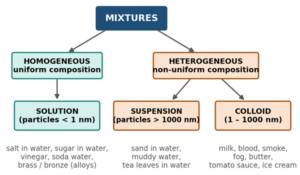
Homogeneous vs. Heterogeneous Mixtures :
(1) Homogeneous Mixtures (Solutions): A mixture in which the components are completely dissolved and uniformly distributed throughout its mass is called a homogeneous mixture.
- It possesses a uniform composition and single phase throughout.
- For example, a well-stirred sugar-water solution is equally sweet in the first and last sip.
- Other examples include vinegar (acetic acid in water), aerated drinks (carbon dioxide gas dissolved in water), and metal alloys (brass, bronze).
(2) Heterogeneous Mixtures: A mixture in which the components remain physically distinct and non-uniformly distributed is called a heterogeneous mixture.
- It contains physically distinct phases with visible boundaries.
- Examples include sand in water, oil in water, chalk powder in water, smoke (solid particles in air), and fog (liquid water droplets in air).
| KEY POINT
• A solution always remains homogeneous. • Oil and water is heterogeneous: two separate layers form because they do not mix (they are immiscible). |
Comparison: Solutions, Suspensions, and Colloids :
Mixtures are broadly categorized into three distinct physical systems based on particle dimension:
True Solutions (< 1 nm), Colloids (1 nm to 1000 nm), and Suspensions (> 1000 nm). The detailed property matrix is presented below:
| Property | True Solution | Suspension | Colloid |
| 1. Nature & Homogeneity | Homogeneous throughout | Heterogeneous | Heterogeneous (appears homogeneous) |
| 2. Particle Size Diameter | Small-sized (< 1 nm) | Large-sized (> 1000 nm) | Moderate-sized (1 nm – 1000 nm) |
| 3. Visibility of Particles | Invisible to naked eye & microscope | Visible to naked eye | Individual particles invisible to naked eye |
| 4. Separation by Filtration | Cannot be separated by filter paper | Separates easily on filter paper | Cannot be separated by ordinary filtration |
| 5. Stability & Settling | Stable; particles do not settle down | Unstable; particles settle under gravity | Stable; particles remain evenly distributed |
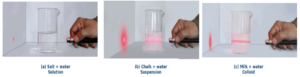
| 6. Tyndall Effect (Light Scattering) | Does NOT scatter light (Beam invisible) | Scatters light (until particles settle) | Scatters light prominently (Tyndall Effect) |
Structure of Colloids & Emulsions:
A colloid consists of two phases:
- Dispersed Phase (solute-like dispersed particles) and
- Dispersion Medium (medium in which particles are suspended).
When both the dispersed phase and dispersion medium are liquids, the colloid is termed an Emulsion.
- Oil-in-Water (O/W) Emulsions: Oil droplets dispersed in water. Examples: Milk, vanishing creams.
- Water-in-Oil (W/O) Emulsions: Water droplets dispersed in oil. Examples: Butter, cold cream, body lotions.
Solutions and Concentration :
Solute, Solvent and Concentration :
- Solute – the substance that gets dissolved.
- Solvent – the substance that dissolves the solute (usually present in larger amount).
- Solution – homogeneous mixture of solute and solvent.
- Concentration – the amount of solute dissolved in a given amount of solvent or solution.
Example: in a sugar–water solution, sugar is the solute and water is the solvent.
Why does proportion matter?
- ORS (Oral Rehydration Solution): specified amounts of salt and sugar in a fixed amount of water. Changing the amounts gives a salt–sugar solution, but not ORS. Not all sugary drinks are ORS.
- Clinical Application : Hospital intravenous (IV) saline drips contain exactly 0.9% m/v sodium chloride in water. This means 0.9 g of NaCl is dissolved in every 100 mL of solution (or 4.5 g NaCl per 500 mL IV bottle). This precise concentration matches human blood plasma osmotic pressure, making it perfectly safe for intravenous fluid replacement during surgeries or emergency dehydration treatment.
- Pesticide spray: too little will not protect the crop; too much damages crops, soil and the environment.
- Also vital in medicines, food, cosmetics, laboratories and even in making a cup of tea.
| Meet a Scientist – Dilip Mahalanabis :
An Indian paediatrician who first developed and implemented the treatment for dehydration caused by diarrhoea and cholera. The ORS he formulated revolutionised rehydration therapy and, popularised by the WHO, has saved millions of lives. |
Expressing Concentration as a Percentage :
| Method | Formula | Used when | Typical example |
| A. Mass by mass %
(% m/m or % w/w) |
\(\frac{\text{Mass of solute}}{\text{Mass of solution}}\) × 100 | Homogeneous mixtures; also solids/heterogeneous mixtures; food labels | Milk powder (fat, protein per 100 g), spice mixtures, alloys |
| B. Mass by volume %
(% m/v or % w/v) |
\(\frac{\text{Mass of solute in g}}{\text{Volume of solution in mL}}\) × 100 | Measuring volume of liquid is easier than weighing it | 5% glucose infusion; 0.9% saline |
| C. Volume by volume %
(% v/v) |
\(\frac{\text{Volume of solute}}{\text{Volume of solution}}\) × 100 | Two miscible liquids mixed | Vinegar (5% v/v acetic acid), perfumes, cosmetics |
| KEY POINT
Mass of solution = mass of solute + mass of solvent. The denominator is always the whole solution, never the solvent alone. % m/m and % w/w are numerically equal (weight and mass are used interchangeably in industry). |
Practice examples :
EXAMPLE 1 : Find the % m/m of a solution made by dissolving 20 g sugar in 180 g water.
Answer :
Calculation of Mass by Mass Percentage (% m/m)
Given Quantities-
- Mass of solute (sugar) = 20 g
- Mass of solvent (water) = 180 g
Calculate the Total Mass of Solution-
- Total mass of solution = Mass of solute + Mass of solvent
- Total mass of solution = 20 g + 180 g
- Total mass of solution = 200 g
Apply the Formula-
Mass by mass percentage (% m/m) = \(\frac{\text{Mass of solute}}{\text{Mass of solution}}\) × 100 = \(\frac{20\,g}{200\,g}\) × 100 = 10%
Answer: The mass by mass percentage of the sugar solution is 10% m/m
EXAMPLE 2 : How much salt is in 500 mL of 0.9 % m/v saline?
Answer :
Calculation of Mass of Salt in Saline Solution
Given Quantities-
- Mass by volume percentage = 0.9% m/v
- Volume of solution = 500 mL
Understand Mass by Volume Percentage (% m/v)-
A 0.9% m/v saline solution contains 0.9 g of salt in every 100 mL of solution.
Apply the Formula-
Mass by volume percentage (% m/v) = \(\frac{\text{Mass of solute in g}}{\text{Volume of solution in mL}}\) × 100
Calculate the Mass of Salt-
0.9 = \(\frac{\text{Mass of salt}}{\text{500 mL}}\) × 100
Mass of salt = \(\frac{0.9×500}{100}\) = 4.5 g
Answer: There are 4.5 grams of salt in 500 mL of a 0.9% m/v saline solution.
EXAMPLE 3 : How much alcohol is in 250 mL of a 20 % v/v hand-rub solution?
Answer :
Calculation of Volume of Alcohol in a Hand-Rub Solution
Given Quantities-
- Volume by volume percentage = 20% v/v
- Volume of solution = 250 mL
Understand Volume by Volume Percentage (% v/v)-
A 20% v/v solution contains 20 mL of alcohol in every 100 mL of solution.
Apply the Formula-
Volume by volume percentage (% v/v) = \(\frac{\text{Volume of solute}}{\text{Volume of solution}}\) × 100
Calculate the Volume of Alcohol-
20 = \(\frac{\text{Volume of alcohol}}{250\,mL}\) × 100
Volume of alcohol = \(\frac{20×250}{100}\)
Volume of alcohol = 50 mL
Answer: There are 50 mL of alcohol in 250 mL of a 20% v/v hand-rub solution. The remaining volume is 200 mL of the other ingredients, assuming the stated solution volume.
Solubility, Thermal Effects & Graphical Curves :
Solubility Definition: The maximum amount of a solute (in grams) that can dissolve in a fixed quantity of solvent (100 g or 100 mL) at a specified temperature is defined as its solubility at that temperature.
- Saturated Solution: A solution that cannot dissolve any additional solute at a given temperature.
- Unsaturated Solution: A solution containing less solute than its saturation limit at that temperature.
Temperature Influence:
- For solid solutes in liquid solvents, solubility generally increases with increasing temperature.
- Conversely, for gases dissolved in liquids (e.g., dissolved oxygen in water, soda carbonation), solubility decreases as temperature rises.
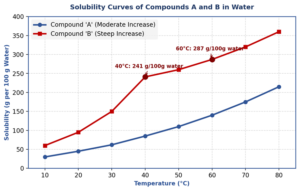
Figure: Solubility Curves of Compounds 'A' and 'B' in Water as a Function of Temperature
Graphical Analysis :
Compound ‘B’ dissolves more than ‘A’ at any given temperature.
- Solubility of ‘A’ at 20 °C is less than its solubility at 60 °C (small increase).
- Solubility of ‘B’ at 20 °C is less than its solubility at 60 °C (large increase).
- The solubility of ‘B’ increases more than that of ‘A’ with an increase in temperature.
The steeper the curve, the more strongly solubility depends on temperature, and the better crystallization works for that substance.
Separation Methods for Homogeneous Mixtures
(1) Crystallization Process & Applications
Crystal – a solid whose particles are arranged in a regular geometric pattern.
Crystallization – Crystallization is the process of obtaining pure solid crystals from a hot saturated solution by cooling it slowly.
- Principle: The solubility of a substance differs at different temperatures.
When is crystallization used?
- To separate two solids that dissolve in the same solvent when one is present in small quantity.
- To purify solids. Newly prepared compounds are often accompanied by unwanted impurities.
- It is better than simple evaporation because some substances, like sugar, may burn or decompose on heating. Crystallization also helps remove soluble impurities.
- Natural crystals: rock salt, sugar crystals (mishri), snowflakes, frost (water vapour turning to ice crystals), quartz, cave formations such as Mawsmai Cave, Sohra.
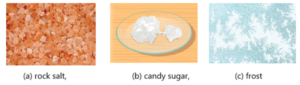
Applications & Examples:
- Purification of Solids: Purifying impure copper sulfate (blue vitriol) or alum crystals.
- Sugar & Candy Industry: Growing large sugar crystals (mishri) from sugarcane juice brines.
- Indian Salt Manufacturing: Coastal communities historically produced Panga salt by boiling concentrated sea brines, and Karkatch salt by solar evaporation of seawater in pans.
(2) Simple Distillation (Miscible Liquids)
Evaporating a solution to get the solute makes the solvent disappear. If we want the solvent as well, or want to separate two miscible liquids, we use distillation.
Principle: Distillation is used to separate a mixture of two miscible liquids that boil without decomposition and have a sufficient difference in boiling points (minimum ΔBP ≥ 25°C). The liquid with the lower boiling point vaporizes first, passes through a water condenser where it cools and condenses, and is collected as distillate in a receiver flask.

Example : Acetone & Water Mixture:
- Boiling point of Acetone = 56°C; Boiling point of Water = 100°C (Difference = 44°C ≥ 25°C).
- Upon heating the mixture in a distillation flask to 56°C, acetone vaporizes rapidly while water remains liquid. Acetone vapor rises, condenses in the Liebig condenser, and drips into the conical flask as pure distillate.

- Historical Contribution: The traditional Deg-Bhapka distillation apparatus in Kannauj, India, has been used for centuries to extract essential oils and perfumes (Attar) from flower petals.
Fractional Distillation & Petroleum Refining :
- Principle: When the boiling points of two or more miscible liquids differ by less than 25°C, simple distillation fails because both components vaporize together.
- Fractional Distillation utilizes a fractionating column packed with glass beads or trays to provide repeated condensation and vaporization cycles along its height.
Industrial Application — Crude Oil Refinery Fractions:
| Petroleum Fraction | Boiling Point Range / State | Primary Industrial / Domestic Application |
| Petroleum Gas | < 20°C (Gaseous) | Liquefied under high pressure as LPG for domestic cooking fuel |
| Petrol (Gasoline) | 40°C – 170°C | Fuel for motor vehicles and light internal combustion engines |
| Aviation Fuel / Kerosene | 170°C – 250°C | Fuel for jet aircrafts, stoves, and domestic lighting |
| Diesel Oil | 250°C – 350°C | Fuel for heavy commercial vehicles, buses, trucks, and generators |
| Lubricating Oil & Paraffin | > 350°C (Heavy liquid) | Engine lubrication, candles, ointments, and vaseline |
| Bitumen / Asphalt | Residue at bottom | Road surfacing, asphalt paving, and waterproofing roofs |
Paper Chromatography :
Paper chromatography is a method used to separate the different colours or substances present in a mixture.
For example, it can separate the different colours present in black ink.
How Does Paper Chromatography Work? :
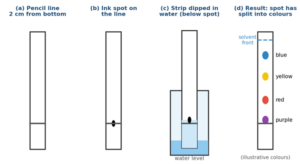
- Take filter paper: Draw a pencil line near the bottom of the paper.
- Apply the ink: Put a small spot of black ink on the pencil line.
- Place the paper in a solvent: Keep the bottom of the paper in water or a suitable solvent. The ink spot must remain above the solvent level.
- Solvent moves upward: The solvent travels up the paper and carries the different colours with it.
- Colours separate: Different colours travel different distances and form separate spots on the paper.
Why Do Colours Separate?
Different substances move at different speeds because they have different attractions to the paper and the solvent. Therefore, the colours separate.
Uses of Paper Chromatography :
- To separate colours present in ink.
- To identify pigments present in leaves.
- To separate colours in food colouring.
- To help identify substances in mixtures.
In simple words: Paper chromatography helps us separate and identify different substances present in a mixture.
Separation Methods for Heterogeneous Mixtures :
(1) Separation of two immiscible liquids :
Separating Funnel :
Meaning: A separating funnel is used to separate two liquids that do not mix with each other, such as oil and water.
Principle: The denser liquid forms the lower layer, while the lighter liquid forms the upper layer.
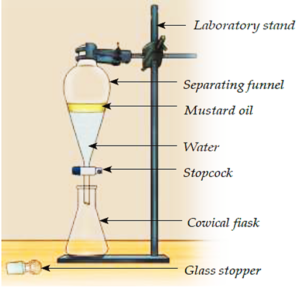
Procedure:
- Pour the mixture into the separating funnel.
- Allow the two liquids to form separate layers.
- Open the tap to collect the lower liquid.
- Close the tap and collect the upper liquid separately.
Example: Separating oil from water.
(2) Sublimation and Deposition :
Sublimation: It is the process in which a solid changes directly into a gas on heating without becoming a liquid.
Deposition: It is the process in which a gas changes directly into a solid on cooling.
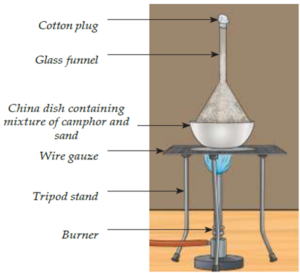
Examples of substances that sublime:
- Camphor
- Naphthalene
- Ammonium chloride
- Iodine
- Dry ice
Use: Sublimation helps separate a substance that changes directly into a gas from substances that do not.
Example: Separating camphor from salt or naphthalene from sand.
(3) Suspensions :
Suspension – a heterogeneous mixture in which solid particles do not dissolve but remain suspended throughout the medium. Particles are larger than in a solution (> 1000 nm) and are visible to the naked eye.
Examples: sand in water, sawdust in water, tea leaves in water, muddy water, chalk in water.
How can we separate mud from water? :
- Sedimentation + decantation: leave undisturbed; heavy mud settles, pour off the water.
- Filtration: cotton cloth or filter paper removes larger particles, but water often stays cloudy – filtration is not enough for tiny particles.
- Still cloudy? Use centrifugation and/or coagulation.
(A) Centrifugation :
Meaning: Centrifugation is a method of separating suspended particles from a liquid by spinning the mixture rapidly.
Principle: The denser particles move outward and collect at the bottom of the tube, while the lighter liquid remains above.
Example: Separating red blood cells from blood plasma in laboratories.

Paperfuge: A paperfuge is a simple, low-cost device made from paper or cardboard. It uses hand-powered spinning to separate components of a sample.
(B) Coagulation Using Alum (Fitkari) :
Meaning: Coagulation is the process of joining tiny suspended particles together to form larger particles.
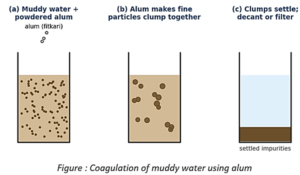
Procedure:
- Add a small amount of alum (fitkari) to muddy water.
- The tiny mud particles join together to form larger clumps.
- These clumps settle at the bottom.
- The clearer water can then be separated by decantation or filtration.
Use:
- Alum helps remove fine suspended impurities from water.
- Everyday example: paneer (cheese) from milk – lemon juice or vinegar (an acid coagulant) coagulates milk proteins.
- Used in water purification and sewage treatment (sedimentation → coagulation → filtration).
Remember: Water treated with alum is not necessarily safe to drink. It may require proper filtration and disinfection.
Colloids :
Blood can be separated by centrifugation and it coagulates, yet we cannot see blood cells with the naked eye. It is neither a solution nor a true suspension: it is a colloid.
Colloid – a mixture whose particles (1–1000 nm) are larger than in a solution but smaller than in a suspension; they are uniformly dispersed, do not settle and scatter light.
Examples: milk, blood, tomato sauce, ice cream, butter, smoke, fog, clouds.

Fig. Solutions, colloids and suspensions differ mainly in particle size
Parts of a colloid :
- Dispersed phase – the solute-like component (the dispersed particles).
- Dispersion medium – the component in which the dispersed phase is spread.
- In blood: dispersed phase = blood cells (RBC, WBC, platelets); dispersion medium = plasma.
Tyndall Effect :
Tyndall effect – the scattering of light by particles in a mixture, making the path of a light beam visible. Named after the scientist John Tyndall.
- Seen in colloids and suspensions; not seen in a true (transparent) solution.
- Everyday examples: a beam of light entering a dark room through a small hole (dust and smoke scatter it); sunlight through leaves of a dense tree; floodlights in a stadium; headlight beams in fog.
Separation in Nature and Daily Life :
- Kidneys remove waste from blood – separation in our bodies.
- Sewage treatment: sedimentation → coagulation → filtration; clean water is reused for flushing toilets and watering plants.
- Cleaning oceans and rivers of plastic waste is a growing separation challenge.
- Waste segregation at home: dry waste (plastic, paper, glass, metal) is recycled; wet waste (food scraps, vegetable peels) is composted.
- Researchers recover valuable materials such as lithium from old mobile-phone and laptop batteries.
- Separation is not always simple – try separating all the ingredients of a lemonade once mixed!
We reply to valid query.