Solutions (Exercise + Intext)
The Big Questions :
Question 1. How did a land of diverse geographies, languages and religions come together to challenge and finally end nearly two centuries of British rule?
- People across India faced economic exploitation, racial discrimination and British repression. These common problems united them.
- A growing sense of Indian pride developed through ideas such as Bande Mataram, Mother India and the teachings of Swami Vivekananda.
- Common platforms like the Indian National Congress, Swadeshi Movement and Gandhi’s mass movements brought people together.
- Events such as the Partition of Bengal and the Jallianwala Bagh massacre created strong opposition to British rule.
- People from different regions, religions and social classes gradually joined the freedom struggle.
- After World War II, Britain became weaker. Mutinies in the armed forces also showed that British control was becoming difficult.
- These developments increased pressure on Britain, and finally British rule in India ended on 15 August 1947.
Question 2. What were the main developments and who were some important figures in India’s struggle for freedom?
1857 Revolt: Indians rose against British rule in a major uprising. Leaders such as Rani Lakshmibai, Bahadur Shah Zafar and Tantia Tope played important roles.
Formation of the Indian National Congress (1885): The Congress became an important platform for Indians to demand political rights and greater self-government.
Swadeshi Movement (1905): The Partition of Bengal led to protests and the boycott of British goods. People promoted Indian-made products.
Gandhian Movements: Mahatma Gandhi led major movements such as the Non-Cooperation Movement, Civil Disobedience Movement and Quit India Movement. He used non-violence and mass participation.
Revolutionary Movement: Leaders such as Bhagat Singh, Chandrashekhar Azad, Ram Prasad Bismil and Ashfaqulla Khan followed revolutionary methods to oppose British rule.
Subhas Chandra Bose and the INA: Subhas Chandra Bose led the Indian National Army (INA) and fought against British rule during the Second World War.
Quit India Movement (1942): Gandhi gave the call of “Do or Die”, demanding that the British leave India.
Towards Independence (1945–47): After World War II, Britain became weaker. Political pressure, mass movements and unrest in sections of the armed forces increased the demand for independence.
Independence (1947): India became independent on 15 August 1947. Jawaharlal Nehru became the first Prime Minister of independent India, while Sardar Vallabhbhai Patel played an important role in integrating the princely states.
Question 3. What issues did the leading freedom fighters agree or disagree upon?
Issues on Which Freedom Fighters Agreed :
- Most freedom fighters agreed that British rule should end and India should become independent.
- They wanted greater political rights and self-government for Indians.
- They believed that Indians from different regions, religions and communities should work together for freedom.
Issues on Which They Disagreed :
- Methods of struggle: Gandhi supported non-violence and peaceful mass movements, while revolutionaries such as Bhagat Singh and Chandrashekhar Azad supported revolutionary methods.
- Constitutional methods: Some leaders, such as Motilal Nehru and C.R. Das, wanted to work through legislative councils, while others preferred direct mass movements.
- Dominion Status or Complete Independence: Some leaders initially accepted Dominion Status, while younger leaders such as Jawaharlal Nehru and Subhas Chandra Bose demanded Purna Swaraj (complete independence).
- Role of religion in politics: Leaders differed over how religion should be connected with the national movement. Muhammad Ali Jinnah opposed mixing religion with the Congress movement at certain stages, while Gandhi supported Hindu-Muslim cooperation.
- Separate electorates:R. Ambedkar supported separate political representation for the Depressed Classes, while Gandhi opposed separate electorates and preferred joint electorates with reserved seats.
Way forward for India: Leaders had different ideas about India's future political system, economic development and the rights of different communities.
Despite these differences, many leaders continued to work towards the common goal of ending British rule and achieving Indian independence.
Intext Exercises :
Let's Explore :
Question 1. (p. 38) Talk to your grandparents or elders about what they remember of India's freedom struggle. Why did people follow different paths despite the same goal?
Suggested interview prompts:
Which leaders did your family admire?
Did anyone take part in Quit India, a salt march or a protest?
How did they hear the news (newspapers, radio, word of mouth)?
Class discussion points:
- People followed different paths because they had different backgrounds, experiences and beliefs.
- Moderates believed in petitions and peaceful discussions. Nationalists believed in mass movements and public pressure.
- Gandhiji followed non-violence and satyagraha. Revolutionaries believed in direct and forceful action.
- Although their methods were different, all wanted India to become free, and each approach put pressure on the British.
Question 2. (p. 42) Below are the first two stanzas of the song. Can you make out some of their meaning?
Vande mātaram! sujalām suphalām malayajaśhītalām śhasyaśhyāmalām, mātaram! Vande mātaram!
Śubhrajyotsnām pulakitayāminīm phullakusumita drumadalaśhobhinīm suhāsinīm sumadhura bhāṣhiṇīm sukhadām varadām, mātaram! Vande mātaram!
The first two stanzas praise India as a motherland and describe her natural beauty and the happiness she gives to her people.
- “Vande Mataram” means “I bow to you, Mother.”
- The motherland is described as rich in water and fruits and cooled by pleasant winds.
- Her green fields and fertile land are praised.
- The song describes bright moonlight, beautiful flowers and trees.
- India is also shown as a smiling and sweet-speaking mother who gives happiness and blessings to her children.
- Overall, the stanzas express love, respect and pride for the motherland.
Question 3. (p. 50) Why do you think the Bande Mataram daily avoided using the word "independence"?
- The Bande Mataram daily avoided using the word “independence” because the British government could punish newspapers for openly demanding freedom through laws such as the Vernacular Press Act.
- If newspapers openly demanded independence, the writers could be prosecuted and the newspaper could be closed. Therefore, newspapers used terms such as “Swaraj” and “absolute national autonomy” to express the idea of freedom in a safer way.
- However, the newspaper was suppressed in 1908.
Question 4. (p. 50) Comment on the phrase "absolute national autonomy" in the quotation.
- "Absolute" means complete, not partial: it rejects mere administrative concessions or dominion status.
- "National autonomy" means the nation governs itself.
- The article says the agitation was "not merely against Partition": the real aim was full self-rule, and only that would satisfy the movement. The phrase is effectively a code for independence.
Question 5. (p. 50) Looking at the two boxes on either side of the daily's title in Fig., what do you observe?
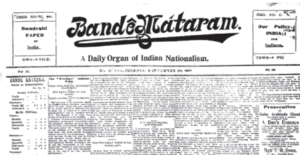
- The box on the left reads "Swadeshi Paper of India" and the one on the right "Our Policy: India for Indians".
- Together with the subtitle "A Daily Organ of Indian Nationalism", they announce the paper's Swadeshi (self-reliance) character and its nationalist policy, so readers know its stand at a glance.
Question 6. (p. 52) In what ways are the two representations of Mother India (Abanindranath Tagore's painting and Bharati's Vijaya cover) similar or different?
Similar: both personify India as a divine mother/woman, drawing on the Bharat Mata idea inspired by Anandamath; both aim to evoke devotion and pride for the motherland.
Different: Abanindranath Tagore's is a standalone painting of a serene, saffron-clad figure, devotional and artistic. Bharati's is a magazine cover in Tamil, placing Mother India with the map of India and slogans: more directly political and meant for public circulation. (Students may add their own observations from the images.)
Question 7. (p. 52) What details can you discern in the front cover of Subramania Bharati's Vijaya?
Observable details: the Tamil title (Vijaya), the figure of Mother India, an outline of the map of India, the words "Vande Mataram" and small figures/attendants around her. This shows how a regional-language magazine took up the national theme of Mother India.
Question 8. (p. 56) Tilak said, "...it may be the will of Providence that the cause I represent may be benefited more by my suffering than by my pen and tongue." What message was he trying to convey?
He was saying that personal sacrifice can inspire more than words. By accepting punishment calmly, he hoped to strengthen the cause and awaken people. It shows courage, faith and selflessness: his suffering would carry the movement further than his speeches and writings.
Question 9. (p. 56) Tilak declared, "Swaraj is my birthright and I shall have it." What does this reveal about his character?
It reveals determination, self-confidence and conviction: he saw self-rule as a natural right, not a favour from rulers. It also shows fearless leadership and the ability to express a big idea in a simple, memorable slogan that ordinary people could rally behind.
Question 10. (p. 43) How are Swami Vivekananda's values relevant in the 21st century? Can some help you achieve your goals?
- Self-confidence and fearlessness: "Arise, awake..." encourages us to overcome self-doubt and keep going until the goal is reached, useful for studies, sports and careers.
- Science and learning: he encouraged scientific research (IISc), relevant to innovation today.
- Rooted but forward-looking: reject blind imitation, value our heritage, yet look forward. This balances tradition and modern life.
- Service: the Ramakrishna Mission joined spiritual practice with social service, which matches today's volunteering and community work.
Question 11. (p. 63) What does Tagore mean when he says the colonial rulers were "possibly congratulating themselves for what they imagine as salutary lessons"?
Tagore means that the rulers ignored the nation's anguish and perhaps felt pleased with the massacre, believing it had taught Indians a useful "lesson" (to fear and obey). He condemns this attitude as heartless: what was an atrocity to Indians was seen by the rulers as a successful act of discipline. By returning his knighthood he showed he could no longer accept honour from such a government.
Question 12. (p. 69) Analyse the elements or demands in the Purna Swaraj resolution (Lahore, 1929).
Natural rights: freedom and the fruits of one's labour, and the necessities of life, are the inalienable right of all peoples.
Right to resist: if a government deprives people of these rights, people may alter or abolish it.
Charges against British rule: loss of freedom, exploitation of the masses, ruin of India economically, politically, culturally and spiritually.
Demand: sever the British connection and attain Purna Swaraj (complete independence).
Comparison: unlike the 1928 Nehru Report (dominion status, still under the Crown), this demanded complete separation.
Question 13. (p. 55) Explore the freedom struggle in the North-East.
Starting points: Tirot Sing (Khasi Revolt 1829–33), Singpho Rebellion, Maniram Dewan and Piyali Baruah (hanged during 1857), Kanaklata Barua and Kushal Konwar (Quit India), Rani Gaidinliu (Manipur, fought from age 13). A short project could pair each with a date, place and what they did.
"Think About It":
Question 1. (p. 62) Why was khadi important?
It was a symbol of Swadeshi and self-reliance, provided work to millions of poor villagers, directly challenged British textile imports, and united people economically and symbolically against foreign rule.
Question 2. (p. 76) Discuss the significance of the numbers jailed or killed.
The figures (40,000 in 1920–22; 60,000+ in 1930; 40,000 in 1931–34; 100,000+ imprisoned and nearly 10,000 killed in 1942–45) show the scale of participation and growing intensity of repression. They show that freedom was a mass movement and a collective sacrifice by ordinary Indians, not only of a few leaders.
Question 3. (p. 80) Add a name to the list of lesser-known fighters.
Examples from the chapter not on the list: Kanaklata Barua (17, Gohpur 1942), Aruna Asaf Ali, Bina Das, Suniti Chowdhury and Shanti Ghosh, Chandra Singh Garhwali, Maniram Dewan, Piyali Baruah, Kushal Konwar. Students may add a local freedom fighter from their own area.
Questions and activities :
The following are suggested activities to choose from.
Question 1. True or False. Find out whether the following statements are true or false:
(1) Right from its inception, the Indian National Congress called for India’s independence.
FALSE — In its initial phase (1885), the Indian National Congress expressed full faith in the British Crown and sought dialogue, civil rights protection, and greater Indian participation in governance rather than complete independence. The call for full independence ('Purna Swaraj') was formally adopted much later at the Lahore session in 1929.
(2) Bal Gangadhar Tilak turned a Shivaji festival into a popular event.
TRUE — Bal Gangadhar Tilak popularized public celebrations of Ganesh Chaturthi and the Shivaji Festival to foster national consciousness, instill pride in Indian heritage, and mobilize the masses against British rule.
(3) The Ghadar Movement of 1914–15 aimed to start a mutiny within the British Indian Army while British troops were busy with World War I.
TRUE — The Ghadar Party, formed by Indian revolutionaries abroad, explicitly planned an armed mutiny among Indian soldiers in the British Indian Army during World War I to overthrow colonial rule while British troops were occupied in Europe.
(4) Vallabhbhai Patel earned the title ‘Sardar’ for his leadership during the Satyagraha agitation in Gujarat.
TRUE — Vallabhbhai Patel successfully led the peasant struggle during the Bardoli Satyagraha (1928) against excessive land revenue. Impressed by his leadership, Mahatma Gandhi bestowed upon him the title 'Sardar' (meaning leader).
(5) The Kakori train robbery of 1925 was carried out to fund the activities of the Hindustan Republican Association.
TRUE — The Kakori train action was executed in 1925 by revolutionaries belonging to the Hindustan Republican Association (HRA) to secure government treasury funds for procuring arms and conducting revolutionary activities.
(6) The ‘Do or Die’ call was given by Mahatma Gandhi during the Non-Cooperation Movement in 1920.
FALSE — The 'Do or Die' ('Karo ya Maro') slogan was proclaimed by Mahatma Gandhi during the Quit India Movement in August 1942, demanding immediate British exit from India. During the 1920 Non-Cooperation Movement, Gandhi promised 'Swaraj within a year' through non-violent non-cooperation.
(7) B.R. Ambedkar and Gandhi were in total agreement regarding the issue of ‘separate electorates’ for Dalits.
FALSE — Dr. B.R. Ambedkar advocated separate electorates to ensure political representation for Dalits, whereas Mahatma Gandhi opposed separate electorates, believing they would divide Hindu society. This disagreement led to Gandhi's fast unto death and the subsequent signing of the Poona Pact (1932), which agreed on reserved seats instead of separate electorates.
(8) Sir Stafford Cripps was sent to India in 1942 because Winston Churchill supported immediate independence for India.
FALSE — Sir Stafford Cripps was sent in 1942 under severe Allied pressure during World War II to secure Indian support for the war effort. Churchill offered only post-war Dominion status with opting-out clauses, which Indian leaders rejected. Churchill strongly opposed Indian independence
(9) Subhas Chandra Bose raised an army during his stay in Germany.
TRUE — During his stay in Germany (1941–1943), Subhas Chandra Bose formed the 'Free India Legion' (Azad Hind Legion) from Indian prisoners of war before traveling to East Asia to reorganize the Indian National Army (Azad Hind Fauj).
(10) The Radcliffe Line, which divided India and Pakistan, was announced a few weeks before Independence Day.
TRUE — British lawyer Sir Cyril Radcliffe was given just five weeks in July 1947 to draw the boundary lines splitting Punjab and Bengal, resulting in the Radcliffe Line that was published around Independence in August 1947.
Question 2. Who Am I? Can you identify these figures?
(1) Known as the ‘Lion of Punjab’, I was severely injured during a brutal lathi charge while protesting against the Simon Commission.
Identified Figure: Lala Lajpat Rai
(2) I famously declared, ‘Swaraj is my birthright, and I shall have it!’ I used the Kesari newspaper and festivals like Ganesh Chaturthi to unite people against British rule.
Identified Figure: Bal Gangadhar Tilak
(3) I was a leader of the Nationalist faction of the Congress. In the daily Bande Mataram, I wrote on the need for India to attain absolute autonomy.
Identified Figure: Bipin Chandra Pal / Sri Aurobindo
(4) I earned my nickname ‘Bagha’ after wrestling a tiger with my bare hands. I was a revolutionary leader who died in a gunfight at while waiting for a shipment of German arms to start an uprising.
Identified Figure: Bagha Jatin (Jatindranath Mukherjee)
(5) I organised the daring attempt to throw a bomb at the Viceroy in 1912. I later escaped to Japan, where I spent years working to organise a movement from there.
Identified Figure: Rash Behari Bose
(6) I was martyred at a young age after an attempt on the life of a British judge.
Identified Figure: Khudiram Bose
(7) I was martyred at a young age after throwing nonlethal bombs in Delhi’s Central Legislative Assembly.
Identified Figure: Bhagat Singh
(8) I turned the freedom struggle into a mass movement through the principles of ahimsa and satyagraha, leading campaigns such as the Dandi March.
Identified Figure: Mahatma Gandhi (Mohandas Karamchand Gandhi)
(9) I sought help from the Axis powers during World War II to organise the Indian National Army.
Identified Figure: Subhas Chandra Bose ('Netaji')
(10) A British lawyer, I was given just five weeks to draw the boundary line that would partition the Indian subcontinent into two separate nations.
Identified Figure: Sir Cyril Radcliffe
Question 3. What kinds of sacrifices are needed to achieve freedom?
Think about the lives of Indian soldiers during wars, families suffering during famines, leaders and ordinary people who were arrested, and countless others who lost their homes and safety while participating in protests. If you were living during India’s freedom struggle, would you have chosen to participate in it? What comforts, opportunities, or personal goals might you have been willing to give up for a cause you strongly believed in?
Kinds of sacrifice:
- Achieving freedom often requires people to give up their comfort, safety, time and opportunities.
- During India’s freedom struggle, many people faced arrest, loss of homes, poverty, hunger and separation from their families.
- Some soldiers and ordinary people also lost their lives.
- People had to give up education, jobs, money and personal goals to take part in the struggle.
- They showed courage, patience and willingness to suffer for a larger cause.
Model personal response:
If I had lived during the freedom struggle,
- I would have wanted to participate in the movement in a peaceful and responsible way.
- I would have been willing to give up some comforts and personal opportunities to support the cause of freedom.
(Students should give their own reasoned view.)
Question 4. What values does Tilak’s statement, “Swaraj is my birthright and I shall have it,” reflect? Can these values be meaningful for young people today?
Bal Gangadhar Tilak’s immortal declaration reflects core values that remain deeply relevant today:
- Self-Respect & Inherent Dignity: It asserts that liberty is an inalienable birthright, not a favor granted by external authorities.
- Courage & Fearlessness: It inspires individuals to stand firmly against injustice, oppression, and systemic inequality.
- Determination & Self-Reliance (Atmabhava): It emphasizes relying on one's own energies and strength rather than begging for concessions.
Relevance for Youth Today:
- For 21st-century youth, 'Swaraj' extends beyond political independence to intellectual autonomy, economic self-reliance, and active citizenship.
- It encourages young minds to fight against corruption, social discrimination, climate injustice, and economic inequality, upholding the right to think critically and shape their nation's future.
Question 5. How did peasants, workers, tribals, and students contribute to the national movement in ways different from political leaders?
While political leaders provided ideological vision, policy resolutions, and organizational frameworks, grassroots groups constituted the actual muscle and mass foundation of the movement:
• Peasants & Farmers: Led grassroots satyagrahas against oppressive land revenues and indigo exploitation (Champaran, Kheda, Bardoli Satyagraha). Their resistance transformed local economic grievances into anti-colonial agitation.
• Tribals & Indigenous Communities: Organized formidable armed revolts against forest laws and land dispossession, such as Birsa Munda’s 'Ulgulan' (Great Tumult) in Chota Nagpur and the Kuka Movement in Punjab.
• Industrial Workers: Initiated nationwide strikes (hartals) in textile mills, railways, and ports, shutting down colonial economic machinery during the Non-Cooperation and Quit India movements.
• Students & Youth: Left government schools and universities to join street processions, picketed foreign cloth shops, operated underground radio stations (Usha Mehta), distributed banned nationalist literature, and formed the frontlines of revolutionary action.
Question 6. Discuss in class this extract from Nehru’s speech on 15 August 1947:
“Long years ago we made a tryst with destiny, and now the time comes when we shall redeem our pledge, not wholly or in full measure, but very substantially. At the stroke of the midnight hour, when the world sleeps, India will awake to life and freedom. A moment comes, which comes but rarely in history, when we step out from the old to the new, when an age ends, and when the soul of a nation, long suppressed, finds utterance…”
What is meant by “redeem our pledge”? How would you define the ‘soul of a nation’?
Analysis of Key Phrases in Nehru's Historic Oration:
• 'Redeem our pledge': Refers to fulfilling the solemn vow taken by the nation during the 1929 Lahore Congress session to achieve 'Purna Swaraj' (complete independence) and build a sovereign, democratic republic free from foreign subjugation.
• 'Soul of a nation, long suppressed, finds utterance': Represents the rebirth of India's ancient civilization, cultural genius, and collective identity after centuries of colonial suppression and economic drain.
Contextual Reflection:
Nehru acknowledged that the pledge was redeemed 'not wholly or in full measure', recognizing the immense grief and scar of Partition that accompanied independence. The speech served as both a celebration of freedom and a call to duty for rebuilding a shattered economy and healing communal wounds.
Question 7. Imagine you are a freedom fighter.
(a) Explain the method you support to achieve freedom.
(b) Discuss with your classmates any other method they would support. Be respectful in your debate.
(c) What does this debate teach us about unity and disagreement?
(a) Model answer (Gandhian): "I support non-violent non-cooperation. If millions refuse to cooperate with an unjust government, it cannot function. Boycotting foreign cloth, courts and schools and spinning khadi unite ordinary people and keep the moral high ground."
(b) A classmate supporting revolutionaries may argue that non-violence is too slow and that force wakes the world; a Moderate may argue that petitions are practical. Listen, ask for reasons and respond with evidence (e.g., Chauri Chaura, repression after Kakori).
(c) Lesson: a movement can be united in goal yet diverse in methods; disagreements can be productive when respectful, and each approach added to the pressure on the British. Unity does not require uniformity.
Question 8. Write a news report based on an important event in the Freedom Movement (Swadeshi, boycott, satyagraha, Non-Cooperation, Quit India, or Partition).
(a) Write a headline.
(b) Include one interview or public reaction.
(c) Explain why this event was important.
SPECIAL HISTORICAL REPORT: BOMBAY, AUGUST 9, 1942
HEADLINE: 'DO OR DIE': MASS REBELLION ERUPTS ACROSS INDIA AS BRITISH ARREST CONGRESS LEADERS
BOMBAY, AUGUST 9 — Following Mahatma Gandhi's electrifying call for immediate British withdrawal at the Gowalia Tank Maidan last evening, colonial authorities launched a pre-dawn sweep, arresting Mahatma Gandhi, Jawaharlal Nehru, Sardar Patel, and the entire Congress Working Committee.
Public Reaction & Interview:
At the scene in Bombay, Aruna Asaf Ali defiantly hoisted the Indian National Flag amidst tear gas and police lathi charges. A 20-year-old university student, Ramanathan, remarked: 'They may jail our leaders, but they cannot jail our spirit. Gandhi ji said Do or Die, and today every street in India is fighting for Swaraj!'
Historical Significance:
The Quit India Movement marks the point of no return for colonial rule. With workers striking in factories and students boycotting classes, Viceroy Linlithgow has conceded this is the most formidable rebellion since 1857. It proves that Britain can no longer govern India without Indian consent.
Question 9. Imagine you are part of a team creating a small museum exhibition on India’s freedom struggle for students of your age.
(a) Choose a title for your exhibit.
(b) Select three objects (for example: a letter, a photograph, a newspaper, a prison diary — you can add to these examples) and explain what each object represents.
(c) Write a short note on what visitors should learn or feel after seeing this exhibit.
Exhibition Title: Echoes of Freedom: Voices, Sacrifices, and the Birth of a Republic
- Object 1: A Hand-Operated Wooden Charkha (Spinning Wheel): Represents economic self-reliance, Swadeshi, and Gandhi's non-violent challenge to British textile dominance, showing how simple everyday actions united millions.
- Object 2: Original Banned Copy of 'Bande Mataram' Daily (1906): Represents the power of the nationalist press, cultural renaissance, and the demand for 'absolute national autonomy' articulated by Bipin Chandra Pal and Sri Aurobindo.
- Object 3: Iron Ankle Shackles from Cellular Jail (Kala Pani): Represents the extreme physical suffering and supreme sacrifice endured by revolutionaries like V.D. Savarkar, Bagha Jatin, and thousands of martyrs who gave their youth for freedom.
Visitor Learning Outcome: Visitors should leave with a profound appreciation for the immense personal sacrifices that secured India's freedom, realizing that modern democracy is a precious legacy that requires active protection, unity in diversity, and civic responsibility.
Question 10. As a class activity, write and stage a small play or skit based on the Freedom Movement.
Suggested skit: "The Spinning Wheel Speaks" (about 5 minutes)
- Scene 1 (1905): Students in Calcutta discuss the Partition of Bengal, tie rakhis and light a bonfire of foreign cloth while singing Vande Mataram.
- Scene 2 (1920): A village meeting: a Congress volunteer explains Non-Cooperation; a weaver demonstrates khadi spinning; an old man worries, a young woman encourages him.
- Scene 3 (1930): Marchers reach the shore; narrator: "A pinch of salt shook an empire."
- Scene 4 (1947): Midnight; a radio plays Nehru's "tryst with destiny"; a refugee family at a station reminds everyone of Partition's price. Close: all cast: "What sort of nation will free India build?"
Roles: narrator, students, volunteer, weaver, villagers, marchers, radio announcer. Rehearse to stay within time and keep scenes respectful, especially Scene 4.
Question 11. India achieved freedom after great sacrifice. What responsibilities do citizens have today to protect and strengthen this freedom? Write 5 to 10 lines.
India's freedom was won through the sacrifice of millions, so it is our duty to protect it.
- First, we must respect the Constitution and obey the law.
- We should use our rights responsibly and respect the rights of others, whatever their religion, caste, region or language.
- Voting when eligible and staying informed about public issues strengthens democracy.
- We must protect public property, the environment and our shared heritage.
- Practising honesty and refusing corruption honours the fighters' ideals.
- We should resolve differences peacefully, remembering the lesson of Partition about the cost of hatred.
- Finally, working hard to build a fair, educated and self-reliant India is the best way to "weave" the tapestry of freedom further.
We reply to valid query.