Notes
|
Topics to be learn :
|
Introduction :
Living and Non-Living Things :
All around us, we see two kinds of things—living organisms and non-living objects.
- Living organisms include dogs, plants, insects, birds, and humans.
- Non-living objects include a collar, a leash, a cart, and a pot.
Living organisms are born, grow, need food, and eventually die. Non-living objects do not perform these activities on their own. The special features that make something alive are called the characteristics of living organisms.
What is a Living Organism?
- A living organism is any organism that shows life processes such as growth, reproduction, respiration, movement, excretion, and response to stimuli.
Diversity in Living Organisms :
- Living organisms are found in many different shapes and sizes.
- Some are microscopic and cannot be seen with the naked eye.
- Others are large, such as trees and animals, and can be seen from a distance.
- Despite their differences, all living organisms need air, food, and water to survive.
- They obtain energy from food to grow, carry out life processes, and stay alive.
7 Characteristics of Living Organisms :
| Characteristic | Meaning | Example |
| Growth | Permanent increase in size, height and weight | Moti the puppy growing into an adult dog |
| Development | Progress in body, intelligence, work capacity and skills | A baby learning to crawl, stand and walk |
| Response to Stimuli | Sensing surroundings (stimulus) and reacting to it (response) | Earthworm moving away from sunlight |
| Excretion | Removal of waste materials produced inside the body | Animals releasing sweat, urine, CO₂; plants shedding leaves/bark, forming gum |
| Reproduction | Producing another living organism like oneself | Hens laying eggs; seeds germinating into new plants |
| Respiration | Producing energy in the body by reaction of oxygen with food | Inhalation and exhalation in animals; respiration in plant cells |
| Movement | Change of position (animals) or internal movements (plants) | Walking, jumping; roots growing towards moisture |
★ Key Point: Growth and Reproduction are considered the MAIN characteristics used to distinguish living organisms from non-living objects.
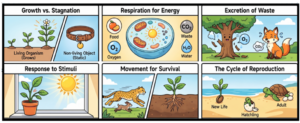
Growth and Development :
Growth: Permanent increase in the size, height and weight of an organism's body.
Development: Development is the improvement in an organism's body, intelligence, work capacity, and skills.
Growth in Animals and Plants :
- All living organisms grow, but animals grow only for a certain period of their life.
- Plants continue to grow throughout their lifetime.
- In animals, growth takes place in all body organs.
- In plants, some parts such as the tree trunk, branches, and roots continue to grow throughout life.
- Some plant parts, like leaves, grow only for a limited period.
Food and Growth
- Plants prepare their own food by the process of photosynthesis.
- Animals depend on plants and other animals for their food.
- The intake of food provides energy and nutrients for growth.
- Growth through the intake of food is an important characteristic of all living organisms.
Memory Tip: “Growth = bigger in size; Development = better in ability.” A tiger cub grows bigger (growth) AND learns to hunt (development) — both happen together.
Response to Stimuli :
Stimulus: Any change in the surroundings that a living being is able to sense (e.g., light, water, heat, danger, injury).
Response (Reaction): The way an organism acts because of a stimulus it has sensed.
All animals — from tiny insects to large animals — sense what is happening around them and respond instantly.
Examples:
- Earthworms move away from sunlight and seek damp soil (stimulus: light; response: moving to darkness/moisture).
- Animals change behaviour when they sense danger.
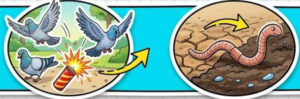
Plants also respond to stimuli, though more slowly:
- Roots grow in the direction of water in the soil (response to moisture as a stimulus).
- Branches grow towards sunlight so leaves get enough light (response to light).
- Plants sense changes in weather, temperature and injury too.

Excretion :
Excretion: Excretion is the process of removing waste materials produced inside the body during various life processes.
Excretion helps living organisms remain healthy by preventing the accumulation of harmful substances.
Excretion in Animals :
- Animals excrete waste through breathing, sweating, and urination
- During breathing, animals exhale carbon dioxide and water vapour.
- They remove waste through sweat from the skin.
- They also excrete urine, which contains excess water, salts, and other waste substances.
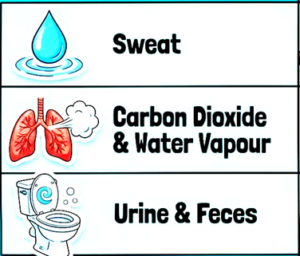
Excretion in Plants :
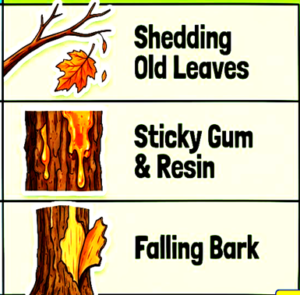
- Plants remove waste by storing it in old leaves and bark, forming gum, and releasing waste through their roots.
- Plants store waste materials such as excess salts, tannins, resin, gum, and calcium oxalate crystals in their bark and old leaves. When old leaves and pieces of bark fall off, these waste materials are removed from the plant.
- Some plants release a sticky liquid from their stems when they are naturally damaged or injured by humans. When this liquid dries, it forms gum, which is also a form of excretion.
- Plant roots also release some waste materials into the soil.
Cellular Structure :
Formation of New Cells : Living organisms are made up of tiny units called cells. New cells are continuously formed in the body, which helps in growth and repair.
Healing of Wounds :
- In animals, small or large wounds heal with time.
- New cells are formed to repair the damaged body parts.
- After healing, the body part becomes almost the same as before.
Growth in Plants :
- New shoots grow from the trunks and stems of trees.
- These shoots develop into new branches and leaves.
- This happens because new cells are continuously formed.
Different Types of Cells : Cells in different parts of the body have different structures. For example, bone cells, muscle cells, and skin cells are different because they perform different functions.
Need for Nutrients and Oxygen : Every living organism is made up of cells. Each living cell needs nutrients (food) and oxygen to stay alive, grow, and function properly.
Reproduction :
Reproduction: Reproduction is the process by which every living organism produces another living organism like itself.
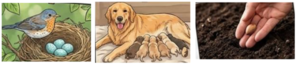
Ways animals reproduce:
- Some animals lay eggs, and their babies hatch from the eggs (e.g., hen, turtle, frog).
- Some animals directly give birth to young ones (e.g., dog, cow, human).
- Some organisms can grow into a whole new organism from just a small part of their body.
Reproduction in plants:
- Most plants reproduce through seeds.
- A seed contains a tiny seedling (embryo) that develops into a new plant.
- When a seed is planted under suitable conditions, it grows into a new plant. This process is called germination.
- During germination, the seed first develops roots and small leaves.
- The food needed by the growing seedling is stored inside the seed.
- Seeds like beans and peas have two halves (cotyledons) that store food.
- Seeds of wheat and jowar also contain stored food for the developing seedling.
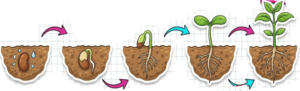
Germination: Germination is the process by which a planted seed grows into a new plant — it develops small leaves and roots.
Sunlight, moisture, and fresh air are essential for germination and plant growth
Respiration :
Inhalation: Taking air into the lungs through the nose.
Exhalation: Releasing carbon dioxide gas and water vapour from the lungs.
Respiration: The process of producing energy in the body through the reaction of oxygen with the food consumed by a living thing.
- Many animals breathe through the nose, and inhalation and exhalation continue one after another.
- Animals without a nose or lungs (such as fish, insects) take in oxygen by other means (gills, tiny tubes, or through the skin).
Important Distinction: Breathing and respiration are two different processes.
Breathing is the physical exchange of air (inhalation/exhalation).
Respiration is the chemical process of releasing energy from food using oxygen, and it happens inside cells — plants respire too, within their cells.
Movement :
Movement: A change shown by living organisms to obtain food, protection or shelter, or as a response to a stimulus.
Animals show movement by walking, jumping, swimming, flying etc., to get food, protection and shelter, and in response to stimuli.
Plants cannot move from one place to another, but they do show movement in other ways:
- Roots grow towards moisture; branches grow towards sunlight.
- Some leaves fold together at night and open again when the sun rises.
- Flower buds bloom — their petals separate from each other.
This shows that even though plants are fixed in one place, movement (of roots, branches, leaves and petals) still occurs in them, proving they are aware of their surroundings.
Life Cycle of a Frog (Metamorphosis) :
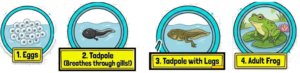
Life Cycle / Metamorphosis: The series of major changes in body structure that an organism goes through during its growth, from birth to adulthood.
At the beginning of the rainy season, frogs lay clusters of eggs (that look like white foam) near ponds.
The stages of a frog's life cycle :
| Stage | Description | Special Feature |
| 1. Eggs | Laid in clusters in water, look like white foam | Hatch into larvae (tadpoles) |
| 2. Tadpole (larva) | Does not look like a frog at all; lives in water | Breathes through gills; has a tail, no legs |
| 3. Tadpole with hind legs | Develops two hind legs while retaining the tail | Body slowly starts transforming |
| 4. Young frog | Develops fore legs; tail begins to shorten | Looks more like an adult frog |
| 5. Adult frog | Tail disappears completely; can live on land and water | Breathes with lungs; fully developed legs |
Life Cycle of a Mosquito :
A mosquito undergoes complete metamorphosis, which means it passes through four stages before becoming an adult.
- Mosquitoes have four stages in their life cycle: Egg → Larva → Pupa → Adult.
- The egg, larva, and pupa stages occur in water.
- The adult mosquito lives on land and in the air.
- Mosquitoes breed in stagnant water, so preventing water collection helps control their population.
Do You Know? — Enrichment Facts :
Sir Jagadish Chandra Bose
- Sir J. C. Bose was a great Indian physicist and botanist.
- He was the first to prove, through experiments, that plants have a special system to sense heat, cold, injury and pain.
- He invented an instrument that could magnify a plant's movements and growth ten thousand times and record them.
- Through his experiments at the Royal Society of London, he demonstrated that plants have feelings.
Olive Ridley Sea Turtles (Konkan Coast) :
- On some Konkan beaches, Olive Ridley sea turtles (a species now becoming rare) lay eggs in the sand between December and March, usually where the rising sun's rays fall.
- Hundreds of hatchlings emerge together around dawn and instinctively move towards the bright light over the sea to reach the water quickly.
- Artificial electric lights near the shore can confuse hatchlings into moving away from the sea.
- Local villagers now switch off shore lights during the hatching season and keep watch to guide hatchlings safely to the sea — some villages even celebrate a Turtle Festival (Kasav Mahotsav) to mark this event.
Summary — What We Have Learnt
- There is great diversity among living organisms, from microscopic to macroscopic; some cannot be seen with the naked eye.
- Every living thing needs food for energy and growth; different organisms eat different types of food.
- Stimulus is the ability to sense surroundings; response/reaction is the way an organism acts because of that sense. Plants respond to stimuli too.
- Excretion: plants shed leaves, bark and gum; animals release carbon dioxide, sweat, faeces and urine.
- Animals can move and change location; plants cannot change their place but show internal movements.
- Germination is the growth of a new plant from a seed.
- The seven characteristics of living organisms are: Growth, Response to Stimuli, Excretion, Respiration, Reproduction, Movement, and Development. Among these, Growth and Reproduction are the main characteristics.
- Significant changes in body structure during growth are called the life stages or life cycle of that organism.
Glossary of Key Terms
| Term | Meaning |
| Stimulus | A change in the surroundings that a living organism can sense. |
| Response/Reaction | The way an organism acts because of a stimulus. |
| Excretion | Removal of waste materials produced inside the body. |
| Reproduction | Producing another living organism like oneself. |
| Germination | Growth of a new plant from a seed. |
| Respiration | Producing energy in the body from the reaction of oxygen with food. |
| Inhalation | Taking air into the lungs. |
| Exhalation | Releasing carbon dioxide and water vapour from the lungs. |
| Movement | Change of position or internal action shown by living organisms. |
| Development | Progress in body, intelligence, work capacity and skills. |
| Metamorphosis / Life Cycle | Series of major changes in body structure during an organism's growth. |
| Microscopic | So small that it cannot be seen with the naked eye. |
Quick Revision — Memory Aid :
Mnemonic — “Grandma’s Rules Really Excite Every Rising Monkey”: Growth, Response to stimuli, Reproduction, Excretion, Everyone-needs-food (Nutrition), Respiration, Movement — the seven characteristics of living organisms.
- Main characteristics (most important): Growth + Reproduction
- Living things that cannot move from place: most plants (but they still show internal movement)
- Breathing ≠ Respiration: breathing is physical (inhale/exhale); respiration is the chemical release of energy inside cells
- Frog life cycle order: Egg → Tadpole (no legs) → Tadpole (hind legs) → Young frog (tail + 4 legs) → Adult frog (no tail)
We reply to valid query.