Notes
|
Topics to be learn :
|
Introduction :
Living organisms on Earth show an incredible variety in their shapes, sizes, structures, habitats, and behaviors. This wide range of variation among living things is called Diversity (विविधता). Living organisms are broadly divided into two major kingdoms: Plants (वनस्पती) and Animals (प्राणी).
Diversity in Plants (वनस्पतींमधील विविधता) :
Plants exhibit rich diversity across various structural parameters, including stem height, leaf venation, root structure, seeds, and flowering habits.
Classification Based on Stem Height and Nature of Stem :
Based on stem size, height, and strength, plants are classified into five major types:
| Type | Key Feature | Examples |
| Trees (वृक्ष) | Tall plants with a hard, thick, woody stem (trunk) strong enough to support branches; usually single main stem. | Mango, Banyan, Neem, Tamarind, Peepal |
| Shrubs (झुडूप) | Medium-height plants (about 5–6 feet) with branches close to the ground; stem is woody but not as thick as a tree. | Rose, Oleander (kanher), Hibiscus, Heena (mehendi) |
| Herbs (रोपटे) | Small plants with a soft, green, tender stem; usually short-lived. | Holy basil (tulsi), Coriander (Kothimbir), Mustard |
| Climbers (वेल/आरोही) | Plants with weak stems that grow upward by wrapping/clinging around a support, often using tendrils. | Grapevine, Money plant, Pea |
| Creepers (भुईवेल) | Plants with weak stems that spread along the ground instead of growing upward. | Grasses like harali, Pumpkin, Watermelon |
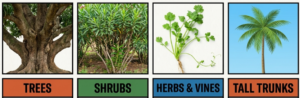
Know This: Amazing Banyan Trees
|
Classification Based on Seed Structure (Cotyledons) :
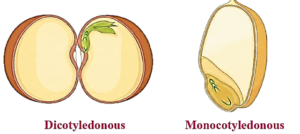
Seeds of plants are categorized based on whether they divide naturally into two equal parts when soaked and peeled:
Dicotyledonous Plants (द्विदल वनस्पती):
- Seeds possess two equal independent parts (cotyledons).
- Examples: Chickpeas (Chana), Peas, Groundnut, Mustard, Moong, Mango, Banyan, and Holy Basil.
Monocotyledonous Plants (एकदल वनस्पती):
- Seeds possess only one single cotyledon and do not split into two equal parts.
- Examples: Wheat, Rice, Jowar, Bajra, Corn, Sugarcane, and Banana.
Diversity in Leaves :
Leaves of different plants differ in size, shape, edges (margins), thickness/stiffness, the pattern of veins, and length of the leaf stalk (petiole). This variation is itself an example of diversity.
Venation — the arrangement of veins in a leaf :
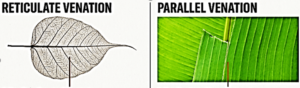
The pattern formed by veins in a leaf is called venation, and it is of two types:
| Type of Venation | Description | Examples | Tearing Behaviour |
| Reticulate Venation | Veins form a complex, net-like (web-like) network across the leaf. | Peepal, Mango, Banyan (dicot leaves) | Leaf does NOT tear in a straight line — tears unevenly because the net of veins resists a straight tear. |
| Parallel Venation | Veins run parallel to each other, like the ruled lines of a notebook page. | Banana, Canna (kardali), Sugarcane, Wheat, Jowar (monocot leaves) | Leaf tears easily and evenly along a straight line, parallel to the veins. |
Diversity in Flowers, Fruits and Seeds :
- Flowering habit: some plants never bear flowers; some bloom only in specific seasons; others flower throughout the year.
- Flowers differ in shape, colour, number of petals, fragrance and arrangement on the stem.
- Fruits are formed from flowers and contain the seeds of the plant. Fruits differ in shape, colour, taste, the thickness of the peel (skin) and the number of seeds they contain — e.g., mango, jamun and bor have very few/single seeds, while orange, lemon and jackfruit contain many seeds.
Roots — Tap Root and Fibrous Root :
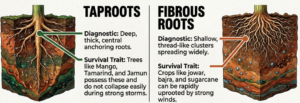
Roots normally grow underground and anchor the plant in soil, but their type can be inferred from how easily a plant is uprooted.
| Root Type | Structure | Support | Examples |
| Tap Root | One main (primary) root grows from the base of the stem, with thinner secondary roots branching off it. | Provides firm anchorage — such plants do not uproot easily. | Mango, Tamarind, Jamun, Roselle (ambadi), Okra (bhendi), Brinjal |
| Fibrous Root | A bunch of thread-like roots grows from the base of the stem; no single main root. | Weaker anchorage — such plants can be pulled out with slight force; badly damaged in storms. | Grass, Sugarcane, Jowar, Bajra, Coconut (monocots) |
Functions of Roots:
- Roots anchor the plant firmly in soil and absorb moisture and minerals via fine thread-like root hairs.
- In certain plants (e.g., Carrot, Radish, Beetroot), roots are modified to store food.
Modified Stems:
- Sprouts growing from buds on tubers like potatoes are stem modifications.
Habitat :
| 📖 Definition : Habitat is the environment that is convenient and favourable for an organism's growth and survival. |
- Habitat of the lotus plant → aquatic (water).
- Habitat of acacia and cactus → arid (very little water / desert regions).
- Desert plants and animals cannot survive in snowy regions, and vice versa.
A habitat is influenced by several factors: soil type, temperature, the duration of sunlight available during the day, and the other living organisms present in the vicinity.
Interconnection Between Leaf Venation, Root Systems, and Cotyledons :
A fundamental rule of plant morphology connects seed types directly with leaf venation and root systems:
| Feature | Monocotyledonous Plants (Monocots) | Dicotyledonous Plants (Dicots) |
| Cotyledons in Seed | Single cotyledon (1 part) | Two equal cotyledons (2 parts) |
| Leaf Venation Pattern | Parallel Venation (Veins run parallel like ruled lines) |
Reticulate Venation (Complex net-like network of veins) |
| Root System Type | Fibrous Roots (Thread-like bunch from base of stem) |
Taproot System (Main primary root with secondary branches) |
Diversity in Animals (प्राण्यांमधील विविधता) :
- Animals exhibit vast diversity in body structure, limb count, movement modes, and habitats.
- All organisms including microscopic water microbes, insects, birds, reptiles, and quadrupeds fall under the animal group.
Classification of Animals Based on Habitat :
| Group | Meaning | Key Feature | Examples |
| Terrestrial (Bhuchar) | 'Bhu' = land, 'Char' = one who moves | Animals that live on land; move by walking, running or jumping. Includes burrow-dwellers. | Tiger, goat, fox, wolf, mice, bandicoots, shrews, rabbits |
| Aquatic | Live in water | Spend their entire life in water; swim using fins and tail; take dissolved oxygen through gills; cannot breathe air directly. | Fish |
| Amphibians | Live on both land and water | Spend one stage of life entirely in water; can live on land too; must surface periodically to breathe air. | Frog |
| Aerial | Spend time flying / on trees | Adapted for flight or life in trees. | Birds |
Ancient Classification by Maharshi Charak (Charak Samhita) :
In ancient India, Maharshi Charak presented a comprehensive scientific classification of animals in Charak Samhita based on detailed observations of their habitats and living behaviors:
| Category (Marathi/Sanskrit) | Habitat / Lifestyle Meaning | Examples |
| Bilashaya (बीलशय) | Living in underground burrows/holes | Mice, Bandicoots, Shrews, Rabbits, Snakes |
| Dhanvachara (धन्वाचर) | Living on dry lands / desert regions | Horse, Camels |
| Aanup (आनुप) | Living in muddy wetlands / marshes | Wild Buffalo |
| Shakhad (शाखाद) | Living on branches of trees | Monkeys |
| Varishaya (वारिशय) | Living inside water (Aquatic) | Fish |
| Varichara (वारीचर) | Floating on the surface of water | Swans, Ducks |
| Guhashaya (गुहाशय) | Living in caves | Lions, Tigers, Bats |
| Bhuchar (भूचर) | Moving on land (Terrestrial) | Cows, Goats, Foxes, Wolves, Tigers |
Animal Adaptations to Habitats :
Animals found in a particular region are only those that can adapt to the local conditions, food availability and temperature.
Animals possess specific anatomical adaptations enabling them to survive comfortably in their respective habitats:
Examples :
- Himalayan bears, giraffes, kangaroos and ostriches cannot survive in habitats very different from their own (e.g., local Indian forests).
- Desert → habitat of camels.
- Areas near large water bodies → habitat of crocodiles and alligators.
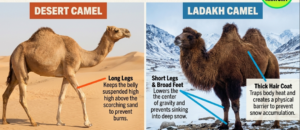
Desert Camels vs. Ladakh Camels:
- Desert camels have long legs to elevate their bodies above blistering hot sand.
- In contrast, camels in snowy Ladakh have shorter legs, broader feet to walk on snow easily, and thick neck/body hair for warmth.
Aquatic Fish Adaptations:
- Fish swim using fins and tails and absorb dissolved oxygen via gills.
- They feature a transparent membrane (nictitating membrane) over their eyes to protect against floating soil particles and decaying leaves in rivers and lakes.
Amphibians (Frog):
- Live in water during initial stages and can survive both on land and in water in adulthood.
- They submerge for long periods and periodically surface to breathe atmospheric oxygen.
We reply to valid query.