Notes
|
Topics to be learn :
|
Objects and Materials :
Everything around us, such as a notebook, a pen, a spoon, and a stone, is made from different materials. These materials include paper, wood, cloth, glass, metal, plastic, and clay.
- Object : An object is anything that we can see and touch. Examples: A table, a chair, a toy, and a bottle.
- Material : A material is the substance used to make an object. For example, a wooden bench is an object, and wood is the material used to make it.
- Matter : Matter is anything that has mass and occupies space. All materials are forms of matter.
Types of Materials :
Materials are mainly of two types based on their source.
- Natural Materials : Natural materials are obtained from nature. Examples: Wood, cotton, wool, water, silk, and sand.
- Man-made (Synthetic) Materials : Man-made materials are made by humans and are not found naturally. Examples: Plastic, nylon, polyester, steel, paper, and paints.
Grouping of Materials :
We can group objects based on their common properties. These properties include shape, colour, hardness, softness, shine, dullness, and the material from which they are made.
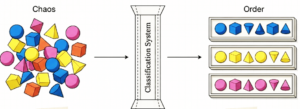
Classification : Classification is the process of arranging objects into groups based on a common property. It helps us identify, compare, and organize objects easily.
- The same object can be made from different materials.
- The same material can be used to make different objects.
Examples:
- A pen may be made of plastic, metal, and ink.
- A tumbler can be made of steel, glass, plastic, or clay.
We choose a material based on its properties and the purpose of the object. Different materials are suitable for different uses.
Importance of Classification : Classification makes our daily work easier by keeping similar things together.
Examples:
- Kitchen utensils are kept together.
- A grocer stores spices, pulses, and grains separately.
- A chemist arranges medicines in an organized way.
Physical Properties of Materials :
Materials are substances used to create objects, and they can be identified and grouped based on various physical characteristics called properties. Choosing the right material for an object depends on these properties and the intended purpose of the object.
The primary properties of materials include:
(i) Appearance (Lustre vs. Non-lustrous) : Materials are often classified by whether or not they have a shiny surface.
- Lustrous: Materials that typically have shiny surfaces are called lustrous. Most metals fall into this category. Examples include iron, copper, zinc, aluminium, and gold.
- Non-lustrous: These materials have a dull surface and do not shine. Examples include paper, wood, rubber, and jute.
(ii) Hardness and Softness : This property is determined by how easily a material can be compressed or scratched.
- Hard: Materials that are difficult to compress or scratch are considered hard. Examples include stones, iron, and bricks.
- Soft: Materials that can be easily compressed or scratched are soft. Examples include erasers, sponges, and pillows.
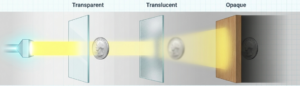
(iii) Transparency : Materials are grouped based on how much light can pass through them, affecting how well we can see through them.
- Transparent: These allow you to see through them clearly. Examples include glass, water, air, and cellophane paper.
- Opaque: These do not allow you to see through them at all. Examples include wood, cardboard, and metals.
- Translucent: These allow you to see through them, but not clearly. Examples include frosted glass and butter paper.
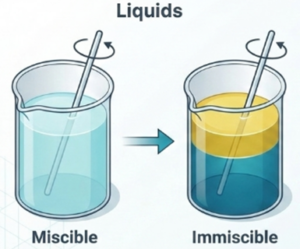
(iv) Solubility in Water : This refers to how a material behaves when mixed with water.
- Soluble: Materials that completely disappear or dissolve when mixed in water are soluble. Examples include sugar, salt, lemon juice, and glucose.
- Insoluble: Materials that do not mix with water and remain visible even after stirring are insoluble. Examples include chalk powder, sand, sawdust, mustard oil, and wheat flour.
(v) Mass, Space and Volume (Defining Matter) : All matter possesses two fundamental properties: mass and volume, which together define them as matter.
- Mass: This is the property used to measure how heavy or light an object is. For example, a cup of pebbles has more mass than an identical cup of water. Mass is measured in units like grams (g) and kilograms (kg).
- Space: The amount of area an object occupies, varying by shape and size.
- Volume: This represents the amount of space an object occupies. For example, water in a 500 mL bottle has a specific volume. Volume is measured in litres (L) and millilitres (mL). SI Unit: Cubic metre (m3).
(vi) Additional Properties :
- Texture: Materials can be felt as being rough or smooth.
- Bounciness: Certain materials are chosen for sports balls based on how high they bounce; for instance, a tennis ball behaves differently than a cricket ball.
The Material Diagnostic Matrix :
| Material | Appearance | Hardness | Transparency | Solubility in Water |
| Glass | Dull | Hard | Transparent | Insoluble |
| Iron Nail | Lustrous | Hard | Opaque | Insoluble |
| Sugar | Dull | Hard (Crystal) | Translucent/ Transparent |
Soluble |
| Wood | Dull | Hard | Opaque | Insoluble |
| Mustard Oil | Dull | Soft/Liquid | Translucent | Immiscible |
What is Matter?
Matter: Anything that occupies space and has mass.
Mass and volume are the two properties possessed by all materials — together they define matter.
- The mass gives the quantity of matter; the volume gives the space it occupies.
- Water, sand, pebbles, a cup, and even air are all examples of matter.
Materials vs. Matter: Materials are types of matter used in the creation or making of objects.
Ayurveda's classification of matter :
Ayurveda describes 20 properties (guṇa — ten pairs of opposites) used to describe all physical matter, living systems, the environment, and food (Aṣhtānga hṛidaya Sūtra sthāna 1.18):
- guru (heavy) ↔ laghu (light);
- manda (slow) ↔ tīkṣhṇa (quick);
- hima (cold) ↔ uṣhṇa (hot);
- snigdha (unctuous) ↔ rukṣha (dry);
- śhlakṣhaṇa (smooth) ↔ khara (rough);
- sāndra (solid) ↔ drava (liquid);
- mṛidu (soft) ↔ kaṭhina (hard);
- sthira (stable) ↔ khāla (moving/unstable);
- sūkṣhma (subtle/small) ↔ sthūla (big/gross);
- viśhada (non-slimy) ↔ picchhila (slimy).
Summary Table: Properties of Materials :
| Property | Categories | Examples |
| Appearance | Lustrous / Non-lustrous | Iron, gold (lustrous); paper, wood (non-lustrous) |
| Hardness | Hard / Soft | Stone, iron (hard); eraser, sponge (soft) |
| Optical nature | Transparent / Translucent / Opaque | Glass (transparent); frosted glass (translucent); wood (opaque) |
| Solubility | Soluble / Insoluble | Sugar, salt (soluble); sand, sawdust (insoluble) |
| Mass | Heavy / Light | Measured in g / kg using a balance |
| Volume | Space occupied | Measured in L / mL; SI unit m³ |
We reply to valid query.