Notes
|
Topics to be learn :
|
Hot or Cold? :
- Humans often rely on touch to judge temperature.
- We know from experience that some bodies are hotter than others — for example, tap water may feel hotter than water from a matka (earthen pot) or a refrigerator. We usually judge this simply by touching the objects.
- The same body feels different to two hands because our sense of touch depends on the temperature our hand was previously exposed to.
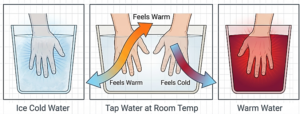
Limitations of Touch
- Sense of touch is relative to the observer's prior state.
- Touch cannot provide a numerical or reliable measure of hotness.
We cannot always rely on our sense of touch to correctly judge whether a body is hot or cold. We need a reliable, unbiased instrument.
Temperature :
Definition : Temperature is defined as the reliable measure of the hotness or coldness of a body,
|
| Definition : Thermometer — a device used to measure temperature. |
Two kinds of thermometers are commonly used:
| Type | Used for |
| Clinical thermometer | Measuring human body temperature |
| Laboratory thermometer | Measuring temperature of substances for many other purposes (water, air, experiments, etc.) |
Measuring Temperature :
(i) Clinical thermometer :
A clinical thermometer is used to measure body temperature.
Digital Thermometers : Modern clinical thermometers are digital — they show the temperature reading on a small screen and run on batteries.
- Scale used: Celsius scale — unit is degree Celsius, denoted °C.
- Digital thermometers determine temperature using heat sensors.
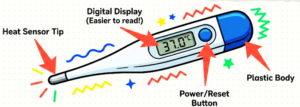
Mercury vs Digital Thermometers :
- Earlier, mercury thermometers were widely used for measuring body temperature.
- Mercury is an extremely toxic substance and is difficult to dispose of safely if the thermometer breaks.
- Digital thermometers pose no such risk, and their display is easier to read.
→ Mercury thermometers are therefore being replaced by digital thermometers.

Non-contact (Infrared) Thermometers :
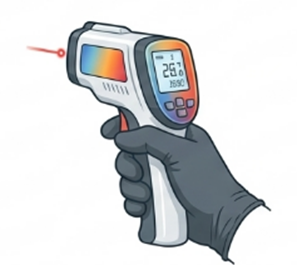
- During the COVID-19 pandemic, special thermometers were used that could measure a person's temperature from a distance, without touching them.
- These are called non-contact thermometers or infrared thermometers.
- They reduce the risk of spreading disease because no physical contact with the person is needed.
Correct Way to Use a Digital Clinical Thermometer :
- Wash your hands and the tip of the thermometer with soap and water.
- Reset the thermometer by pressing the reset button.
- Place the thermometer under the tongue and close your mouth.
- Wait till it beeps or flashes a light.
- Take it out and read the temperature on the digital display.
- Record the temperature.
- Clean the tip again with soap and water, and dry it.
Precautions while Using a Digital Clinical Thermometer :
- Read the instruction manual before use.
- Wash the tip with soap and water before and after use.
- While washing, keep the digital display portion out of water.
- Do NOT hold the thermometer by the tip.
Normal Body Temperature :
The normal temperature of a healthy human body is taken to be 37.0 °C (98.6 °F). However, this is an average — the temperature of every healthy person may not be exactly 37.0 °C.
- 'Normal temperature' = average body temperature of a large number of healthy people.
- A perfectly healthy person may have a normal temperature slightly different from 37.0 °C.
- Body temperature is influenced by age, time of day, and activity level.
- Human body temperature normally does not go below 35 °C or above 42 °C.
- For small children or old people, the thermometer may be placed in the armpit — this reading is about 0.5 °C to 1 °C LOWER than the actual body temperature.
Know This — Detecting Fever Before Thermometers
|
Temperature Scales :
| Scale | Unit | Symbol | Notes |
| Celsius scale | degree Celsius | °C | Commonly used in clinical thermometers |
| Fahrenheit scale | degree Fahrenheit | °F | 37.0 °C = 98.6 °F; rarely used in scientific studies now |
| Kelvin scale | kelvin | K | SI unit of temperature; used in scientific work
Temperature in Kelvin = Temperature in Celsius + 273.15 |
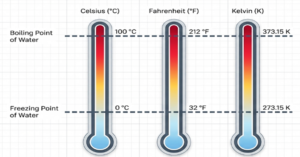
Writing Conventions for Temperature Units :
- Names of scales (Celsius, Fahrenheit, Kelvin) start with a CAPITAL letter.
- 'degree Celsius' and 'degree Fahrenheit' — the word 'degree' starts with a lower-case letter.
- The unit 'kelvin' starts with a lower-case letter (no 'degree' before it).
- Symbols °C, °F, K are always CAPITAL letters. Note: the degree sign (°) is NOT written with K.
- A full stop is not written after the symbol (except at the end of a sentence).
- Leave a space between the number and the unit, e.g., 37.0 °C (not 37.0°C or 37.0 C).
- For temperatures greater than one, use the plural 'degrees' when writing the full form, e.g., '37 degrees Celsius'.
| Know This — Can a clinical thermometer measure boiling water or ice?
No. The temperatures of boiling water and ice lie OUTSIDE the range of a clinical thermometer (which is designed only for the narrow human body-temperature range, roughly 35 °C–42 °C). |
(ii) Laboratory thermometer :
A laboratory thermometer is used to measure temperatures beyond the range of a clinical thermometer — such as boiling water, ice, or air.
Structure of a Laboratory Thermometer
- A long, narrow, uniform, sealed glass tube.
- One end has a bulb containing a liquid (the liquid can be alcohol, coloured red for visibility, or mercury).
- A Celsius scale is marked along the tube.
- The liquid column rises or falls with a change in temperature.
- The mark on the scale where the top of the liquid column stops indicates the temperature reading.
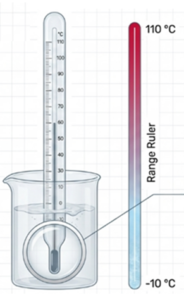
Range: The lowest and highest temperature a thermometer can measure. Example: a common laboratory thermometer has a range of −10 °C to 110 °C.
Least count (smallest readable value): Found using this method —
- Note the temperature difference between two large (numbered) marks, e.g., between 0 °C and 10 °C → 10 °
- Count the number of small divisions between these two large marks, e.g., 10 divisions.
- Least count = \(\frac{\text{Temperature difference}}{\text{number of divisions}}\) = \(\frac{10 °C}{10}\) = 1 °C.
Worked Example :
|
- Different laboratory thermometers may have different ranges and least counts — always examine the thermometer you are about to use.
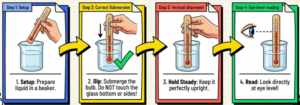
Correct Way of Measuring Temperature with a Laboratory Thermometer :
- Take some warm water in a beaker.
- Dip the thermometer so that the bulb is fully immersed in the water.
- Observe the liquid column rise; wait until it stops rising (don't wait too long, or the water itself starts cooling).
- Read the temperature WHILE the thermometer is still immersed in the water.
Precautions & Correct Technique
- The bulb should NOT touch the bottom or sides of the beaker.
- Hold the thermometer vertically — do not tilt it.
- Read the temperature while the thermometer is still immersed (the liquid column starts falling as soon as it is taken out).
- Keep your eye directly in line with the level of the liquid column while reading.
- Handle with care — it can break if it hits a hard object.
- Do not hold the thermometer by the bulb.
Phase Changes and Temperature Stability :
A critical scientific observation noted is that the temperature of a substance remains constant during a change of state:
- Boiling: The temperature of water remains constant while it is boiling. Water stays at 100°C while boiling, even as heat is continuously added.
- Melting: The temperature of ice remains constant while it is melting. Ice remains at 0°C while melting. The heat energy supplied during these transitions is used to overcome intermolecular forces of attraction rather than raising the temperature.
(iii) Air temperature :
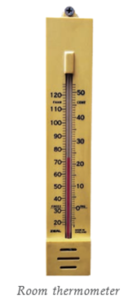
Thermometers hung on walls of school laboratories, doctors' clinics, and hospitals give an approximate idea of room temperature — these are called room thermometers.
Weather reports (in newspapers, TV, or the internet) mention the maximum and minimum air temperature of the day.
- Air temperature is monitored at weather stations across the world and used to prepare weather forecasts.
- Maximum and minimum temperatures usually vary from day to day since weather depends on several factors.
- Generally, temperature rises as summer approaches and falls during winter.
| Know a Scientist —
Anna Mani (1918–2001)
Scottish-Irish physicist, Willlam Thomson aka Lord Kelvin is best known today for inventing the international system of unit of temperature that bears his name, Kelvin.
|
Know This — Extreme Temperatures
|
Available in Notes PDF :
- Glossary — Key Terms
- Memory Aid (Mnemonic)
- Chapter Summary — Key Points
- Exam Preparation Tips
- Practice Questions
We reply to valid query.