Notes
|
Topics to be Learn :
|
Foundations of Credit Instruments & Legal Framework :
Commercial Credit Economy and Historical Context :
- In modern commerce, goods are predominantly sold on credit rather than immediate cash payment.
- When a trade transaction occurs on credit, the seller (creditor) extends credit to the buyer (debtor) based on an implied or expressed promise to pay at a future date.
- However, relying purely on oral promises or unwritten understandings creates severe recovery risks and financial uncertainty for sellers.
Historical Heritage:
- To eliminate credit defaults and provide formal legal recourse, commercial practices evolved to document debts through recognized negotiable instruments.
- In India, credit transactions have an ancient heritage through traditional instruments termed
- Drafted in regional Indian languages such as Marathi, Gujarati, Urdu, and Hindi, Hundies served as vital credit documents enabling inland trade across provinces.
Key traditional varieties of Hundies include:
- Shahjog Hundi: Drawn on a respectable person, payable only after confirming the payee's identity.
- Darshani Hundi: Payable immediately on demand upon presentation ('at sight').
- Muddati / Miadi Hundi: Payable after a specified credit period or tenor ('muddat').
- Namjog Hundi: Payable specifically to the party named in the instrument.
- Dhani-Jog Hundi: Payable to the bearer or holder possessing the instrument.
- Jawabee Hundi: Functions as a remittance instrument where payment is made upon receiving written confirmation.
Commercial Necessity and Strategic Functions of Bills of Exchange :
A Bill of Exchange serves as an indispensable tool in modern trade and industrial financing. The statutory and operational necessity of bills of exchange is summarized below:
- Conclusive Proof of Debt: Provides clear, written legal evidence of a trade debt that stands in a court of law.
- Risk Mitigation: Relieves the seller from the anxiety and financial tension regarding payment recovery.
- Definite Settlement Date: Establishes a fixed, legally binding maturity date, allowing business entities to manage working capital precisely.
- Bank Discounting Facility: Enables immediate liquidity. The holder can discount the bill with a commercial bank before maturity to raise working funds.
- Negotiability & Debt Settlement: Functions as a transferable instrument. A creditor can endorse the bill to a third party to settle their own outstanding liability.
Legal Definition under Negotiable Instruments Act, 1881 :
| KEY DEFINITION & STATUTORY CONCEPT: DEFINITION OF A BILL OF EXCHANGE (SEC. 5, NI ACT 1881) : "An instrument in writing containing an unconditional order signed by the maker, directing a certain person to pay on demand, or on a certain future date, or after a certain period of time, a certain sum of money only to, or to the order of a certain person or to the bearer of the instrument." ― According to the Negotiable Instruments Act, 1881. |
Essential Legal Features & Statutory Prerequisites :
For an instrument to be legally valid and enforceable as a Bill of Exchange, it must fulfill all mandatory statutory features stipulated under law:
- Written Format: The instrument must strictly be in writing. Oral orders or verbal promises carry no legal status as negotiable instruments.
- Statutory Stamping: Must bear proper adhesive or impressed revenue stamps as prescribed under the Indian Stamp Act, 1889, corresponding to the bill's monetary value.
- Date of Execution: Must clearly state the precise date on which the draft is prepared and executed.
- Unconditional Order: The order to pay must be completely unconditional. It cannot be pegged to contingent future events or conditional occurrences.
- Certainty of Sum: The principal amount payable must be definite and specified clearly in both figures and words.
- Specified Parties: The bill must clearly identify and specify the drawer, drawee, and payee.
- Drawer's Signature: Must be signed by the maker (drawer) of the bill.
- Acceptance by Drawee: Must be formally accepted by the drawee (debtor) by writing 'Accepted' across the face along with their signature and date.
- Specified Payment Term: Must explicitly outline the tenor or period after which payment falls due.
Parties, Anatomy & Pro Forma Specimens :
The Three Core Parties to a Bill of Exchange :
Every valid bill of exchange involves three distinct legal roles, though two roles may be combined in a single person:
- Drawer (Maker/Creditor): The seller or creditor who drafts and signs the bill ordering payment. In accounting, the drawer records this instrument as a 'Bills Receivable' (Asset).
- Drawee (Acceptor/Debtor): The debtor on whom the bill is drawn. Upon giving consent by signing 'Accepted', the drawee becomes the 'Acceptor'. In accounting, the drawee records this instrument as a 'Bills Payable' (Liability).
- Payee (Ultimate Beneficiary): The person or entity designated to receive payment. Often, the drawer themselves is the payee. However, if endorsed to a creditor, that third party becomes the payee.
Essential Contents & Pro Forma Structure :
A standard bill of exchange comprises seven vital structural components:
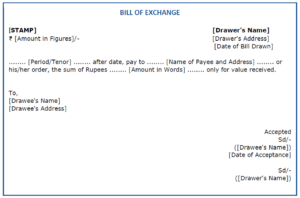
- Date of Bill: Top right-hand corner below drawer's address; establishes the baseline for maturity calculation.
- Tenor / Term: Stated in months or days (e.g., 60 days, 3 months).
- Amount: Stated in figures inside a bordered box (top left) and written fully in words within the text body.
- Revenue Stamp: Revenue stamp affixed at the top left as per Stamp Act requirements.
- Names & Addresses: Full legal names and postal addresses of Drawer, Drawee, and Payee.
- Consideration Clause: Mandatory legal phrase confirming consideration ('for value received').
- Formal Acceptance: Drawee's signature across the bill with the word 'Accepted' and date of acceptance.
Pro Forma Specimen 1: Standard Format of a Bill of Exchange :
Below is the formal legal layout of a Bill of Exchange as prescribed in commercial accountancy:
Types of Acceptance: General vs. Qualified
Draft vs. Bill: A bill before acceptance is termed a
Draft. It becomes a legally binding Bill of Exchange only when accepted by the drawee. Acceptance falls into two legal categories:
- General Acceptance (Unconditional): When the drawee accepts the bill exactly as drawn without introducing any changes, variations, or conditions.
- Qualified Acceptance (Conditional): When the drawee accepts the bill subject to modifications regarding time, place, amount, parties, or conditions.
There are five distinct forms of Qualified Acceptance recognized under negotiable instruments law:
- (a) Qualified as to Time: Drawee modifies the payment period (e.g., bill drawn for 60 days accepted for 90 days).
- (b) Qualified as to Place: Drawee specifies payment at a particular location only (e.g., 'payable only at SBI Bank, Mulund Branch').
- (c) Qualified as to Amount: Drawee accepts for a smaller sum than drawn (e.g., bill drawn for ₹ 50,000 accepted for ₹ 35,000).
- (d) Qualified as to Parties: Drawee modifies payee or adds parties.
- (e) Qualified as to Condition: Drawee attaches a conditional clause (e.g., 'accepted payable on delivery of goods').
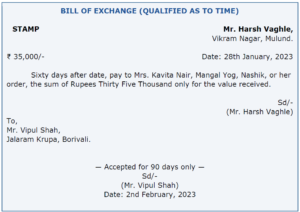
Illustrative Worked Example 1: Specimen of Qualified Acceptance :
Problem Statement: Prepare a specimen of a Bill of Exchange from the following details provided in the source digest:
- Drawer: Harsh Vaghle, Vikram Nagar, Mulund.
- Drawee: Vipul Shah, Jalaram Krupa, Borivali.
- Payee: Kavita Nair, Mangal Yog, Nashik.
- Amount & Drawn Period: ₹ 35,000 |
Period: 60 days | Date of Bill: 28th January 2023 | Date of Acceptance: 2nd February 2023.
Special Condition: Accepted for 90 days only (Qualified as to Time).
Specimens for practice :
Learn the wording — the bill wording changes with the type of bill. Study how each variant differs from the basic bill.
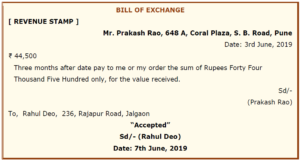
(i) After-date bill, general acceptance (Illustration 1)
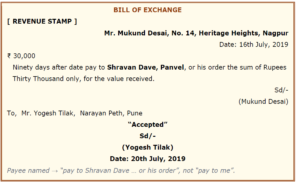
(ii) After-date bill with a third-party Payee (Illustration 2)
(iii) After-sight bill (Illustration 3)
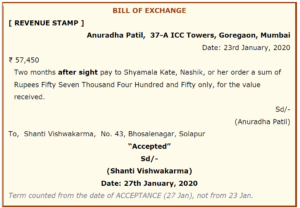
(iv) Qualified acceptance as to AMOUNT (Illustration 4)
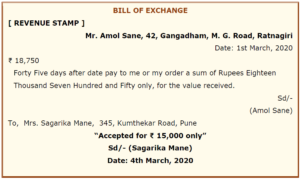
(v) Qualified acceptance as to TIME (Illustration 5)
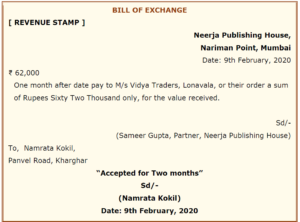
(vi) Demand bill (Illustration 6)
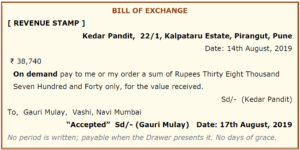
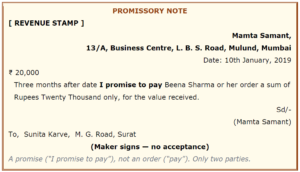
(vii) Promissory note
| EXAM REMINDER Marks-winning checklist for drawing a bill
✔ Stamp ✔ Date ✔ Drawer’s name & address ✔ Term + “after date/sight/demand” ✔ Payee (or “me or my order”) ✔ Amount in figures and words ✔ “For value received” ✔ Drawer’s signature ✔ Drawee’s name & address ✔ “Accepted”, signature & date of acceptance |
Important Terms, Types of Bills and Due Date :
Important terms :
| Term | Meaning |
| Term / Tenor / Tenure | Period after which the bill becomes payable (months or days). |
| Draft | A bill before acceptance. |
| Days of grace | Three extra days allowed by law over and above the term, so the Drawee can arrange payment. Not allowed for bills payable on demand or at sight. |
| Date of maturity / Due date | The date on which the bill falls due for payment. |
| Nominal due date | Date calculated without adding days of grace. |
| Legal due date | Nominal due date + 3 days of grace. |
| Holder | Person in possession of the bill and entitled in his own right to receive the amount. |
| Holder in due course | One who obtains the instrument (i) for valuable consideration, (ii) in good faith and (iii) before maturity. |
| Endorsement / Endorser / Endorsee | Writing on the back of the bill with signature to transfer title. Transferor = endorser; transferee = endorsee. |
Types of bills :
| Type | Description | Grace days? | |
| By Purpose | Trade bill | Drawn and accepted for a genuine trade transaction, with valuable consideration | — |
| By Purpose | Accommodation bill | Drawn and accepted without consideration, to oblige friends / for mutual financial help | — |
| By Place | Inland bill | Drawn and payable in the same country | — |
| By Place | Foreign bill | Drawn in one country and payable in another (e.g. drawn in India, payable in Australia) | — |
| By Time | After date bill | Payable at a fixed period; term counted from date of drawing | Yes (3) |
| By Time | After sight bill | Term counted from date of acceptance | Yes (3) |
| By Time | Demand / at-sight bill | Payable immediately on presentation; no period mentioned | No |
Calculating the due date :

Rules of due date :
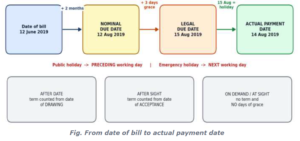
Step 1 : Find the starting date: After date → date of drawing; After sight → date of acceptance.
Step 2 : Add the term: months → move the calendar forward the same day number; days → count the *unexpired days* of the first month, then full months, until the total equals the term.
Step 3 : Add 3 days of grace → legal due date (no grace for demand/sight bills).
Step 4 : If the legal due date is a public holiday → payment on the preceding working day. If it is an emergency holiday → next working day.
| MNEMONIC Holiday rule :
Public holiday → Previous day. Emergency holiday → Ensuing (next) day. Public holidays in examples: 26 January and 15 August. |
Worked examples :
Example 1 : Term in months (after date).
Bill dated 12 June 2019, payable 2 months after date.
| Day | Month | Year | |
| Date of bill | 12 | 6 | 2019 |
| (+) Term | 2 months | ||
| Nominal due date | 12 | 8 | 2019 |
| (+) Days of grace | 3 | ||
| Legal due date | 15 | 8 | 2019 |
15 August is a public holiday (Independence Day) → the bill falls due on the preceding day, 14 August 2019.
Example 2 : term in days (after date).
Bill dated 14 December 2019, payable 90 days after date.
| Month | Days counted | Running total |
| December 2019 (31 − 14) | 17 | 17 |
| January 2020 | 31 | 48 |
| February 2020 (leap year) | 29 | 77 |
| March 2020 | 13 (balance) | 90 |
Nominal due date = 13 March 2020; + 3 days grace → legal due date = 16 March 2020.
Example 3: after sight.
Bill dated 27 December 2019, 2 months after sight, accepted on 31 December 2019.
Count from acceptance: 31 Dec 2019 → 31 Jan 2020 (1 month) → 29 Feb 2020 (2 months; February has only 29 days, so the last day of the month is taken). Nominal due date = 29 Feb 2020; + 3 days = 3 March 2020.
| End-of-month rule : If the month reached has fewer days than the starting day (e.g. 31 Dec + 2 months), take the last day of that month as the nominal due date. |
Example 4 : emergency holiday -
Bill dated 3 July 2019, 90 days after date.
| Month | Days counted | Running total |
| July (31 − 3) | 28 | 28 |
| August | 31 | 59 |
| September | 30 | 89 |
| October | 1 | 90 |
Nominal 1 Oct 2019 + 3 days grace = 4 Oct 2019. That day was declared an emergency holiday → due date is the next working day, 5 Oct 2019.
Quick reference — days in each month
| Jan | Feb | Mar | Apr | May | Jun | Jul | Aug | Sep | Oct | Nov | Dec |
| 31 | 28 / 29 | 31 | 30 | 31 | 30 | 31 | 31 | 30 | 31 | 30 | 31 |
Leap years (Feb = 29): 2016, 2020, 2024 … The same rule applies to the year in the discount formula (365 or 366 days).
Examiner’s favourites :
|
Honour, Dishonour, Noting and Protest :
Honour of a bill :
If the acceptor pays the amount on the due date, the bill is honoured. The holder must present the bill to the acceptor for payment on or before the due date — failing which the acceptor and every endorser are discharged from liability.
Dishonour of a bill :
If the acceptor does not, or is not able to, pay, the bill is dishonoured. On dishonour the acceptor becomes liable to pay the amount plus any legal expenses incurred by the holder.
| Kind of dishonour | Meaning |
| By non-acceptance | The Drawee refuses to accept the bill when it is presented |
| By non-payment | The Drawee accepted but defaults on payment on the due date |
Noting, protest, notary public, noting charges :
| Term | Explanation |
| Noting | Recording of the fact of dishonour by a Notary Public. The holder takes the bill to the notary, who formally demands acceptance/payment from the Drawee and, on refusal, notes the fact, date and reason on the bill. It must be done within a reasonable time after dishonour. It provides the authenticated proof needed to sue the Drawee. |
| Protest | A formal certificate issued by the Notary Public, based on noting, attesting the fact of dishonour. |
| Notary Public | A legal practitioner or public servant appointed by the Central or State Government under Section 3 of the Notaries Act, 1952; empowered to attest foreign documents and to note and protest dishonoured bills and notes. |
| Noting charges | Fees charged by the Notary Public. Paid by the holder, then recovered from the person from whom the bill was received, and finally borne by the Drawee / acceptor. |
| MNEMONIC Noting charges
Holder pays, Drawee bears. Book entry: the Drawee’s account is debited with bill amount + noting charges. |
| EXAM REMINDER Sequence to remember
Dishonour → Noting (notary records the fact) → Protest (notary’s certificate) → suit against the Drawee. Do not reverse noting and protest. |
Classification for accounting :
| Account | Who uses it | Nature |
| Bills Receivable A/c | Person who draws the bill (Drawer / holder) | Asset |
| Bills Payable A/c | Person who accepts the bill (Drawee) | Liability |
Books of original entry for bills :
- Bills Receivable Book — columns: No. of bill · Date received · Date of bill · From whom received · Drawer · Acceptor · Where payable · Term · Due date · Ledger folio · Amount (₹) · Cash Book folio · Remarks.
- Bills Payable Book — columns: No. of bill · Date of bill · To whom given · Drawer · Payee · Where payable · Term · Due date · Ledger folio · Amount paid (₹) · Date · Cash Book folio · Remarks.
Accounting Treatment — Overview and the Retained Bill :
Four ways the Drawer can use a bill receivable :
| The golden rule of dishonor :
· When a bill is dishonoured, the Drawee’s account is always debited (his debt revives). · The account credited shows where the bill was at that moment: |
| If the Drawer had… | Dishonour: Drawee’s A/c Dr, To … | Honour: Dr … |
| Retained the bill | Bills Receivable A/c (+ Cash A/c if he pays noting charges) | Cash / Bank A/c |
| Discounted it with the bank | Bank A/c (bill + noting charges paid by bank) | No entry (cash already received) |
| Endorsed it to a creditor | Endorsee’s A/c (bill + noting charges paid by endorsee) | No entry (debt already settled) |
| Sent it for collection | Bill sent for collection A/c (+ Bank A/c for noting charges) | Bank A/c (+ Bank Charges A/c) |
| MNEMONIC RDEC — “Real Dogs Eat Carrots”
Retained → Receivable A/c · Discounted → Bank A/c · Endorsed → Endorsee’s A/c · Collection → Collection A/c. (The account that is credited on dishonour.) |
Retaining the bill till the due date :
The Drawer keeps the bill and presents it to the Drawee on the due date; the Drawee honours or dishonours it.
Entries — Drawer / Drawee :
| Transaction | Books of Drawer | Books of Drawee |
| 1 Goods sold on credit | Debtor’s A/c Dr
To Sales A/c |
Purchases A/c Dr
To Creditor’s A/c |
| 2 Bill drawn & acceptance received | Bills Receivable A/c Dr
To Drawee’s A/c |
Drawer’s A/c Dr
To Bills Payable A/c |
| 3 Honoured on due date | Cash/Bank A/c Dr
To Bills Receivable A/c |
Bills Payable A/c Dr
To Cash/Bank A/c |
| 4 Dishonoured on due date | Drawee’s A/c Dr
To Bills Receivable A/c |
Bills Payable A/c Dr
To Drawer’s A/c |
| 5 Dishonoured; noting charges paid by Drawer | Drawee’s A/c Dr
To Bills Receivable A/c To Cash A/c |
Bills Payable A/c Dr
Noting Charges A/c Dr To Drawer’s A/c |
When a retained bill is dishonoured, it is the Drawer’s duty to prove presentation to the Drawee. The Drawer pays the noting charges, which are ultimately recovered from the Drawee.
Discounting a Bill with the Bank :
A bill runs for a fixed term but the Drawer may need cash before the due date. He can discount the bill with his bank: the bank pays the present value (bill amount minus discount) immediately and collects the full amount from the Drawee on the due date. Discount is an expense (loss) for the Drawer.
Calculating the discount :
Discount formula :
Discount = Amount of bill × \(\frac{Rate}{100}\) × Unexpired period
Unexpired period = \(\frac{months}{12}OR\frac{days}{365}\) or (use 366 in a leap year, e.g. 2020).
The period is counted from the date of discounting to the due date (the textbook does not include the days of grace).
Discount is charged only for the UNEXPIRED period
Case (i): discounted on 1 Apr -> unexpired = 4 months -> Discount = Rs. 500
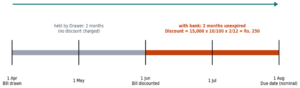
Fig. Only the unexpired period attracts discount
| Problem | Working | Discount |
| Bill ₹ 15,000, 1 Apr 2019, 4 months, 10% p.a. — discounted on 1 Apr | 15,000 × \(\frac{10}{100}×\frac{4}{12}\) | ₹ 500 |
| Same bill discounted on 1 June | 15,000 × \(\frac{10}{100}×\frac{2}{12}\) | ₹ 250 |
| Bill ₹ 21,900, 15 May 2019, 60 days, 8% — discounted same day | 21,900 × \(\frac{8}{100}×\frac{60}{365}\) | ₹ 288 |
| Bill ₹ 25,620, 1 Mar 2020, 90 days, 10% — discounted same day (leap year) | 25,620 × \(\frac{10}{100}×\frac{90}{366}\) | ₹ 630 |
Entries :
| Transaction | Books of Drawer | Books of Drawee |
| 1 Drawer discounts bill | Bank A/c Dr
Discount A/c Dr To Bills Receivable A/c |
No entry — Drawee is not a party to discounting |
| 2 Honoured on due date | No entry — cash already received | Bills Payable A/c Dr
To Cash/Bank A/c |
| 3 Dishonoured | Drawee’s A/c Dr
To Bank A/c |
Bills Payable A/c Dr
To Drawer’s A/c |
| 4 Dishonoured; noting charges paid by bank | Drawee’s A/c Dr (bill + noting)
To Bank A/c |
Bills Payable A/c Dr
Noting Charges A/c Dr To Drawer’s A/c |
| NOTE Bill broker (additional information) : A bill broker is a discount house — a firm that buys and sells bills of exchange for a fee. |
| EXAM REMINDER Watch out
Discounting entry has three accounts: Bank Dr + Discount Dr = Bills Receivable Cr. Bank = bill amount − discount. Discounting charges are an expense — never credit them. |
Endorsement of a Bill :
A bill is a negotiable instrument, so the holder can transfer it to his own creditor to settle a debt. Endorsement means writing on the back of the bill and signing it. The holder who transfers is the endorser; the person receiving it is the endorsee (who can endorse it further until the due date).
Fig. Endorsing a bill to a creditor :
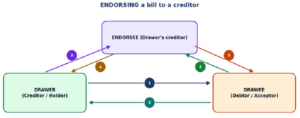
1. Drawer draws the bill on Drawee 2. Drawee accepts & returns the bill 3. Drawer endorses the bill to his creditor 4. Debt to the creditor is settled 5. Endorsee presents bill on due date 6. Drawee pays the Endorsee
Entries in the books of Drawer (endorser), Drawee and Endorsee :
| Transaction | Drawer / Endorser | Drawee | Endorsee |
| 1 Bill endorsed | Endorsee’s A/c Dr
To Bills Receivable A/c |
No entry | Bills Receivable A/c Dr
To Endorser’s A/c |
| 2 Honoured | No entry | Bills Payable A/c Dr
To Cash/Bank A/c |
Cash/Bank A/c Dr
To Bills Receivable A/c |
| 3 Dishonoured | Drawee’s A/c Dr
To Endorsee’s A/c |
Bills Payable A/c Dr
To Drawer’s A/c |
Endorser’s A/c Dr
To Bills Receivable A/c |
| 4 Dishonoured; noting by endorsee | Drawee’s A/c Dr (bill + noting)
To Endorsee’s A/c |
Bills Payable A/c Dr
Noting Charges A/c Dr To Drawer’s A/c |
Endorser’s A/c Dr
To Bills Receivable A/c To Cash A/c |
Bill Sent to the Bank for Collection :
A business with many bills cannot keep track of all due dates. The Drawer therefore sends the bill to his bank, which collects the amount on the due date and charges a fee called bank charges. The Drawer opens a temporary account — “Bill sent for collection A/c” — which is closed on the due date. Bank charges are an expense of the Drawer.
| Transaction | Books of Drawer | Books of Drawee |
| 1 Bill sent to bank | Bill sent for collection A/c Dr
To Bills Receivable A/c |
No entry |
| 2 Honoured; bank charges debited | Bank A/c Dr
Bank Charges A/c Dr To Bill sent for collection A/c |
Bills Payable A/c Dr
To Cash/Bank A/c |
| 3 Dishonoured | Drawee’s A/c Dr
To Bill sent for collection A/c |
Bills Payable A/c Dr
To Drawer’s A/c |
| 4 Dishonoured; noting charges paid | Drawee’s A/c Dr
To Bill sent for collection A/c To Bank A/c |
Bills Payable A/c Dr
Noting Charges A/c Dr To Drawer’s A/c |
Renewal of a Bill :
Renewal : Cancellation of a bill on maturity in return for a new bill for an extended period of credit.
- When the acceptor doubts he can pay on the due date, he asks the Drawer to cancel the old bill and draw a fresh one. The Drawee gets extra credit time and must pay interest for it.
Entries (main method) :
| Step | Books of Drawer | Books of Drawee |
| 1 Cancel old bill (or dishonour) | Drawee’s A/c Dr
To Bills Receivable A/c or To Bank A/c or To Bill sent for collection A/c or To Endorsee’s A/c |
Bills Payable A/c Dr
To Drawer’s A/c |
| 2 Interest due on balance | Drawee’s A/c Dr
To Interest A/c |
Interest A/c Dr
To Drawer’s A/c |
| 3 Part payment received / paid | Cash/Bank A/c Dr
To Drawee’s A/c |
Drawer’s A/c Dr
To Cash/Bank A/c |
| 4 New bill drawn & accepted | Bills Receivable A/c Dr
To Drawee’s A/c |
Drawer’s A/c Dr
To Bills Payable A/c |
| Which account is credited in step 1?
Retained → Bills Receivable · Discounted → Bank · Sent for collection → Bill sent for collection · Endorsed → Endorsee. In every case the Drawee’s A/c is debited. |
Three ways of settling interest, part payment and new bill :
| Case | Interest | Part payment | New bill |
| (a) | Paid in cash | Optional | For the full amount of the old bill |
| (b) | Included in the part payment | Cash = part payment + interest | For the balance (old bill − part payment) |
| (c) | Added to the new bill | Cash = part payment only | For balance + interest |
Alternate treatment (interest received immediately in cash) :
| Step | Books of Drawer | Books of Drawee |
| Cancellation | Drawee’s A/c Dr
To Bills Receivable A/c (or Bank / Collection / Endorsee) |
Bills Payable A/c Dr
To Drawer’s A/c |
| Part payment + interest in cash | Cash/Bank A/c Dr
To Drawee’s A/c To Interest A/c |
Drawer’s A/c Dr
Interest A/c Dr To Cash/Bank A/c |
| New bill for balance | Bills Receivable A/c Dr
To Drawee’s A/c |
Drawer’s A/c Dr
To Bills Payable A/c |
Retirement of a Bill under Rebate :
Retirement : Paying a bill well before its due date.
The Drawer/holder allows a rebate (discount) for the unexpired period. Rebate is an expense for the Drawer and an income for the Drawee.
| Books of Drawer | Books of Drawee |
| Cash/Bank A/c Dr
Rebate / Discount A/c Dr To Bills Receivable A/c |
Bills Payable A/c Dr
To Cash/Bank A/c To Rebate / Discount A/c |
Example :
A bill of ₹ 6,000 is retired one month before the due date at a rebate of 12% p.a. Rebate = 6,000 × \(\frac{12}{100}×\frac{1}{12}\) = ₹ 60.
Drawer: Bank Dr 5,940, Rebate Dr 60, To Bills Receivable 6,000.
| EXAM REMINDER : Do not confuse
Rebate (early payment by the Drawee) ≠ Discount (Drawer selling the bill to the bank). Both are debited in the Drawer’s books, but rebate is *allowed to the Drawee*, discount is *charged by the bank*. |
Insolvency of the Drawee :
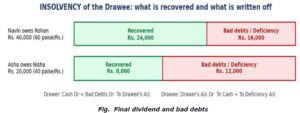
- An insolvent person is one whose liabilities exceed his assets and who cannot pay his debts.
- When the acceptor is declared insolvent by the court, his bills are certain to be dishonoured.
- The Drawer receives a share of the Drawee’s estate — the final dividend (e.g. “60 paise in a rupee”) — and the unrecoverable balance is written off.
| Step | Books of Drawer | Books of Drawee |
| 1 Cancel the bill | Drawee’s A/c Dr
To Bills Receivable A/c (or Bank / Collection / Endorsee) |
Bills Payable A/c Dr
To Drawer’s A/c |
| 2 Final dividend received; balance written off | Cash/Bank A/c Dr
Bad Debts A/c Dr To Drawee’s A/c |
Drawer’s A/c Dr
To Cash/Bank A/c To Deficiency A/c |
| MNEMONIC : Same amount, two names
Unrecoverable amount = Bad Debts in the Drawer’s books = Deficiency in the Drawee’s books. Cash received = paise-in-rupee × amount. |
Example :
Prakash accepted Mayur’s bill of ₹ 21,000 and became insolvent; 25% recovered. Mayur: (1) Prakash’s A/c Dr 21,000 To Bills Receivable 21,000. (2) Bank Dr 5,250, Bad Debts Dr 15,750, To Prakash’s A/c 21,000.
Part B at a glance — Drawer’s entries by mode and outcome :
| Mode | Bill dealt with | Honoured | Dishonoured |
| Retained | Nothing until due date | Cash Dr / To BR | Drawee Dr / To BR |
| Discounted | Bank Dr, Discount Dr / To BR | No entry | Drawee Dr / To Bank |
| Endorsed | Endorsee Dr / To BR | No entry | Drawee Dr / To Endorsee |
| Collection | Collection A/c Dr / To BR | Bank Dr, Bank charges Dr / To Collection A/c | Drawee Dr / To Collection A/c |
| Renewal | — | Cancel → interest → part payment → new bill | (new bill can itself be honoured, dishonoured or retired) |
| Retirement | Cash Dr, Rebate Dr / To BR | — | — |
| Insolvency | Drawee Dr / To (BR/Bank/…) | Cash Dr, Bad Debts Dr / To Drawee | — |
(BR = Bills Receivable A/c. Noting charges paid by someone else are simply added to the amount debited to the Drawee and credited to that person / the bank.)
We reply to valid query.