Notes
|
Topics to be Learn :
|
Introduction :
Plants, unlike animals, do not consume food but instead they produce it themselves through a complex biological process known as photosynthesis. This process occurs primarily in the leaves and requires four critical components: sunlight, water, carbon dioxide, and chlorophyll.
How Do Plants Grow? :
Growth in plants can be seen through physical changes such as:
- The growth of new leaves and branches.
- An increase in the height of the plant.
- The stem becoming thicker.
Unlike animals, plants do not eat other organisms for food. They obtain nutrients by interacting with their surroundings.
Factors Influencing Plant Growth
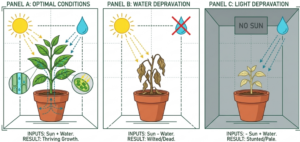
(i) Water :
- Water is essential for the growth and functioning of plant cells.
- Plants cannot survive without water.
- A plant that does not receive water eventually dies.
(ii) Sunlight :
- Sunlight is the main source of energy for plants.
- Plants use sunlight to make their food.
- Plants kept in darkness grow poorly and remain weak compared to plants receiving enough sunlight.
(iii) Soil :
- Soil provides support and helps roots anchor the plant firmly.
- It also supplies water and nutrients needed for growth.
- Healthy soil helps plants grow properly.
(iv) Air: Necessary for gaseous exchange.
How Do Plants Get Food for their Growth? :
Photosynthesis: in a nutshell
Photosynthesis is the process by which plants make their food (glucose) using sunlight, carbon dioxide, and water in the presence of chlorophyll.

Leaves: The Food Factories of Plants
Leaves are the main sites where photosynthesis takes place because of their special structure and composition.
(i) Shape and Structure :
- Most leaves are broad and flat.
- Their large surface area helps them absorb more sunlight and take in carbon dioxide from the air.
(ii) Presence of Chlorophyll :
- Chlorophyll is the green pigment found in leaves.
- It absorbs sunlight and helps in making food.
- Some leaves may appear red, violet, or brown because other pigments hide the green color of chlorophyll.
(iii) Storage of Food as Starch :
- Plants store the food they produce in the form of starch.
- Starch is a type of carbohydrate.
- The presence of starch in a leaf shows that photosynthesis has taken place.
Importance of Photosynthesis :
- It provides food for plants.
- It releases oxygen into the atmosphere.
- It forms the basis of the food chain for most living organisms.
Role of Sunlight and Chlorophyll in Starch Production :
An experiment using variegated leaves (leaves with green and non-green patches) shows that both sunlight and chlorophyll are necessary for starch production.
| Condition | Iodine Test Result |
| Plant kept in sunlight – green patches | Turns blue-black (starch present) |
| Plant kept in sunlight – non-green patches | No colour change (lack of chlorophyll) |
| Plant kept in darkness – green patches | No colour change (no sunlight, no starch) |
| Plant kept in darkness – non-green patches | No colour change |
Conclusion :
- Green patches contain chlorophyll and produce starch when exposed to sunlight.
- Non-green patches do not contain enough chlorophyll, so they do not produce starch.
- Even green patches cannot produce starch in the absence of sunlight.
- Therefore, both chlorophyll and sunlight are essential for the production of starch during photosynthesis.
Role of air in the preparation of food :
An experiment was conducted using a destarched plant. Part of a leaf was placed inside a flask containing caustic soda (sodium hydroxide), which absorbs carbon dioxide from the air.
| Part of Leaf | Carbon Dioxide Available? | Starch Formed? |
| Outside the flask (in air) | Yes | Yes (turns blue-black with iodine) |
| Inside the flask (with caustic soda) | No (CO₂ absorbed by NaOH) | No (no colour change) |
Conclusion :
- The part of the leaf exposed to air received carbon dioxide and produced starch.
- The part inside the flask did not receive carbon dioxide and could not produce starch.
- This shows that carbon dioxide (CO₂) from the air is essential for the production of starch during photosynthesis.
How do leaves exchange gases during photosynthesis? :
Photosynthesis involves the exchange of gases between plants and their surroundings.
- Carbon Dioxide Intake : Plants absorb carbon dioxide (CO₂) from the air. Carbon dioxide is used to make food (glucose) during photosynthesis.
- Oxygen Release : Oxygen is produced as a byproduct of photosynthesis. It is released into the atmosphere by the plant.
- Experiment Showing Oxygen Release : A water plant kept in sunlight releases bubbles of gas. When these bubbles are collected and tested with a glowing or lit matchstick, the flame burns more brightly. This shows that the gas released is oxygen.
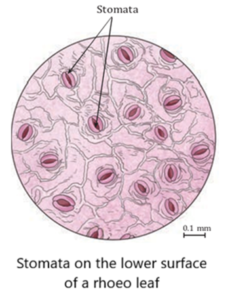
- Mechanism of Gas Exchange : The exchange of carbon dioxide and oxygen mainly takes place through the leaves. Tiny openings on the leaf surface help in this exchange. These openings can be seen under a microscope, especially on the lower surface of the leaf.
Conclusion :
- Plants take in carbon dioxide and release oxygen during photosynthesis.
- This gaseous exchange mainly occurs through tiny openings in the leaves.
Key Components and Structures :
| Component | Function/Description |
| Chlorophyll | A green pigment that captures solar energy. It is found in leaves and other green parts (stems). |
| Leaves | Known as the "food factories" of the plant. Their broad, flat structure maximizes surface area for sunlight capture and gaseous exchange. |
| Stomata | Tiny pores on the leaf surface (primarily the lower surface) that allow for the exchange of CO_2 and O_2. |
| Guard Cells | Specialized cells that surround stomata and control their opening and closing. |
Note on Leaf Color: Some leaves appear red, violet, or brown. This is because they contain higher amounts of other colored pigments that mask the green chlorophyll. However, these leaves still contain chlorophyll and perform photosynthesis.
Transport of water and minerals :
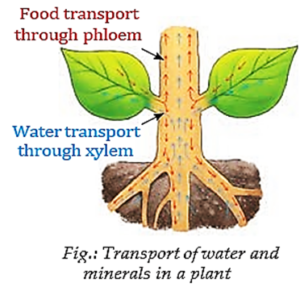
Plants absorb water and minerals from the soil through their roots. The leaves use water and carbon dioxide to prepare food by photosynthesis. The food made in the leaves is then transported to all parts of the plant.
Absorption by Roots : Roots absorb water and minerals from the soil.
- Transport Through Xylem : Water and minerals move from the roots to the stem and leaves through tube-like tissues called xylem. Xylem forms a continuous network connecting the roots, stem, branches, and leaves. Xylem transports water and minerals to all parts of the plant.
Transport of food :
- Food Preparation : Leaves prepare food by photosynthesis.
- Transport Through Phloem : The food produced in the leaves is transported to all parts of the plant through thin tube-like tissues called phloem.
- Food Storage : Some of the transported food may be stored in plant parts such as roots, stems, fruits, and seeds.
Do Plants Respire? :
- All parts of a plant carry out respiration, whether they are green or non-green.
- During respiration, glucose is broken down in the presence of oxygen.
- This process releases carbon dioxide, water, and energy.
Word Equation for Respiration
Glucose + Oxygen → Carbon Dioxide + Water + Energy
Importance of Respiration :
- Respiration releases energy from food.
- This energy is used for the growth and development of the plant.
- It also helps the plant carry out its life processes.
Transport Summary :
- Xylem transports water and minerals from the roots to the rest of the plant.
- Phloem transports food from the leaves to all parts of the plant.
- All plant parts perform respiration to release energy needed for growth and other activities.
We reply to valid query.