Notes
|
Topics to be Learn :
|
Introduction :
- Light is a form of energy that helps us see the world around us. Without light, everything would appear dark and invisible.
- Light is important for many living things. Plants use sunlight to make their food through photosynthesis, and humans need light for vision and daily activities.
- The study of light helps us understand many natural phenomena such as shadows, reflection, and the formation of rainbows. Light plays a vital role in our lives and makes the world bright and beautiful.
Sources of Light :
Light comes from different sources. These sources can be natural or artificial.
Natural Sources of Light : Natural sources of light are found in nature and produce their own light.
Examples:
- The Sun is the main natural source of light on Earth.
- Stars give off their own light.
- Lightning produces light during storms.
- Some living organisms, such as fireflies, also emit light.
Artificial Sources of Light : Artificial sources of light are made by humans.
Examples:
- In ancient times, people used fire for light.
- Fire was produced using fuels such as animal fat, oil, wax, and gas.
- Today, electricity is used for lighting.
- Electric bulbs, tube lights, CFLs, and LEDs are common artificial sources of light.
Luminous and Non-Luminous Objects :
Objects can also be classified according to whether they produce their own light.
Luminous Objects : Luminous objects are objects that emit their own light.
Examples:
- Natural Sources: The Sun (primary source on Earth), stars, lightning, and natural fire. Certain biological entities, such as fireflies and specific deep-sea creatures, also produce light naturally.
- Human-Involved/Artificial Sources: Light bulbs and LED (Light Emitting Diode) lamps.
Non-Luminous Objects : Non-luminous objects do not produce their own light. They can be seen only when light from another source falls on them.
Examples:
- The Moon, A table, A chair, A mirror
Important fact: The Moon is a non-luminous object. It does not emit its own light — it only reflects the sunlight that falls on it.
| LED Lamps :
• LED (Light Emitting Diode) lamps consume much less power, are brighter, and last longer than traditional lamps. • They reduce electricity bills and are better for the environment. • The Indian government has promoted nationwide use of LED lamps. • At the end of their life, LED lamps must be properly disposed of or recycled — not thrown in the garbage. |
Does Light Travel in a Straight Line? :
Light travels from a source in a straight line, visible as a beam of light. This property of light is called rectilinear propagation.
Experimental evidence confirms that light travels in straight lines. Observation of a candle flame through a straight pipe is possible, whereas viewing the same flame through a bent pipe is impossible because the light cannot curve around the bend to reach the eye.
Light through Transparent, Translucent, and Opaque Materials :
Light behaves differently when it passes through various materials. Based on how much light they allow to pass through, materials are classified into transparent,
translucent and opaque.
- Transparent materials: Allow light to pass almost completely through them (e.g., clear glass, water, air). Objects can be seen clearly through them.
- Translucent materials: Allow light to pass through only partially (e.g., tracing paper, frosted glass, thin cloth). Objects appear blurred through them.
- Opaque materials: Do not allow light to pass through at all (e.g., cardboard, wood, metal). Objects cannot be seen through them.
| Material | Classification | Light Behaviour |
| Cardboard | Opaque | Does not pass at all |
| Paper | Translucent (varies with thickness) | Passes partially |
| Glass (clear) | Transparent | Passes almost completely |
| Tracing paper | Translucent | Passes partially |
| Thick cloth | Opaque | Does not pass (or very little) |
Shadow Formation :
When an opaque object is placed in the path of light, since light travels in a straight line, the object blocks the light. The dark patch formed where light does not reach is called a shadow.
Requirements for Shadow Formation :
To form a shadow, three components must be present:
- A source of light.
- An opaque object.
- A screen (e.g., a wall, the ground) on which the shadow forms.
Properties of Shadows :
- Color: Shadows are always black, regardless of the color of the object.
- Detail: They provide a rough idea of an object's shape but do not reveal color or detailed identity.
- Size and Sharpness:
- If the object is moved closer to the light source, the shadow becomes larger and blurrier.
- If the object is moved closer to the screen, the shadow becomes smaller and sharper.
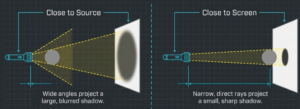
- Positioning: Shadows are always formed on the side opposite to the light source. The length of a shadow changes based on the angle of the light source (e.g., shadows are shortest at noon when the Sun is directly overhead).
- Opaque objects form darker (well-defined) shadows.
- Translucent objects make lighter shadows.
- Even some transparent objects can create faint shadows.
- The shape, size, and sharpness of a shadow depend on the position of the object relative to the light source and the screen.
- Changing the colour of an opaque object does NOT change the colour of its shadow.
- A shadow may or may not give useful information about the actual shape of the object.
| Fascinating Facts: Shadow Puppetry
Shadow play (shadow puppetry) is a centuries-old cultural art form in which flat cut-out figures (shadow puppets) are placed between a light source and a screen. Moving the puppets and light creates life-like movements. Regional styles include:
These traditions are used for entertainment and to communicate important messages to the community. |
Reflection of Light :
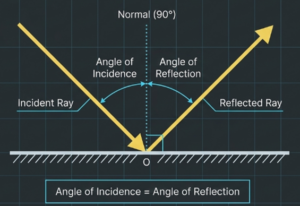
- Reflection of light is the bouncing back of light when it falls on a smooth, shiny surface such as a mirror.
- When light strikes a polished surface, it changes its direction and returns back. This phenomenon is called reflection of light.
Reflection Principles :
- Specular Reflection: Occurs when light reflects in a specific direction from a smooth, shiny surface, allowing for a clear image.
- Angle Correspondence: In reflection, the angle at which light hits the mirror (angle of incidence) is equal to the angle at which it reflects (angle of reflection).
Examples of Reflection
- When light falls on a shiny steel plate or a polished spoon, it bounces back. In such cases, the shiny surface acts like a mirror.
- The surface of calm water can also act as a mirror. This is why we can see the reflection of trees, buildings, and mountains in water.
Images Formed by a Plane Mirror :
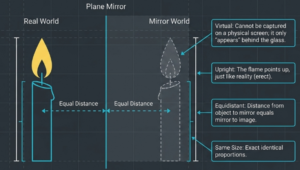
When an object is placed in front of a plane mirror, an image is formed. This image has the following characteristics:
- Virtual Image : The image formed in a plane mirror is a virtual image. It cannot be obtained on a screen and appears to be behind the mirror.
- Upright Image : The image is always upright (erect). It is not upside down.
- Same Size : The image formed is of the same size as the object.
- Laterally Inverted Image : The image is laterally inverted. This means the left and right sides appear reversed.
- The distance of the image from the mirror equals the distance of the object from the mirror.
Example: When you raise your right hand in front of a plane mirror, the image appears to raise its left hand. This reversal of left and right is called lateral inversion.
Pinhole Camera :
- Principle: Based on the rectilinear propagation of light.
- Function: Light rays from an object pass through a tiny hole (pinhole) to form an image on a screen.
- Image Nature: Unlike a plane mirror, a pinhole camera produces a real and inverted (upside down) image.
- Natural Occurrence: Small circular patches of sunlight seen under a tree with many leaves act as natural pinhole images of the Sun, where gaps between leaves function as pinholes.
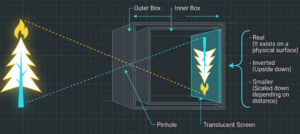
Pinhole Camera vs Mirror Image :
| Feature | Pinhole Camera Image | Plane Mirror Image |
| Orientation (up/down) | Inverted (upside down) | Not inverted — erect |
| Left-right orientation | Not laterally inverted | Laterally inverted |
Making Some Useful Items :
Several devices utilize the principles of straight-line travel and reflection:
Periscope :
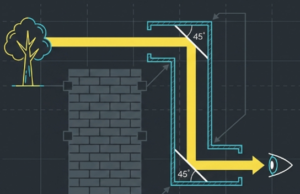
- Purpose: Allows the observer to see objects not in their direct line of sight (e.g., used in submarines, tanks, or looking over walls).
- Construction: Uses a tube with two plane mirrors placed at 45-degree angles to each other. Light reflects off the top mirror to the bottom mirror and then to the viewer's eye.
Kaleidoscope :
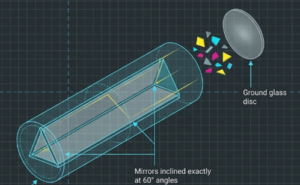
- Purpose: An optical instrument used by designers and artists to generate new patterns.
- Principle: Based on multiple reflections of light.
- Construction: Typically contains three plane mirrors inclined at an angle (usually 60 degrees) to each other inside a tube. Colored glass pieces or beads between glass discs create patterns that never repeat as the tube is rotated.
We reply to valid query.