Solutions (Exercise + Intext)
Intext Questions :
Question 1. What changes can be observed in a plant during its life span? (Page 137)
As a plant grows, it increases in height, its stem thickens, and new leaves and branches emerge.
Question 2. What factors contribute to the growth of plants? (Page 138)
The essential factors for plant growth are sunlight, water, chlorophyll, and carbon dioxide.
Question 3. How do plants obtain the food they need to grow? (Page 140)
Unlike animals, plants do not eat; instead, they prepare their own food (glucose/starch) through a process called photosynthesis using sunlight, water, and carbon dioxide.
Question 4. Why is the leaf decolourised at the beginning of the iodine test activity for photosynthesis? (Page 141)
A leaf is decolourised (by boiling it in alcohol) so that the blue-black colour change indicating the presence of starch can be easily observed.
Question 5. How does sunlight contribute in the production of starch in plants? (Page 141)
Sunlight provides the light energy that chlorophyll captures to prepare starch; without sunlight, plants cannot produce food.
Question 6. Besides sunlight and chlorophyll, which other components are necessary for plants to make their food? (Page 143)
Plants also require water and carbon dioxide.
Question 7. Which gas from the air is essential in the process of food preparation in plants? (Page 143)
Carbon dioxide is the essential gas absorbed from the air for photosynthesis.
Question 8. Do green parts of a plant other than leaves help in making food? (Page 144)
Yes, any other green parts of a plant that contain chlorophyll can also perform photosynthesis.
Question 9. Which part of the plant is involved in the synthesis of starch? (Page 144)
The leaves are the primary site (often called 'food factories'), but other green parts containing chlorophyll are also involved.
Question 10. During the process of photosynthesis, do plants only absorb substances or do they also release something? (Page 144-45)
Plants absorb water and carbon dioxide, and they release oxygen as a byproduct.
Question 11. Which part of the plant helps in the exchange of carbon dioxide and oxygen? (Page 146)
Tiny pores on the surface of leaves called stomata facilitate the exchange of gases.
Question 12. How do water and minerals taken up by the roots move to all parts of the plant? (Page 147)
They move upward through thin, tube-like structures called the xylem.
Question 13. How does food get transported to other parts of a plant? (Page 148)
Food prepared in the leaves is transported to all parts of the plant through thin, tube-like structures called the phloem.
Question 14. Do plants also respire like humans do? (Page 149)
Yes, plants respire by breaking down glucose in the presence of oxygen to release energy, while producing carbon dioxide and water as byproducts.
Let Us Enhance Our Learning : Exercise Questions
Question 1. Complete the following table
| S. No. | Feature | Photosynthesis | Respiration |
| 1. | Raw materials | ||
| 2. | Products | ||
| 3. | Word equation | ||
| 4. | Importance |
| S.No. | Feature | Photosynthesis | Respiration |
| 1. | Raw materials | Carbon dioxide and water in the presence of sunlight and chlorophyll. | Glucose and oxygen., |
| 2. | Products | Glucose (carbohydrates) and oxygen. | Carbon dioxide, water, and energy., |
| 3. | Word equation | Sunlight + Carbon dioxide + Water Glucose + Oxygen. | Glucose + Oxygen → Carbon dioxide + Water + Energy. |
| 4. | Importance | It is the process by which plants synthesise their own food for growth., | It releases energy from food, which plants use for their growth and development., |
Question 2. Imagine a situation where all the organisms that carry out photosynthesis on the earth have disappeared. What would be the impact of this on living organisms?
If all photosynthetic organisms (such as green plants, algae, and photosynthetic bacteria) disappeared from Earth, the impact on living organisms would be severe:
Food production would stop :
- Photosynthetic organisms are the primary producers in food chains.
- Without them, herbivores would have no food, and carnivores would eventually lose their food sources as well.
Oxygen levels would decrease :
- Photosynthesis releases oxygen into the atmosphere.
- Without photosynthetic organisms, oxygen would gradually be used up by respiration and combustion, making it difficult for most living organisms to survive.
Carbon dioxide levels would increase :
- Plants absorb carbon dioxide during photosynthesis.
- Without them, carbon dioxide would accumulate in the atmosphere, contributing to climate imbalance.
Food chains and ecosystems would collapse :
- Most ecosystems depend directly or indirectly on photosynthetic organisms.
- The disappearance of producers would lead to the extinction of many species.
Most life on Earth would eventually die out :
- Animals, including humans, depend on plants for food and oxygen.
- Only a few organisms that do not rely on photosynthesis, such as some deep-sea and chemosynthetic microorganisms, might survive.
Conclusion: Photosynthetic organisms are essential for maintaining food supplies, oxygen levels, and ecological balance. Their disappearance would cause the collapse of most life on Earth.
Question 3. A potato slice shows the presence of starch with iodine solution. Where does the starch in potatoes come from? Where is the food synthesised in the plant, and how does it reach the potato?
Where does the starch in potatoes come from?
The starch present in a potato comes from the food prepared by the green leaves of the potato plant.
Where is the food synthesised in the plant ?
- Food is synthesised in the leaves
- Green leaves prepare food by the process of photosynthesis using sunlight, water, and carbon dioxide.
- The food produced is mainly in the form of glucose (sugar).
how does it reach the potato?
- The glucose made in the leaves is transported to different parts of the plant through the phloem tissue.
- Storage in the potato
- The potato is an underground stem that acts as a storage organ.
- The transported glucose is converted into starch and stored in the potato.
[Short Answer: The starch in potatoes comes from the glucose produced by photosynthesis in the leaves. The food is synthesised in the green leaves and is transported through the phloem to the potato, where it is converted into starch and stored.]
Question 4. Does the broad and flat structure of leaves make plants more efficient for photosynthesis? Justify your answer.
Yes, the broad and flat structure of leaves makes plants more efficient for photosynthesis.
Justification:
- Broad and flat leaves provide a large surface area to absorb more sunlight, which is essential for photosynthesis.
- The large surface allows more carbon dioxide to enter through the stomata and oxygen to exit.
- The flat shape helps expose more leaf area directly to sunlight, increasing the amount of light captured.
- The thin structure of leaves allows carbon dioxide, water, and food to move easily within the leaf.
Conclusion: The broad and flat structure of leaves increases sunlight absorption and facilitates gas exchange, making photosynthesis more efficient.
Question 5. X is broken down using Y to release carbon dioxide, Z, and energy.
X + Y → Carbon dioxide + Z + Energy
X, Y, and Z are three different components of the process.
What do X, Y, and Z stand for?
Glucose + Oxygen → Carbon dioxide + Water + Energy
In this process :
- X stands for Glucose:
- Y stands for Oxygen:
- Z stands for Water:
During respiration, plants break down glucose (X) in the presence of oxygen (Y) to release energy for their growth, while producing carbon dioxide and water (Z) as byproducts
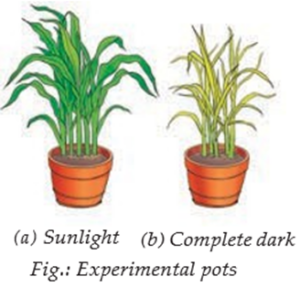
Question 6. Krishna set-up an experiment with two potted plants of same size and placed one of them in sunlight and the other in a dark room, as shown in Fig.
Answer the following questions —
(i) What idea might she be testing through this experiment?
(ii) What are the visible differences in plants in both the conditions?
(iii) According to you, leaves of which plants confirm the iodine test for the presence of starch?
(i) Krishna is likely testing the role of sunlight in the production of food (starch) in plants.
(ii) Visible differences in plants in both the conditions :
- Plant in Sunlight: This plant is likely to appear healthy and green, showing normal growth in height and the emergence of new leaves.
- Plant in Dark Room: This plant will likely show poor growth compared to the one in sunlight. Over time, its leaves may turn yellow or the plant may become weak because it cannot prepare the food (glucose) necessary for its development.
(iii) Only the leaves of the plant kept in sunlight will confirm the presence of starch. When tested with iodine solution, the green parts of these leaves will turn blue-black.
The leaves from the plant kept in the dark will not show this color change, indicating that no starch was produced without exposure to sunlight.
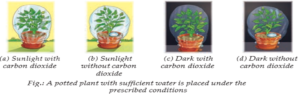
Question 7. Vani believes that ‘carbon dioxide is essential for photosynthesis’. She puts an experimental set-up, as shown in Fig. to collect evidence to support or reject her idea.
Answer the following questions —
(i) In which plant(s) in the above set-up(s) will starch be formed?
(ii) In which plant(s) in the above set-up(s) will starch not be formed?
(iii) In which plant(s) in the above set-up(s) will oxygen be generated?
(iv) In which plant(s) in the above set-up(s) will oxygen not be generated?
(i) Starch will only be formed in Plant (a). For starch to be produced, the plant must undergo photosynthesis, which requires four essential components: sunlight, carbon dioxide, water, and chlorophyll. Plant (a) is the only setup that has all of these requirements.
(ii) Starch will not be formed in Plants (b), (c), and (d).
- Plant (b) lacks carbon dioxide, which is essential for preparing starch.
- Plant (c) lacks sunlight, which provides the energy needed for the process.
- Plant (d) lacks both sunlight and carbon dioxide.
(iii) Oxygen will only be generated in Plant (a). Oxygen is released as a byproduct of the photosynthetic process. Since photosynthesis only occurs when all requirements (including light and carbon dioxide) are met, only Plant (a) will release oxygen.
(iv) Oxygen will not be generated in Plants (b), (c), and (d). Without the necessary conditions for photosynthesis (specifically sunlight for energy and carbon dioxide as a raw material), the chemical reaction that releases oxygen cannot take place.
Question 8. Ananya took four test tubes and filled three-fourth of each test tube with water. She labelled them A, B, C, and D (Fig.). In test tube A, she kept a snail; in test tube B, she kept a water plant; in test tube C, she kept both a snail and a plant. In test tube D, she kept only water. Ananya added a carbon dioxide indicator to all the test tubes. She recorded the initial colour of water and observed if there are any colour changes in the test tubes after 2–3 hours.
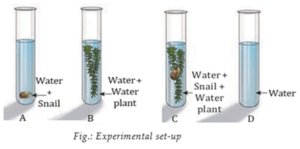
What do you think she wants to find out? How will she know if she is correct?
(i) Ananya wants to find out how plants and animals affect the amount of carbon dioxide in water through the processes of photosynthesis and respiration.
What happens in each test tube?
Test tube A (snail only):
- The snail respires and releases carbon dioxide into the water.
- The carbon dioxide indicator will show an increase in carbon dioxide.
Test tube B (water plant only):
- In the presence of light, the plant uses carbon dioxide for photosynthesis.
- The indicator will show a decrease in carbon dioxide.
Test tube C (snail + plant):
- The snail releases carbon dioxide through respiration.
- The plant uses carbon dioxide for photosynthesis.
- The indicator may show little or no change if the carbon dioxide released by the snail is used by the plant.
Test tube D (water only):
- No living organism is present.
- The indicator should show no change and acts as a control.
(ii) How will she know if she is correct?
- She will compare the colour of the carbon dioxide indicator in the four test tubes after 2–3 hours:
- A colour change indicating more carbon dioxide in test tube A confirms that animals release carbon dioxide during respiration.
- A colour change indicating less carbon dioxide in test tube B confirms that plants use carbon dioxide during photosynthesis.
- Little or no change in test tube C shows that the carbon dioxide released by the snail is being used by the plant.
- No change in test tube D confirms that any changes are due to the living organisms.
Conclusion:
The experiment demonstrates that animals release carbon dioxide during respiration, while plants use carbon dioxide during photosynthesis, helping maintain a balance of gases in nature.
Question 9. Design an experiment to observe if water transportation in plants is quicker in warm or cold conditions.
Experiment Design: Effect of Temperature on Water Transportation
Aim: To observe and compare if water transportation in plants occurs more quickly in warm or cold conditions.
Materials Required:
- Four glass tumblers.
- Water and red ink.
- Four similar twigs of a tender plant with white flowers (e.g., balsam or sadabahar).
- A stopwatch or clock.
- A warm location (like a sunny windowsill) and a cold location (like a refrigerator or a bowl of ice).
Procedure:
- Preparation: Label two tumblers as 'Warm' (A and B) and the other two as 'Cold' (A and B).
- Setup: Fill one-third of each tumbler with water. Add several drops of red ink to tumblers 'Warm B' and 'Cold B'. Keep 'Warm A' and 'Cold A' with plain water as controls.
- Cutting: Obliquely cut the base of the four plant twigs while holding them underwater to prevent air bubbles from entering.
- Placement: Immediately place one twig into each of the four tumblers.
- Environmental Conditions:
- Place the 'Warm' setup in a warm area (e.g., in direct sunlight).
- Place the 'Cold' setup in a cold area (e.g., surrounded by ice cubes).
- Observation: Check the plants every 30 minutes. Look for the first visible signs of red colour appearing in the stem, leaves, or white petals of the flowers.
Observations to Record:
- Record the exact time when the red colour first becomes visible in the 'Warm' twig versus the 'Cold' twig.
- Note which twig shows a deeper or more extensive red colouration after a fixed period (e.g., 3 hours).
Expected Conclusion: By comparing the time taken for the red ink to travel through the xylem, you can determine which temperature condition facilitates faster transportation. Usually, warmer conditions increase the rate of transpiration, which in turn pulls water up through the xylem more quickly than in cold conditions.
Question 10. Photosynthesis and respiration are essential to maintain balance in nature. Discuss.
Photosynthesis and respiration are complementary processes that help maintain the balance of gases in nature.
Photosynthesis :
- Green plants use carbon dioxide and water to prepare food in the presence of sunlight.
- During this process, oxygen is released into the atmosphere.
Respiration :
- Plants, animals, and other living organisms use oxygen to break down food and release energy.
- During respiration, carbon dioxide is released.
How they maintain balance :
- The oxygen released during photosynthesis is used by living organisms for respiration.
- The carbon dioxide released during respiration is used by plants for photosynthesis.
- Thus, these two processes continuously recycle oxygen and carbon dioxide in the environment.
Conclusion :
Photosynthesis and respiration are essential because they maintain the balance of oxygen and carbon dioxide in the atmosphere and support the survival of all living organisms.
We reply to valid query.