Notes
Weather and its Elements :
What is weather? :
- Weather is the condition of the Earth’s air at a particular place and time.
- For example, it can be hot, cold, rainy, or windy.
What is the Atmosphere?
- The atmosphere is the layer of gases that surrounds the Earth.
- These gases together are called air.
- The atmosphere can be compared to a cake with many layers.
The Troposphere (Lowest Layer) :The lowest layer of the atmosphere is called the troposphere. All humans, animals, and plants live in this layer. Almost all weather changes happen here. It extends about 6 to 18 km above the Earth.
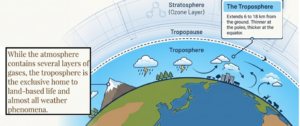
It is:
- Thinner at the poles (because air is cold and shrinks)
- Thicker near the equator (because air is warm and expands)
We use different words to describe weather, such as:
- Hot
- Cold
- Rainy
- Cloudy
- Windy
- Humid
- Snowy
Elements of Weather : These are the main parts that help us understand weather:
- Temperature : It tells how hot or cold the air is.
- Precipitation : It is water that falls from the sky, like rain, snow, or hail.
- Atmospheric Pressure : It is the weight of air pressing on the Earth.
- Wind : It is the movement of air, including its speed and direction.
- Humidity : It is the amount of water vapour (moisture) in the air.
Observing Nature’s clues :
It is difficult to describe weather without proper measurement. So, scientists use standard tools to measure things like temperature, wind, and rainfall.
Traditional Weather Prediction : In old times, people observed nature to predict weather.
Some signs include:
- Birds flying low
- Ants carrying eggs
- Frogs croaking loudly
- Squirrels storing food
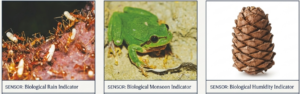
These signs helped people guess rain or storms. Even today, many people in India use these traditional methods.
Modern Weather Forecasting : Today, scientists use advanced tools and instruments to study weather. Experts called meteorologists study these changes.
They can predict weather for:
- A few hours
- A few days
- Even a few weeks ahead
Weather Instruments :
Weather instruments are tools used to measure different elements of weather like temperature, rainfall, wind, etc.
(a) Temperature (Thermometer) :
- Temperature tells how hot or cold the air is.
- It is measured using a thermometer.
- Some thermometers measure current temperature, while others record maximum and minimum temperatures of the day.
- Many thermometers use a coloured liquid that expands when heated.
- Nowadays, digital thermometers are more accurate.
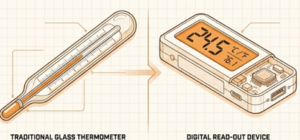
Useful Temperature Data :
- Range of Temperature : Difference between maximum and minimum temperature in a day.
- Mean Daily Temperature : Average temperature of the day.
Formula: Mean = (Maximum + Minimum) ÷ 2
(b) Precipitation (Rain Gauge) :
- Precipitation means water falling from the sky (rain, snow, hail).
- It is measured using a rain gauge.
- Rainwater is collected in a container and measured using a scale.
- Example: If water collected is 5 mm high, it means 5 mm rainfall.
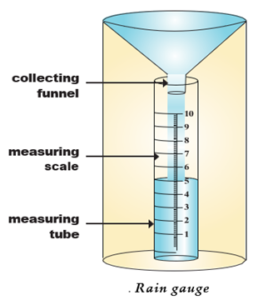
(c) Atmospheric Pressure (Barometer) :
- Atmospheric pressure is the weight of air pressing on Earth.
- It is measured using a barometer.
- Unit used: millibar (mb)
Important Points :
- Normal pressure at sea level is about 1013 mb.
- Pressure below 1000 mb may indicate a storm or cyclone.
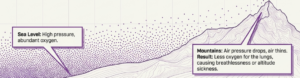
Air pressure: Is higher near sea level. Is lower in mountains
- At high altitudes: Air is thin Less oxygen is available People may feel tired or breathless
(d) Wind (Wind Vane & Anemometer) :
Wind is the movement of air from high pressure to low pressure areas.
Two main things we measure:
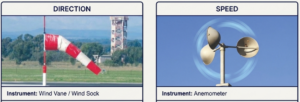
- Direction
- Speed
Instruments Used :
- Wind Vane (Weather Vane) : The direction and speed of wind is measured by wind vane. It has a spinning arm with a pointer on one side and a tail on the other. When the wind blows, the tail moves, and the pointer turns in the direction of wind. It can move even with a gentle breeze.
- Wind Sock : A wind sock is a type of wind vane found on airport tarmacs . It shows wind direction to the pilots during take-off and landing. Similar winds socks are used in factories that release ash or gases.
- Anemometer : Measures wind speed. Has cups that spin faster when wind is strong.
Importance of Wind :
- Helps in weather forecasting
- Useful for pilots and sailors
- Helps farmers predict rain
- Strong wind can dry soil faster
(e) Humidity (Hygrometer) :
Humidity is the amount of water vapour in the air. It is measured using a hygrometer. It depends on factors like temperature, wind, pressure and location.
Relative Humidity : Humidity of the air is measured as relative humidity. Measured in percentage (%)
- 0% → No moisture (not possible in real life)
- 100% → Fully saturated air
Humidity Levels :
- Dry weather: 20% – 40%
- Humid weather: 60% – 80%
Importance of Humidity :
- Important in food industries
- Museums control humidity to protect old items
Weather Stations :
A weather station is a place where different weather instruments are kept together. These instruments measure and record weather conditions regularly. It helps scientists understand changes in weather.
Automated Weather Station (AWS) :
An Automated Weather Station (AWS) is a machine that records weather data automatically. It does not need a person to operate it.
AWS Measures :
- Temperature
- Humidity
- Wind speed and direction
- Rainfall (precipitation)
- Atmospheric pressure
Uses of AWS :
- Agriculture – helps farmers plan crops
- Aviation – helps pilots during flights
- Navigation – useful for ships and travel
- Environment monitoring – studies climate and nature
Example : In 2023, an AWS was set up near a glacial lake in Sikkim at a height of over 4800 metres. It helps give early warnings about weather changes.
Predicting the Weather :
Scientists called meteorologists study weather data collected from AWS. They use scientific methods to predict future weather.
Importance of Weather Prediction :
Helps prepare for extreme weather like:
- Droughts
- Floods
- Cyclones
These events are increasing due to climate change. Early warnings help save lives and property.
The India Meteorological Department (IMD) :
Established in 1875, the IMD is the primary body for weather monitoring in India. Its motto, ādityāt jāyate vriṣhti ("From the sun arises rain"), reflects ancient insights from the Manusmṛiti regarding the cyclical nature of the sun, rain, food, and life.
Modern Meteorology :
Meteorology is the systematic study of weather and its evolution. Meteorologists use precise instruments to monitor elements and predict weather patterns over hours, days, or weeks.
Key Instruments and Units :
| Element | Instrument | Units/Scales |
| Temperature | Thermometer (Ambient, Max/Min, Digital) | Celsius (°C), Fahrenheit (°F) |
| Precipitation | Rain Gauge | Millimeters (mm) |
| Pressure | Barometer | Millibars (mb) |
| Wind Direction | Wind Vane or Wind Sock | Cardinal Directions (N, S, E, W) |
| Wind Speed | Anemometer | Speed units (e.g., km/h) |
We reply to valid query.