Notes
The Big Questions :
Question 1. What is an empire?
- An empire is a group of smaller kingdoms or territories ruled by one powerful emperor or a group of rulers.
- The emperor has supreme power over the entire empire.
- The smaller kingdoms usually keep their own local rulers but accept the authority of the emperor.
- These kingdoms are called tributaries or vassals and pay tribute, such as gold, grain, or livestock, as a sign of loyalty and submission.
- In ancient Sanskrit, an emperor was called Samraj (supreme ruler), Adhiraja (overlord), or Rajadhiraja (king of kings).
- The emperor ruled the empire from a capital city, which was the main centre of administration and trade.
Question 2. How did empires rise and shape Indian civilisation?
Political Unity :
- Empires such as the Maurya Empire united most of the Indian subcontinent under one ruler.
- This reduced wars between smaller kingdoms and brought peace and stability.
Economic Growth :
- Empires developed major trade routes like the Uttarapatha and Dakshinapatha.
- They issued standard coins and encouraged trade.
- Powerful guilds (Shrenis) helped traders and craftsmen grow their businesses.
Good Administration :
- Empires created well-organised systems of government.
- Kautilya's Arthashastra guided rulers in administration, defence, justice, and public welfare.
- Kautilya explained that a strong kingdom should have seven important parts (Saptanga).
Culture and Ethics :
- Emperor Aśhoka promoted Dharma, which means moral values and righteous living.
- He spread messages of peace, kindness, and religious tolerance through rock and pillar edicts.
- His ideas encouraged people to live with honesty, respect, and compassion.
- Rise of Empires
- Powerful empires often developed in resource-rich regions like Magadha, which had fertile land, forests, iron ore, and rivers that supported agriculture, trade, and military strength.
Question 3. What factors facilitated the transition from kingdoms to empires?
Factors that Helped a Kingdom Become an Empire
(1) Natural Resources :
- Access to iron ore helped in making strong weapons and iron ploughs.
- Iron ploughs increased agricultural production, while better weapons strengthened the army.
(2) Economic Strength :
- Surplus food grains supported a large population.
- Some people could work as artisans, craftsmen, and traders.
- Trade and taxes increased the wealth of the kingdom.
(3) Military Power :
- A strong and well-trained army helped rulers conquer and protect territories.
- Horses and elephants were important in battles and made the army more powerful.
(4) Control of Trade and Resources :
- Rulers tried to control rivers, trade routes, and valuable resources.
- This increased trade, tax income, and the overall prosperity of the empire.
(5) Efficient Administration :
- Wise advisors like Kautilya (Chanakya) helped rulers govern large empires.
- A good administration collected taxes, maintained law and order, and ensured the smooth functioning of the empire.
Question 4. What was life like from the 6th to the 2nd century BCE?
Life during the 6th to the 2nd Century BCE
Bustling Cities :
- Cities like Pataliputra were large and well-planned.
- They had wooden walls, watchtowers, and moats for protection.
- Many houses were made of wood and were up to two storeys high.
Economy and Trade :
- Markets were busy and sold goods such as silk, spices, gems, and handicrafts.
- Trade flourished within India and with other countries.
- Traders and craftsmen worked together in guilds (Shrenis).
Rural Life :
- Most people were farmers.
- They usually grew two crops each year because of seasonal rains.
- The government stored food in granaries to help people during famines.
Culture and Society :
- People commonly wore cotton clothes and leather shoes.
- Entertainment included street performers, dancers, and acting groups.
- The teachings of Buddha and Mahavira greatly influenced society.
- Emperor Aśhoka encouraged religious tolerance, peace, and respect for all religions.
Intext/Textbook Exercises :
Let's Explore :
Question 1. Empires extended over vast areas and had diverse people with differing languages, customs and cultures. How do you think the emperors made sure that they lived in harmony? Discuss in groups and share your thoughts with the class. (Page 89)
Ancient Indian emperors, particularly those of the Maurya dynasty, utilized a combination of philosophical, religious, and administrative strategies to maintain harmony among their diverse subjects:
- Ancient Indian emperors maintained harmony by promoting Dharma, which taught truth, moral values, and righteous conduct.
- Emperor Aśhoka spread these ideas through rock and pillar edicts written in Prakrit, the language of the common people.
- He encouraged religious tolerance and asked people of different faiths to respect one another.
- Aśhoka also appointed Officers of Dhamma to promote peace and look after different religious communities.
- Rulers believed that the welfare of the people was the foundation of a strong kingdom.
- They built roads, wells, rest houses, planted trees, and provided medical care for both people and animals.
- Local rulers, guilds (Shrenis), and village councils were allowed to manage their own affairs while remaining loyal to the empire.
- Emperors ensured fair administration by instructing officials to treat people justly and avoid unnecessary punishment.
- They also improved communication, trade, and administration by building roads and introducing standard laws, coins, weights, and measures.
Question 2. Looking at the many challenges involved in managing an empire, why should a king be so keen to expand his kingdom into an empire and become an emperor? (Page 89)
Expanding a kingdom into an empire presented significant challenges, such as the high cost of maintaining a large army and the difficulty of controlling far-off territories that were prone to rebellion. However, there was several compelling reasons why a king would be keen to pursue this expansion:
- Kings wanted to expand their kingdoms to become more powerful and rule over large territories.
- They wished to gain fame and be remembered as great rulers by future generations.
- Expanding the empire gave them control over fertile land, forests, mines, and other valuable resources.
- It also increased their wealth through trade and tax collection.
- A larger empire could maintain a strong army with better weapons, horses, and elephants for protection and conquest.
- Bringing many kingdoms under one ruler helped reduce conflicts between smaller states and promoted peace and stability.
- Local kings continued to rule their regions but accepted the emperor's authority and paid tribute as a sign of loyalty.
- Thus, becoming an emperor brought greater power, wealth, unity, and prestige.
Question 2. Warfare apart, what other methods do you think the rulers might have used to expand their empires? (Page 91)
While warfare was a primary tool for expansion, the ancient Indian rulers used several other sophisticated methods to expand and consolidate their empires:
- Ancient Indian rulers used alliances and peace treaties to strengthen their kingdoms and avoid unnecessary wars.
- They controlled important trade routes, rivers, and resources, which increased trade and tax income.
- Emperor Aśhoka built friendly relations with neighbouring regions by providing medical care and welfare measures.
- He also spread the teachings of Buddha and the message of Dharma through emissaries, increasing India's cultural influence.
- Rulers introduced standard coins, weights, and measures, making trade easier across the empire.
- Local kings were often allowed to continue ruling their own regions after accepting the emperor's authority.
- These rulers remained loyal by paying tribute to the emperor.
- Through diplomacy, trade, good administration, and respect for local rulers, emperors expanded and strengthened their empires without relying only on warfare.
Question 3. Observe the map of the trade routes. Identify geographical features that helped the traders travel across the Subcontinent. (Page 93)
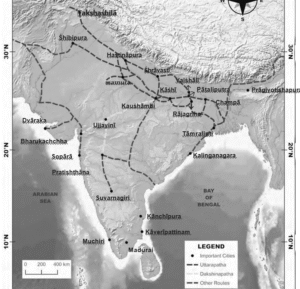
Based on the map of trade routes, several key geographical features facilitated travel and trade across the Subcontinent:
(1) Major River Systems :
- Rivers like the Ganga, Indus, Yamuna, Narmada, and Godavari helped people travel and transport goods.
- They served as natural waterways for trade and communication.
(2) The Northern Plains :
- The Ganga Plains had flat and fertile land.
- This made travel easier and supported the Uttarapatha, an important northern trade route.
(3) Coastal Areas and Seas :
- Port cities such as Tamralipti, Sopara, and Bharukachchha were important centres of sea trade.
- Ships carried Indian goods to many distant countries through the Bay of Bengal and the Arabian Sea.
(4) The Deccan Plateau and Southern Route :
- The Dakshinapatha connected northern India with the Deccan Plateau and southern India.
- It helped in the movement of people, goods, and ideas.
(5) Natural Passes :
- Mountain passes in northwestern India connected the Subcontinent with other regions.
- These routes encouraged trade with Central Asia and the Mediterranean world.
- Communication and Transport
- Kings built and maintained roads, river routes, and ports to improve travel and trade.
- These transport networks helped connect different parts of the empire and supported economic growth.
Question 4. What modes of transport on those roads do you think were available at the time? (Page 93)
In ancient India, people used various modes of transport to travel across the land, for example
- Bullock Carts : These two-wheeled or four-wheeled carts were drawn by oxen and used to carry goods and people.
- Horse-Drawn Carts : It is also known as tangas, these were two-wheeled carts pulled by horses, often used by wealthier individuals.
- Chariots : It is Used in ancient times, these were light, two-wheeled vehicles drawn by horses, primarily for warfare.
- Palanquins : It is also called palkis, these were enclosed carriers carried by people, used by nobles and royalty.
- Elephants : Elephants are employed for heavy transport and ceremonial purposes, especially by kings and nobles.
- Additionally, while not on the roads themselves, river and sea navigation were integral parts of the broader communication network, with goods frequently being moved by boat to major ports for international trade
These modes of transport were essential for trade, communication, and daily life in ancient India.
Question 5.
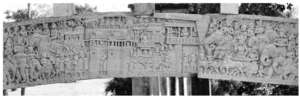
- (i) Take a close look at the panel given above. How many types of weapons can you identify? What different uses of iron can you make out?
- (ii) In the left part of the panel, a parasol (chhattra) is kept over the casket containing the Buddha’s relics. Why do you think this was done? (Page 94)
(i) Identification of Weapons and Uses of Iron :
Types of Weapons in Fig.: In this detailed relief depicting the siege of Kusinārā, several types of weapons and military equipment can be identified:
- Bows and Arrows: Numerous archers are visible, both on foot and on the ramparts, utilizing large bows.
- Swords: Many foot soldiers carry swords, often seen in sheaths at their sides.
- Shields: Soldiers are shown using rectangular or oblong shields for protection.
- Spears or Lances: Riders on elephants and horses appear to be carrying long poles or spears to attack from an elevated position.
Uses of Iron: The availability of iron ore was a major factor in the rise of empires like Magadha, as it transformed technology in two primary ways:
- Warfare: Iron was used to forge "lighter and sharper iron weapons" that significantly strengthened the capabilities of the army.
- Agriculture: Beyond the battlefield, iron was used to create iron ploughs to till the land, which increased agricultural surplus and helped sustain the empire's population and army.
(ii) The Significance of the Parasol (Chhattra)
The parasol (chhattra) kept over the casket containing the Buddha’s relics in the panel is a traditional symbol of high status, royalty, and deep respect.
In ancient Indian culture, the parasol served several symbolic purposes:
- Veneration: It signifies that the contents of the casket—the relics of the Buddha—were considered sacred and worthy of the highest honor, equal to or greater than that of a king.
- Sovereignty: Just as an emperor would have a parasol held over him to denote his "supreme power," the chhattra over the relics indicates the spiritual sovereignty of the Buddha’s teachings (dharma).
- Protection: Symbolically, it offers protection to the sacred object, highlighting its importance during the procession as it is carried away on an elephant.
Question 6. Kautilya says, "A king shall increase his power by promoting the welfare of his people, for power comes from the countryside which is the source of all economic activity. [The king] shall show special favours to those in the countryside who do things which benefit the people, such as building embankments or road bridges, beautifying villages, or helping to protect them."
Why do you think it was important to take special care of the countryside? (Page 103)
Taking special care of the countryside was vital for an ancient Indian king because it served as the literal and metaphorical foundation of an empire's power.
The importance of the countryside can be broken down into several key areas:
(1) Source of Revenue :
- Most people lived in villages and worked in agriculture.
- Farming was the main source of income for the empire.
- Taxes collected from agriculture increased the king's revenue.
(2) Support for the Army and Administration
- The countryside produced surplus food grains.
- This food fed the army, officials, artisans, and traders.
- A strong food supply helped the empire function smoothly.
(3) Rich in Natural Resources
- Villages and nearby forests provided timber, iron ore, and elephants.
- These resources were used to build houses, make tools and weapons, and strengthen the army.
(4) Food Security
- The government built granaries to store food for times of famine.
- Stored grain helped protect people during droughts and other natural disasters.
(5) Welfare and Stability
- Kautilya believed that the land and its people (Janapada) were the foundation of a strong kingdom.
- He taught that a king's happiness depended on the happiness of his people.
- By caring for villages and improving the lives of farmers, rulers gained the loyalty of the people and made the empire stronger.
Question 7. Ashoka, in his edicts, tells the story of the Kalinga war. He could have chosen not to mention it and maintain his image as a peaceful, benevolent king for future generations. Why do you think he admitted to this destructive war? (Page 104)
- Ashoka openly acknowledged the Kalinga War in his edicts to demonstrate his genuine remorse and commitment to peace. He described the immense suffering caused by the war, including the loss of over 100,000 lives and the forced displacement of many more, which deeply affected him.
- By publicly admitting the consequences of his actions, Ashoka aimed to show that he had learned from his mistakes and was dedicated to promoting non-violence and ethical governance.
Question 8. Look carefully at the artefacts presented on the spread on the next page. What conclusions can you draw about people and life during the Mauryan era? (Page 109)
- Artifacts from the Mauryan era reveal a society rich in craftsmanship and cultural values.
- The Lion Capital of Ashoka, with its detailed carvings, symbolises the spread of Buddhism and the importance of dharma.
- Ringstones, intricately designed, suggest religious or decorative purposes.
- The use of burnt bricks and ring wells indicates advanced urban planning and infrastructure.
- These findings reflect a well-organized society that valued art, religion, and efficient living.
Question 9. Notice the different symbols on the coins. Can you guess what any of the symbols in the coins below might mean? (Page 112)
- The chakra symbol on Mauryan punch-marked coins represents the Dharmachakra or 'Wheel of Dharma.'
- This symbol signifies the spread of righteousness and moral law, reflecting Ashoka's commitment to Buddhist principles.
Questions and activities :
Question 1. What are the features of an empire, and how is it different from a kingdom? Explain.
An empire is a large territory made up of many smaller kingdoms or regions ruled by one powerful emperor. The emperor has supreme authority over the entire empire.
Key Features of an Empire
- An empire maintains a large army to protect its borders and control its territories.
- It has a well-organised administration to collect taxes and maintain law and order.
- The government issues currency and controls important resources such as forests, mines, and agricultural land.
Difference Between a Kingdom and an Empire :
- A kingdom is usually a single territory ruled by a king.
- An empire consists of several kingdoms or territories under one emperor.
- Local rulers may continue to govern their regions, but they must accept the emperor's authority.
- These rulers, called tributaries or vassals, pay tribute such as money, gold, grain, or livestock as a sign of loyalty and submission.
Question 2. What are some important factors for the transition from kingdoms to empires?
Several factors facilitated this transition in ancient India:
- Natural Resources: Access to fertile land for agriculture and abundant forests for timber and elephants was crucial.
- Iron Technology: Iron ore from hilly regions allowed for the creation of iron ploughs (increasing food surplus) and sharper, lighter weapons that strengthened the army.
- Economic Power: Brisk trade and a surplus of food grains allowed people to specialize in crafts and arts, boosting the treasury's income.
- Strategic Control: Rulers sought to control rivers and trade networks (like the Uttarapatha and Dakṣhiṇapatha) to secure tax revenue and precious resources.
- Administrative Strategy: The guidance of master strategists, most notably Kauṭilya, helped kings organize and manage vast territories effectively.
Question 3. Alexander is considered an important king in the history of the world —why do you think that is so?
Alexander is considered important because
- He created one of the largest empires in history, spreading across three continents.
- After conquering the Persian Empire, his campaigns reached the northwest of the Indian subcontinent, where he defeated King Porus.
- While his direct political impact in India was limited, his arrival opened the door for significant Indo-Greek cultural contacts.
Question 4. In early Indian history, the Mauryas are considered important. State your reasons.
The Mauryas are significant for several reasons:
- Unification: They created India’s first vast empire, bringing political unity to almost the entire subcontinent.
- Administration: They established a sophisticated system of governance based on Kauṭilya’s Arthaśhāstra, which emphasized the welfare of subjects.
- Economic Growth: They strengthened trade routes, issued standardized coins, and developed well-designed urban centers.
- Cultural Legacy: They promoted art and architecture (such as the Sanchi Stūpa and polished stone pillars) and left a lasting ethical legacy through Aśhoka’s promotion of dharma.
Question 5. What were some of Kauṭilya’s key ideas? Which ones of these can you observe even today in the world around us?
Kauṭilya’s key ideas included the "Saptānga" (seven vital parts of a kingdom), which included the king, ministers, territory (janapada), fortified cities, treasury, army, and allies. He believed the king's primary duty was the welfare of his people, stating, "In the happiness of his subjects lies the king’s happiness".
Modern Observations: Today, we see these ideas reflected in modern nation-states through organized civil services (ministers/officials), the maintenance of a national treasury (taxation and budgeting), the building of public infrastructure (roads and bridges), and the focus on national security (the army).
Question 6. What were the unusual things about Aśhoka and his empire? What of that has continued to influence India and why? Write your opinion in about 250 words.
Aśhoka was a unique ruler of the Maurya Empire. After the Kalinga War, he saw the suffering caused by violence. This changed his life. He gave up war and decided to rule with peace and kindness. He believed in dharma (moral values) and non-violence instead of military conquest.
Aśhoka was also a great communicator. He had his messages engraved on rocks and pillars. He used Prakrit, the language spoken by common people, instead of only Sanskrit. This helped everyone understand his teachings. He encouraged people to be truthful, kind, and respectful towards all religions.
Aśhoka cared for both people and nature. He promoted the protection of forests and animals. He also arranged medical care for both humans and animals.
Aśhoka's ideas continue to influence India even today. The Sarnath Lion Capital is the National Emblem of India. The Ashoka Chakra (Dharmachakra) is at the centre of the Indian National Flag. The national motto "Satyameva Jayate" means "Truth Alone Triumphs." These symbols remind us of Aśhoka's values of truth, peace, religious tolerance, and the welfare of all living beings.
In my opinion, Aśhoka's greatest achievement was showing that a ruler can be strong without being cruel. His message of non-violence, equality, and care for all living beings is timeless. These ideals continue to inspire India because they help build a peaceful, united, and caring society.
Question 7. Thus speaks the Beloved of the Gods, the king Piyadasi: My officers of Dhamma are busy in many matters of public benefit, they are busy among members of all sects, both ascetics and householders. I have appointed some to concern themselves with the Buddhist Order, with brahmans and Ājīvika..., with the Jains..., and with various sects. There are many categories of officers with a variety of duties, but my officers of Dhamma are busy with the affairs of these and other sects.
After reading the above edict of Aśhoka, do you think he was tolerant towards other religious beliefs and schools of thought? Share your opinion in the classroom.
Yes, the evidence strongly suggests he was.
- In his edicts, he explicitly stated that his "officers of Dhamma" were busy among members of all sects, including Buddhists, Brahmans, Ājīvikas, and Jains.
- He claimed to support the wellbeing of all religious groups and encouraged different schools of thought to accept and study each other’s "best teachings".
Question 8. The Brahmi script was a writing system that was widely used in ancient India. Try to learn more about this script, taking help from your teacher wherever required. Create a small project and include what you have learnt about Brahmi.
- The Brahmi script was a widely used writing system in ancient India and is considered the "mother of all regional scripts of India".
- Most of Aśhoka’s edicts were written in this script to ensure his messages were accessible. (Note: For a school project, you could further explore how Brahmi evolved into modern scripts like Devanagari).
Question 9. Suppose you had to travel from Kauśhāmbī to Kāveripattanam in the 3rd century BCE. How would you undertake this journey, and how long would you expect it to take, with reasonable halts on the way?
- The Route: You would likely travel south along the Dakṣhiṇapatha (the southern trade route), passing through major trade hubs like Pratiṣhṭhāna before heading toward the southern coast.
- Mode of Transport: You would likely travel on horseback for speed or by bullock cart if carrying goods.
- Expected Time: Since it took close to two months on horseback just to reach the empire's borders from the capital, a journey from the northern plains to the deep south would likely take several months, including stops at rest houses planted by the state along the main roads.
We reply to valid query.