Solutions (Exercise + Intext)
The Big Questions :
Question 1. Why is the period that followed the Maurya empire sometimes called the ‘Age of Reorganisation’?
The period after the Maurya Empire is sometimes called the ‘Age of Reorganisation’ because the large Mauryan Empire broke into many smaller kingdoms.
- Many new kingdoms and dynasties emerged in different parts of India.
- Former Mauryan territories came under the control of rulers such as the Shungas, Indo-Greeks, Shakas, Kushanas, Cholas, Cheras and Pandyas.
- These kingdoms developed their own systems of administration, trade, art, culture and religion.
- There was also a lot of cultural exchange between different regions and foreign groups.
Thus, the period was called the ‘Age of Reorganisation’ because political powers changed and new kingdoms, cultures and traditions developed across India.
Question 2. What were the values or principles that guided emperors of that period?
The emperors of this period were generally guided by the following values:
- Welfare of the people: They worked for the safety and well-being of their people.
- Respect for different religions: Many rulers respected different religions and schools of thought.
- Justice and good administration: They tried to maintain peace, order and proper administration.
- Cultural development: They supported art, literature, education and architecture.
- Trade and prosperity: They encouraged trade and agriculture to improve the prosperity of their kingdoms.
- Religious tolerance: Rulers such as Kharavela and the Kushanas supported different religious traditions.
Thus, welfare of the people, good governance, religious tolerance and cultural development were important values during this period.
Question 3. How did foreign invaders assimilate into Indian society and contribute to cultural confluence?
Foreign groups such as the Indo-Greeks, Shakas and Kushanas gradually became part of Indian society.
- They adopted Indian customs, languages and religious beliefs.
- They respected and supported different Indian religions and schools of thought.
- They married and interacted with local people, which helped in cultural mixing.
- Their rule brought Greek, Central Asian and Indian traditions together.
- This cultural exchange influenced art, architecture, coins, language, religion and trade.
- The Gandhara School of Art is a good example, as it combined Greek and Indian artistic features.
- Coins showing both Greek and Indian deities also show this cultural confluence.
Thus, foreign invaders gradually became part of Indian society and helped create a rich blend of different cultures and traditions.
Intext/Textbook Exercises :
Let's Remember :
Question 1. While working on the timeline, did you notice the transition from BCE to CE? Remember what you learned in the Grade 6 chapter 'Timeline and Sources of History' about how time is measured in history. (Page 119)
Yes, the transition from BCE to CE is a fundamental part of how history is structured. Based on the sources, here is a breakdown of how time is measured and why this transition matters:
- Measuring Time: History uses a timeline to help us understand the chronological order of events. Years are counted both forward and backward from a central point: the birth of Jesus Christ.
- BCE and CE: The years before the birth of Christ are referred to as BCE (Before Common Era), while the years following are called CE (Common Era). These terms are now preferred over the older BC (Before Christ) and AD (Anno Domini) because they are considered more neutral.
- The Transition: A key detail in this measurement system is that there is no year zero. The year 1 BCE is immediately followed by 1 CE.
- Importance for Historians: This standardized method allows historians to place historical events accurately and compare what was happening in different regions at the same time. For example, the sources note that while the Maurya Empire existed in the 3rd century BCE, the Gupta Empire rose later in the 4th century CE.
This system provides the necessary framework to see the continuous flow of history across the "Age of Reorganisation" and beyond.
Let's Explore :
Question 1. In the previous chapter, you studied the map of the Maurya empire (see page 100). Above is a map of the post-Maurya period. How many kingdoms can you count in the area that were previously under the control of the Maurya empire? (Page 120)
At least 8 kingdoms can count in the area that was previously under the control of the Maurya Empire.
These kingdoms emerged as the large Maurya Empire broke apart into many smaller regional powers. The specific kingdoms identified in the sources include:
- Shaka Kingdom
- Parthian Kingdom
- Kushana Empire
- Satavahana Kingdom
- Indo-Greek Kingdom
- Cheras
- Cholas
- Pandyas
Question 2. Below is a panel from the Bharhut Stupa. Look at the two figures on the right. What are they doing? Can you guess their profession? Notice their attire. What does this tell us about them? List other details that you notice in the panel and discuss your findings in class. (Page 124)
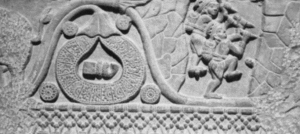
The panel from the Bharhut Stupa provides a glimpse into the artistic and social life of the post-Mauryan period. Here are the findings based on the analysis of that specific relief:
- The two figures on the right appear to be artisans or sculptors who are carving or decorating stone.
- Their simple clothes suggest that they were working-class but highly skilled craftsmen.
- This shows that craftsmen played an important role in building and decorating religious monuments.
- The tree enclosed in a railing at the centre likely represents the Bodhi tree, a symbol of the Buddha.
- The panel shows the high level of artistic skill during the Shunga period and the importance of Buddhist art.
Thus, the Bharhut carvings are among the earliest and most important examples of Buddhist relief art in India.
Question 3. Look closely at the pictures given below in the collage. In a note, write down your observations on the clothes, the jewellery and other objects of daily use. (Page 124)
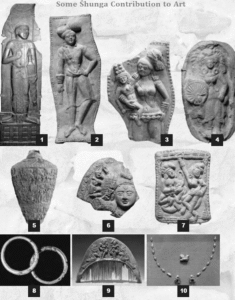
Here is a note on the clothes, jewellery, and daily objects used during this period:
- Cloths : People during this period wore traditional Indian clothes such as dhotis and saris. The style and quality of clothes often showed a person’s social status. Foreign influence can also be seen in the clothes of rulers like Kanishka, who wore long coats, tunics and boots.
- Jewellery : People used gold bangles, earrings and necklaces, while kings and wealthy people wore more elaborate jewellery and crowns.
- Daily-use objects included utensils, tools, vessels and terracotta items, showing the skills of artisans. Books and other educational materials suggest that learning and education were valued.
These clothes, ornaments and objects give us an idea of the social and cultural life of people during the period of reorganisation.
Question 4. What, according to you, could the tradition of using the mother's name at the beginning of a king's name signify? (Page 126)
- Using the mother's name at the beginning of a king's name shows the importance and respect given to royal women.
- This naming tradition reflected a society where royal women held substantial influence, social prestige, and active roles in the kingdom's religious and administrative life.
Question 5. Carefully observe this massive statue (1.85 m high) and notice the clothing, weapon and footwear. What does it tell us about this figure? (Page 136)
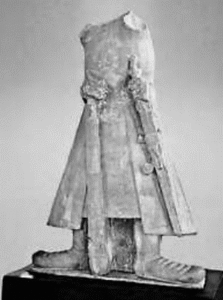
The massive 1.85 m high "headless" statue of King Kaṇiṣhka gives us important information about his origin, power, and status
Here is what these specific features reveal about him:
- He is shown wearing a long coat and sturdy boots, which reflect his Central Asian background.
- He is holding a sword and a mace, showing that he was a powerful warrior and ruler.
- His strong and formal posture also represents his military power.
- The large size of the statue shows his high status and authority.
- The inscription at its base calls him the “king of kings” and “son of God” (devaputra). This shows that Kanishka was a powerful ruler who claimed a special and respected position.
Question 6. Observe the coins carefully. Who, besides the emperor, appears on the coin? (Page 136)
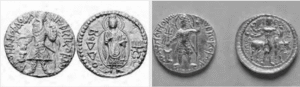
- Besides the emperor, Buddha appears on the inscription in Greek script.
- On another coin, Shiva is featured alongside the bull Nandi.
Think About It :
Question 1.

In the above series of numerals, which ones look somewhat like our modern numerals? Which ones don't? (Page 126)
Numerals that look somewhat similar to modern ones:
- 1 — shown as a short horizontal dash (—). This is quite different from our numeral "1,"
- 2 — shown as two horizontal dashes (=), stacked like a double line. This doesn't closely resemble modern "2," but it follows a logical pattern (one dash = 1, two dashes = 2) which is intuitive.
- 6 — the Brahmi symbol has a looped/curved shape that bears a rough resemblance to our modern "6," especially the curl at the bottom.
- 7 — the symbol also has a similar curved-hook shape that isn't too far off from how we write "7" today.
Numerals that look quite different from modern ones:
- 4 — shown as a cross-like or "+"-shaped symbol, which looks nothing like our modern "4."
- 9 — resembles a curved shape closer to how we might draw a "2," which could actually be a bit confusing when compared to the modern "9."
- 10 — shown with a distinct looping shape, quite different from our two-digit "10"
Even though many symbols don't look exactly like our modern numerals, historians point to this as evidence that modern numerals ultimately originated in India —gradually transformed into the numerals we use today, even though the 2nd century BCE Brahmi versions look quite different at first glance.
(This is an open-ended "Think About It" question, so there's no single fixed answer — it's meant to get you observing and discussing.)
Question 2. This sculpture of a yakṣha from Pitalkhora carries an inscription on its hand, kanhadāsena hiramakarena kāṭa meaning ‘made by Kanahadasa, a goldsmith’. Is it not interesting to see that a goldsmith could also craft a sculpture made of stone? What do you think this tells us about people’s professions at the time? (Page 127)
Kanahadasa, a goldsmith known as a hiramakara, also created a stone Yaksha sculpture during the Satavahana period.
- This shows that artisans could have skills in more than one type of craft.
- The skills used in gold work, such as precision and fine detailing, could also be applied to stone carving.
- It also shows the high level of training and technical skill of artisans during this period.
- Different craft traditions influenced one another and encouraged artisans to experiment with different materials.
- The fact that Kanahadasa’s name was recorded shows that individual craftsmen were valued and recognised.
Thus, his work reflects the importance of artistic skill, creativity and craftsmanship in Satavahana society.
Question 3. Notice the regularity of the rock-cut chambers sculpted nearly two millennia ago. How did artisans achieve such precision with just a chisel and a hammer? Picture yourself as a sculptor in that era, shaping stone into art with your own hands. What tools would you use? (Page 129)
- The rock-cut chambers were made with great skill, patience and careful planning.
- Ancient craftsmen carved large rooms, pillars and beautiful designs directly into solid rock.
- They used a chisel to cut and shape the stone and a hammer to strike the chisel.
- By using these simple tools carefully, they could create smooth surfaces and detailed carvings.
- Their experience helped them achieve great accuracy and precision.
- The skills of craftsmen from different traditions also influenced their work.
Thus, simple tools combined with skill and hard work helped create impressive rock-cut architecture that has survived for centuries.
If I were a sculptor in that era, my primary tools for shaping stone would be:
- Chisel: This would be my main instrument for fine detailing and carving the intricate statues and reliefs seen in the sources.
- Hammer: I would use this to provide the force needed to drive the chisel into the hard rock surface.
Together, these simple tools were used to create notable examples of rock-cut architecture that have endured for centuries.
Question 4. In the map given on next page, you may notice different symbols alongside the names of the kingdoms. What do these symbols represent? Think about how they highlight the unique identities of the kingdoms. (Page 129)
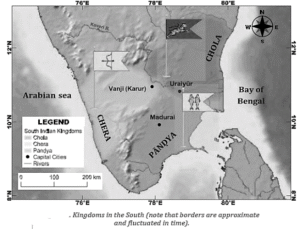
In the map, the symbols alongside the names of the kingdoms represent the unique identities or emblems of each South Indian kingdom
- The Chola kingdom is shown with a tiger symbol, which was their royal emblem and represented power and strength.
- The Chera kingdom has a bow symbol, reflecting their identity and might in warfare.
- The Pandya kingdom is marked with a fish symbol, symbolising their connection to the sea and their coastal location.
These symbols were important because they helped differentiate the kingdoms, represent their cultural and political identity, and were often used on flags, coins and
seals. They also show how kingdoms in ancient India used visual symbols to express authority and unity.
Question 5. Observe the statue of the king. How is he depicted? What do his posture, clothing, and expression say about his power and status? (Page 132)
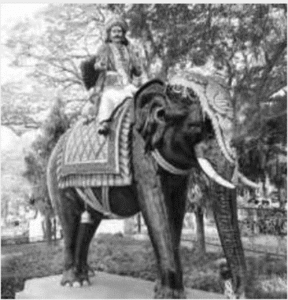
In that depiction, King Karikāla's power and status are conveyed through several key artistic choices:
- Depiction on an Elephant: King Karikāla is shown riding a large, decorated elephant, which represents royal power and military strength. The elephant is beautifully decorated with ornaments, showing the wealth and prosperity of the kingdom.
- Commanding Posture: The king sits upright and confidently, showing his authority and leadership. He holds objects in his hands that may represent weapons or symbols of power.
- Ornate Royal Clothing: His crown, necklaces and armlets show his high status and royal position.
- Stern Expression: His stern expression and prominent moustache make him appear strong and powerful.
Overall, the depiction presents Karikāla as a wealthy, powerful and respected ruler.
Question 6. Have you ever wondered how historians uncover the trade relations between two distant kingdoms many centuries ago? Let's take a moment to brainstorm and discuss how this information comes to light. (Page 133)
- Historians learn about ancient trade through inscriptions, coins, foreign travelers' writings, archaeological finds and remains of ports and goods.
- These sources show what was traded, with whom and how far trade routes extended, helping us understand connections between distant kingdoms.
Question 7. The Pandyas were known for their pearls. Why do you think pearls were an important article of trade during these times? (Page 134)
Pearls were a cornerstone of the Pāndyan economy and an essential trade article for several key reasons:
- Pearls were an important trade item for the Pandyas because they were rare and valuable luxury goods.
- They were used to make beautiful jewellery and ornaments.
- Pearls were highly valued by rich people in India and other countries.
- The Pandyas traded pearls with the Greeks and Romans, earning great wealth. Pearls were also traded within India and were brought from the Pandya kingdom to other regions.
- The Pandya rulers controlled the pearl fisheries along their coast.
- Taxes and tolls on pearl trade provided income to the royal treasury.
Thus, pearls played an important role in the trade and prosperity of the Pandya kingdom.
Question 8. Do you know where Gandhara is? Does it remind you of a character from the epic Mahabharata? (Page 137)
- Gandhara was an ancient region in present-day Pakistan and Afghanistan, known for its unique artistic style.
- In the Mahabharata, it is linked to Gandhari, the princess who married Dhritarashtra and chose to blindfold herself, and Sakuni, her brother and a key strategist.
- The text connects the historical region with its mythological significance.
Questions and activities :
Question 1. Why was the post-Maurya era also known as the era of reorganisation?
- The post-Maurya era was known as the era of reorganisation because the Maurya Empire broke into several smaller kingdoms.
- Many new regional rulers and dynasties emerged in different parts of India.
- The Indo-Greeks, Shakas, Kushanas and Satavahanas became important powers. These rulers reorganised the political structure of the Indian subcontinent.
- New centres of trade, culture and administration developed.
- There was also increased contact between India and other regions through trade and migration.
Thus, this period saw major political, economic and cultural changes, so it is called the era of reorganisation.
Question 2. Write a note on the Sangam literature in 150 words.
- Sangam literature is a collection of ancient Tamil works composed during the Sangam period in South India.
- It provides valuable information about the Pandyas, Cholas and Cheras and the life of people during that time.
- The word Sangam refers to assemblies of Tamil poets and scholars who gathered to compose and discuss literature.
- These works include poems, songs and descriptions of kings, warriors, traders and ordinary people.
- Sangam literature also describes the social, economic and political life of ancient Tamil society.
- It gives information about agriculture, trade, occupations, festivals, customs and religious beliefs.
- Works such as the Ettuthokai (Eight Anthologies) and Pattuppattu (Ten Idylls) are important collections of Sangam literature.
- Tolkappiyam, an ancient Tamil work on grammar and literature, is also associated with this tradition.
- Sangam poems mention maritime trade with foreign countries, including the Romans.
- A famous later epic, Silappadikāram (The Tale of the Anklet), highlights the importance of the ruler's duty (dharma) to protect justice.
Thus, Sangam literature is an important source for understanding the history and culture of ancient South India.
Question 3. Which rulers mentioned in this chapter included their mother’s name in their title, and why did they do so?
The rulers of the Sātavāhana dynasty were known for including their mother’s name in their titles. A prominent example is Gautamīputra Sātakarṇi, whose name literally means "son of Gautamī," referring to his mother, Gautamī Balaśhrī.
They practiced this tradition because:
- Maternal Lineage: In Sātavāhana culture, it was a traditional naming convention for princes.
- Status of Royal Women: It reflected the significant power and influence held by queens. Gautamī Balaśhrī, for example, was a powerful figure who donated land and commissioned major inscriptions.
- Religious Authority: Incorporating a mother's name signified her active role in the kingdom’s life. Another Sātavāhana widow queen is recorded as having performed major Vedic rituals like the aśhvamedha yajña and acting as a major patron for scholars and monks.
Question 4. Write a note of 250 words about one kingdom from this chapter that you find interesting. Explain why you chose it. After presenting your note in class, find out what kingdoms have been the most selected by your classmates.
- The Kuṣhāṇa Empire is particularly interesting because it serves as the ultimate example of the "cultural confluence" that defined this age. Originally from central Asia, the Kuṣhāṇas established a vast empire in the 2nd century CE that stretched from their homelands into large parts of northern India. I chose this kingdom because of its remarkable ability to blend its foreign nomadic roots with local Indian traditions and global trade.
- Under their most famous ruler, King Kaṇiṣhka, the empire became a hub for the Silk Route, connecting India to both the West and East Asia. Kaṇiṣhka’s status as a "king of kings" and "son of God" was balanced by his deep respect for local beliefs. This is evident in his coinage, which featured diverse deities like Buddha and Śhiva, signaling a values system based on peaceful co-existence.
- Furthermore, the Kuṣhāṇas pioneered a revolutionary artistic fusion. The Gāndhāra school of art blended Greco-Roman realistic anatomy and flowing robes with Indian features, while the Mathurā school developed a distinct Indian style using red sandstone. This era of Kuṣhāṇa rule laid the groundwork for later Indian religious art and temple architecture, making it a pivotal
Question 5. Imagine you have the chance to create your own kingdom. What royal emblem would you choose, and why? What title would you take as the ruler? Write a note about your kingdom, including its values, rules and regulations, and some unique features.
Royal Emblem: I would choose Two Intersecting Rivers. This symbolises the "dialogue of cultures" and the economic stability brought by irrigation and trade, as seen in the Sātavāhana and Chola kingdoms.
Title: "Loka-Dharmapāla" (Guardian of the People's Justice), emphasizing the principles found in the Silappadikāram.
Kingdom Note: My kingdom would be founded on the "Indian ethos" of protecting all schools of thought, as practiced by King Khāravela.
- Values: Inclusivity, generosity, and the promotion of literature and art.
- Rules: The ruler is bound by dharma to protect the subjects and ensure justice.
- Unique Features: Similar to the Sātavāhanas, we would issue coins depicting seafaring ships to celebrate our connection to the global world. We would also build great public works, like the Grand Anicut, to support our farmers and ensure the prosperity of the "rice bowl" of our region.
Question 6. You have read about the architectural developments of the post-Maurya era. Take an outline of the Indian subcontinent and mark the approximate locations of some of the ancient structures mentioned in this chapter.
Here are the approximate locations of ancient structures to mark on a map:
- Bharhut Stūpa: Present-day Madhya Pradesh.
- Naneghat Caves: Near Pune, Maharashtra.
- Nāśhik: Maharashtra (site of the Gautamī Balaśhrī inscription).
- Karla Caves: Near Lonavala, Maharashtra.
- Pitalkhora Caves: Maharashtra (site of the yakṣha sculpture).
- Udayagiri-Khandagiri Caves: Near Bhubaneswar, Odisha.
- Kallaṇai (Grand Anicut): Kāveri delta, Tamil Nadu.
- Heliodorus Pillar: Near Vidisha, Madhya Pradesh.
- Mathurā: Present-day Uttar Pradesh.
Gāndhāra Region: Northwestern regions (parts of present-day Pakistan and
We reply to valid query.