Notes
|
Topics To be Learned:
|
Introduction: End of the Mauryas :
- It is generally believed that the last Maurya emperor, Brihadratha, was killed around 185 BCE by his commander-in-chief, Pushyamitra Shunga.
- After this, the Maurya Empire broke apart less than 50 years after Ashoka’s rule.
- Many new kingdoms arose in different parts of the Indian subcontinent.
- Some of these kingdoms had earlier been tributary states of the Maurya Empire.
Rise of New Kingdoms :
- The North-Western part of the Maurya Empire became weak.
- This made it easier for foreign invaders to enter India.
- Many new kingdoms competed with each other for power and territory.
- They sometimes used peaceful methods, such as marriage alliances between royal families.
- They also fought over border areas because these areas were important for the safety of their kingdoms.
Age of Reorganization :
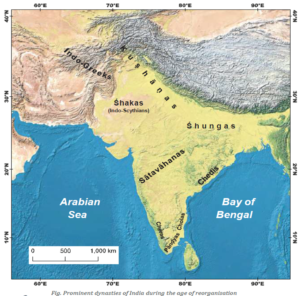
- Historians sometimes call this period the Age of Reorganization.
- During this time, many old regions were divided and reshaped into new kingdoms.
- The political map of India changed greatly, with new rulers and boundaries.
💡 Why 'Age of Reorganisation'?
Timeline of the Period :
|
Prominent Dynasties of the Subcontinent :
The 'new' kingdoms competed for territorial control through two main methods:
- Matrimonial alliances — marriage-based alliances between neighbouring royal families to cement peace.
- Warfare — use of force, especially to control border regions important for a kingdom's safety.
Alongside political events, there was a burst in the development of art, architecture, literature, and cultural exchange.
Classification of Dynasties :
| Dynasties from WITHIN the Subcontinent | Dynasties from OUTSIDE the Subcontinent |
| Shungas, Chedis, Satavahanas, Cholas, Cheras, Pandyas | Indo-Greeks, Shakas, Kushanas |
|
Matrimonial Alliance : An alliance arranged through marriage, generally between two members of royal families — typically a king offering his daughter in marriage to a neighbouring royal family to cement political ties. |
Surge of the Shungas :
- Founder: Pushyamitra Shunga founded the Shunga dynasty, ruling over parts of north and central India.
- Ashvamedha Yajna: He performed this Vedic ritual to establish himself as the most powerful ruler.
- Extent: His empire was smaller than the Maurya Empire, but he kept it safe from invaders.
- Relations with Greeks: Maintained friendly relations after an initial military campaign against them.
- Duration: The empire did not last long — it was gone about a century after Pushyamitra Shunga.
- Religious revival: The period saw a revival of Vedic rituals and practices, though other schools of thought continued to flourish.
| Know This :
The Ashvamedha Yajna : A Vedic ritual conducted by rulers to declare their kingship. A horse accompanied by soldiers was left to wander freely; any territory it crossed unchallenged became part of the king's empire. If a ruler stopped the horse, it led to a battle to determine supremacy. |
Shunga Contributions to Art, Language & Literature :
- Sanskrit emerged as a preferred language for philosophical and literary works.
- Yoga Sutras were compiled by Patanjali during this period.
- Bharhut Stupa (present-day Madhya Pradesh) — probably built during Ashoka's time, but the Shungas added beautifully carved railings and reliefs depicting stories from the Buddha's life. Considered among the earliest examples of Buddhist art.
- Other Shunga artefacts include terracotta figures, ivory combs, gold-covered bronze bangles, and necklace beads — showing skilled craftsmanship in daily-life objects.
The Satavahanas :
- Region: Ruled large parts of the Deccan from the 2nd century BCE onward, south of the Shunga Empire; sometimes called 'Andhras'.
- Territory: Present-day Andhra Pradesh, Telangana, and Maharashtra.
- Capitals: Different capitals at different times — most famous were Amravati and Pratishthana (Paithan).
Economy & Trade
- Coins depicting ships suggest maritime trade and advanced shipbuilding/navigation technology.
- Agriculture flourished in the Krishna-Godavari river system, providing economic stability.
- Active trade networks reached the Roman Empire — exports included spices, textiles, sandalwood, gold-plated pearls, and ivory; imports included glass and perfumed ointments.
- Tolls and taxes on trade added revenue — the Naneghat Caves near Pune were used for toll collection and as resting places for traders.
Life & Society under the Satavahanas
- Matronymic naming: Princes were often named after their mothers — e.g., Gautamiputra Satakarni, named after Gautami Balashri.
- Gautami Balashri: A powerful queen who donated land to Buddhist monks; her inscription at Nashik shows her influence.
- Naneghat inscriptions: Record a Satavahana widow queen performing Vedic rituals, including the ashvamedha yajna, and donating land, cattle, horses, elephants and silver coins.
- Religion: Devout followers of Vasudeva (Krishna), but also patronised Vedic scholars, Jaina and Buddhist monks with tax-free land grants.
Art & Architecture
- Karla Caves (near Lonavala, Maharashtra) — rock-cut caves for Buddhist monks, with magnificent pillars and a stone stupa replica.
- Pitalkhora Caves (Maharashtra) — yaksha sculpture inscribed 'made by Kanahadasa, a goldsmith', showing goldsmiths also crafted stone sculpture.
|
📉 Decline : In the 3rd century CE, the Satavahana Empire fragmented into smaller kingdoms, mainly due to weak central control and gradual economic decline — again paving the way for regional powers to reassert dominance. |
Coming of the Chedis :
Rise of Kalinga : After the decline of the Maurya Empire, Kalinga became a powerful kingdom. It was ruled by kings of the Chedi dynasty.
King Kharavela :
- Kharavela was a famous ruler of the Chedi dynasty.
- He was a follower of Jainism and was sometimes called ‘bhikshu-raja’ or ‘monk-king’.
- He respected different religions and schools of thought.
Udayagiri-Khandagiri Caves :
- The Udayagiri-Khandagiri caves, near Bhubaneswar, were probably built for Jain monks.
- The caves have beautiful carvings, statues and large rooms cut into rocks.
- They show the excellent skills of ancient craftsmen and are good examples of rock-cut architecture.
Hathigumpha Inscription :
- One of the caves has the Hathigumpha inscription, written in Brahmi script.
- It describes Kharavela’s achievements, including his military victories and the welfare activities he carried out for his people.
Respect for All Religions :
- Kharavela stated that he created a council of ascetics and sages from different regions.
- He supported different religions by repairing temples and respecting all religious sects.
|
🇮🇳 The 'Indian Ethos' : A recurring theme in this period: rulers took pride in extending protection and patronage to all schools of thought, regardless of their own personal faith. This idea of respecting religious plurality is considered a fundamental part of the 'Indian ethos'. |
Kingdoms and Life in the South :
Between the 2nd–3rd century BCE and the 3rd century CE, three powerful kingdoms rose to prominence in south India — the Cheras, Cholas, and Pandyas ('the three crowned kings'). They competed for control while contributing greatly to trade and culture.
- Ashoka's empire stopped at the borders of these south Indian kingdoms (mentioned in his edicts), suggesting they remained independent even at the height of Mauryan power.
- Kharavela claimed to have defeated an alliance of south Indian kings, but the battle location is unknown, and he does not seem to have invaded the south.
Sangam Literature & the Sangam Age
- This period saw the rise of many poets whose works are collectively called 'Sangam literature' — giving the era its name, the 'Sangam Age'.
- The word sangam comes from Sanskrit sangha, meaning 'association' or 'coming together', referring to an assembly of poets.
- It is the oldest literature in south India and a key source for historians studying society and culture of the time.
- Sangam poetry skillfully expresses personal emotions (like love) and societal values (like heroism and generosity).
- The Sangam literature mentions three important crowned kings of South India — the Cholas, Cheras and Pandyas.
The Three Kingdoms of the South :
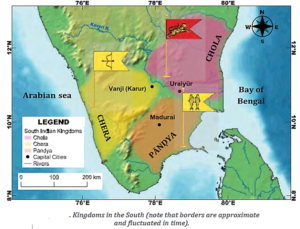
(i) The Cholas : The Cholas were a powerful dynasty that ruled parts of South India from the 3rd century BCE to the 13th century CE.
King Karikala :
- Karikala was a famous Chola king. He is believed to have defeated the combined forces of the Cheras and Pandyas and established Chola supremacy.
Kallanai Dam :
- Karikala started several projects for the welfare of his people.
- One of his important achievements was the construction of Kallanai, also called the Grand Anicut.
- Kallanai is an ancient water-diversion system built on the Kaveri River, downstream of Srirangam Island.
- It helped divert Kaveri water to the central and southern parts of the Kaveri delta.
Importance of Kallanai :
- The irrigation system made more land suitable for farming.
- The Kaveri delta became highly fertile and is known as the ‘Rice Bowl of the South’.
- Kallanai has been repaired and restored many times over the centuries.
- Even today, it helps provide water for irrigation and supports agriculture in Tamil Nadu.
(ii) The Cheras : The Cheras were also known as Keralaputra, meaning ‘sons of Kerala’. They ruled the western parts of Tamil Nadu and Kerala.
- Capital : The capital of the Cheras was Vanji, which is identified with present-day Karur in Tamil Nadu.
- Culture and Literature : The Cheras played an important role in the cultural and economic development of the region. They encouraged Tamil literature and supported Sangam poets.
- Trade : The Cheras had strong trade relations with the Roman Empire and West Asia. They exported goods such as spices, timber, ivory and pearls to foreign markets.
- Coins : The Chera kings issued several types of coins during their rule. These coins provide information about their kingdom and trade.
(iii) The Pandyas : The Pandyas ruled parts of Tamil Nadu and nearby regions. Their capital was Madurai.
- Prosperous Kingdom : In his work Indika, the Greek traveller Megasthenes described the Pandya kingdom as a prosperous kingdom. It had a strong system of administration and active trade.
- Trade : The Pandyas traded with different parts of India and also with distant regions such as Greece and Rome. They were famous for their pearls. Kharavela mentioned receiving hundreds of pearls from the Pandya kingdom.
- Naval Power : The Pandyas were also an important naval power in the Indian subcontinent.
- Art and Architecture : In later periods, the Pandyas made valuable contributions to art and architecture. They also helped in the overall development and prosperity of the region.
- Welfare and Religious Tolerance : The Pandya kings left many inscriptions showing their concern for the welfare of their people. They also supported and encouraged different schools of thought and beliefs.
Silappadikaram: The Tale of the Anklet :
- A famous epic composed soon after the Sangam collections. It tells the story of Kannagi, who lived happily with her husband Kovalan in the Chola capital Puhar.
- Kovalan lost his wealth over a dancer, but Kannagi forgave him, and they moved to Madurai (Pandya capital) to rebuild their lives.
- Kannagi gave Kovalan an anklet to sell, but he was falsely accused of theft and executed by the Pandya king.
- Kannagi proved his innocence with her second anklet; the king died of shock.
- She then cursed Madurai, and the god of fire destroyed the city.
- She later went to the Chera kingdom, where she was honoured as a goddess — she is still worshipped in Tamil Nadu and Kerala today.
|
📖 Theme of Silappadikaram
|
Invasions of the Indo-Greeks :
After the decline of the Maurya Empire, Indo-Greek rulers entered India through the North-Western frontier. They gained control over parts of North-Western, Northern and Central India.
Origin of the Indo-Greeks :
- Alexander appointed officials called satraps to govern the territories he conquered. Later, some of these satraps became independent rulers. They came to be known as the Indo-Greeks.
- After the fall of the Maurya Empire, the North-Western regions, including parts of present-day Pakistan and Afghanistan, became easy targets for the Indo-Greeks.
- Although they came as conquerors, the Indo-Greeks were greatly influenced by the rich local Indian culture.
Cultural Exchange and Legacy : The interaction between the Greeks and Indians created a mixture of Greek and Indian traditions. This influence could be seen in governance, art, language and daily life.
Heliodorus Pillar :
- The Heliodorus Pillar, near Vidisha in Madhya Pradesh, is an important example of Indo-Greek cultural interaction.
- Heliodorus was an Indo-Greek ambassador. He dedicated the pillar to Vasudeva, praising him as the ‘God of Gods’.
The inscription mentions three important principles that lead to heaven:
- Self-control
- Charity
- Consciousness
Indo-Greek Coins :
- Many Indo-Greek coins have been found in North India. These coins help historians learn about the Indo-Greek rulers.
- The coins were made of gold, silver, copper and nickel. They often showed a king on one side and a Greek deity on the other. Some coins also showed Indian deities such as Vasudeva-Krishna and Lakshmi. This shows the cultural exchange between Greek and Indian traditions.
End of Indo-Greek Rule : The rule of the Indo-Greeks eventually ended with the invasions of the Indo-Scythians, also called Shakas.
|
📅 Know This: The Shaka Samvat Calendar
|
The Emergence of the Kushanas :
- Origin: Originally from Central Asia; entered India probably in the 2nd century CE.
- Extent: At its peak, the empire extended from Central Asia to large parts of northern India.
- Significance: Their rule encouraged trade, cultural exchange, art and literature. The Kushana period had a major influence on the history and culture of the region.
Emperor Kanishka :
- Kanishka was one of the most famous Kushana rulers. He encouraged art and culture and helped new artistic styles to develop.
- A famous headless statue of Kanishka has a Brahmi inscription. It describes him as “Maharaja Rajadhiraja Devaputra Kanishka”, meaning “the great king, king of kings, son of God, Kanishka.”
Kushana Coins :
- Kushana coins provide useful information about their rulers and religious beliefs.
- One coin shows Kanishka holding a spear with the title “King of Kings.” The other side shows Buddha with his name written in Greek script.
- Another coin shows the emperor on one side and Shiva with the sacred bull Nandi on the other.
- These coins show that different religious traditions existed during the Kushana period.
Kushana Art, Architecture and Culture :
The Kushanas controlled important parts of the Silk Route. During their rule, trade increased and connected India with Central Asia, other parts of Asia and the West.
Kushana art was influenced by Indo-Greek traditions. The two important schools of art were the Gandhara School and the Mathura School.
Gandhara School of Art
- The Gandhara School developed in the western parts of Punjab. It combined Greco-Roman artistic features with Indian ideas.
- The sculptures were mainly made from grey-black schist stone. Buddha images often showed realistic human features and flowing robes.
Mathura School of Art :
- The Mathura School developed in the Mathura region of present-day Uttar Pradesh. It had a more Indian style and was less influenced by Greco-Roman art.
- Artists mainly used red sandstone. They made sculptures of many deities and figures, including Kubera, Lakshmi, Shiva, Buddha, Yakshas and Yakshinis.
Cultural Exchange
- The Kushana period saw the mixing of different cultures and religious traditions. Hindu and Buddhist themes were common in art and architecture.
- This period also saw the growth of Sanskrit literature. Important Indian works such as the Mahabharata and Ramayana were composed and developed during this broader period.
Chronology at a Glance :
| Approx. Date | Ruler / Dynasty | Event |
| 185 BCE | Pushyamitra Shunga | Assassinates last Maurya emperor; founds Shunga dynasty |
| 2nd c. BCE onward | Satavahanas | Rise to power in the Deccan |
| Late 2nd c. BCE – 5th c. CE | Shakas (Indo-Scythians) | Invade & rule the northwest; develop Shaka Samvat calendar |
| c. 1st c. BCE | Kharavela | Chedi ruler of Kalinga; Hathigumpha inscription |
| 3rd c. BCE – 13th c. CE | Cholas, Cheras, Pandyas | Sangam Age flourishes in south India |
| 2nd c. CE | Kushanas (Kanishka) | Empire extends from Central Asia to north India; peak of Gandhara & Mathura art |
| 3rd c. CE | Satavahanas | Empire fragments into smaller kingdoms |
Extra contents available in notes PDF :
- Memory Aids & Mnemonics
- Glossary of Key Terms
- Exam Preparation Tips
- Chapter Summary
- Practice Questions
We reply to valid query.