Notes
|
Topics to be learn :
|
Objects vs. Substances :
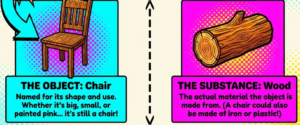
Objects : Objects are things that have a particular shape, structure, and use.
- Examples include chairs, scissors, glasses, clocks, hammers, and locks.
Substances : Substances are the materials used to make objects.
- For example, a chair can be made of wood, iron, or plastic. An object can be made from one substance or a combination of different substances.
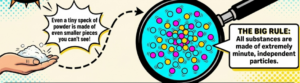
Particle Nature of Matter : All substances are made up of very tiny particles that cannot be seen with our naked eyes.
- For example, talcum powder, milk, oil, and air are made up of tiny particles.
Historical Context :
Panchtatva (Five Elements) : Ancient Indian philosophy describes five basic elements called Panchtatva. They are Earth, Water, Fire, Air, and Space.
- People in ancient times believed that these five elements formed the basis of all substances in nature.
The States of Matter and Particle Arrangement :
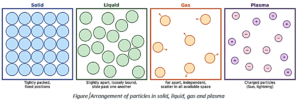
Matter commonly exists in three states: solid, liquid, and gas. These states depend on how particles are arranged and how strongly they attract one another.
(1) Solid State : In solids, particles are very close to one another and are held tightly in fixed positions.
- Solids have a fixed shape and a definite volume.
- They do not flow and are not easily compressed.
- Examples: Stones, iron, gold, glass, bricks, and wooden furniture.
(2) Liquid State : In liquids, particles are slightly farther apart than in solids and can move past one another.
- Liquids have a definite volume but no fixed shape.
- They flow easily and take the shape of their containers.
- Examples: Water, milk, cooking oil, fruit sherbet, and molten lava.
(3) Gaseous State : In gases, particles are far apart and move freely in all directions.
- Gases have neither a fixed shape nor a fixed volume.
- They spread out and fill the entire container.
- Examples: Air, oxygen, nitrogen, carbon dioxide, and water vapour.
(4) Plasma State (Fourth State of Matter) : Plasma is another state of matter formed at very high temperatures or under certain electrical conditions. In this state, many particles become electrically charged.
- Plasma is found in the Sun, stars, and lightning.
- Solid, liquid and gas are the common states. In places like the interior of the Sun, where immense energy is created, or in lightning during the rainy season, the nature of the particles is slightly different. Hence it is considered a separate state, called the Plasma state.
Comparison of the Three States
| Property | Solid | Liquid | Gas |
| Particle spacing | Very close | Slightly further apart | Very far apart |
| Binding between particles | Very tight | Loose | Almost none (independent) |
| Movement of particles | Stay in fixed positions | Flow past each other | Scatter everywhere |
| Shape | Fixed shape | Takes shape of container | Takes shape of container and fills it |
| Flow | Does not flow | Flows towards a slope | Spreads in all directions |
| Examples | Stone, iron, wood, ice | Water, milk, oil | Air, oxygen, vapour |
Thermal Effects and Changes of State :
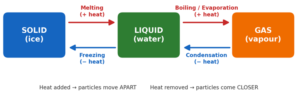
When heat is added to or removed from a substance, its particles move faster or slower. This can change the state of the substance without changing its chemical identity.
(1) Melting (Solid to Liquid) : When a solid is heated, its particles vibrate faster and move apart. At a certain temperature, the solid changes into a liquid. This process is called melting.
- Examples: Ice melts into water. Iron and glass melt when heated strongly. Rocks melt deep inside the Earth to form molten rock.
(2) Vaporization (Liquid to Gas) : When a liquid is heated, its particles move faster and spread apart. The liquid changes into a gas or vapour. This process is called vaporization.
- Example: Water changes into steam when it boils.
(3) Condensation (Gas to Liquid) : When a gas cools, its particles slow down and come closer together. The gas changes into a liquid. This process is called condensation.
- Example: Water droplets form on a cold mirror when it comes in contact with moist air.
(4) Freezing (Liquid to Solid) : When a liquid is cooled, its particles move more slowly and become closely packed. The liquid changes into a solid. This process is called freezing.
- Examples: Water freezes into ice. Ice cream becomes solid when cooled. Coconut oil may become solid during cold weather.
(5) Other Changes of State :
- Liquefaction: Some gases can be changed into liquids by cooling them or applying pressure.
- Sublimation: Solid carbon dioxide, called dry ice, changes directly into gas without becoming liquid under normal atmospheric pressure.
| KEY POINT
· Some solids need a little heat to melt (wax), others need a lot (glass, iron, rocks). · Lava is liquid formed when rocks of the earth's crust melt; it is called molten rock. · Stone, gold, glass, iron are not always solid, and oil, water, milk are not always liquid. These are only their states at normal temperature. |
Gases can be turned into liquids and solids :
- Nitrogen, oxygen and carbon dioxide are common gases. Cooling can convert them into liquids.
- Liquid nitrogen: used in laboratories to keep things extremely cold.
- Liquid oxygen: used in rockets for space missions.
- Carbon dioxide gas, cooled sufficiently, becomes a solid called dry ice (very cold).
Fundamental Physical Measurements and Density :
Matter : Matter is anything that has mass and occupies space. All objects and substances are made of matter.
Clearing common confusions about 'matter' :
- There is no separate, independent substance in the world called matter.
- Matter does not mean only liquids like oil, water or milk.
- Every substance in the universe is matter, including substances in the Moon, the Sun, stars and comets.
Important Physical Quantities :
(A) Volume :
- Volume is the amount of space occupied by an object or substance.
- The volume of solids is measured in cubic centimetres (cm³) or cubic metres (m³).
- The volume of liquids is measured in millilitres (mL) or litres (L).
- 1 cm³ = 1 mL
(B) Mass :
- Mass is the amount of matter present in an object. It is measured using a balance.
- Units: Gram (g) and kilogram (kg).
(C) Weight :
- Weight is the force with which gravity pulls an object towards the Earth. It is measured using a spring balance.
Measuring the Volume of an Object :
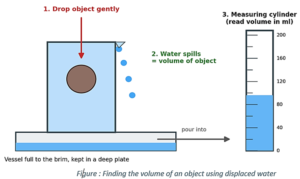
- When an object (a potato, stone or iron block) is dropped into a vessel full of water, it pushes the water aside and occupies that space. The water pushed aside is exactly equal to the volume of the object.
- Measuring this spilled water with a measuring cylinder or an injection syringe gives the volume of the object, without breaking it.
- This method helps us measure the volume of irregular objects.
Density : Density tells us how much mass is present in a given volume of a substance.
Density = \(\frac{Mass}{Volume}\)
Standard units of density:
- Grams per cubic centimetre (g/cm³)
- Kilograms per cubic metre (kg/m³)
Examples:
- Density of pure water = 1 g/cm³
- Density of pure gold = 19.3 g/cm³
- Gold is much denser than water because the same volume of gold has much more mass than water.
Uses of Density :
- Building and Construction : Engineers use density to calculate the mass of materials such as concrete and steel. This helps them design strong buildings and bridges.
- Testing Purity : Density helps us check the purity of substances. It can be used to identify possible adulteration in materials such as gold, milk, and fuel.
Specific Physical Properties of Substances :
Substances have different properties. Two important properties are their ability to allow light to pass through them and their attraction to magnets.
Optical Properties : Based on how much light passes through them, substances are divided into three types.
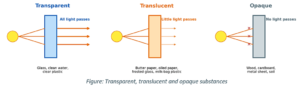
(A) Transparent Substances : Transparent substances allow almost all light to pass through them. We can see objects clearly through them.
- Examples: Clean water, clear glass, and transparent plastic.
(B) Translucent Substances : Translucent substances allow some light to pass through them. Objects seen through them appear blurred.
- Examples: Frosted glass, butter paper, and oiled paper.
(C) Opaque Substances : Opaque substances do not allow light to pass through them. We cannot see objects through them.
- Examples: Wood, cardboard, soil, and thick metal sheets.
Magnetic Properties :
Based on their attraction to magnets, materials are divided into two types.
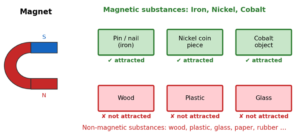
(A) Magnetic Materials : Magnetic materials are attracted to magnets. Iron, nickel, and cobalt are examples of magnetic materials.
- Examples: Iron nails and objects made of iron.
(B) Non-Magnetic Materials : Non-magnetic materials are not attracted to ordinary magnets.
- Examples: Wood, plastic, glass, and paper.
Solved Conceptual & Numerical Exercises :
| EXAMPLE 1 : A stone has mass 150 g and displaces 50 ml of water. Find its density.
Volume of stone = 50 cm³. Density = \(frac{150}{50}\) = 3 g/cm³. |
| EXAMPLE 2 : (finding mass) : Density of gold is 19.3 g/cm³. What is the mass of 10 cm³ of gold?
Mass = Density × Volume = 19.3 × 10 = 193 g. |
Example : Mass vs. Volume Comparison (1 kg Cotton vs. 1 kg Iron)
Volume Comparison:
- Cotton has a far lower density than iron, meaning its particles are loosely packed. Therefore, 1 kg of cotton occupies a significantly larger physical volume than 1 kg of compact iron.
Balance Scale Behavior:
- When placed on opposite pans of a balance scale, both pans remain perfectly balanced at the same level. This is because both sides contain an identical mass of exactly 1 kg.
We reply to valid query.