Solutions
Objective Questions
(A) Select the correct option and rewrite the sentence:-
(1) The person on whom a bill is drawn is called a .
(a) Drawee
(b) Payee
(c) Drawer
(d) Acceptor.
(a) Drawee
(2) Before acceptance the bill is called a .
(a) Order
(b) Request
(c) Draft
(d) Instrument.
(c) Draft
(3) When the due date of bill drawn falls due on a public holiday, the payment must
be made on the day.
(a) Same
(b) preceding
(c) next
(d) any.
(b) preceding
(4) The due date of the bill drawn for 2 months on 23rd Nov. 2019 will be
(a) 23rd Jan. 2020
(b) 25th Jan. 2019
(c) 26th Jan. 2019
(d) 25th Jan. 2020.
(d) 25th Jan. 2020.
(5) Nothing charges are borne by .
(a) Notary Public
(b) Drawee
(c) Drawer
(d) Endorsee.
(b) Drawee
(6) There are parties to bill of exchange.
(a) five
(b) four
(c) three
(d) two.
(c) three
(7) When a bill is drawn for 2 months after date on 3rd Jan. 2020, its due date will be .
(a) 3rd Jan. 2020
(b) 3rd Mar. 2020
(c) 5th Mar. 2020
(d) 6th Mar. 2020
(d) 6th Mar. 2020.
(8) Notary Public is .
(a) Govt. Officer
(b) Drawer
(c) Payee
(d) Endorsee
(a) Govt. Officer
(9) When Acceptor or Drawee does not pay the amount of bill to the holder on the due date it is known as the bill.
(a) returning
(b) discounting
(c) honouring
(d) dishonouring.
(d) dishonouring
(10) The person who accepts the bill treats the bill as .
(a) Bills Payable
(b) Promissory note
(c) Draft
(d) Bills Receivable.
(a) Bills Payable
(B) Give one word / phrase / term which can substitute each of the following statements:-
(1) Three extra days which are allowed over and above the term of bill.
(2) Fees charged by Notary Public for getting the fact of dishonour noted.
(3) A person who is entitled to receive the amount of bill of exchange.
(4) A person in whose favour a bill endorsed.
(5) Officer appointed by government for noting of dishonor of bill.
(6) Cancellation of bill on maturity in return of a new bill for extended period of credit.
(7) Bill of exchange drawn and accepted without any valuable consideration.
(8) Person who is in possession of Bill of Exchange.
(9) Conversion of Bill of Exchange into its present value.
(10) Amount which is not recoverable from Drawee on account of insolvency.
| Statement | (word/phrase/term) |
| (1) Three extra days which are allowed over and above the term of bill. | Grace days |
| (2) Fees charged by Notary Public for getting the fact of dishonour noted. | Noting Charges |
| (3) A person who is entitled to receive the amount of bill of exchange. | Payee |
| (4) A person in whose favour a bill endorsed. | Endorsee |
| (5) Officer appointed by government for noting of dishonour of bill. | Notary Public |
| (6) Cancellation of bill on maturity in return of a new bill for extended period of credit. | Renewal of Bill |
| (7) Bill of exchange drawn and accepted without any valuable consideration, | Accommodation Bill |
| (8) Person who is in possession of Bill of Exchange. | Holder |
| (9) Conversion of Bill of Exchange into its present value. | Discounting of the Bill |
| (10) Amount which is not recoverable from Drawee on account of insolvency. | Bad debts |
(C) State True or False with reasons:-
(1) Inland bill is one which is drawn in one country and payable in another country.
Statement is : False
Reason : A bill drawn in one country and payable in another is a foreign bill. An inland bill is drawn *and* payable in the same country.
(2) Retirement of bill means payment of the bill before due date.
Statement is : True
Reason : Retirement = payment of the bill before the due date, usually with a rebate.
(3) Drawee can transfer the ownership of Bill.
Statement is : False
Reason : It is the holder (usually the Drawer/payee) who transfers the bill by endorsement. The Drawee is the acceptor who has to pay it.
(4) Acceptance of bill without making any changes in the terms of bill is called qualified acceptance.
Statement is : False
Reason : Acceptance without any change in terms is general (clean) acceptance. Qualified acceptance adds a condition or change.
(5) Discounting is a device to convert the bill into its present value.
Statement is : True
Reason : Discounting converts the bill into its present value — the bank pays amount less discount.
(6) A bill of exchange must be presented to the acceptor on the due date.
Statement is : True
Reason : The holder must present the bill to the acceptor for payment on (or before) the due date, otherwise the acceptor and endorsers are discharged.
(7) If a bill is discounted by the holder, no entry is passed in his book when bill is honoured on the due date.
Statement is : True
Reason : On honour of a discounted bill the bank collects from the Drawee; the Drawer has already received cash, so no entry.
(8) Noting charges are to be borne by the drawer.
Statement is : False
Reason : Noting charges are paid by the holder but borne by the Drawee (acceptor).
(9) If a bill is drawn payable “on demand” no grace days are allowed.
Statement is : True
Reason : Days of grace are not allowed for bills payable on demand or at sight.
(10) There are three parties to a Promissory Note.
Statement is : False
Reason : A promissory note has two parties — maker and payee.
(D) Find the odd one:-
(1) a) Retaining b) Noting c) Discounting d) Endorsing
Noting : Retaining, discounting and endorsing are ways of dealing with a bill receivable; noting is a step after dishonour.
(2) a) Trade bill b) Accommodation bill c) After date bill d) Demand bill.
Demand bill : Trade, accommodation and after-date bills all have a term and carry days of grace; a demand bill has neither. (Alternatively, grouping by *purpose* vs *time* is arguable — write your reason.)
(3) a) Notary Public b) Drawer c) Drawee d) Payee.
Notary Public : Drawer, Drawee and Payee are parties to the bill; the notary is not.
(4) a) Discounting charges b) Rebate c) Bank charges d) Noting charges.
Rebate ; Discounting, bank and noting charges are fees charged by outsiders (bank/notary); rebate is an allowance by the Drawer to the Drawee for early payment.
(5) a) Stamp b) Acceptance c) Draft d) Amount.
Draft : Stamp, acceptance and amount are contents of the bill format; a draft is a bill *before acceptance* (a state, not a content).
(E) Complete the sentence:-
(1) Making payment of bill before the due date of maturity is known as .................... .
retirement of a bill.
(2) Person whose liabilities are more than his assets and is not in position to pay off his liabilities is .................. .
Insolvent
(3) Amount that cannot be paid by acceptor on account of inslovency is known as ....................
deficiency (bad debts for the Drawer)
(4) A bill of exchange payable after certain period is known as ....................
after date bill (time / usance bill)
(5) A bill which is drawn and accepted with valuable consideration is known as .....................
trade bill
(6) A person who draws the bill of exchange is known as .................... .
Drawer
(7) A bill whose due date is calculated from the date of acceptance is known as .....................
after sight bill
(8) Recording the fact of dishonour of Bill is known as .................... .
Noting
(9) When Drawee accepts the bill payable at a particular place only, it is known as ....................
qualified acceptance as to place
(10) Fees charged by the bank for collection of bill on behalf of holder is .................... .
bank charges
(F) Answer in sentence:-
(1) What do you mean by bill of exchange?
A bill of exchange is a written, unconditional order signed by the maker directing a certain person to pay a certain sum to a certain person or to his order or to the bearer (Section 5, N.I. Act, 1881).
(2) What are days of grace?
Days of grace are three extra days allowed by law over and above the term of the bill so that the Drawee can arrange payment.
(3) What do you mean by discounting a bill of exchange?
Discounting is encashing the bill with the bank before its due date at its present value — the bank deducts discount for the unexpired period.
(4) What is noting of the bill?
Noting is the recording of the fact of dishonour of a bill by a Notary Public, with the date and reason of dishonour.
(5) What are noting charges?
Noting charges are the fees charged by the Notary Public for noting the dishonour; paid by the holder, borne by the Drawee.
(6) What is relationship between Drawer and Drawee?
The Drawer is the creditor who draws the bill; the Drawee is the debtor on whom it is drawn and who accepts and pays it.
(7) Who is payee of the bill?
The payee is the person to whom the amount of the bill is to be paid.
(8) What do you mean by rebate?
Rebate is the discount allowed by the Drawer to the Drawee for paying (retiring) the bill before its due date.
(9) What is legal due date?
Legal due date is the date arrived at after adding three days of grace to the nominal due date.
(10) What is bills payable on demand?
A bill payable on demand is one that must be paid immediately on presentation; it carries no term and no days of grace.
(G) Do you agree or disagree with the following statements:-
(1) A bill of exchange is a conditional order.
(2) The party which is ordered to pay the amount is known as payee.
(3) The person in whose favour the bill is endorsed is known as endorsee.
(4) Rebate or discount given on retiring a bill is an income to the Drawee.
(5) A bill from the point of view of debtor is called Bills payable.
(6) In case of bill drawn payable ‘on demand’ no grace days are allowed.
(7) A bill is required to be accepted by Drawer.
(8) A bill of exchange need not be dated.
(9) A bill before acceptance is called Promissory Note.
(10) Renewal is request by Drawee to extend the credit period of the bill.
| Q | Verdict | Correct statement |
| 1 | Disagree | A bill of exchange contains an unconditional order. |
| 2 | Disagree | The party ordered to pay is the Drawee; the payee is the one who receives. |
| 3 | Agree | The person in whose favour a bill is endorsed is the endorsee. |
| 4 | Agree | Rebate on retirement is an income to the Drawee (and expense to the Drawer). |
| 5 | Agree | For the debtor (acceptor) the bill is Bills Payable. |
| 6 | Agree | No days of grace for bills payable on demand. |
| 7 | Disagree | A bill must be accepted by the Drawee, not the Drawer. |
| 8 | Disagree | A bill must be dated; otherwise its maturity cannot be determined. |
| 9 | Disagree | A bill before acceptance is a draft, not a promissory note. |
| 10 | Agree | Renewal is the Drawee’s request to extend the credit period (by cancelling the old bill and accepting a new one). |
(H) Calculations:-
(1) Ganesh draws a bill for ₹ 40,260 on 15th Jan. 2020 for 50 days. He discounted the bill with Bank of India @15% p.a. on the same day. Calculate the amount of discount.
Discount = Amount of bill × \(\frac{Rate}{100}\) × Unexpired period
= 40,260 × \(\frac{15}{100}\) × \(\frac{50}{366}\) = 110 × \(\frac{15}{100}\) × 50 = ₹ 825.
[Unexpired period = \(\frac{Month}{12}\) or \(\frac{days}{366}\) (use 366 in a leap year)]
(2) Shefali Traders drew a bill on Maya for ₹ 30,000 on 1st Oct. 2019 payable after 3 months. Calculate amount of discount in the following cases:-
(i) Shefali Traders discounted the bill on the same day @ 12% p.a.
(ii) Shefali Traders discounted the bill on 1st Nov. 2019 @ 12% p.a.
(iii) Shefali Traders discounted the bill on 1st Dec. 2019 @ 12% p.a.
Discount = Amount of bill × \(\frac{Rate}{100}\) × \(\frac{Unexpired months}{12}\)
| Case | Discounted on | Unexpired | Working | Discount |
| (i) | 1 Oct 2019 | 3 months | 30,000 × \(\frac{12}{100}\) × \(\frac{3}{12}\) | ₹ 900 |
| (ii) | 1 Nov 2019 | 2 months | 30,000 × \(\frac{12}{100}\) × \(\frac{2}{12}\) | ₹ 600 |
| (iii) | 1 Dec 2019 | 1 month | 30,000 × \(\frac{12}{100}\) × \(\frac{1}{12}\) | ₹ 300 |
(3) Veena who had accepted Sudha’s bill for ₹ 28,000 was declared bankrupt and only 35 paise in a rupee could be recovered from her estste. Calculate the amount of bad debts.
Veena’s acceptance ₹ 28,000; 35 paise in a rupee recovered.
Recovered = 28,000 × \(\frac{35}{100}\) = ₹ 9,800.
Bad debts = 28,000 − 9,800 = ₹ 18,200.
(4) Nitin renewed his acceptance for ₹ 72,000 by paying ₹ 22,000 in cash and accepting a new bill for the balance plus interest @ 18% p.a. for 4 months. Calculate the amount of new bill.
Nitin renews ₹ 72,000: pays ₹ 22,000 cash, new bill for the balance plus interest at 18% p.a. for 4 months.
Balance = 72,000 − 22,000 = 50,000.
Interest = 50,000 × \(\frac{18}{100}\) × \(\frac{4}{12}\) = ₹ 3,000.
New bill = 50,000 + 3,000 = ₹ 53,000.
(5) Nisha’s acceptance for ₹ 16,850 sent to bank for collection was honoured and bank charges debited were ₹ 125. Find out the amount actually received by Drawer.
Nisha’s acceptance ₹ 16,850 sent for collection, honoured; bank charges ₹ 125.
Amount actually received = 16,850 − 125 = ₹ 16,725
(Bank A/c Dr 16,725, Bank Charges A/c Dr 125).
(6) A bill of ₹ 16,000 was drawn by Keshav on Gopal on 12th June 2019 for 2 months. What will be the due date, if all of sudden, the legal due date is declared as emergency holiday?
Keshav’s bill ₹ 16,000 dated 12 June 2019, 2 months; the legal due date is declared an emergency holiday.
Nominal due date = 12 Aug 2019; legal due date = 15 Aug 2019 (Independence Day) — but it is declared an emergency holiday, so payment is due on the next working day: 16 August 2019.
[Note : 15 August is also a public holiday, which would normally shift payment to 14 August. But the question says the legal due date itself is declared an emergency holiday, so the next-working-day rule applies → 16 August 2019. State this reasoning in the exam.]
(I) Prepare the following Specimens :-
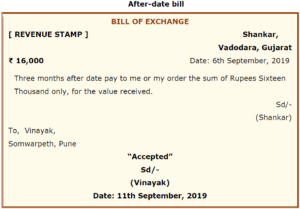
(1) Prepare a bill of exchange form the following information :
Drawer : Shankar, Vadodara, Gujrat.
Drawee : Vinayak, Somwarpeth, Pune.
Amount : ₹ 16,000
Period : 3 months
Date of Bill : 6th Sept. 2019.
Date of acceptance : 11th Sept. 2019.
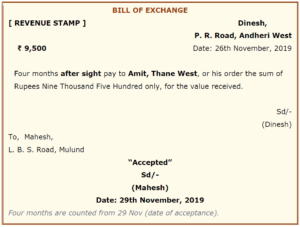
(2) Prepare a bill of exchange from the following information :
Drawer : Dinesh, P. R. Road, Andheri West.
Drawee : Mahesh, L. B. S. Road, Mulund.
Payee : Amit, Thane West.
Amount : ₹ 9,500
Period of Bill : 4 months after sight.
Date of Bill : 26th Nov. 2019.
Date of acceptance : 29th Nov. 2019.
After-sight bill with payee
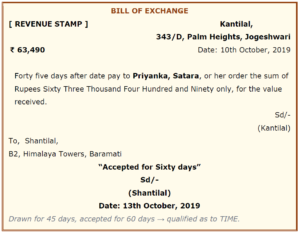
(3) Kantilal, 343/D, Palm Heights, Jogeshwari, drew a bill on 10th Oct. 2019 for ₹ 63,490 for 45 days after date on Shantilal, B2, Himalaya Towers, Baramati, payable to Priyanksa, Satara.\ The bill was accepted on 13th Oct. 2019 for 60 days.
- Prepare a format of bill of exchange from the above detalis.
Qualified acceptance as to time
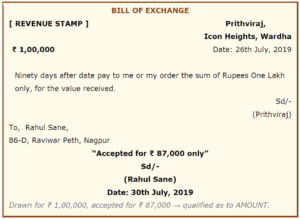
(4) Prepare a format of bill exchange from the following details :
Rahul Sane, 86-D, Raviwar Peth, Nagpur accepted the bill drawn on him by Prithviraj, Icon Heights, Wardha for ₹ 87,000 on 30th July 2019. The bill was drawn on 26th July 2019 for ₹ 1,00,000 for 90 days after date.
Qualified acceptance as to amount
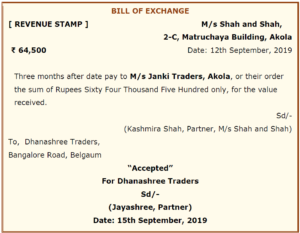
(5) Prepare a format of bill of exchange from the followings.
Drawer : Kashmira Shah, Partner M/S Shah and Shah, 2-C, Matruchaya Building, Akola.
Drawee : Dhanashree Traders, Bangalore Road, Belgaum. (Signed by Jayashree, Partner)
Payee : M/S Janki Traders, Akola.
Amount : ₹ 64,500
Period of Bill : 3 months
Date of drawing : 12th Sept. 2019
Date of acceptance : 15th Sept. 2019
Partnership firms as Drawer and Drawee
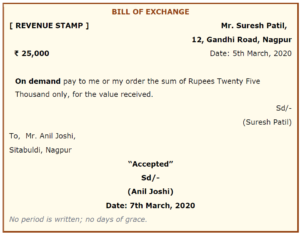
(6) Prepare a demand bill with imaginary Drawer, Drawee, Address , Amount and Date.
Demand bill (imaginary details)
(J) Complete the following Table
(1)
| Date of Drawing | Date of Acceptance | Payable | Due Date |
| i. 30.1.2019 | 1.2.2019 | 60 days after date | ----- |
| ii. 17.8.2019 | 21.8.2019 | 3 months after sight | ----- |
| iii. 23.12.2019 | 26.12.2019 | 1 months after date | ----- |
| iv. 28.1.2019 | 28.1.2020 | 1 months after date | ----- |
| v. 30.6.2019 | 2.7.2019 | 45 days after date | ----- |
| Drawn | Accepted | Term | Working | Due date (legal) | |
| i | 30.1.2019 | 1.2.2019 | 60 days after date | Jan 1 + Feb 28 + Mar 31 = 60 → nominal 31 Mar; +3 | 3 Apr 2019 |
| ii | 17.8.2019 | 21.8.2019 | 3 months after sight | From acceptance: 21 Nov nominal; +3 | 24 Nov 2019 |
| iii | 23.12.2019 | 26.12.2019 | 1 month after date | 23 Jan nominal; +3 = 26 Jan (Republic Day) | 25 Jan 2020 |
| iv | 28.1.2019 | 28.1.2019* | 1 month after date | 28 Feb nominal (28 days in Feb 2019); +3 | 3 Mar 2019 |
| v | 30.6.2019 | 2.7.2019 | 45 days after date | Jun 0 + Jul 31 + Aug 14 = 45 → nominal 14 Aug; +3 | 17 Aug 2019 |
* The textbook prints the year of acceptance in (iv) as 2020; 2019 is intended.
(2)
| Sr. No. | DATE OF DRAWING | Date of acceptance | Tenure | Type | Nominal due date |
Legal due date |
| i) | 3rd January, 2020 | 5t January,2020 | 45 days | after date |
? | ? |
| ii) | 9th April, 2019 | 12th April, 2029 | 4 months | After
sight |
? | ? |
| iii) | 23rd November 2019 | 23rd November, 2029 | 2 months | After
date |
? | ? |
| iv) | 16th August, 2019 | 20th August, 2019 | 4 months | After
sight |
? | ? |
| v) | 23rd December, 2018 | 24th December, 2018 | 60 days | After
date |
? | ? |
| Drawn | Accepted | Tenure & type | Nominal due | Legal due | |
| i | 3 Jan 2020 | 5 Jan 2020 | 45 days after date | Jan 28 + Feb 17 = 45 → 17 Feb 2020 | 20 Feb 2020 |
| ii | 9 Apr 2019 | 12 Apr 2019* | 4 months after sight | 12 Aug 2019 (from acceptance) | 15 Aug → holiday → 14 Aug 2019 |
| iii | 23 Nov 2019 | 23 Nov 2019* | 2 months after date | 23 Jan 2020 | 26 Jan → holiday → 25 Jan 2020 |
| iv | 16 Aug 2019 | 20 Aug 2019 | 4 months after sight | 20 Dec 2019 | 23 Dec 2019 |
| v | 23 Dec 2018 | 24 Dec 2018 | 60 days after date | Dec 8 + Jan 31 + Feb 21 = 60 → 21 Feb 2019 | 24 Feb 2019 |
* Textbook prints “2029” for the year of acceptance in (ii) and (iii); 2019 is intended. Sundays are not adjusted in the textbook method.
We reply to valid query.