Solutions (Exercise + Intext)
Intext Questions :
Question 1. Adolescents, especially girls, may sometimes suffer from blood-related health problem(s) because of a deficiency of iron or vitamin-B12 in the body. (Page 80)
(i) Find out about such health problem(s).
(ii) How can we manage iron deficiency in our body?
(iii) Find out about government schemes aimed to prevent such deficiencies.
(i) Health Problems :
- Deficiency of iron or vitamin B12 can cause anaemia.
- Anaemia means low haemoglobin in the blood.
- Common symptoms include:
- Tiredness and weakness
- Pale skin
- Dizziness
- Shortness of breath
(ii) Management of Iron Deficiency :
- Eat iron-rich foods like:
- Leafy vegetables (spinach)
- Jaggery (gud)
- Pulses and beans
- Meat, fish, eggs
- Include vitamin C foods (like oranges, lemon) to help absorb iron.
- Take iron supplements if advised by a doctor.
- Maintain a balanced diet regularly.
(iii) Government Schemes :
- Anaemia Mukt Bharat (AMB): Aims to reduce anaemia among children, adolescents, and women.
- Weekly Iron and Folic Acid Supplementation (WIFS): Provides iron tablets to school-going adolescents.
- Mid-Day Meal Scheme: Provides nutritious meals to improve health of students.
Question 2 Did you know that vitamin-B12 is required for the proper functioning in most of the human body? (Page 80)
Vitamin B12 is essential for proper functioning of the body.
It helps in:
- Formation of red blood cells
- Proper functioning of the brain and nervous system
- Preventing anaemia
Question 3 Discuss the sources of vitamin-B12. (Page 80)
Vitamin B12 is mainly found in animal-based foods such as:
- Milk and dairy products
- Eggs
- Meat and fish
- Some fortified foods (like cereals) also contain vitamin B12.
- Vegetarians may need supplements if there is deficiency.
Let Us Enhance Our Learning : Exercise Questions
Question 1. Ramesh, an 11-year-old boy, developed a few pimples on his face. His mother told him that this is because of ongoing biological changes in his body.
(i) What could be the possible reasons for the development of these pimples on his face?
(ii) What can he do to get some relief from these pimples?
(i) Possible Reasons: During adolescence, there is an increase in oily secretions from the skin. These secretions can clog skin pores, leading to infections and the development of reddish pimples, a manifestation of the condition known as acne.
(ii) Relief: Maintaining personal hygiene, specifically keeping the face and body clean, is crucial to protect against infections and manage these skin changes.
Question 2. Which of the following food groups would be a better option for adolescents and why?
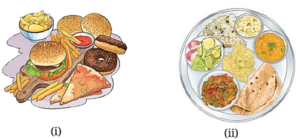
Better Option: Food group (ii)
Why: Adolescence is a period of rapid growth and development that requires a nutritious diet.
- Food group (ii) includes balanced healthy foods like vegetables, pulses. These foods provide proteins, carbohydrates, vitamins, minerals and fibre, which are important for proper growth and development during adolescence.
- Option (i) contains junk food like burgers, fries and pizza which are high in fats, sugar and salt, but low in nutrition and can harm health if eaten often.
Question 3. Unscramble the underlined word in the following sentences:
(i) The discharge of blood in adolescent girls which generally occurs every 28–30 days is nstmnoiaretu.
(ii) The hoarseness in the voice of adolescent boys is due to enlarged iceov xob.
(iii) Secondary sexual characteristics are natural signs that the body is preparing for adulthood and mark the onset of urtypeb.
(iv) We should say NO to lahoclo and srugd as they are addictive.
- (i) nstmnoiaretu: Menstruation
- (ii) iceov xob: Voice box
- (iii) urtypeb: Puberty
- (iv) lahoclo and srugd: Alcohol and drugs
Question 4. Shalu told her friend, “Adolescence brings only physical changes, like growing taller or developing body hair.” Is she correct? What would you change in this description of adolescence?
Shalu is not completely correct. Adolescence does involve physical changes, but it is much more than just that.
You could improve her description like this:
- “Adolescence is a stage of life in which a person undergoes not only physical changes (like increase in height and body hair) but also emotional, mental, and social changes.”
- Teenagers begin to develop independent thinking, experience mood changes, become more aware of relationships, and form their own identity.
So, instead of saying “only physical changes,” it should include:
- Emotional changes (mood swings, feelings)
- Mental changes (thinking ability, decision-making)
- Social changes (relationships, behavior with others)
In short, adolescence is a period of overall development, not just physical growth.
Question 5. During a discussion in the class, some of the students raised the following points. What questions would you ask them to check the correctness of these points?
(i) Adolescents do not need to worry about behavioural changes.
(ii) If someone tries a harmful substance once, they can stop anytime they want.
To check whether these statements are correct, you can ask thoughtful questions that make students reflect:
(i) “Adolescents do not need to worry about behavioural changes.”
- Do mood swings or sudden anger affect relationships with family and friends?
- Can behavioural changes influence decision-making and future choices?
- Is it important to learn self-control and good habits during adolescence?
- What might happen if negative behaviours are ignored?
(ii) “If someone tries a harmful substance once, they can stop anytime they want.”
- Do all substances have the potential to cause addiction even after limited use?
- Why do some people find it difficult to stop after trying once?
- What effects do harmful substances have on the brain and body?
- Are there real-life examples where people struggled to quit after starting?
These questions help students think critically and understand that both statements are not entirely correct.
Question 6. Adolescents sometimes experience mood swings. On some days, they feel very energetic and happy, while on other days, they may feel low. What other behavioural changes are associated with this age?
Along with mood swings, adolescents often show several other behavioural changes as part of growing up. These include:
- Desire for independence – wanting to make their own decisions and not always depend on parents
- Increased self-awareness – becoming more conscious about appearance and what others think
- Changing interests – shifting hobbies, likes, and dislikes
- Peer influence – giving more importance to friends’ opinions and spending more time with them
- Emotional sensitivity – getting easily hurt, excited, or upset
- Curiosity and risk-taking – wanting to try new things, sometimes without fully thinking about consequences
- Development of personal identity – trying to understand “Who am I?” and forming their own values and beliefs
These changes are a normal part of adolescence and reflect overall emotional, social, and mental development.
Question 7. While using a toilet, Mohini noticed that used sanitary pads were scattered near the bin. She got upset and shared her feelings with her friends. They discussed the importance of menstrual hygiene and healthy sanitary habits. What menstrual hygiene and sanitary habits would you suggest to your friends?
That situation would upset anyone—good that Mohini spoke up.
Here are some simple, healthy menstrual hygiene habits you can suggest:
- Use clean sanitary pads or cloth during periods.
- Change the pad every 4–6 hours.
- Wash your hands before and after changing the pad.
- Keep the private parts clean by washing with water.
- Wrap used pads in paper and throw them in a dustbin. Do not leave them in the toilet.
- Wear clean and dry underwear.
- If using cloth, wash it properly and dry it in sunlight before using again.
- Talk openly about menstrual hygiene and do not feel shy.
These habits help us stay clean, healthy, and safe during periods.
Question 8. Mary and Manoj were classmates and good friends. On turning 11, Mary developed a little bulge on the front of her neck. She visited the doctor who gave her medication and asked to take iodine-rich diet. Similarly, a bump was developed on the front of Manoj’s neck when he turned 12. However, the doctor told him that it was a part of growing up. According to you, what could be the possible reason for advising Mary and Manoj differently?
- Manoj: His bump is likely the Adam’s apple, which is a normal growth of the voice box in adolescent boys. The doctor called it a part of growing up because it is a standard secondary sexual characteristic for males.
- Mary: While a girl's voice box grows slightly, it is not usually noticeable as a bump. The doctor’s advice for an iodine-rich diet suggests her bulge was related to a nutritional deficiency (such as goiter) rather than a normal developmental change.
Question 9. During adolescence, the boys and girls undergo certain physical changes, a few of which are given below.
(i) Change in voice
(ii) Development of breasts
(iii) Growth of moustache
(iv) Growth of facial hair
(v) Pimples on the face
(vi) Growth of hair in the pubic region
(vii) Growth of hair in armpits
Categorise these changes in the table given below:
| Observed only in boys | Observed only in girls | Common in boys and girls |
| Observed only in boys | Observed only in girls | Common in boys and girls |
| Growth of moustache (iii) | Development of breasts (ii) | Change in voice (i)* |
| Growth of facial hair (iv) | Pimples on the face (v) | |
| Growth of hair in the pubic region (vi) | ||
| Growth of hair in armpits (vii) |
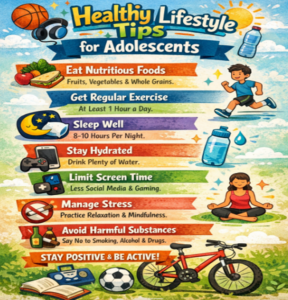
Question 10. Prepare a poster mentioning the tips for adolescents to live a healthy lifestyle.
We reply to valid query.