Solutions (Exercise + Intext)
Intext Questions :
Q.1. Observe the below picture and give answers. (Page 10)
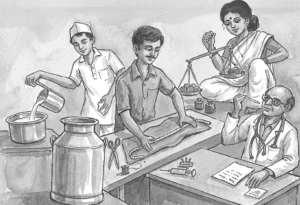
(a) When the milkman fills the milk-measuring cup, then exactly what is being measured?
(b) What is the cloth sellers measuring using a measuring tape before cutting the cloth?
(c) What a doctor is checking using the instrument shown in the picture?
(d) What the vegetable vendor is measuring?
(a) The milkman is measuring the volume of milk using the milk-measuring cup.
(b) The cloth seller is measuring the length of the cloth using a measuring tape.
(c) The doctor is checking the temperature of the body using the instrument shown.
(d) The vegetable vendor is measuring the mass (weight) of the vegetables using a weighing instrument.
Q.2. For the game of cricket, they decided that the distance from the stumps to the bowling point should be measured as fifteen steps. But where to mark the other end? Both of them measured the fifteen steps distance. The results were different! Why did this happen? What could be the reason for this confusion? (Page 10)
The results were different because everyone’s steps are not the same length. One person may have longer steps, while another may have shorter steps.
- One player’s 15 steps could cover a greater distance.
- Another player’s 15 steps could cover a smaller distance.
- Therefore, measuring distance using steps is not accurate or standard.
- This caused confusion about where to mark the bowling point.
A standard unit of length, such as a metre, should be used to measure the cricket pitch accurately.
Q.3. On highways connecting major cities, there are boards or stones (milestones) indicating the distance to the next big town. From which specific location in the town is the distance measured? (Page 13)
The distance shown on a milestone is usually measured from a fixed reference point in the town, generally the town centre or a designated point on the main road.
So, the distance is not measured from every place in the town, but from an officially fixed starting point.
Q.4. Which units will you use to measure the length of a classroom, a handkerchief, a saree and a playground? (Page 14)
Suitable units for measuring length
| Object | Suitable Unit |
| Classroom | metre (m) |
| Handkerchief | centimetre (cm) |
| Saree | metre (m) |
| Playground | metre (m) |
Q.5. Which instruments will you use to measure the thickness of a notebook, a newspaper and a pencil? (Page 14)
Instruments for measuring thickness
| Object | Suitable Instrument |
| Notebook | Ruler (scale) |
| Newspaper | Ruler (scale) |
| Pencil | Ruler (scale) |
For very small thicknesses, instruments such as a screw gauge can give more accurate measurements.
Q.6. If you are standing on an open ground with a thermometer and you are not measuring the temperature of any specific substance, what temperature will the thermometer show? What should be done to measure the temperature of a leaf on a tree? (Page 17)
- It will show the temperature of the surrounding air. This is called air temperature.
- To measure the temperature of a leaf on a tree, gently place the bulb/sensor of the thermometer in contact with the leaf. Wait for the reading to become steady, and then read the temperature.
Exercises
Question (1): Suggest the appropriate word for the blanks.
(1) The instrument used for measuring temperature is called a ……………
The instrument used for measuring temperature is called a Thermometer.
(2) The normal temperature of the human body is……………….
The normal temperature of the human body is approximately 37°C.
(3) When measuring distance from a fixed point, that point is called the .……
When measuring distance from a fixed point, that point is called the Reference Point.
(4) 1 Metre = …….. Centimetres.
1 Metre = 100 Centimetres.
(5) In the glass bulb of a thermometer, coloured ………. is filled.
In the glass bulb of a thermometer, coloured mercury or alcohol is filled.
(6) The SI unit of temperature is………
The SI unit of temperature is Kelvin.
Question (2) Which instrument will you use for the following measurements? State the name of the appropriate instrument.
(1) Length of a pencil or pen
(2) Your own height
(3) The girth (circumference) of a large tree trunk
(4) The thickness of an eraser
(1) Length of a pencil or pen — Ruler (15 cm scale).
(2) Your own height — Measuring tape / metre scale.
(3) The girth (circumference) of a large tree trunk — Flexible measuring tape (tailor's tape) or a thread with a ruler.
(4) The thickness of an eraser — Screw Gauge or Vernier Caliper.
Question (3) Find my pair
| Group A | Group B |
| (1) SI unit of length | (a) Alcohol |
| (2) Unit of temperature used in research experiments | (b) Non - standard method of length measurement |
| (3) Measurement using a hand span | (c) Metre |
| (4) Red coloured liquid in thermometer | (d) Kelvin |
| Group 'A' | Group 'B' (Answer) |
| (1) SI unit of length | (c) Metre |
| (2) Unit of temperature used in research experiments | (d) Kelvin |
| (3) Measurement using a hand span | (b) Non-standard method of length measurement |
| (4) Red coloured liquid in thermometer | (a) Alcohol |
Question (4) Write whether the following statements are true or false.
(a) 1 km = 100 cm.
False - (1 km = 1,00,000 cm).
(b) If a ruler and a measuring tape are used to measure length, the length of the table will be different.
False - (length remains the same with correctly marked standard instruments).
(c) Digital thermometer is used to measure the temperature of boiling water in a laboratory.
False - (a laboratory thermometer with a 0°C–110°C range is used; digital/clinical thermometers only cover 35°C–42°C).
(d) Errors in observation can lead to mistakes while recording temperature.
True
(e) The accurate temperature of an object can be told just by touching it.
False - (touch gives only relative sensation, not accurate temperature).
Question (5) Arrange the following units in the correct order from biggest to smallest.
(a) 1 cm. (b) 1 km. (c) 1 mm. (d) 1 m.
1 km > 1 m > 1 cm > 1 mm
Question (6) What is the smallest length that can be measured using a ruler from a compass box?
A 15 cm ruler is divided into millimetres, so the smallest length that can be measured directly is 1 millimetre (mm).
Question (7) Which unit will you use while measuring the following?
(a) Length of a book
(b) Thickness of a key
(c) Distance between Nagpur and Mumbai
(d) Length of a cloth
(a) Length of a book — Centimetre (cm).
(b) Thickness of a key — Millimetre (mm) (or screw gauge for higher precision).
(c) Distance between Nagpur and Mumbai — Kilometre (km).
(d) Length of a cloth — Metre (m).
Question (8) Why there is a need of standard measurement tools?
- Non-standard units like hand span or footstep vary from person to person because body sizes differ, which causes confusion and disputes, especially in trade.
- Standard measurement tools use the same fixed unit everywhere, so anyone who measures gets the same, reliable result — making trade, construction, science, and daily life accurate and fair for everyone.
Question (9) Obtain information about the measurements used in earlier days in your area to measure distance, weight and volume.
Measurements Used in Earlier Days :
In earlier days, people did not have standard measuring instruments. They used body parts and common objects to measure distance, weight, and volume.
(1) Measuring Distance :
- People used handspan, finger, foot, cubit, and steps to measure length or distance.
- These measurements were not exact because the body sizes of people were different.
(2) Measuring Weight :
- People used stones, seeds, grains, and other objects to compare the weight of things.
- Balance scales were used to compare an object with known weights.
- The measurements could differ because the objects used as weights were not always of the same size or mass.
(3) Measuring Volume :
- People used pots, cups, jars, baskets, and other containers to measure liquids and grains.
- The amount was often described as one pot, one cup, or one basket.
- Since the sizes of these containers were different, the measurements were not uniform.
These old methods were useful in daily life, but they were not accurate or uniform. This created a need for standard units and standard measuring instruments.
We reply to valid query.