Notes
|
Topics Covered
|
Concept and Nature of Force :
Force is a push or pull applied by one object on another object. It can change the state of rest or motion of an object.
Effects of Force :
Force can produce the following effects:
- Starts Motion: A force can make a stationary object move. Example: Kicking a football.
- Changes Speed: A force can increase or decrease the speed of a moving object. Example: Applying brakes to a moving vehicle.
- Changes Direction: A force can change the direction of a moving object. Example: Hitting a cricket ball with a bat.
- Changes Shape and Size: A force can change the shape or size of an object. Example: Squeezing a lemon or stretching a spring.
Properties, SI Unit and Measurement of Force
- Vector Quantity: Force is a vector quantity because it has both magnitude (strength) and direction.
- SI Unit: The SI unit of force is Newton (N). One newton is equal to 1 kg m/s².
- Example of 1 Newton: Holding a 100 g object in your palm requires an upward force of approximately 1 N to balance its weight.
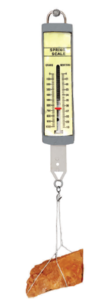
- Measuring Instrument: A spring balance is used to measure force. It contains a spring that stretches when a force is applied.
- Uses of Spring Balance: It is used to measure the weight of objects and pulling forces.
| Know This :
Scale of Forces in Nature : Human sensory touch registers minimum forces around millinewtons (10⁻³ N). In specialized physics research, scientists can detect forces as small as yoctonewtons (10⁻²⁴ N). |
Balanced and Unbalanced Forces :
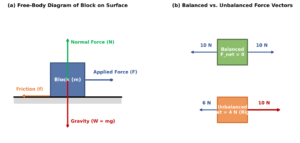
When two or more forces act on an object, their combined effect is called the net force.
Balanced Forces (Net Force = 0) :
When two or more forces acting on an object are equal in strength and opposite in direction, they cancel each other. These are called balanced forces.
Effects of Balanced Forces:
- They do not change the state of rest or motion of an object.
- The object does not accelerate.
Examples:
- Tug-of-War: When both teams pull with equal force, the rope does not move.
- Weightlifting: A weightlifter holding a barbell steadily overhead balances its weight with an upward force.
- Floating Ball: A ball floating at rest on water experiences an upward force equal to its downward weight.
Unbalanced Forces (Net Force ≠ 0) :
When two or more forces acting on an object do not cancel each other, they are called unbalanced forces.
Effects of Unbalanced Forces:
- They can change the speed of an object.
- They can change the direction of motion.
- They cause acceleration in an object.
Calculation of Net Force:
- Forces in the Same Direction: Add the forces.
Net Force = F₁ + F₂
- Forces in Opposite Directions: Subtract the smaller force from the larger force. The net force acts in the direction of the larger force.
Net Force = F₁ − F₂ (larger force minus smaller force)
With no forces acting on it, the ball stays at rest
The Opposing Force of Friction :
Friction is a force that opposes the motion or attempted motion of an object when it moves or tries to move over a surface.
- Friction always acts in the direction opposite to motion.
- It acts between two surfaces in contact.
- Friction makes it difficult for objects to move.
Example: When we push a box on the floor, friction acts in the opposite direction and resists its movement.
Forces Acting on a Box:
- The weight of the box acts downward.
- The normal force from the floor acts upward.
- These two vertical forces balance each other.
- The applied force acts forward, while friction acts backward.
- The box moves forward when the applied force is greater than friction.
Galileo's Thought Experiment and Newton's First Law :
Earlier, people believed that a continuous force was needed to keep an object moving. Galileo Galilei showed that this was not correct through his inclined plane experiment.
Galileo's Thought Experiment :
Galileo used two inclined planes and a marble to explain the effect of gravity and friction.
- Rolling Down: When a marble rolls down an inclined plane, its speed increases due to gravity.
- Rolling Up: When it moves up the opposite inclined plane, its speed decreases.
- Equal Height: The marble reaches the same height from which it was released.
- Horizontal Surface: If the second inclined plane is made completely horizontal, the marble will continue moving for a very long distance.
- Conclusion: In the absence of friction, a moving object continues to move without needing an additional force.
Newton's First Law of Motion :
Law of Inertia : An object at rest remains at rest, and an object in motion continues to move with constant velocity unless an external unbalanced force acts on it.
Mathematical Expression:
Fnet = 0 → a = 0
This means that when the net force is zero, there is no acceleration and the object's velocity remains constant.
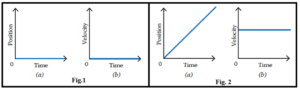
Graphs for zero net force :
| State | Position–time graph | Velocity–time graph |
| At rest (Fig.1 (a) & (b)) | Horizontal straight line (position does not change) | Horizontal line on the time axis (v = 0) |
| Constant velocity (Fig.2 (a) & (b)) | Inclined straight line (slope = velocity) | Horizontal line above time axis (v = constant) |
Concept of Inertia and Mass :
Inertia is the property of an object by which it resists any change in its state of rest or motion.
- An object at rest tends to remain at rest.
- A moving object tends to continue moving with the same velocity.
- Heavier objects have greater inertia than lighter objects.
- Mass is the measure of inertia.
Example: It is more difficult to push a 25 kg iron block than a 1 kg wooden block because the heavier block has greater inertia.
Newton's Second Law of Motion: Force and Momentum :
Newton's Second Law explains the relationship between force, mass and acceleration. It tells us how an object changes its motion when an unbalanced force acts on it.
Relationship Between Force, Mass and Acceleration
Two important relationships are:
- Force and Acceleration: When the mass of an object remains constant, acceleration increases with an increase in force.
a ∝ F
- Mass and Acceleration: When the applied force remains constant, acceleration decreases when the mass increases.
a ∝ 1/m
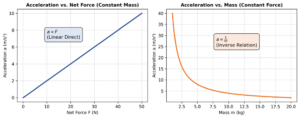
Example: A cart moves faster when we apply more force. A heavier cart needs more force to produce the same acceleration.
Statement and Formula of Newton's Second Law :
Statement: When an unbalanced force acts on an object, it produces acceleration in the direction of the force. Acceleration is directly proportional to force and inversely proportional to mass.
Mathematical Formula: F = m × a
Where:
- F = Force
- m = Mass
- a = Acceleration
Definition of One Newton:
One newton is the force required to produce an acceleration of 1 m/s² in an object of mass 1 kg.
1 N = (1 kg) × (1 m s⁻²) = 1 kg m s⁻²
Momentum and Rate of Change of Momentum :
Momentum is the product of the mass and velocity of an object.
p = m × v
Where:
- p = Momentum
- m = Mass
- v = Velocity
- Momentum depends on both mass and velocity.
- A heavier or faster-moving object has greater momentum.
- Momentum is a vector quantity.
- Its SI unit is kg m/s.
Newton's Second Law in Terms of Momentum:
The rate of change of momentum of an object is directly proportional to the applied net force and takes place in the direction of the force.
F ∝ \(\frac{Δp}{Δt}\)
F = \(\frac{Change\,in\,momentum}{Time}\)
For constant mass:
F = \(\frac{mv-mu}{t}\) = \(\frac{m(v-u)}{t}\) = m a => F = m a
Where:
- u = Initial velocity
- v = Final velocity
- t = Time taken
Practical Applications of Newton's Second Law
- Cricket Fielder: A fielder pulls their hands backwards while catching a fast ball. This increases the time taken to stop the ball and reduces the force on the hands.
- Coconut Falling on the Ground: When a falling coconut hits a hard surface, it stops in a very short time. This produces a large force and may crack the coconut.
- Car Airbags: Airbags increase the time taken for a person to stop during a collision. This reduces the impact force and helps prevent injuries.
- High Jump Mats: Soft landing mats increase the time taken by a person to stop after landing. This reduces the force on the body.
Newton's Third Law of Motion: Action and Reaction :
Newton's Third Law explains how two objects interact with each other.
Statement: Whenever one object applies a force on another object, the second object applies an equal and opposite force on the first object. This is known as the Action-Reaction Law.
Important Properties of Action-Reaction Forces
- Act on Two Different Objects: Action and reaction forces always act on two different objects. Therefore, they do not cancel each other.
- Equal and Opposite: Both forces are equal in strength but act in opposite directions.
- Act at the Same Time: Action and reaction forces occur simultaneously.
- Different Acceleration: If the masses of two objects are different, their accelerations will also be different, even though the forces are equal.
Everyday Examples of Newton's Third Law
- Walking and Cycling: Our feet push the ground backwards, and the ground pushes us forward. This helps us move.
- Rowing a Boat: The paddle pushes water backwards, and the water pushes the boat forward.
- Rocket Propulsion: A rocket pushes gases downwards, and the gases push the rocket upwards. This helps the rocket move upward.
Rocket motion in detail
| Stage | Explanation |
| Launch | Engine expels gas downward; gas exerts equal and opposite force upward on the rocket. This upward force is larger than the weight → net force upward → lift-off. |
| In space (slowing down) | If the engine fires in the direction of motion, the exhaust gases exert a force opposite to motion and slow the rocket. Used by the Vikram lander of Chandrayaan-3 to slow down and attain the velocity for a soft landing near the Moon’s south pole. |
| In space (changing velocity) | With negligible gravity, a spacecraft can change velocity only by expelling gas (PP 10): the reaction force changes its speed or direction. |
- Recoil of a Gun: When a bullet moves forward, the gun moves backwards due to an equal and opposite force.
Example of Gun Recoil: 5 kg gun firing a 0.1 kg bullet with 2 N force
- Mass of bullet = 0.1 kg
- Mass of gun = 5 kg
- Force on bullet = 2 N
- Force on gun = 2 N in the opposite direction.
Acceleration of bullet:
a = F/m = 2/0.1 = 20 m/s2
Acceleration of gun:
a = F/m = 2/5 = 0.4 m/s2
The bullet has greater acceleration because its mass is much smaller than the mass of the gun.
Forces Acting on a System of Connected Objects :
When two or more objects are connected by a string and move together, we can study them separately or as one complete system.
- Internal Forces:
- Internal forces act between the connected objects.
- For example, the tension force in a string acts between two connected boxes.
- These forces cancel each other when we consider both boxes as one system.
- External Forces:
- External forces act on the entire system from outside.
- For example, a pulling force applied to the first box moves both boxes.
- The external force accelerates the total mass of the system.
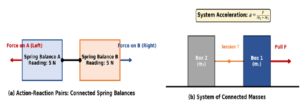
Formula :
System Acceleration: a = F / (m₁ + m₂)
Where:
- F = External pulling force
- m₁ and m₂ = Masses of the two boxes
- a = Acceleration of the system
Conclusion: When connected objects are considered as one system, internal forces cancel out, and external forces determine the motion of the system.
Solved Step-by-Step Numerical Examples :
| 📌 Example 1: Net Force Calculation on a Block Question: Two forces of 10 N and 6 N act on a block lying on a table. Calculate net force magnitude and direction for: (a) Both forces acting towards right. (b) 10 N right, 6 N left. (c) 10 N left, 6 N right. Solution: (a) Fnet = 10 N + 6 N = 16 N (towards Right). (b) Fnet = 10 N - 6 N = 4 N (towards Right). (c) Fnet = 10 N - 6 N = 4 N (towards Left). |
| 📌 Example 2: Weightlifter Holding Barbell Question: A weightlifter holds a barbell with 10 kg plates on each side and a 10 kg bar steady overhead. How much force does she apply? Solution: Total mass m = 10 kg + 10 kg + 10 kg = 30 kg. Downward weight force W = mg = 30 kg × 9.8 m s⁻² = 294 N. To keep barbell steady (Fnet = 0), weightlifter must exert F = 294 N upwards. |
| 📌 Example 3: Pushing a Block against Friction Question: A 25 kg stationary block faces maximum opposing friction of 50 N. Determine displacement in 2 seconds if pushed with constant force of (i) 50 N, (ii) 55 N. Solution: (i) Fnet = 50 N - 50 N = 0 N => Block remains stationary (Displacement s = 0 m). (ii) Fnet = 55 N - 50 N = 5 N (forward). Acceleration a = Fnet / m = 5 N / 25 kg = 0.2 m s⁻². Displacement s = u × t + (1/2) × a × t² = (0)(2) + (0.5)(0.2)(2²) = 0.4 m (forward). |
| 📌 Example 4: Force Analysis from Velocity-Time Graph Question: A sports car of mass 1500 kg moves east. Its v-t graph shows velocity rising linearly from 0 to 10 m/s in 5s, staying 10 m/s for 5s, and dropping to 0 in 5s. Calculate net force in each interval. |
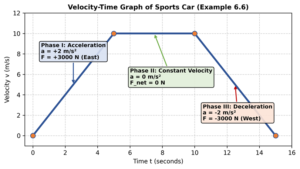
Solution:
(i) 0 s to 5 s: u = 0, v = 10 m/s, t = 5s => a = (10 - 0)/5 = +2 m s⁻².
Force F = m*a = 1500 kg × 2 m s⁻² = +3000 N (East).
(ii) 5 s to 10 s: Constant velocity (v = 10 m/s)
=> a = 0 m s⁻²
=> F_net = 0 N.
(iii) 10 s to 15 s: u = 10 m/s, v = 0, t = 5s
=> a = (0 - 10)/5 = -2 m s⁻².
Force F = 1500 kg × (-2 m s⁻²) = -3000 N (3000 N West).
We reply to valid query.