Notes
| Topics Covered
● How to Study Cells — microscopy & magnification ● Structure of a Cell — membrane & cell wall ● Osmosis, Diffusion & Tonicity ● The Cell Interior — organelles & their functions ● Prokaryotic vs Eukaryotic Cells ● Cell Growth, Division — Mitosis & Meiosis ● Cell Theory |
Introduction — Origin of the Cell
Origin of Life : Scientists believe that life first originated in water. Some researchers think that life began in small pools of water with changing environmental conditions rather than in the oceans. Hot springs are examples of such environments.
Hot Springs of Puga Valley : The Puga Valley in Ladakh has hot springs with water temperatures close to the boiling point, even in a very cold climate. These conditions are believed to be similar to those on the early Earth about 3.5 billion years ago. The organisms living in these hot springs are mainly thermophiles, which are heat-loving, single-celled (unicellular) bacteria.
Scientists' Findings : Scientists from the Birbal Sahni Institute of Palaeosciences, Lucknow studied the hot springs of Puga Valley.
- They found that calcium carbonate was formed rapidly around the hot springs.
- These deposits may have protected early organic molecules from harmful radiation and harsh conditions.
- They may have also helped in the formation of the first protective cell membrane, which surrounds and protects a cell.
Cells – The Basic Unit of Life :
All living organisms are made up of cells. A cell is the basic structural and functional unit of life.
- Unicellular organisms : Some organisms, such as bacteria and yeast, have only one cell. They are called unicellular organisms.
- Multicellular organisms : Organisms such as plants, fish, birds, and humans have millions of cells. They are called multicellular organisms.
Organisation of Cells :
- A group of similar cells performing the same function forms a tissue.
- Different tissues join together to form an organ.
- Several organs work together to form an organ system.
- For example, the nasal pores, nasal cavity, trachea, and lungs together form the respiratory system.
Importance of Cells :
- Even in complex organisms, the cell remains the basic unit of structure and function.
- Cells perform many important activities such as growth, repair, reproduction, and communication.
- In this chapter, we will learn about the parts of a cell, how cells communicate, and how cells grow and die as we explore the fascinating world of cells.
| Exam Tip
● Remember the hierarchy: Cell → Tissue → Organ → Organ System → Organism. ● The cell is called the structural AND functional unit of life — this phrase is a favourite one-mark/definition question. |
How to Study Cells?
Limit of Resolution of the Human Eye :
- The human eye can see two very close objects as separate only up to a certain limit. This ability is called the limit of resolution of the human eye.
- When viewed from about 25 cm, two points must be at least 0.1 mm apart to be seen separately. If they are closer than 0.1 mm, they appear as a single point.
Why Do We Need a Microscope?
- Most cells are too small to be seen with the naked eye.
- Therefore, scientists use a microscope to study the structure and function of cells.
- A microscope uses convex lenses to make objects appear larger.
- It has two main lenses:
- Objective lens
- Eyepiece lens
- These lenses magnify tiny objects so that they can be seen clearly.
Robert Hooke – Discovery of the Cell
- In 1665, Robert Hooke became the first person to observe cells.
- He used a self-designed microscope with 200–300× magnification.
- While observing a thin slice of cork, he saw many small box-like compartments. He named these compartments "cells."
Light Microscope :
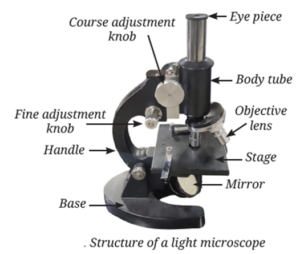
- Light microscopes are commonly used in school laboratories.
- They use visible light to observe tiny objects.
- Different objective lenses, such as 10× and 40×, provide different levels of magnification.
- A microscope shows a magnified image, making the fine details of an object visible.
Three key features scientists have improved in microscopes over the years:
- Resolution — measure of clarity (ability to distinguish two close points).
- Contrast — difference in brightness between different parts of an object.
- Magnification — how much larger the object appears.
| Formula
Estimated cell size = \(\frac{\text{Diameter of visible field(µm)}}{\text{Number of cells along diameter}}\) Unit conversion: 1 mm = 1000 µm |
| Memory Aid
● R-C-M → 'Really Clear Magnification' helps recall Resolution, Contrast, Magnification. ● Nanometre = one-billionth of a metre (10⁻⁹ m); Micrometre = one-millionth of a metre (10⁻⁶ m). |
Structure of a Cell
Cell as a Functional Unit
- Cells are organised into tissues and organs to perform specific functions.
- To work properly, cells must communicate with each other and with their surroundings.
- This exchange of substances takes place through the cell membrane.
- Even unicellular organisms interact with their environment through the cell membrane.
Cell Membrane – The Universal Feature of a Cell
- The cell membrane is a thin outer covering that surrounds the cell.
- It protects the cell and gives it a definite shape.
- It is also called the plasma membrane.
- The cell membrane is selectively permeable, which means it allows some substances to enter or leave the cell while blocking others.
Diffusion and Osmosis :
- Cells interact with their surroundings through the movement of particles across gradients.
- The cell membrane allows water to move in and out of the cell but not sugar or salt molecules.
- Water moves from a region of higher water concentration (dilute solution) to a region of lower water concentration (concentrated solution) until concentrations equalise.
Osmosis : Osmosis is the movement of water through a selectively permeable membrane.
- Water moves from a dilute solution (more water, less solute) to a concentrated solution (less water, more solute).
- This movement continues until the concentration becomes equal on both sides.
- In plants, water enters root cells by osmosis.
Diffusion : Diffusion is the movement of particles from a region of higher concentration to a region of lower concentration.
- Diffusion does not require a membrane.
- Osmosis is a special type of diffusion in which only water moves through a selectively permeable membrane.
Tonicity — Effect of Solutions on Cells :
| Term | Condition | Effect on Cell |
| Isotonic solution | Solute conc. outside = Solute conc. inside | No net water movement; cell size unchanged |
| Hypotonic solution | Solute conc. outside < Solute conc. inside | Water enters cell; cell swells |
| Hypertonic solution | Solute conc. outside > Solute conc. inside | Water leaves cell; cell shrinks |
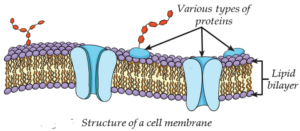
Structure of the Cell Membrane :
- The cell membrane is very thin, about 7–10 nanometres (nm) thick.
- It is made of lipids (fats) and proteins.
- According to the fluid-mosaic model, the membrane has:
- A lipid bilayer (two layers of fat molecules).
- Proteins embedded in the lipid layers.
- The lipid and protein molecules can move sideways, making the membrane fluid.
- The proteins act like gatekeepers, controlling the movement of substances into and out of the cell.
- The arrangement of molecules looks like a mosaic, so it is called the fluid-mosaic model.
Cell Communication :
- The cell membrane helps cells exchange materials with their surroundings.
- It also helps cells communicate with neighbouring cells.
Cell Wall – The Outer Covering of Plant Cells :
- Plant cells have an extra outer covering called the cell wall.
- The cell wall is present outside the cell membrane.
- It provides strength, support, and protection to the plant cell.
- It helps plants remain upright and withstand wind, rain, and other environmental stresses.
- It also helps leaves and flowers maintain their shape.
Permeability of the Cell Wall : The cell wall is permeable, which means water and dissolved minerals can pass through it.
- The cell membrane is selectively permeable, allowing only certain substances to pass.
- Together, the cell wall and cell membrane help plant roots absorb water and nutrients from the soil.
Effect of Osmosis on Plant Cells :
- When a Rhoeo leaf or onion peel is placed in a concentrated sugar solution, water moves out of the cells by osmosis.
- The cell membrane pulls away from the cell wall, and the inner contents shrink.
- However, the cell does not lose its shape because the rigid cell wall supports it.
- This shows that the cell wall helps plant cells remain firm.
Animal Cells :
- Animal cells do not have a cell wall.
- When placed in a concentrated sugar solution, they lose water and shrink.
- Since they do not have a rigid cell wall, animal cells can change their shape easily.
- This flexibility helps in the movement and functioning of animal tissues.
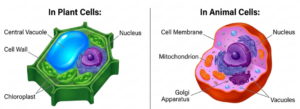
This flexibility-vs-rigidity difference is why animal cells can easily change shape (supporting movement) while plant cells stay firm.
| Exam Tip
● A common HOTS question: 'Why do plant cells not shrink in salt solution but animal cells do?' → Answer using cell wall rigidity. ● Remember: Cell membrane = present in ALL cells; Cell wall = present only in plants, fungi, bacteria. |
Composition of the Cell Wall :
- The plant cell wall is mainly made of cellulose.
- Cellulose is a type of carbohydrate made up of many glucose molecules.
- In our diet, cellulose acts as roughage, which helps in proper digestion.
Cell Wall in Other Organisms :
- Some microorganisms, such as fungi and bacteria, also have a cell wall.
- Their cell wall provides protection, support, and strength to the cells.
The Cell Interior — A Coordinated Working System
Main Parts of a Cell : Most cells have three basic parts:
- Cell (Plasma) Membrane – A selectively permeable membrane that surrounds the cell.
- Cytoplasm – A semi-fluid, jelly-like substance inside the cell.
- Nucleus – A prominent structure that controls the activities of the cell.
Cytoplasm : The cytoplasm fills the inside of the cell. It contains several cell organelles and other substances.
- Most organelles are too small to be seen with a light microscope and can only be seen with an electron microscope.
- The organelles work together to perform different functions of the cell.
Cell Organelles : Cell organelles are specialised structures present in the cytoplasm. Each organelle performs a specific function. Together, they help the cell work efficiently.
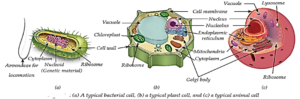
Prokaryotic Cells : Bacterial cells do not have a well-defined nucleus. They also lack membrane-bound organelles. Such cells are called prokaryotic cells.
- The word "pro" means primitive, and "karyon" means nucleus.
- In prokaryotic cells, most cellular activities take place directly in the cytoplasm.
Eukaryotic Cells : Plant and animal cells have a well-defined nucleus. They also contain membrane-bound organelles. Such cells are called eukaryotic cells.
- The word "eu" means true, and "karyon" means nucleus.
- Eukaryotic cells are more complex than prokaryotic cells.
Difference Between Prokaryotic and Eukaryotic Cells :
| Characteristic | Prokaryotic Cell | Eukaryotic Cell |
| Nucleus | Have no well-defined nucleus | Have a well-defined nucleus |
| Membrane-bound organelles | Absent | Present |
| Diameter (typical) | 1 to 10 µm | 10 to 100 µm |
| Number of cells in organism | Usually unicellular | Unicellular or multicellular |
| Genetic material | Single circular DNA molecule (nucleoid region) | DNA organised into chromosomes within nucleus |
| Examples | Bacteria | Plants, animals, fungi, protists |
| Cellular activities | Cellular activities occur in the cytoplasm | Cellular activities are carried out by different organelles |
Cell Organelles and Their Functions :
Importance of Cell Organelles :
- Eukaryotic cells contain different cell organelles.
- Each organelle performs a specific function.
- Different organelles carry out different life processes at the same time.
- Cell organelles help in:
- Making new materials
- Removing waste
- Producing energy
- Together, they help the cell function efficiently.
- A cell can be compared to a tiny living factory, where each organelle has a special job.
Nucleus – The House of Coded Instructions :
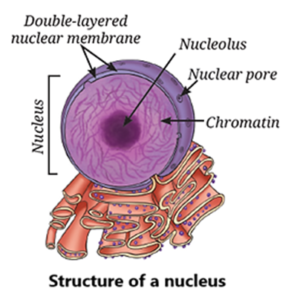
- The nucleus is the control centre of the cell.
- It stores the genetic information and controls all the activities of the cell.
Nuclear Membrane :
- The nucleus is surrounded by a double-layered membrane called the nuclear membrane.
- The nuclear membrane has tiny pores.
- These pores allow the exchange of materials between the nucleus and the cytoplasm.
Nucleolus :
- Inside the nucleus is a dense, round structure called the nucleolus.
- The nucleolus makes the subunits of ribosomes.
- These subunits move into the cytoplasm, where they join together to form ribosomes.
Chromosomes :
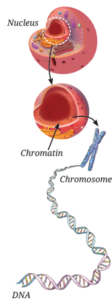
- The nucleus contains chromosomes.
- Chromosomes become clearly visible when the cell is about to divide.
- They carry the hereditary information that is passed from parents to their offspring.
DNA and Genes :
- Chromosomes are made of DNA (Deoxyribonucleic Acid) and proteins.
- DNA stores the genetic information of an organism.
- The functional parts of DNA are called genes.
- Genes control inherited characteristics such as eye colour, height, and blood group.
Chromatin :
- In a non-dividing cell, DNA is present as chromatin.
- Chromatin appears as a thread-like network inside the nucleus.
- When the cell is about to divide, the chromatin condenses to form chromosomes.
Nucleus in Prokaryotic Cells :
- Prokaryotic cells do not have a well-defined nucleus.
- Their DNA is present as a single circular molecule associated with proteins.
- This DNA is found in a region called the nucleoid.
- The nucleoid is not surrounded by a nuclear membrane.
Ribosomes – The Protein Factories :
- Ribosomes are tiny structures present in the cell.
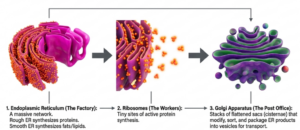
- They may be free in the cytoplasm or attached to the rough endoplasmic reticulum (RER).
- Ribosomes are the sites of protein synthesis.
- They make the proteins needed for the growth, repair, and functioning of the cell.
Endoplasmic Reticulum (ER) – The Manufacturing Factory :
- The Endoplasmic Reticulum (ER) is a network of membrane-bound tubes and sacs present in the cytoplasm.
- It is connected to the outer membrane of the nucleus.
- The ER helps in the manufacture and transport of proteins, fats (lipids), and some hormones.
- The structure of the ER varies according to the function of the cell.
Types of Endoplasmic Reticulum :
- Rough Endoplasmic Reticulum (RER) : RER has ribosomes attached to its surface, so it appears rough. It is mainly involved in the synthesis and transport of proteins. It is well developed in protein-secreting cells, such as pancreatic gland cells.
- Smooth Endoplasmic Reticulum (SER) : SER does not have ribosomes on its surface, so it appears smooth. It helps in the synthesis and storage of fats (lipids) and hormones.
Golgi Apparatus – The Packaging and Shipping Centre :
- The Golgi apparatus is made up of stacks of flattened, sac-like structures.
- It is connected with the ER, cell membrane, and other cell organelles.
- It modifies, sorts, and packages proteins and lipids.
- These materials are packed into vesicles for transport, storage, secretion, or the formation of lysosomes.
- The Golgi apparatus is often called the "post office" or "packaging and shipping centre" of the cell.
Lysosomes – The Clean-up System :
- Lysosomes are single membrane-bound sacs filled with digestive enzymes.
- They break down unwanted proteins, carbohydrates, fats, and damaged cell parts.
- Lysosomes help remove waste materials, keeping the cell clean and healthy.
- The useful products formed after digestion are released into the cytoplasm.
- These products are reused by the cell in other cellular processes.
- Therefore, lysosomes are known as the "clean-up system" or "recycling centres" of the cell.
Mitochondria – The Powerhouse of the Cell :
- Mitochondria are called the "powerhouses of the cell".
- They produce the energy needed for most cellular activities.
Structure of Mitochondria :
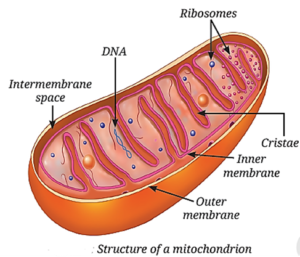
Each mitochondrion is surrounded by two membranes.
- The outer membrane is smooth and porous.
- The inner membrane is folded into finger-like projections called cristae.
- Cristae increase the surface area for energy-producing chemical reactions.
Function of Mitochondria :
- Mitochondria break down glucose and other food molecules during cellular respiration. This process releases energy.
- The energy is stored in the form of ATP (Adenosine Triphosphate).
- ATP is called the energy currency of the cell because it provides energy for all cellular activities.
Plastids – The Centre for Food Synthesis in Plant Cells :
- Plastids are special organelles found only in plant cells.
- They help in the manufacture and storage of food.
- Animals obtain food from their surroundings, but plants prepare their own food.
Chloroplast – A Type of Plastid :
- Chloroplasts are a type of plastid.
- They contain a green pigment called chlorophyll.
- Chlorophyll absorbs sunlight and helps plants prepare food by photosynthesis.
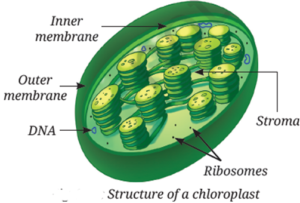
Structure of Chloroplast :
Chloroplasts are surrounded by two membranes.
- Inside the chloroplast is a semi-fluid substance called the stroma.
- The stroma contains disc-shaped membrane structures with chlorophyll.
- These structures absorb light energy during photosynthesis.
- The sugars produced during photosynthesis are stored in the stroma, along with starch granules.
Similarities Between Mitochondria and Plastids :
- Both mitochondria and plastids have their own DNA and ribosomes.
- They can make some of their own proteins.
- These features suggest that they evolved from ancient bacteria.
Key Functions of Mitochondria and Plastids :
| Organelle | Main Function |
| Mitochondria | Produce energy (ATP) by cellular respiration. |
| Plastids (Chloroplasts) | Prepare food by photosynthesis and store food in plant cells. |
How Do Flowers, Fruits, and Vegetables Get Different Colours? :
Chromoplasts – The Colour-Giving Plastids :
- Chromoplasts are a type of plastid found in plant cells. They contain pigments other than chlorophyll. These pigments may be yellow, orange, or red.
- Chromoplasts give bright colours to flowers, fruits, and some vegetables.
- Bright colours attract pollinators such as bees and butterflies for pollination.
- They also attract fruit-eating animals, which help in seed dispersal.
Leucoplasts – The Food Storage Plastids :
- Leucoplasts are colourless plastids because they do not contain pigments.
- They mainly store food in plant cells. They store starch, oils, or proteins.
- For example, the leucoplasts in potato and taro (Colocasia) store starch.
Vacuoles – The Organelles for Storage and Support :
- Vacuoles are membrane-bound organelles present in the cell.
- In a mature plant cell, there is usually one large central vacuole.
- It is surrounded by a single selectively permeable membrane.
- The vacuole is filled with a watery fluid called cell sap.
Functions of Vacuoles :
- Vacuoles store water, minerals, sugars, and waste materials.
- They help maintain pressure inside the cell, keeping the plant cell firm and upright.
- When a plant does not get enough water, the vacuole loses water.
- As a result, the cells become less firm, and the plant wilts.
Vacuoles in Animal Cells :
- Animal cells may also have vacuoles.
- They are smaller than the vacuoles in plant cells.
- They help in the temporary storage of materials.
Types of Plastids and Their Functions :
| Type of Plastid | Pigment/Contents | Function |
| Chloroplast | Chlorophyll (green pigment) | Absorbs sunlight for photosynthesis; stores sugars/starch in the stroma |
| Chromoplast | Yellow, orange or red pigments | Gives colour to flowers/fruits; attracts pollinators & seed dispersers |
| Leucoplast | Colourless (no pigment) | Stores food — starch, oils, or proteins (e.g., potato, taro) |
How Do Normal Cells Grow and Divide?
Growth of Cells :
- Our body grows because cells divide to form new cells.
- Cells also replace old, dead, or damaged cells.
- For example, cuts on the skin heal and new hair grows because of cell division.
- Cells can grow only up to a certain size, so body growth mainly occurs through cell division.
Cell Division :
- Cell division is the process by which one cell divides to form new cells.
- It helps in growth, repair, and replacement of cells.
- In the growing tip of an onion root, cells divide continuously.
- Therefore, onion root tips are commonly used to study cell division.
Stages of Cell Division : During cell division, a cell passes through different stages. Cells at the onion root tip show different structures because they are at different stages of division.
Cell Replacement :
- Every day, hundreds of billions of cells in our body are replaced.
- This is about 1% of the total number of cells in the human body.
- Continuous cell replacement keeps our body healthy and functioning properly.
Cell Division in Different Organisms :
- Both prokaryotic and eukaryotic cells divide.
- Prokaryotic cells divide by a simple process.
- Eukaryotic cells divide in a controlled and orderly manner through a process called the cell cycle.
Cell Division :
Cell division is the process by which new cells are formed from pre-existing cells. It helps living organisms to grow, repair damaged tissues, and reproduce. Some cells, such as skin cells, divide continuously to replace old or damaged cells.
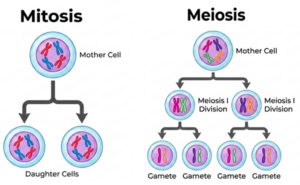
There are two main types of cell division: (i) Mitosis (ii) Meiosis
(i) Mitosis :
- Mitosis is the most common type of cell division.
- It is responsible for growth, repair, maintenance, and asexual reproduction.
- Every human begins life as a single fertilised egg, which divides repeatedly by mitosis to form trillions of cells.
Features of Mitosis :
- One parent cell divides to form two daughter cells.
- The daughter cells are genetically identical to the parent cell.
- Each daughter cell has the same DNA and the same number of chromosomes as the parent cell.
- Mitosis helps maintain the genetic information in body cells.
(ii) Meiosis :
- Meiosis is a type of cell division that produces gametes (sex cells).
- It occurs only in the reproductive organs.
- Meiosis is important for sexual reproduction and genetic diversity.
Where Does Meiosis Occur? :
- In Animals : In males, meiosis occurs in the testes to produce sperms. In females, meiosis occurs in the ovaries to produce eggs (ova).
- In Plants : Meiosis occurs in the anthers to produce pollen grains. It also occurs in the ovaries to produce egg cells.
Features of Meiosis :
- One parent cell divides twice. It produces four daughter cells.
- Each daughter cell has half the number of chromosomes compared to the parent cell.
- During fertilisation, the sperm and egg fuse, restoring the original chromosome number.
- Meiosis creates genetic variation, so children resemble their parents but are not exactly the same.
Difference Between Mitosis and Meiosis :
| Mitosis | Meiosis |
| Produces 2 daughter cells | Produces 4 daughter cells |
| Daughter cells are genetically identical | Daughter cells are genetically different |
| Chromosome number remains the same | Chromosome number is reduced to half |
| Occurs in body cells | Occurs in reproductive cells |
| Helps in growth, repair, and maintenance | Helps in sexual reproduction and genetic diversity |
Errors in Cell Division :
- Errors in Mitosis : Errors in mitosis can cause uncontrolled cell division. This may lead to the formation of tumours. It may also cause an abnormal number of chromosomes in body cells.
- Errors in Meiosis : Errors in meiosis can lead to genetic disorders. These disorders may cause developmental problems or distinctive physical features. Faulty meiosis may also result in early pregnancy loss or reduced fertility.
Cell Theory — The Unifying Principle of Biology
Development of Cell Theory :
- In 1838, the German botanist Matthias Schleiden stated that all plants are made up of cells.
- In 1839, the German zoologist Theodor Schwann stated that all animals are made up of cells.
- In 1855, the German scientist Rudolf Virchow added that new cells arise only from pre-existing cells.
Their discoveries together led to the Cell Theory.
Cell Theory : According to the Cell Theory: All living organisms are made up of one or more cells. The cell is the basic structural and functional unit of life. All new cells arise from pre-existing cells.
Importance of Cell Theory :
- Cell Theory explains that all living organisms, from bacteria to humans, are made of cells.
- It shows that life continues through cell division.
- It is considered the unifying principle of biology.
Do Cells Grow and Reproduce Forever?
Life Span of Cells :
- Cells grow, divide, perform their functions, and eventually die.
- Every cell has a definite life span.
- Dead cells are replaced by new cells that perform the same function.
- This helps keep the body healthy and functioning properly.
Contact Inhibition : In many animal cells, cell division stops when cells come into contact with neighbouring cells. This process is called contact inhibition. Contact inhibition helps control normal cell growth.
Cancer Cells :
- Cancer cells lose the ability to show contact inhibition.
- They continue to divide uncontrollably.
- This uncontrolled growth leads to the formation of tumours.
Growth in Plant Cells : Plant cells have a rigid cell wall. They do not show contact inhibition. Therefore, plant cells follow a different pattern of growth.
Importance of Cells :
Cells are very small, but they perform many important functions.
They:
- Produce energy
- Make and secrete substances
- Divide to form new cells
- Work together to keep the body functioning properly
Every living organism, from a tiny bacterium to a giant tree, is made up of cells.
Cells are the basic building blocks of all living organisms.
| Know This :
Scientific Frontiers :
Advancements in Cell Biology : Modern science has moved from observing the building blocks of life to actively repairing and editing them.
|
Scientists who contributed:
- Robert Hooke: In 1665, he was the first person to observe a cell using a self-designed microscope. While examining a thin slice of cork, he noticed box-like compartments and named them "cells".
- Camillo Golgi: An Italian scientist who, in 1898, first observed a thread-like network in the nerve cells of a barn owl using special staining techniques. This structure was later named the Golgi apparatus in his honor.
- J. Craig Venter: In 2010, his team studied the DNA sequence of the bacterium Mycoplasma mycoides and chemically synthesized an exact copy of its DNA. By inserting this synthetic DNA into another cell, they demonstrated that DNA controls the structure and activities of a cell.
- Arun Kumar Sharma: A famous Indian scientist and botanist known for his work on chromosomes, plant taxonomy, and evolution. He invented several laboratory methods to study plant chromosomes and received honors such as the Padma Bhushan.
- Matthias Schleiden: A German botanist who reported in 1838 that all plants are made up of cells.
- Theodor Schwann: A German zoologist who found in 1839 that all animals are also made up of cells.
- Rudolf Virchow: In 1855, he expanded the Cell Theory by stating that new cells are formed only from pre-existing cells.
- Gottlieb Haberlandt: An Austrian botanist who proposed in 1902 that any living plant cell has the ability to develop into a complete plant, a concept known as totipotency. His work laid the foundation for Plant Tissue Culture Technology.
Glossary of Key Terms :
| Term | Definition |
| Cell | The basic structural and functional unit of all living organisms. |
| Limit of resolution | The smallest distance at which two points can be seen as separate; 0.1 mm for the human eye. |
| Magnification | The apparent enlargement of an object as seen through a lens/microscope. |
| Thermophiles | Heat-loving unicellular bacteria found in hot springs. |
| Cell membrane (plasma membrane) | Thin, selectively permeable boundary surrounding a cell. |
| Selectively permeable | Allows some substances to pass through while blocking others. |
| Fluid-mosaic model | Model describing the cell membrane as a fluid lipid bilayer studded with mobile proteins. |
| Diffusion | Net movement of particles from higher to lower concentration. |
| Osmosis | Diffusion of water across a selectively permeable membrane. |
| Isotonic / Hypotonic / Hypertonic | Terms comparing solute concentration outside vs inside a cell. |
| Cell wall | Rigid outer covering (cellulose-based) found in plant, fungal, and bacterial cells. |
| Cytoplasm | Semi-fluid, jelly-like substance filling the cell, containing organelles. |
| Organelle | A specialised sub-cellular structure performing a specific function. |
| Nucleus | Membrane-bound control centre containing genetic material (in eukaryotic cells). |
| Chromatin / Chromosome | Thread-like DNA-protein complex; condenses into chromosomes during cell division. |
| Gene | A functional segment of DNA carrying hereditary information. |
| Ribosome | Site of protein synthesis; free or attached to ER. |
| Endoplasmic reticulum (ER) | Network organelle for synthesis/transport of proteins, lipids, and hormones. |
| Golgi apparatus | Organelle that modifies, sorts, and packages proteins/lipids into vesicles. |
| Lysosome | Membrane-bound sac of enzymes that digests waste and worn-out cell parts. |
| Mitochondrion | 'Powerhouse' organelle; site of cellular respiration and ATP production. |
| Cristae | Finger-like folds of the inner mitochondrial membrane. |
| ATP (Adenosine Triphosphate) | The energy currency of the cell. |
| Plastid | Plant organelle for food synthesis/storage (chloroplast, chromoplast, leucoplast). |
| Chlorophyll | Green pigment in chloroplasts that absorbs light for photosynthesis. |
| Stroma | Semi-fluid matrix inside the chloroplast. |
| Vacuole | Storage organelle; large and central in mature plant cells, filled with cell sap. |
| Prokaryotic cell | Cell lacking a well-defined nucleus and membrane-bound organelles. |
| Eukaryotic cell | Cell with a well-defined nucleus and membrane-bound organelles. |
| Nucleoid | Region in a prokaryotic cell containing genetic material (no membrane). |
| Cytoskeleton | Network of fine fibres providing structural support and enabling movement inside eukaryotic cells. |
| Cell division | Process by which new cells form from pre-existing cells. |
| Mitosis | Cell division producing two genetically identical daughter cells. |
| Meiosis | Two-step cell division in reproductive cells producing four gametes with half the chromosome number. |
| Gamete | Reproductive cell (sperm, egg, or pollen) formed by meiosis. |
| Contact inhibition | Stopping of cell division when cells contact neighbouring cells. |
| Tumour | Mass formed by uncontrolled cell division. |
| Programmed Cell Death (PCD) | Genetically regulated, organised process of selective cell destruction. |
| Cell theory | Unifying principle: all organisms are made of cells; the cell is the basic unit of life; all cells arise from pre-existing cells. |
| Cell culture | Technique of growing cells outside the body in a nutrient-rich medium. |
| Totipotency | The ability of a plant cell to develop into a complete new plant. |
Quick Revision — At a Glance :
- The cell is the basic structural and functional unit of all living organisms.
- Prokaryotic cells lack a well-defined nucleus (genetic material in the nucleoid) and lack membrane-bound organelles.
- Eukaryotic cells are larger, more complex, with a well-defined nucleus and membrane-bound organelles.
- All cells have a cell membrane; plant, fungal, and bacterial cells additionally have a cell wall.
- The nucleus contains chromosomes (DNA + proteins) carrying genetic information.
- Cytoplasm in eukaryotic cells houses organelles, each with a specific function.
- Key organelles: nucleus, ER, mitochondria, Golgi apparatus, ribosomes, lysosomes.
- Plant cells also have plastids (chloroplasts, chromoplasts, leucoplasts) and usually a large central vacuole.
- Mitosis → 2 identical daughter cells (growth/repair); Meiosis → 4 daughter cells with half the chromosome number (gametes/genetic diversity).
- Normal cells grow, function, and die in a controlled way; cancer cells divide uncontrollably, forming tumours.
- Cell Theory: all organisms are made of cells; the cell is life's basic unit; all cells arise from pre-existing cells.
| Last-Minute Exam Tips
● Draw and label a simple animal cell and plant cell diagram — practice this, as labelling questions are common. ● Be ready to differentiate: Cell membrane vs Cell wall | RER vs SER | Chloroplast vs Chromoplast vs Leucoplast | Mitosis vs Meiosis | Prokaryotic vs Eukaryotic. ● Osmosis/potato-experiment based questions are frequently asked as case studies — understand WHY water moves, not just the observation. ● Remember real-life links: RBCs (no nucleus), sperm (lysosomal enzymes), fingers (PCD), cancer (contact inhibition loss). |
We reply to valid query.