Solutions (Exercise + Intext)
The Big Questions :
Question 1. How can we measure and monitor the weather around us?
We can measure and monitor the weather using weather instruments and weather stations.
(i) Using Weather Instruments :
Different instruments are used to measure different elements of weather:
- Thermometer → measures temperature
- Rain Gauge → measures rainfall
- Barometer → measures air pressure
- Anemometer → measures wind speed
- Wind Vane → shows wind direction
- Hygrometer → measures humidity
(ii) Using Weather Stations : A weather station has all these instruments in one place. It records weather data regularly.
Question 2. How do weather predictions help us prepare for events like heavy rain, storms, drought and heat waves?
Weather predictions help us prepare for extreme events by providing early warnings that allow for the mobilization of resources and timely action. These predictions are increasingly vital as climate change makes extreme weather more frequent. Preparation efforts include:
- Storms and Cyclones: Predictions allow local governments to issue warnings to fishermen against going to sea and, if necessary, to evacuate entire coastal areas.
- Heavy Rain and Flooding: Forecasting enables authorities to prepare for potential disasters and manage resources effectively to assist affected populations.
- Heat Waves and Drought: Accurate data helps in monitoring these conditions, allowing for advanced planning in agriculture and environmental management.
- Safety in Travel and Industry: Pilots and sailors rely on wind and pressure data for safe navigation, while industries use wind socks to monitor the spread of released gases or ash
Intext/Textbook Exercises :
Let's Explore :
Question 1. What are some of the words in your local language that you use to describe the weather? Hot, cold, warm, chilly, crisp, pleasant and so on, are commonly used terms in English. (Page 28)
Here are some common Hindi words used to describe weather, similar to English words like hot, cold, pleasant, etc.
| English Term | Hindi Word | Usage Example |
| Hot | गरम (Garam) | आज मौसम गरम है। (The weather is hot today.) |
| Cold | ठंडा (Thandā) | पानी बहुत ठंडा है। (The water is very cold.) |
| Warm | गुनगुना (Gungunā) | गुनगुना पानी पीना अच्छा है। (It’s good to drink lukewarm water.) |
| Chilly / Cool | सर्द (Sard) | बाहर सर्दी है। (It’s chilly outside.) |
| Sunny | धूपदार (Dhoopdār) | आज धूपदार दिन है। (It’s a sunny day.) |
| Cloudy | बादलों से घिरा (Bādlon se Ghirā) | आसमान बादलों से घिरा है। (The sky is cloudy.) |
| Rainy | बरसाती (Barsātī) | बरसाती मौसम में छाता जरूरी है। (Umbrella is needed in rainy weather.) |
| Foggy | कोहरा (Kohra) | सुबह कोहरा छाया हुआ था। (It was foggy in the morning.) |
| Humid | नम (Nam) | नम मौसम में पसीना आता है। (Humid weather makes you sweat.) |
| Dry | खुश्क (Khushk) | रेगिस्तान का मौसम खुश्क होता है। (Desert weather is dry.) |
Question 2. What do you think could be some other reasons to measure the weather more precisely? (Hint : Think how knowing the weather a few hours or a few days in advance would help you plan some activities.) (Page 29)
If we know the weather a few hours or days in advance, we can make smarter decisions in daily life. Here are some important reasons:
- Planning daily activities : We can decide what to wear (carry an umbrella, wear warm clothes, etc.). Plan outdoor activities like picnics, sports, or trips. Avoid going out during heavy rain or extreme heat
- Helping farmers : Farmers can plan when to sow seeds, water crops, or harvest. They can protect crops from storms, frost, or drought.
- Travel and transport : Helps people plan journeys and avoid delays. Pilots, train drivers, and ship captains rely on weather forecasts for safety
- Safety and disaster preparedness : Early warnings about storms, cyclones, floods, or heat waves help save lives. People can take precautions like staying indoors or moving to safe places
- School and events planning : Schools can plan sports days or outdoor activities. Organizers can manage events like fairs, weddings, or matches
Accurate weather measurement helps us stay prepared, safe, and organized in our daily life.
Question 3. Here's a chart of the temperatures of a city in Madhya Pradesh. What is the maximum temperature recorded in the week shown here? What is the minimum? Calculate the range. (Page 32-33)
| Date | Maximum Temperature
(in ℃) |
Minimum Temperature
(in ℃) |
| 28.02.2025 | 29 | 16 |
| 01.03.2025 | 30 | 15 |
| 02.03.2025 | 31 | 17 |
| 03.03.2025 | 32 | 18 |
| 04.03.2025 | 30 | 17 |
| 05.03.2025 | 28 | 14 |
| 06.03.2025 | 29 | 15 |
- Maximum Temperature: The highest temperature recorded during the week was 32°C (on 03.03.2025).
- Minimum Temperature: The lowest temperature recorded during the week was 14°C (on 05.03.2025).
- Range of Temperature: The range is calculated by subtracting the minimum temperature from the maximum temperature.
- Calculation: 32°C - 14°C = 18°C,.
Question 4. Remember the conversation between Krishnan and Amir? If Krishnan said it was 20C in Chennai and he was feeling a little cold, he and Amir would have a measure they could understand. What do you think Amir's reaction to Krishnan's statement might be? (Page 33)
- Amir would likely feel surprised or amused because 20°C would seem pleasant or even warm to him in Kashmir.
- This shows that the feeling of “cold” is subjective and depends on what a person is used to.
- While someone from a warmer place like Chennai may feel cold at 20°C, a person from a colder region like Kashmir finds it comfortable.
- Using a standard temperature like 20°C helps both understand the weather clearly, even if their experiences are different.
Question 5. Where do you think humidity is likely to be more, Kochi or Jaipur? You might guess that Kochi has higher humidity than Jaipur because it is located near the sea. But how will we know for sure? If we had to compare the humidity level between Kochi and Mangaluru, how would we do it? Discuss with your classmates. (Page 37)
Kochi is likely to have higher humidity than Jaipur because Kochi is a coastal city near the sea, while Jaipur is inland and has a drier climate.
But instead of just guessing, we can know for sure by measuring humidity.
How to compare humidity:
- Use an instrument called a hygrometer (or humidity sensor)
- Measure the relative humidity (%) in both places at the same time
- Compare the readings
Example: If Kochi shows 80% humidity and Jaipur shows 30%, then Kochi is more humid.
Comparing Kochi and Mangaluru:
- Both are coastal cities, so both will have high humidity. To compare:
- Take humidity readings in both cities at the same time and under similar conditions
- The city with the higher percentage value has more humidity
So, accurate measurement using instruments helps us compare humidity instead of just relying on assumptions.
Question 6. Look carefully at the map of India above (ref. Text Book Page 40). This map was issued by the Indian Meteorological Department on 19th May, 2024. Study the icons and connect them to the conditions shown on the map. (Page 41)
- (a) What do you observe happening on that day? What are the various weather conditions that the IMD is alerting people to?
- (b) Which states have warning signs?
- (c) Which parts of India are likely to be free from severe weather?
- (d) Which states are likely to face heat wave conditions?
- (e) What are the causes for warning in Tripura and Lakshadweep?
(a) On that day, the IMD is warning people about different severe weather conditions like heavy rain, heat waves, Hot and Humid, thunder and lightning and Strong Surface Winds.
(b) The states which are having warning signs are Kerala, Tamil Nadu, Rajasthan, Punjab Haryana and Delhi and others.
(c) North-East part of India is to be free form serve weather conditions.
(d) The states which are likely to face heat wave conditions are Madhya Pradesh, Rajasthan, Haryana, Punjab, Uttar Pradesh, West Bengal, Tamil Nadu and many more.
(e) Causes for warnings in Tripura and Lakshadweep
- Tripura Thunder and lightning is the cause of concern.
- Lakshadweep Heavy rain, Thunder and Lightning is the cause of concern.
Think About It :
Question 1. Let us imagine that Krishnan from Chennai is speaking with Amir in Kashmir. Krishnan tells Amir that it has become chilly in Chennai after it rained the previous night. Amir asks him how cold it is. How will Krishnan explain to Amir how cold it is? After all, what is cold for Krishnan may be quite pleasant for Amir! (Page 29)
- Krishnan should explain the cold by giving an exact temperature, instead of just saying “it is chilly.”
- For example, he can say: “The temperature here is about 20°C.”
- This way, Amir can clearly understand how cold it is, even if his personal feeling is different. While Krishnan may feel chilly at 20°C, Amir (who lives in a colder place like Kashmir) might find it quite pleasant.
- So, using measured values like temperature helps avoid confusion and gives a clear idea of the weather to everyone.
Question 2. Why do you think it would be important to measure atmospheric pressure? Who are the people most likely to use such measurements? (Page 35)
Measuring atmospheric pressure is important because it helps us understand and predict changes in the weather.
Why it is important :
- Weather forecasting: A drop in pressure often means rain or storms are coming, while high pressure usually means clear weather.
- Early warnings: Helps predict cyclones, storms, and other extreme events in advance
- Understanding climate: Scientists study pressure patterns to understand how the atmosphere behaves
Who uses it :
- Meteorologists (weather scientists) to predict weather
- Pilots and aviation staff to ensure safe flying (air pressure affects altitude)
- Sailors and fishermen to avoid storms at sea
- Mountaineers to understand altitude and oxygen levels
- Farmers to plan farming activities based on weather changes
Question 3. Have you seen seeds like these flying in the wind? What would happen to the seeds if there was no wind? (Page 36)
Yes, many seeds are carried by the wind—like those of cotton, dandelion, or maple. They are light and often have wings or fluffy parts that help them float.
If there were no wind:
- The seeds would fall straight down near the parent plant.
- They would not spread far, so new plants would grow very close together.
- This could lead to overcrowding, with plants competing for sunlight, water, and nutrients.
- As a result, fewer plants might survive.
So, wind helps in seed dispersal, allowing plants to spread to new places and grow better.
Question 4. If the humidity in Delhi is at 52% while in Kochi it is 84%, in which of the two places are wet clothes likely to dry faster? And where are you likely to sweat more, assuming the temperature is the same in both places? (Page 38)
Wet clothes will dry faster in Delhi because it has lower humidity than Kochi. In Kochi, the air already has more water vapour, so it is harder for moisture to leave the clothes. You are also likely to sweat more in Kochi because sweat doesn't dry quickly in humid air, making you feel hotter.
Questions and activities :
Question 1. Match the instrument with the weather element it measures.
| Instrument used | Element of the Weather | ||
| (1) | Hygrometer | (a) | Precipitation |
| (2) | Anemometer | (b) | Atmospheric pressure |
| (3) | Barometer | (c) | Wind direction and speed |
| (4) | Thermometer | (d) | Humidity |
| (5) | Rain gauge | (e) | Temperature |
1-(d), 2-(c), 3-(b), 4-(e), 5-(a)
Question 2. Jyotsna is deciding what clothes to pack for her school trip to Mumbai in June. She looks at the weather forecast, which predicts 29°C and 84% humidity. What would be your advice to her?
Since the forecast for Mumbai is 29°C with 84% humidity, the weather will feel hot and sticky (humid).
Advice for Jyotsna:
- Wear light, loose cotton clothes – they absorb sweat and keep the body cool
- Choose light colours (like white or pastel shades)
- Carry an extra set of clothes because humidity can make you sweaty
- Take a cap/hat and sunglasses for sun protection
- Keep a handkerchief or towel
- Wear comfortable sandals or breathable shoes
- Carry a water bottle to stay hydrated
- Since June may have rain, pack a light raincoat or umbrella
Overall, she should pack clothes that are cool, comfortable, and suitable for humid weather.
Question 3. Imagine that a small group of students is setting up a rain gauge.
Here are some options for the site.
(1) The school vegetable garden.
(2) The terrace of the school building.
(3) Open ground with elevated platform.
(4) Compound wall of school.
(5) Verandah of the school laboratory.
Discuss in your group and finalise the site. Write down the reasons for your decision.
- After discussing with the group we have come to conclusion that the best place to set up a rain gauge is the open ground with an elevated platform.
- This is because it is out in the open, away from walls and roofs, so rain can fall into it properly without anything blocking it.
Question 4. Below is a chart taken from IMD, Jammu and Kashmir. Looking at the data available, write a short script to report the weather conditions in different parts of Jammu and Kashmir on the date shown. (Hint: Cover the temperature range, maximum and minimum temperatures, humidity, precipitation, etc.)
Daily Weather Parameters
Jammu & Kashmir (EVENING) DATE: 01-02-2024
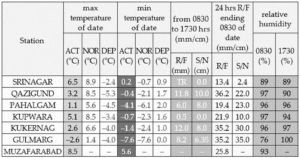
Jammu and Kashmir on February 1, 2024, weather report script:
- "Good evening. Here is your weather update for Jammu and Kashmir. The region experienced very cold conditions today with widespread snowfall.
- Temperatures remained low, with Srinagar at 6.5°C, while Gulmarg stayed below zero at -2.6°C. Heavy snowfall was recorded, with Gulmarg receiving 35 cm, followed by Kukernag and Pahalgam.
- Humidity levels were very high, reaching up to 100%, making the weather extremely cold and damp.
- Residents are advised to stay warm and be careful of icy roads."
We reply to valid query.