Notes
|
Topics to be learn :
|
Introduction to Measurement :
Measurement is an important part of science and daily life. It helps us describe the size, length, weight, temperature, and other physical quantities using numbers and units.
In the past, people often used parts of the human body to measure things. However, because people's body sizes are different, these methods were not always accurate or consistent. This led to the development of standard measurement systems.
Non-Standard and Standard Measurement :
Non-Standard Measurement :
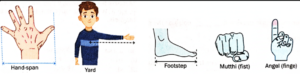
In ancient times, people used body parts to measure length. Some common examples are:
- Finger-width (Angul): The width of one finger was used to measure very small lengths.
- Fist (Mushti): The width of a closed hand was used to measure small distances.
- Hand span (Hasta): It was the distance from the tip of the thumb to the tip of the little finger when the hand was fully stretched.
- Footstep: The length of one step was used to measure larger distances, such as fields and pathways.
Problems with Non-Standard Measurement :
- Different people have different body sizes.
- A child's hand span may be smaller than an adult's hand span.
- Therefore, the same object may give different measurements when measured by different people.
- For example, a desk measured using hand spans may have different results when measured by a student and a teacher.
- Such measurements are called non-standard measurements because they are not fixed or universally accepted.
| 📜 Know This :
· In Ancient Egypt, the distance from a person's elbow to the tip of the middle finger was called a Cubit. · Since it varied from person to person, the King's Cubit (Royal Cubit) was fixed as the standard. · The Romans divided their cubit into two feet; each foot had twelve inches. · For long distances, they used mille passus ("one thousand paces") — the ancestor of today's mile, which is slightly longer. |
Standard Measurement :
To avoid these differences, scientists developed standard units of measurement.
- Standard units have fixed and definite values.
- They give the same measurement to everyone, everywhere.
- For example, a 1-metre scale used in a shop will have the same length as a 1-metre scale used at home.
- Standard measurements make trade, commerce, construction, and scientific experiments fair and reliable.
- They also help people around the world understand and compare measurements easily.
Importance of Standard Measurement :
- Standard measurement is important because it provides accuracy, consistency, and fairness. It allows measurements to be repeated and compared correctly, which is essential in both science and everyday life.
Standard System / SI Units :
Since different regions once used different instruments and units, trade and daily tasks became difficult. To solve this, a uniform system called the Standard System or International System of Units (SI Units) was established worldwide.
| Measurement | Unit | Symbol |
| Length / Distance | Metre | m |
| Mass | Kilogram | kg |
| Time | Second | s |
Units of Length :
The standard SI unit of length is the metre (m). Smaller and larger units are used according to the size of the object or distance.
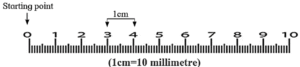
If one metre is divided into 100 equal parts, each part is called a centimetre (cm).
Each centimetre is further divided into ten small parts, and each small part is called a millimetre (mm). So, a millimetre is the tenth part of a centimetre.
| Relation | Value |
| 1 km | = 1000 m |
| 1 m | = 100 cm |
| 1 cm | = 10 mm |
Choosing the right unit:
- Centimetre (cm) — convenient for measuring the length of a line segment or small objects.
- Metre (m) — suitable for length of cloth, length/breadth of a playground.
- Kilometre (km) — used for large distances, like between two cities (1 km = 1000 m).
Accurate Measurement of Length :
Choosing the Correct Measuring Instrument :
Different measuring tapes (used by cloth merchants, carpenters, surveyors) have markings suited to their own needs, so it is important to use the right tape/tool for the job.
- Ruler (15 cm) — ideal for small objects, e.g. a piece of chalk.
- Metre scale / measuring tape — for larger lengths, e.g. height of a door.
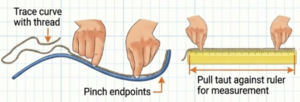
- Flexible tape (tailor's tape) / thread — for curved surfaces, e.g. circumference of a ball or jar (a thread is wrapped around the curved part, then the thread's length is measured on a ruler).
Steps for Accurate Measurement :
To get a correct measurement, we should follow these steps:
(i) Place the Ruler Correctly :
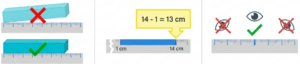
- Keep the object in direct contact with the ruler.
- Place the ruler straight and parallel to the length being measured.
(ii) Start from the Correct Point :
- Try to place the beginning of the object exactly at the 0 mark of the ruler.
- Make sure the object does not move while taking the measurement.
(iii) Read the Final Mark :
- Look straight down at the scale to avoid reading errors.
- Note the marking that matches the other end of the object.
| 🧠 Memory Aid : "Eye, Edge, Zero" — keep your Eye straight above the mark, align the object's Edge with the ruler, and start from Zero (or adjust if zero is broken). |
Measuring with a Damaged Zero Mark :
Sometimes the 0 mark of a ruler may be damaged, faded, or broken. The ruler can still be used.
- Place one end of the object at a clearly visible mark, such as 1 cm or 2 cm.
- Note the reading at the other end of the object.
- Subtract the starting reading from the final reading.
Formula: True Length = Final Reading − Initial Reading
Example :
If an object starts at 2 cm and ends at 12 cm:
True Length = 12 cm − 2 cm = 10 cm
Reference Point :
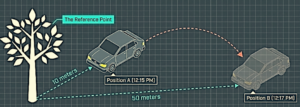
Whenever a distance is measured, it is measured from a fixed object or a specific point, called the Reference Point.
Example:
- In Kho-Kho, a fixed distance is maintained between two poles — the first fixed pole acts as the reference point for placing the second pole.
- Similarly, sports fields are marked out from reference points using a measuring tape, and highway milestones show distance from a fixed reference location in a town.
Industrial Precision and Tolerance :
The accuracy required depends on the purpose of the measurement.
- In everyday activities, a small difference of 1–2 mm may sometimes be acceptable.
- For example, a small variation may be acceptable while marking a Kho-Kho field or cutting cloth for a shirt.
- In industries, much greater accuracy is needed. Machine parts that fit together must have very accurate lengths and thicknesses.
- Such measurements may need to be smaller than one millimetre.
- Special precision instruments are used in factories to make these highly accurate measurements.
Instruments for Very Accurate Measurement :
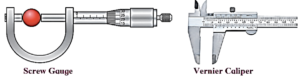
- Screw Gauge — used to measure very small thicknesses/diameters very precisely.
- Vernier Caliper — used to measure internal, external, and depth dimensions with high precision.
|
💡 Key Idea : The correct measuring instrument and proper measuring method are essential for obtaining accurate and reliable measurements. |
Temperature and Thermometer :
Temperature tells us how hot or cold an object is. We can sometimes use our hands to guess whether something is hot or cold, but this method is not accurate or reliable. Therefore, we use thermometers to measure temperature correctly.
Why Human Touch Is Not Reliable :
- Our skin can sense changes in temperature, but it cannot measure temperature accurately.
- The same object may feel hot to one hand and cold to the other.
- This happens because our hands become adjusted to the temperature they were exposed to.
Example: Three Jars of Water
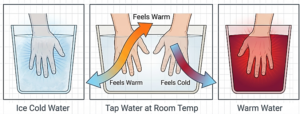
Consider three jars of water:
- Jar A: Contains moderately hot water that is safe for bathing.
- Jar B: Contains very cold water.
- Jar C: Contains water at room temperature.
Now perform the following activity:
- Place one hand in Jar A and the other hand in Jar B for a short time.
- Then place both hands together in Jar C.
- The hand that was in hot water will feel Jar C as cold.
- The hand that was in cold water will feel Jar C as warm.
What Does This Show?
- This activity shows that our sense of touch is subjective. It depends on what our hands experienced earlier. Therefore, we cannot use touch to measure temperature accurately.
A thermometer gives an objective and reliable measurement of temperature.
Temperature Units and Scales :
Temperature is commonly expressed using three important scales:
(i) Degree Celsius (°C) :
- Celsius is the most commonly used temperature scale in daily life.
- It is used for weather reports, cooking, and measuring everyday temperatures.
(ii) Degree Fahrenheit (°F) :
- Fahrenheit is used in some countries for weather and domestic temperature measurements.
- It is also used in some medical and household applications.
(iii) Kelvin (K) :
- Kelvin is the SI unit of temperature.
- It is mainly used in scientific experiments and laboratory work.
- Kelvin measures absolute temperature.
- The symbol is written as K, without the degree symbol.
| 💡 Key Idea : Our sense of touch can only give us an approximate feeling of hotness or coldness. A thermometer is needed for accurate and reliable temperature measurement. |
Types of Thermometers :
Different thermometers are designed for different purposes. They have different temperature ranges, structures, and methods of measurement.
(1) Clinical Thermometers :
A small thermometer with a shorter range (35°C to 42°C), used to check human body temperature (normal body temperature ≈ 37°C).
(2) Laboratory Thermometer: Structure-
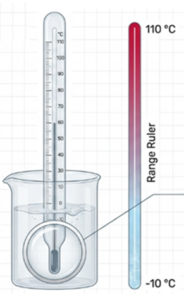
A laboratory thermometer has the following main parts:
- It has a long, narrow glass tube with a thin capillary inside.
- A glass bulb is present at the bottom.
- The bulb contains a thermometric liquid, such as coloured alcohol or, in older thermometers, mercury.
- When the bulb is heated, the liquid expands and rises through the narrow tube.
- The level of the liquid shows the temperature on the calibrated scale marked on the thermometer.
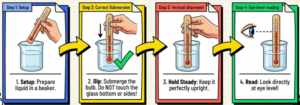
How to Read a Laboratory Thermometer Correctly :
Follow these steps to get an accurate reading:
(i) Keep the Bulb Fully Immersed :
- The bulb should be completely inside the substance being measured.
- This allows the thermometer to reach the temperature of the substance.
(ii) Keep the Thermometer Vertical :
- Hold the thermometer straight and upright.
- This helps the liquid column give a correct reading.
(iii) Do Not Touch the Container :
- The bulb should not touch the bottom or sides of the container.
- Otherwise, it may measure the temperature of the container instead of the substance.
(iv) Read at Eye Level :
- Keep your eyes at the same level as the top of the liquid column.
- Reading from above or below can cause parallax error and give an incorrect value.
| Feature | Clinical Thermometer | Laboratory Thermometer |
| Temperature Range | 35°C to 42°C | 0°C to 110°C |
| Main Purpose | Measures human body temperature | Measures the temperature of liquids and substances in laboratories |
| Design | Modern ones are usually digital. Traditional ones used a special constriction to hold the liquid level. | It has a long, thin glass tube with a bulb containing a thermometric liquid. |
| Common Uses | Checking body temperature during fever or medical examination | Measuring the temperature of liquids during experiments and chemical reactions |
(3) Digital Thermometers :
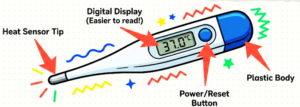
Modern thermometers are commonly digital.
- Digital thermometers do not use a glass tube containing mercury.
- They use electronic sensors to detect temperature.
- The temperature is shown directly as a number on a display.
- They are convenient, quick, and easy to read.
- They are widely used for measuring human body temperature.
Steps for Using a Digital Clinical Thermometer :
- Clean your hands: Wash your hands before handling the thermometer.
- Switch on the thermometer: Press the power or reset button and check that the display is ready.
- Place the thermometer: Put the sensor in the recommended position, such as the armpit, with proper skin contact.
- Wait for the signal: Keep it in position until the thermometer gives a beep or other signal.
- Read the temperature: Remove it and read the number shown on the display.
- Clean the thermometer: Clean the sensor according to the manufacturer's instructions and store it safely.
Mercury vs Digital Thermometers :
- Earlier, mercury thermometers were widely used for measuring body temperature.
- Mercury is an extremely toxic substance and is difficult to dispose of safely if the thermometer breaks.
- Digital thermometers pose no such risk, and their display is easier to read.
→ Mercury thermometers are therefore being replaced by digital thermometers
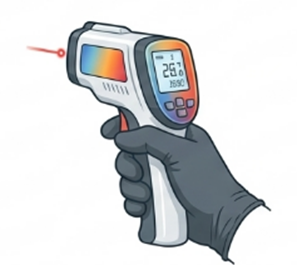
(4) Non-Contact Thermometers :
- Non-contact thermometers can measure temperature without touching the person's body.
- They detect infrared radiation emitted from the body.
- They can give a temperature reading quickly from a short distance.
- They became widely used in public places and healthcare settings during the COVID-19 pandemic.
- They reduced the need for direct contact between the thermometer and different people.
| 💡 Key Idea :
· Clinical thermometers are designed to measure body temperature, while laboratory thermometers are designed for a wider range of temperatures in scientific experiments. · Modern digital and non-contact thermometers make temperature measurement faster, safer, and easier. |
Environmental Temperature Measurement :
- The India Meteorological Department (IMD) records weather conditions at many stations across India.
- Special thermometers are used to measure the temperature of the surrounding air.
- These thermometers are usually placed in suitable weather stations or protective enclosures.
- They help record changes in air temperature accurately.
- The collected information is useful for preparing weather forecasts and studying changes in weather conditions.
Introduction to Scientists :
Anna Mani (1918–2001) — "Weather Woman of India"
Anna Mani designed numerous instruments useful for weather forecasting. She is especially known for her work on the radiosonde, an instrument used to measure atmospheric pressure, temperature, and humidity at high altitudes. She carried out her research at the India Meteorological Department in Pune and Bengaluru, and her work reduced India's dependence on other countries for weather forecasting.
We reply to valid query.