Notes
Introduction :
Nutrition and respiration are two vital biological activities that provide us energy.
Carbohydrates proteins fats vitamins minerals, water and fibres in adequate amount are the dietary needs of human being.
Nutrition :
Nutrition is the sum of an organism's processes for consuming and utilising food substances.
Food :
- Food is the basic requirement of all living beings.
- It provides energy and organic materials for growth and repairing of tissues.
- The major components of the food are carbohydrates, proteins and fats.
- Vitamins and minerals are also required in small quantities.
- The water we take in also plays an important role in body's metabolic processes.
- WHO defines nutrition as the intake of food, considered in relation to the body’s dietary needs.
Various steps involved in nutrition :
- Ingestion: It is the introduction of food into mouth, i.e. intake of food (eating) inside the body.
- Digestion: The process during which the complex, non-diffusible and non-absorbable food substances are converted into simple, diffusible and absorbable substances by the action of enzymes is called digestion.
- Absorption: The process of diffusion of digested food into blood and lymph is called absorption.
- Assimilation: The process by which protoplasm is synthesized into each cell of the body by utilizing simple food substances are called assimilation.
- Egestion: The elimination of undigested food from the body is called egestion.
Precisely, the nutrients are organic and inorganic chemicals. These can be categorised into two broad categories, i.e. macronutrients and micronutrients.
- The macronutrients are also called proximate principles of food. They include mainly proteins, lipids and carbohydrates.
- The micronutrients are also called protective principles of food. They include vitamins and minerals.
Digestion :
The process by which complex, non-diffusible and non-absorbable food substances are converted into simple diffusible and assimilable substances is known as digestion.
- In human it occurs through a complex system known as human digestive system.
- It comprises of alimentary canal and associated digestive glands.
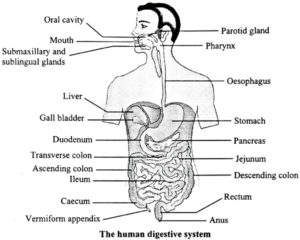
The structural description of digestive system is discussed below
Alimentary canal :
- It is a long tubular structure starting from mouth and ending with anus. It is about 8-10 meters long and consists of following organs :
- Alimentary canal consists of mouth, buccal cavity, pharynx, oesophagus, stomach, small intestine, large intestine and anus.
Histological Structure of Alimentary Canal :
The wall of alimentary canal is made up of four layers. From outer to inner side these layers are serosa, muscularis, or muscularis externa, submucosa and mucosa.
(i) serous membrane or serosa :
- The serous membrane or serosa is made up of squamous epithelium and areolar connective tissue. It is continuous with mesentery and represents visceral peritoneum, i.e. membranous coelomic epithelium.
- The outer wall of oesophagus is not lined by serous membrane. Because, oesophagus lies outside the coelom.
- Hence, in this case the outer wall is seen in the form of an irregular coat of yellow elastic dense fibrous connective tissue called adventitia externa or tunica adventitia.
(ii) The muscularis or muscularis externa :
- The muscularis or muscularis externa is made up of two muscle layers. These are inner circular and outer longitudinal smooth muscle layers.
- Out of these the longitudinal layer is thicker than the circular layer.
- Another (third) layer of oblique muscle fibres is also seen in stomach. It is present inside to circular muscle layer. This third layer is absent in the intestine.
- Throughout the alimentary canal a network or plexus of neurons and nerve fibres is present in between these two layers. This plexus have nerve cells and parasympathetic fibres. It is called Auerbach's or Myenteric plexus. This plexus controls peristalsis.
- In most of the mammals the muscularis externa of oesophagus contains voluntary or striated fibres in its anterior region, mixed fibres in middle region and involuntary or smooth fibres in the posterior region.
- In ruminants on the other hand all the fibres of oesophageal region are voluntary or striated type. This is to help the animal in the process of rumination.
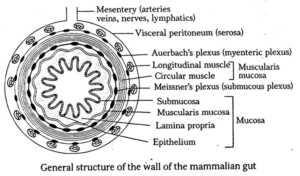
- The submucosa is a loose connective tissue layer. It is richly supplied with blood and lymphatic blood This layer contains another plexus of nerve cells and sympathetic nerve fibres called Miessiner's plexus or Submucosal plexus. In the intestine this layer contains mucus secreting glands called Brunner's glands.
Note : The Auerbach's and Meissner's plexus are absent in the upper one third part of oesophagus.
- The mucus membrane or mucosa is the innermost layer lining the lumen of alimentary canal. It is named so because it secretes mucus.
This layer forms rugae in the stomach. It is composed of three sublayers
- Muscularis mucosa or muscularis interna consisting of outer longitudinal and inner circular muscle fibres.
- Lamina propria consisting of loose connective tissue, blood vessels, glands and some lymphoid tissues.
- Epithelium forming gastric glands in stomach, villi and intestinal glands in small intestine.
The mucus mambrane layer contains lymph nodules as well. These lymph nodules in the small intestinal region gets aggregated at some places, to form well-defined lymphoid patches called as Peyer's patches.
Absorption, Assimilation and Egestion
After the food is digested in the human alimentary canal it
is then futher passed onto the following three processes:
- Absorption : It is the process by which the end products of digestion pass through the intestinal mucosa into the blood and lymph. It is carried out by passive, active or facilitated transport mechanisms.
- Assimilation : It is defined as the process by which protoplasm is synthesised into each cell of the body by utilising simple food. The mitochondria oxidise food to liberate energy in the form of ATP.
- Egestion : Elimination of undigested remains of the food from the alimentary canal is called egestion. It is carried out by large intestine. In the colon, water is absorbed into the blood, thus concentrating chyle into faeces. It is brown in colour due to the presence of urobilin and sterobilin.
Egestion involves coordinated action of muscles of large intestine, abdominal muscles and anal sphincter. This act is partly voluntary and partly involuntary.
Calorific Value of Nutrients :
Gross calorific value (gross energy) is the amount of heat liberated by complete combustion of 1g food in a bomb calorimeter.
- Gross calorific value : The amount of heat liberated by complete combustion of 1g food in a bomb calorimeter is termed as gross calorific (gross energy) value.
- Physiological value : The actual energy produced by 1g food is its physiological value.
In animals, the energy content of food is expressed in terms of heat energy.
(ii) Physiological value is the actual energy produced by 1 g of food.
| Food components | Gross calorific value
(K. cal/g) |
Physiological value
(K. cal/g) |
| Fats | 9.45 | 9.0 |
| Proteins | 5.65 | 4.0 |
| Carbohydrates | 4.1 | 4.0 |
We reply to valid query.