Notes
Why Is Earth a Unique Planet?
Earth is considered a unique planet because it is the only place in the known universe where life exists and thrives in all its forms.
While there are billions of planets, Earth possesses a specific combination of conditions that make it a perfect home for living beings.
The primary factors that contribute to Earth's uniqueness include:
- The Habitable Zone
- Ideal Size and Gravity
- A Protective Atmosphere
- Magnetic Field
- Dynamic Interconnected Systems
- Stable Orbit
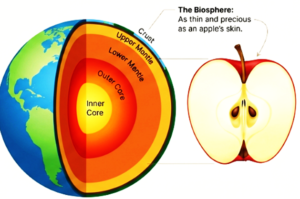
A Delicate Surface: If Earth were the size of an apple, all life-from the deepest ocean trench to the highest mountain-would exist on a layer as thin as the apple's skin. This delicate crust is where the miracle of life unfolds.
What Do the Planets of Our Solar System Look Like?
The planets in our solar system are categorized into two main groups based on their physical composition: small rocky planets and large gaseous planets.
(i) The Rocky Planets :
The four planets closest to the Sun—Mercury, Venus, Earth, and Mars—are relatively small and have solid, rocky surfaces.
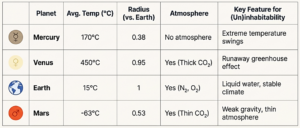
- Mercury: This planet is rocky and is unique for having no atmosphere at all.
- Venus: Venus is the hottest planet in the solar system, with an average temperature of 450°C. It is covered by a thick atmosphere made almost entirely of carbon dioxide, which traps heat through the greenhouse effect.
- Earth: Often called the "Blue Planet," Earth appears blue from space because approximately 70% of its surface is covered by water. It features a diverse range of landscapes, including lush forests, vast oceans, towering mountains, and endless deserts. Greenhouse effect plays an important role in maintaining just the right temperature on Earth.
- Mars: Mars is a rocky planet with an atmosphere that is 100 times thinner than Earth's. While it currently appears dry, scientists believe it may have had liquid water and lakes in its ancient past.
(ii) The Gas Giants : The four outer planets—Jupiter, Saturn, Uranus, and Neptune—are significantly larger than the rocky planets and are mostly made of gases.
- Size: These planets are massive; for example, Jupiter has a radius 11 times larger than Earth's, while Neptune's radius is 4 times larger.
- Temperature: Because they are far from the Sun, these planets are extremely cold. Neptune, the farthest planet, has an average temperature of -200°C.
The Challenge of Mars Colonization :
Recreating Earth-like conditions on Mars presents monumental challenges. Any human settlement would need to overcome:
- Breathable Atmosphere: The thin, carbon dioxide-heavy atmosphere lacks sufficient oxygen for respiration and pressure for survival. Creating and maintaining a stable, oxygen-rich environment would be technologically demanding.
- Temperature Control: Mars's extreme cold requires robust, insulated habitats and a constant energy source for heating.
- Liquid Water: Water would need to be extracted, transported, and kept from freezing.
- Radiation Shielding: Without a global magnetic field and thick atmosphere, colonists would require significant shielding from cosmic and solar radiation.
What Makes the Earth Suitable for Life to Exist ?
The Earth is uniquely suited for life due to a combination of its physical position, protective layers, and the dynamic interaction of its natural systems.
(i) Position of the Earth :
The Earth can support life mainly because it is at the right distance from the Sun. This distance keeps the Earth warm enough for water to stay in liquid form.
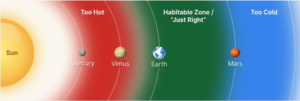
- If the Earth were closer to the Sun, it would be too hot and all the water would evaporate. If it were farther away, it would be too cold and the water would freeze. In both cases, most life forms like plants, animals, and humans could not survive.
- Liquid water is necessary for life to develop and continue. Earth’s position allows water to remain liquid, making life possible. This special range of distance from the Sun where liquid water can exist is called the habitable zone or the Goldilocks zone.
(ii) Size of the Earth :
Earth’s size and gravity are very important for supporting life.
- Holding the atmosphere: Earth’s gravity is strong enough to hold air around it. If Earth were much smaller, its gravity would be weak and the atmosphere would escape into space. This is why Mars has a very thin atmosphere and Mercury has almost none.
- Suitable gravity for life: If Earth were much bigger, gravity would be too strong. This could make it difficult for plants, animals, and humans to survive because their bodies would be crushed under their own weight.
The Protective Atmosphere :
The atmosphere is a layer of gases around Earth that makes life possible.
- Greenhouse effect: Gases like carbon dioxide trap some of the Sun’s heat and keep Earth warm. This gentle greenhouse effect maintains a suitable temperature. On Venus, too much carbon dioxide causes extreme heating, making it the hottest planet.
- Life-Sustaining Gases: It contains oxygen for respiration and carbon dioxide for photosynthesis.
- Ozone layer: Some oxygen forms ozone, creating the ozone layer. This layer protects life by blocking harmful ultraviolet (UV) rays from the Sun, which can damage living cells.
(iii) Magnetic field of the Earth :
Earth has a magnetic field created by the movement of molten iron in its outer core. This magnetic field is very important for life.
- Protection from harmful particles: The magnetic field deflects most of the harmful particles coming from the Sun (solar wind) and from outer space (cosmic rays).
- Without this protection : These particles could remove Earth’s atmosphere, damage the ozone layer, and expose living organisms to dangerous radiation. High-energy particles would bombard the surface, increasing cancer risks and damaging both plants and animals. Satellites and communication systems would be disrupted.
What Allows Life to Be Sustained on Earth?
Life on Earth is sustained by the constant interaction between four major systems, or "spheres," which together regulate climate, cycle nutrients, and support all ecosystems.
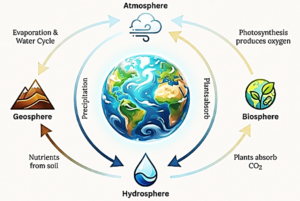
- Atmosphere: This is the air around Earth. It provides oxygen for breathing and carbon dioxide for plants to make food in the presence of sunlight. It also keeps Earth warm through the greenhouse effect and controls weather, which helps spread water.
- Hydrosphere: This includes all the water on Earth—oceans, rivers, lakes, groundwater, and ice. Water is essential for all living things. It helps transport nutrients, regulate body temperature, and provides homes for many aquatic plants and animals.
- Geosphere: This is the solid part of Earth, including rocks, soil, and landforms. Soil supplies nutrients needed for plant growth. The geosphere also provides minerals and creates different habitats like mountains, plains, and valleys.
- Biosphere: This includes all living organisms—plants, animals, and microorganisms. Living things depend on each other: plants make food, animals eat plants or other animals, and decomposers break down dead matter and return nutrients to the soil.
Importance of balance : All these systems work together like a team. If one system is disturbed—such as cutting down forests—it can affect air quality, water cycles, and wildlife. This balance between Earth’s systems is what makes our planet suitable for life.
What Keeps Life from Disappearing? :
Reproduction: Reproduction is the process by which living organisms produce new individuals. It helps life continue from one generation to the next and allows species to adapt to changes in the environment.
Genetic Material: Living organisms pass special instructions called genes from parents to their offspring. These genes control how an organism grows and develops, which is why offspring look similar to their parents (for example, a cow gives birth to a calf).
Types of Reproduction :
There are two main types of reproduction, each important in its own way.
(i) Asexual Reproduction :
- Process: Only one parent is involved. The offspring produced are exactly like the parent.
- Purpose: Helps organisms multiply quickly in stable environments.
- Examples:
- Vegetative propagation: Plants like potato, ginger, and money plant grow from stems, roots, or leaves.
- Cell division: Single-celled organisms such as bacteria and amoeba divide into two.
- Budding and regeneration: Hydra forms buds that grow into new individuals, and Planaria can grow a whole body from a small piece.
(ii) Sexual Reproduction :
- Process: Two parents are involved. They produce special cells called gametes (sperm and egg). Each gamete carries half the genetic information. When they fuse during fertilization, a zygote is formed.
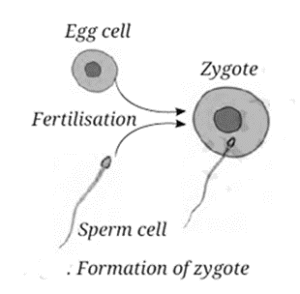
- Purpose: Produces variation in offspring. These differences help species adapt and evolve over time.
- Examples in plants: Flowers have male parts (pollen) and female parts (ovules). Pollination brings pollen to the ovule, leading to fertilization and seed formation.
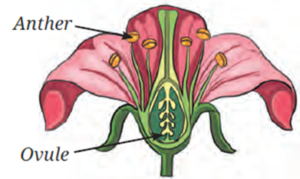
- Examples in animals:
- Fertilization may be external (as in fish and frogs) or internal (as in birds and mammals).
- The young may develop outside the body in eggs (birds) or inside the mother’s body (most mammals).
Reproduction not only keeps life going but also helps living beings change and survive in a changing world.
What Are the Threats to Life on Earth? :
Human activities are changing Earth’s natural systems very rapidly. These changes are creating serious problems that threaten the stability of our planet.
The Triple Planetary Crisis :
There are three major and connected environmental problems affecting Earth today:
- Climate Change: Burning fuels like coal and oil releases greenhouse gases such as carbon dioxide and methane. These gases trap extra heat in the atmosphere, causing global warming. This leads to melting ice caps, rising sea levels, and more frequent and severe events like floods, heatwaves, and storms.
- Loss of Biodiversity: Forests, wetlands, and other natural habitats are being destroyed for farming, cities, and industries. This causes many plants and animals to disappear. When species are lost, ecosystems become weaker and cannot provide important services such as pollination, clean water, and soil fertility.
- Pollution: Pollution harms living beings and the environment.
- Air pollution: Smoke from factories and vehicles causes breathing problems, smog, and acid rain.
- Water pollution: Waste from industries, fertilizers from farms, and plastic waste pollute rivers and oceans, harming aquatic life and making water unsafe.
- Soil pollution: Excessive use of chemicals and poor waste management reduce soil quality and allow harmful substances to enter the food chain.
Global Efforts and the Way Forward :
Countries around the world have tried to reduce these problems.
- The Montreal Protocol helped protect the ozone layer.
- The Kyoto Protocol and the Paris Agreement aimed to reduce greenhouse gas emissions and limit global warming to below 5°C, but current efforts are still not enough.
To protect Earth, action is needed at every level—from international cooperation to individual choices. Simple steps like saving energy and water, reducing waste, and supporting sustainable practices can help maintain the balance that makes life on Earth possible.
We reply to valid query.