Notes
Defining the Environment :
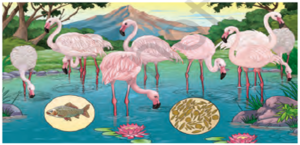
Habitat: A habitat is defined as the specific natural environment that provides the conditions necessary for an organism or community to live, including food, water, and shelter.
- Habitats can be terrestrial (e.g., forests, deserts) or aquatic (e.g., ponds, lakes, rivers).
How Do We Experience and Interpret Our Surroundings?
We experience and interpret our surroundings by exploring different habitats and observing the complex interactions between their various components
Core Components of an Ecosystem :
Every ecosystem is composed of two fundamental types of components that interact to maintain balance.
| Component Type | Description | Examples |
| Biotic | All living or once-living elements within an ecosystem. | Plants, animals (fish, birds, insects), fungi, bacteria, micro-organisms. |
| Abiotic | All non-living chemical and physical elements in the ecosystem. | Water, sunlight, air, soil, rocks, mud, temperature, fallen leaves. |
Who All Live Together in Nature? :
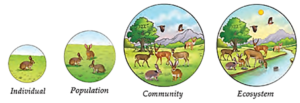
Nature is organized into a hierarchy of interconnected levels, building from the individual to the entire ecosystem.
Population:
- A population is a group of individuals of the same species living together in a particular habitat at a given time.
- For instance, all the fish of a single kind in a pond constitute a population.
Community:
- A community comprises all the different populations of various species (plants, animals, microorganisms) that live and interact within the same habitat.
- The entire collection of living beings in a pond—including all populations of fish, frogs, insects, and plants—forms the pond community.
Ecosystem:
- An ecosystem is the comprehensive system formed by the interaction of a biotic community with its abiotic environment.
- Ecosystems can be large, like a forest, or small, like a single large tree.
They are broadly categorized into two main types:
- Aquatic Ecosystems: Include ponds, rivers, and lakes.
- Terrestrial Ecosystems: Include forests, farms, grasslands, and mountains. Human-made ecosystems, such as farms and parks, also exist but require continuous human management.
Does Every Organism in a Community Matter? :
Every organism in a community matters because they are all part of an intricately interconnected web where the actions or presence of one species directly or indirectly affects many others. This interdependence is vital for maintaining a dynamic balance within an ecosystem.
- Direct and Indirect Interconnections : Organisms within a community depend on each other for essential life processes such as nutrition, respiration, and reproduction.
- The Vital Role of Each Trophic Level : Every organism occupies a specific position called a trophic level, and the removal of any level disrupts the flow of energy:
- Consequences of Removing a Species : Removing even one type of organism can lead to a cascading collapse of the system:
What Are the Different Types of Interactions Among Organisms and their Surroundings? :
The survival and stability of an ecosystem depend on the constant and complex interactions among its components. These interactions occur between living and non-living elements as well as among different living organisms.
Interactions Among Biotic and Abiotic :
There is a fundamental interdependence between the living and non-living parts of an ecosystem.
(i) Biotic Dependence on Abiotic: Living organisms rely on abiotic factors for essential life processes.
- Plants require sunlight, carbon dioxide, and water for photosynthesis and need soil for nutrients and anchorage.
- Animals need air for oxygen, water for survival, and physical spaces for shelter.
(ii) Abiotic Dependence on Biotic: The presence of living organisms also shapes the abiotic environment.
- Plants release oxygen into the atmosphere, their roots bind soil to prevent erosion, and they help retain soil moisture and cool the atmosphere.
Interactions Among Biotic Components :
Living beings depend on one another for nutrition, respiration, and reproduction. These interactions fall into several sub-categories:
Symbiotic and Competitive Interactions :
Beyond predator-prey dynamics, organisms interact in other ways that maintain ecosystem balance.
(i) Mutualism: A relationship where both organisms benefit.
- An example is the interaction between honeybees, which get nectar from flowers, and the flowers, which get pollinated by the bees.
(ii) Commensalism: An interaction where one organism benefits while the other is neither helped nor harmed.
- Orchids grow on tree branches to gain better access to sunlight, without affecting the tree.
(iii) Parasitism: A relationship where one organism (the parasite) benefits at the expense of the other (the host).
- Ticks feeding on the blood of a dog is a clear example of parasitism.
(iv) Competition: Organisms often compete for shared resources like food, water, space, or sunlight. This competition is vital because it naturally controls population sizes and maintains a dynamic balance in the ecosystem.
(v) Decomposition: Saprotrophs (fungi and bacteria) break down dead matter and waste, recycling vital nutrients back into the soil.
Examples of Different Types of Interactions :
| Criterion 1: Interactions between biotic and abiotic components | Criterion 2: Interaction between two abiotic components | Criterion 3: Interaction among the biotic components |
| Earthworms live in moist soil. | The day temperature is high due to the bright sunlight. | A frog eats insects. |
| Many microbes are present in the pond. | Water is evaporating fast due to the sunlight. | A water snake eats fish. |
| A fish lays eggs in water. | Air current is blowing slowly on the water surface creating gentle waves. |
Frogs and fish may compete for small insects larvae. |
| The soil near the pond is moist. |
A fish lays eggs in water near vegetation to protect them from other fish or frogs. |
Who Eats Whom? :
(1) Classification by Eating Habits :
Every organism in a community can be classified based on how it obtains its nutrition:
- Producers (Autotrophs): These are green plants that perform photosynthesis to make their own food. They sit at the first trophic level.
- Consumers (Heterotrophs): These organisms cannot make their own food and must eat others. They are further divided into:
- Herbivores: Animals like deer and hares that eat only plants.
- Carnivores: Animals like leopards or vultures that eat only other animals.
- Omnivores: Organisms like crows, foxes, and mice that eat both plants and animals.
(2) Food Chains and Food Webs :
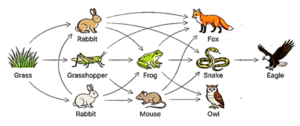
- Food Chains: A simple, linear sequence showing the transfer of food. For example: Grass → Grasshopper → Frog → Snake → Eagle.
- Food Webs: In reality, ecosystems are more complex because one organism might be eaten by multiple types of predators. These interlinked food chains form a network called a food web.
(3) Trophic Levels :
Each position in a food chain is known as a trophic level.
- First Level: Producers (plants).
- Second Level: Herbivores (hares, deer).
- Third Level: Small carnivores (frogs).
- Fourth Level: Large carnivores (tigers, vultures).
(4) The Role of Decomposers :
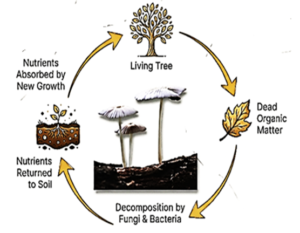
- When organisms die, decomposers (also called saprotrophs), such as fungi and bacteria, take over the "eating" process.
- They break down complex dead matter into simpler substances, returning vital nutrients to the soil so that plants can grow again. This ensures that in nature, nothing is wasted.
What Happens to Waste in Nature? :
In nature, waste is not thrown away. Things like dead plants, dead animals, leftover food, and animal droppings are recycled through a process called decomposition.
Small living things called decomposers do this work.
- Bacteria and fungi break dead matter into simple substances.
- Insects like beetles and flies help by breaking down animal waste.
During decomposition, useful nutrients are returned to the soil. Plants use these nutrients to grow, and animals then depend on plants for food.
In this way, waste becomes useful again, nutrients are reused, and nature stays clean and balanced.
How Does One Change Lead to Another? :
In nature, everything is connected. Because of this, a change in one part of an ecosystem can cause a chain reaction of changes. This is called a cascading effect. Even a small change can affect many other living and non-living things.
Examples:
(i) Pollution in Water Bodies :
- If pollution kills plants in a pond, the oxygen level in water decreases.
- Fish then die due to lack of oxygen. With fewer fish, insects increase in number and spread to nearby farms, damaging crops.
- Farmers then use more pesticides, which further harm soil and water.
(ii) Indirect Relationships Between Living Things :
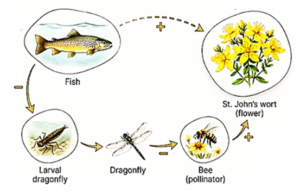
- When there are more fish in a pond, they eat dragonfly larvae.
- Fewer dragonflies means more pollinators like bees and butterflies survive.
- More pollinators lead to better seed production in plants around the pond.
- Thus, a change in water life affects land plants.
(iii) Human Activities and Their Effects :
When humans remove or overuse a species, ecosystem balance is disturbed.
- Bullfrog Example: Overharvesting of Indian bullfrogs reduced their population. As frogs control pests, their loss caused pest populations to rise, leading to excessive pesticide use and environmental damage.
- Habitat Loss: Cutting forests for roads and buildings destroys animal homes. Animals like elephants then move into human areas for food, causing conflicts and crop damage.
(iv) Soil and Farming Practices :
- Harmful practices such as overuse of fertilizers and pesticides, too much groundwater use, and growing only one crop damage soil health.
- Soil loses nutrients, beneficial organisms die, erosion increases, pests become resistant, and pollinators decline.
- Farmers then depend even more on harmful methods, creating a harmful cycle.
Case Study: The Sundarbans Mangrove Ecosystem :
- The Sundarbans mangroves protect coastal areas from storms, support rich wildlife, and absorb carbon dioxide.
- However, deforestation and overuse of forest resources threaten this ecosystem.
- Damage to the Sundarbans reduces protection for people and wildlife, showing how human actions can disturb nature’s balance.
Thus, in ecosystems, one change always leads to another. Protecting nature is important because disturbing one part can harm the entire system.
How Do Interactions Maintain Balance in Ecosystems? :
Ecosystem balance is maintained through continuous interactions among organisms and between living and non-living components.
- Competition for resources naturally regulates population sizes.
- Feeding relationships and predation control species numbers, ensure smooth energy flow, and prevent pest outbreaks.
- Decomposers recycle nutrients by breaking down waste and dead matter, maintaining soil fertility and supporting plant growth.
- Living organisms also interact with abiotic factors—plants regulate atmospheric gases, prevent soil erosion, and help control climate, while environmental factors like sunlight and water influence organism behavior and adaptation.
When these interactions are disturbed, cascading effects occur, leading to ecosystem imbalance and conflicts between wildlife and humans.
What Are the Benefits of an Ecosystem? :
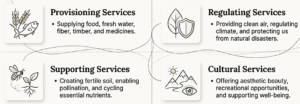
Ecosystems provide a wide range of essential services that support both human life and the overall health of the planet.
- They supply basic needs such as food, fresh water, raw materials, and medicines.
- Ecosystems help regulate the environment by maintaining air quality, controlling temperature, and reducing climate change through carbon absorption.
- They protect land and human settlements by preventing soil erosion, maintaining soil fertility, and reducing the impact of natural disasters like floods and storms.
- Ecosystems also support agriculture through pollination and natural pest control.
- In addition, they offer aesthetic, recreational, and cultural value, contributing to human well-being and mental health.
Conservation and the Path to Sustainability :
Ecosystems are very valuable, but they are also under threat. Therefore, conserving nature and using resources wisely is essential for a sustainable future.
Protecting Natural Ecosystems :
- Governments and communities take active steps to protect nature.
- India has created national parks, wildlife sanctuaries, and biosphere reserves to conserve plants, animals, and their habitats, such as Jim Corbett National Park, Manas National Park, and the Nilgiri Biosphere Reserve.
- Wildlife corridors are also developed to help animals like elephants move safely between forests and reduce conflict with humans.
- Migratory birds connect different ecosystems and help in pollination, seed dispersal, and natural pest control, which supports agriculture.
Sustainable Human-Made Ecosystems :
- Human-made ecosystems like farms must be managed carefully. Many farmers are adopting organic and natural farming to reduce harmful chemicals.
- Example : The Green Revolution successfully increased food production in India through the use of modern machinery and synthetic fertilisers and pesticides, which helped to address a food crisis. However, these methods are now considered unsustainable due to the overuse of chemicals leading to soil degradation, excessive extraction of groundwater, and a loss of crop diversity from monoculture practices.
- Traditional knowledge, such as Vrikshayurveda, highlights the importance of healthy soil and the use of organic manure like Kunapa Jala, showing that sustainable practices have been valued since ancient times.
Conclusion : By protecting natural ecosystems and adopting sustainable practices, humans can conserve biodiversity and ensure a healthy environment for future generations.
We reply to valid query.