Notes
The Plane Mirror:
A polished, flat glass plate with one surface coated with a reflecting material.
Function: Creates an image through simple reflection, without converging or diverging parallel light rays.
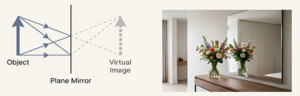
The Resulting Image:
- Virtual: The image cannot be projected onto a screen.
- Upright: The image is not inverted.
- Equal Size: The image is the same size as the object.
- Laterally Inverted: Left and right are reversed.
Use: Dressing mirrors, periscopes.
What Are Spherical Mirrors? :
A spherical mirror is a portion of a hollow sphere whose one surface is polished.
Unlike plane mirrors, which produce same-size, erect images, spherical mirrors can form images that are enlarged or diminished.
They are classified based on which surface is reflective.
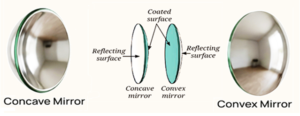
Manufacturing Note: Spherical mirrors are not manufactured by slicing a hollow glass sphere. Instead, they are created by grinding and polishing a flat piece of glass into a curved surface. A reflective coating, such as a thin layer of aluminum, is then applied.
- Concave Mirror: The coating is applied to the outer curved surface.
- Convex Mirror: The coating is applied to the inner curved surface.
What Are the Characteristics of Images Formed by Spherical Mirrors?
Concave Mirrors (Converging Mirrors) :
The inner, hollow surface of the sphere is the reflecting surface. These mirrors converge parallel light rays to a focal point.
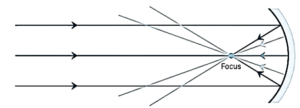
Image Characteristics: Concave mirrors can form both real and virtual images. The characteristics of the image—its nature, orientation, and size—depend on the object's distance from the mirror.
- When an object is placed very close (inside the focal length), the image is virtual, erect, and magnified.
- When the object is placed far from the mirror, the image is real, inverted, and can be smaller or larger than the object.
Uses:
- Reflectors: Used in torches, headlights of cars, and scooters to produce a focused beam of light.
- Magnification: Used by dentists in dental mirrors to obtain an enlarged, erect view of teeth when held close.
- Telescopes: Large concave mirrors are the primary mirrors in most modern reflecting telescopes.
- Solar Concentrators: Used in devices like solar furnaces and cookers to concentrate sunlight into a small area to generate high temperatures for heating, cooking, or even melting steel.

Convex Mirrors (Diverging Mirrors) :
The outer, bulging surface of the sphere is the reflecting surface. These mirrors diverge parallel light rays, making them appear to originate from a point behind the mirror.
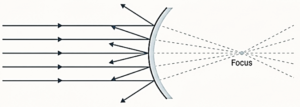
Image Characteristics: Convex mirrors always form images that are:
- Nature: Virtual.
- Orientation: Upright (erect).
- Size: Diminished (smaller than the object).
Key Feature: They provide a significantly wider field of view compared to a plane mirror of the same size. This property is why the warning "Objects in mirror are closer than they appear" is printed on them; the diminished image creates a distance perception that can be misleading.
Uses:
- Vehicle Side-View Mirrors: These mirrors are convex because they always form an erect, diminished image, which provides a much wider field of view of the traffic behind the vehicle.
- Road Safety: Installed at sharp bends and intersections to give drivers visibility of the other side and prevent collisions.
- Surveillance: Used as security mirrors in large stores to monitor a wide area and deter theft.

Images Formed by Mirrors :
| Mirror Type | Object Position | Image Orientation | Image Size |
| Plane | Any distance | Erect | Same size as object |
| Concave | Close to the mirror | Erect | Enlarged (larger than the object) |
| Farther from the mirror | Inverted | Initially enlarged, then gets smaller as distance increases | |
| Convex | Any distance | Always Erect | Always Diminished (smaller than the object) |
Real vs. Virtual :
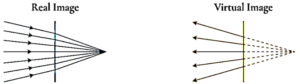
| Real Image | Virtual Image |
| Formed when reflected or refracted rays actually meet.
Can be projected onto a screen. Example : Concave Mirror, Convex Lens |
Formed when reflected or refracted rays appear to diverge from a point.
Cannot be projected onto a screen. Example : Plane Mirror, Convex Mirror, Concave Lens (and Concave Mirror / Convex Lens under specific conditions) |
What Are the Laws of Reflection?
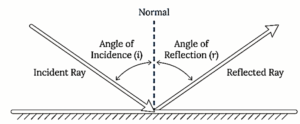
The formation of images by all types of mirrors—plane, concave, and convex—is governed by two fundamental laws of reflection.
The Two Laws :
- First Law: The angle of incidence is equal to the angle of reflection (i = r). When an incident beam falls along the normal, both the angle of incidence and the angle of reflection are zero.
- Second Law: The incident ray, the normal to the mirror at the point of incidence, and the reflected ray all lie in the same plane.
Laws on a Curved Surface :
While each individual ray still obeys the ∠i = ∠r rule, the curve of the mirror means that the 'normal' (the 90° line) is pointing in a different direction at every point on the surface. This is what causes the rays to either focus together or spread apart.
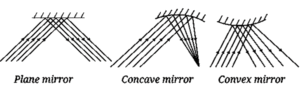
- Plane Mirrors: A plane mirror reflects multiple parallel beams as parallel beams, without convergence or divergence.
- Concave Mirrors (Converging): When multiple parallel beams of light strike a concave mirror, the reflected beams converge, or get closer together, concentrating at a point. This property allows concave mirrors to focus light and generate significant heat, enough to ignite paper when focusing sunlight.
- Convex Mirrors (Diverging): When multiple parallel beams of light fall on a convex mirror, the reflected beams diverge, or spread out.
Key Terminology :
- Incident Ray: The ray of light that falls on the mirror.
- Reflected Ray: The ray of light that comes back from the mirror after reflection.
- Normal: A line drawn at a 90° angle to the reflecting surface at the point where the incident ray strikes.
- Angle of Incidence (i): The angle between the incident ray and the normal.
- Angle of Reflection (r): The angle between the reflected ray and the normal.
What Is a Lens? :
Principle of Refraction :
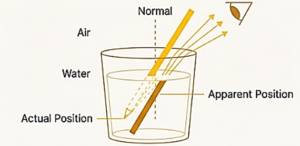
- Refraction is the bending of light when it passes from one transparent medium to another, such as from air to water. This happens because light travels at different speeds in different materials.
- Light moves faster in air and slower in water. When light goes from air into water, it slows down and bends toward the normal. When it comes out from water into air, it speeds up and bends away from the normal.
- A common example of refraction is a pencil kept in a glass of water. The pencil looks bent or broken at the surface of the water. This happens because light from the part of the pencil inside the water bends when it comes out into the air before reaching our eyes.
Lenses and Image Formation :
A lens is a transparent object, typically made of glass or plastic, with one or two curved surfaces that refract light to form an image.
(1) Convex Lenses (Converging Lenses) :
A convex lens is thicker in the middle and thinner at the edges. It converges parallel rays of light to a principal focus.
Image Characteristics: Convex lenses can form both real and virtual images, depending on the object's position relative to the lens.
- Images can be real and inverted.
- Images can be virtual and erect.
- The size can be magnified, diminished, or the same as the object.
Uses:
- Magnifying Glasses: A convex lens is used to make objects appear larger.
- Eyeglasses: To correct farsightedness.
- Scientific Instruments: Essential components in cameras, microscopes, and telescopes.
- Focusing Light: Can concentrate sunlight to a point, generating enough heat to burn paper.
(2) Concave Lenses (Diverging Lenses) :
A concave lens is thinner in the middle and thicker at the edges. It diverges parallel rays of light, making them appear to spread out from a focal point.
Image Characteristics: Concave lenses always form images that are:
- Nature: Virtual.
- Orientation: Upright (erect).
- Size: Diminished.
Uses:
- Eyeglasses: To correct short-sightedness (myopia).
- Peepholes in Doors: Provide a wide-angle view of the outside.
Concave Lens vs. Convex Lens :
| Feature | Concave Lens (Diverging) | Convex Lens (Converging) |
| Shape | Thinner in the middle and thicker at the edges. | Thicker in the middle and thinner at the edges. |
| Nature of Image | Always forms a virtual, erect, and diminished image. | Can form both real and virtual images. Can be inverted/erect, magnified/diminished. |
| Two Uses | 1. Correcting short-sightedness (Myopia)
2. Peepholes in doors |
1. Magnifying glass
2. Used in cameras, microscopes, telescopes |
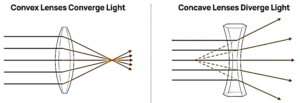
Characteristics of Images Viewed Through Lenses
The appearance of an object viewed through a lens is dependent on the lens type and the object's distance.
| Lens Type | Object Position | Image Orientation | Image Size |
| Convex | Close to the lens | Erect | Enlarged |
| Farther from the lens | Inverted | Initially enlarged, then diminishes in size as distance increases | |
| Concave | Any distance | Always Erect | Always Diminished |
Key Terms :
- Real Image: An image formed where light rays actually converge or meet. It can be projected onto a screen.
- Virtual Image: An image formed where light rays only appear to diverge from. It cannot be projected onto a screen.
- Principal Axis: A straight line passing through the center of the lens or mirror.
- Focus (Focal Point): The point where light rays parallel to the principal axis meet (or appear to meet) after reflection or refraction.
- Focal Length: The distance between the optical center (for a lens) or pole (for a mirror) and its focal point.
We reply to valid query.