Notes
Introduction to Materials Around Us :
Materials around us are mainly classified into two groups based on their properties: metals and non-metals.
Metals and non-metals are types of elements. An element is a pure substance that cannot be broken down into simpler substances.
At present, 118 elements are known. These elements are the basic building blocks of all matter. Some elements are found naturally, while others are artificially made in laboratories and do not occur in nature.
- Examples of metals are iron, aluminium, copper, silver, and gold.
- Examples of non-metals are carbon, sulphur, oxygen, nitrogen, and phosphorus.
Metals and non-metals show different physical and chemical properties. The properties of metals and non-metals are discussed in detail below.
Classification through Physical Properties :
Physical Properties of Metals :
Metals have special physical properties that make them useful in our daily life.
These include appearance, hardness, malleability, ductility, sonority, and conduction of heat and electricity.
(i) Appearance : Metals like copper, aluminium, and iron are shiny. This shine is called metallic lustre. Gold and silver shine brightly.
(ii) Malleability: Metals can be beaten into thin sheets. This property is called malleability.
- Uses: Silver foil is used to decorate sweets and aluminium foil is used for wrapping food.
- Most malleable metals: Gold and silver are the most malleable metals.
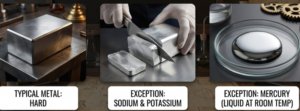
(iii) Hardness and Physical State : Most metals are hard and solid at room temperature.
Exceptions:
- Soft metals: Sodium and potassium are very soft and can be cut with a knife.
- Liquid metal: Mercury is the only metal that is liquid at room temperature and is used in thermometers.
(iv) Ductility : Ductility is the property by which metals can be drawn into thin wires.
- Uses: Copper and aluminium wires are used for electrical fittings. Metal wires are also used to make jewellery and musical instruments.
- Highly ductile metal: One gram of gold can be drawn into a wire about 2 km long.
(v) Sonority : Metals produce a ringing sound when struck. This property is called sonority.
- Uses: School bells, metal coins, and ghungroos make sound because of this property.
(vi) Conduction of Heat : Metals are efficient conductors of heat, whereas materials like wood are poor conductors.
- Example: A metal spoon immersed in hot water becomes hot to the touch much faster than a wooden spoon of the same size.
- Use: Cooking vessels are made of metal to facilitate heat transfer, while their handles are often made of wood or plastic to prevent burns.
(vii) Conduction of Electricity : Materials that allow electricity to pass through them easily are called good conductors of electricity.
- Use : Most metals are good conductors, so they are used in electric wires and electrical equipment.
Materials that do not allow electricity to pass through them are called poor conductors or insulators.
- Use : These materials are used for safety purposes because they prevent electric current from flowing.
- Examples: The plastic covering on screwdrivers and the rubber gloves worn by electricians are made of insulators. They protect people from electric shock while working with live electrical wires or devices.
Physical Properties of Non-metals :
Non-metals generally display the opposite characteristics of metals:
- Appearance: They are non-lustrous and appear dull (e.g., coal, sulphur).
- Brittleness: Unlike metals, non-metals are not malleable or ductile. They break into pieces when hammered or subjected to stress. Materials like coal, sulfur, and wood do not flatten when hammered; instead, they break into pieces.
- Conductivity: They are poor conductors (insulators) of heat and electricity.
- Sonority: They produce dull sounds rather than ringing tones when struck.
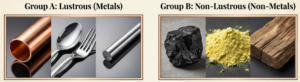
Note: Some materials like plastic, wood, rubber, glass, and paper are not classified as metals or non-metals because they are not elements.
Chemical Properties and Reactions
The chemical properties of metals and non-metals depend on how they react with oxygen, water, and air. These reactions decide the type of compounds they form.
(i) Reaction with Oxygen : Both metals and non-metals react with oxygen to form oxides, but these oxides are different in nature.
- Metal oxides (basic): Metals form oxides that are basic in nature. When these oxides dissolve in water, they turn red litmus paper blue.
Example: When magnesium burns, it forms magnesium oxide (white ash). This reacts with water to form magnesium hydroxide. - Non-metal oxides (acidic): Non-metals form oxides that are acidic. When dissolved in water, they turn blue litmus paper red. Example: Burning sulphur produces sulphur dioxide, which forms sulphurous acid in water.
(ii) Reaction with Water and Air :
- Metals: Some metals are very reactive. Sodium reacts violently with air and water and may catch fire. Therefore, it is stored in kerosene.
- Non-metals: Most non-metals do not react with water. Phosphorus catches fire in air but does not react with water, so it is stored under water.
(iii) Corrosion and Rusting : Corrosion is the slow damage of metals caused by air, water, or chemicals. It makes metals weak.
- Rusting of iron: Rusting occurs when iron reacts with oxygen and moisture, forming a brown layer called rust.
- Other examples: Copper forms a green coating, and silver forms a black coating when exposed to air.
- Methods to prevent corrosion:
- Painting – stops air and water from reaching the metal
- Oiling or greasing – forms a protective layer
- Galvanisation – coating iron with zinc to prevent rusting
Historical Evidence: The Iron Pillar of Delhi, built over 1600 years ago, stands as a testament to ancient Indian metalwork, as it has not rusted despite centuries of exposure.
Summary of Properties :
| Property | Metals | Non-metals |
| Appearance | Lustrous (Metallic Lustre) | Dull |
| Hardness | Generally hard (except Sodium/Potassium) | Generally soft/brittle |
| Malleability | High (can be made into sheets) | Low (breaks into pieces) |
| Ductility | High (can be drawn into wires) | Non-ductile |
| Sonority | Sonorous (ringing sound) | Non-sonorous (dull sound) |
| Conductivity | Good conductors of heat and electricity | Poor conductors |
| Oxide Nature | Generally Basic | Generally Acidic |
Practical Applications of Elements :
The uses of metals and non-metals depend on their special properties.
Uses of Metals :
- Construction and tools: Iron is used to make buildings, bridges, and farming tools because it is strong.
- Electrical work: Copper and aluminium are used for electric wires and motors as they allow electricity to pass easily and can be drawn into thin wires.
- Aerospace: Aluminium is used in aeroplanes because it is light and does not rust. Titanium and zirconium are used in aircraft and atomic energy work.
- Household items: Metals are used for cooking utensils because they conduct heat well, and for jewellery because they are shiny and can be shaped easily.
- Special uses: Mercury is used in thermometers because it is a metal that stays liquid at room temperature.
Uses of Non-metals :
- Living things: Oxygen is needed for breathing. Carbon is the basic element of all living organisms.
- Agriculture: Nitrogen helps plants grow and is used to make fertilisers.
- Sanitation: Chlorine is used to clean drinking water. Iodine solution is used to clean wounds.
- Safety: Phosphorus is used in matchsticks because it catches fire easily.
We reply to valid query.