Notes
Electricity :
Electricity is a form of energy that is produced by the movement of electric charges, usually electrons.
- Electricity can produce light, heat, sound, and motion.
- It is used to run fans, lights, TVs, computers, and machines.
- It flows only when there is a closed electric circuit.
Example: When you switch on a bulb, electricity flows through the wire and makes the bulb glow.
Generation of Electricity :
Electricity is generated through multiple methods that convert other forms of energy into electrical energy. The sources mentioned include:
- Hydroelectric power (force of falling water)
- Windmills (wind energy)
- Solar panels (Sun's energy)
- Natural gas
- Coal
This generated electricity is delivered to homes and factories through a network of wires.
Applications of Electricity :
Electricity has a vast and growing range of uses, which can be organized into several key categories:
| Category | Examples |
| Entertainment | Television, radio |
| Communication | Mobile phone, Internet |
| Cooking | Electric kettle, mixer grinder, toaster, oven, microwave |
| Transportation | Train, bus, car, scooter, lift, escalator |
| Lighting | Homes, offices, streets, markets, factories |
| Heating and Cooling | Fan, room heater, immersion rod, geyser, refrigerator, air conditioner |
| Other | Water pump, crane, computer |
An electrical circuit :
An electric circuit is a complete, closed path through which electric current flows.
It usually consists of:
- a source of electricity (like a cell or battery),
- conducting wires,
- a switch (to open or close the circuit),
- and an electric device (like a bulb or fan).
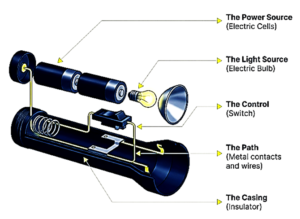
Flow Path: Electric current always flows from the positive terminal to the negative terminal of the electric cell. Current flows only when the circuit is closed. If the circuit is broken (open), electricity cannot flow and the device will not work.
Requirement for a Closed Path: For a device like a lamp to function, it must be connected to the terminals of a cell to form a complete, unbroken circuit. A broken or fused filament inside a lamp will stop the flow of current and prevent it from lighting up.
Example: A simple circuit with a battery, wires, a switch, and a bulb. When the switch is turned ON, the circuit is completed and the bulb glows.
Types of Circuits :
There are two primary states for any electric circuit, determined by the continuity of the path:
- Closed Circuit: An unbroken path that allows current to pass from the power source, through the components, and back to the source. In a closed circuit, electricity can flow continuously, and devices like bulbs will light up.
- Open Circuit: A broken path with a gap in the connections between the cell, wires, and other components. An open circuit prevents the flow of electricity. An electrical switch in the "OFF" position intentionally creates an open circuit.
Circuit Diagrams : A circuit diagram is a simplified representation of an electrical circuit that uses standardized symbols for its various components.
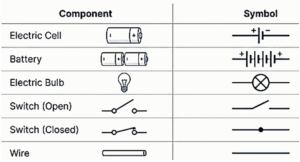
- Purpose: Using symbols makes it significantly easier to draw, read, and understand electrical circuits.
- Standardization: International organizations, including the International Electrotechnical Commission (IEC), American National Standards Institute (ANSI), and the Institute of Electrical and Electronics Engineers (IEEE), establish these standard symbols to ensure universal comprehension across different countries and industries.
Troubleshooting and Common Issues :
A circuit may fail to work for several reasons, which can be diagnosed through systematic checks.
- Possible Faults:
- Open Circuit: The switch is in the OFF position, or there is a break in a wire.
- Broken Filament: The thin wire inside the bulb is broken, creating an open circuit within the bulb itself.
- Depleted Cell/Battery: The cell is "dead" and no longer provides electrical energy.
- Incorrect Connections: Wires may be loose, or components like batteries or LEDs may be connected with the wrong polarity. For a battery, cells must be connected positive-to-negative in series. For an LED, the positive terminal of the source must connect to its longer leg (anode).
- Presence of an Insulator: An insulating material placed in the circuit path will block the current flow.
Fundamental Components of an Electric Circuit :
An electric circuit requires a power source, a path for the current, and a device (or load) that uses the electricity. A switch is used to control the circuit. The source material focuses on simple, portable components for foundational understanding.
Power Sources :
Electric Cell : An electric cell is a portable source of electrical energy. A device that produces electricity from chemicals stored inside it or a device which is used to produce small amount of electricity by chemical reactions is known as electric cell.
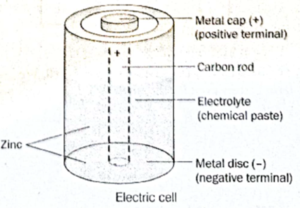
- All electric cells possess two terminals: a positive (+ve) terminal and a negative (–ve) terminal.
- Chemicals like ammonium chloride and zinc chloride are present, in between the two terminals which are called electrolytes.
- The metal cap serves as the positive terminal, while the flat metal disc at the base is the negative terminal.
Symbol : In the symbol for an electric cell, the long line represents the positive terminal, while the short line represents the negative terminal
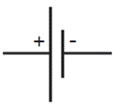
Battery : An electric cell is a single unit that gives electricity. When two or more cells are used together, it is called a battery.
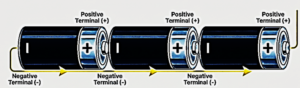
- A battery is used to run bigger devices.
- When the positive terminal of one cell is connected to the negative terminal of another cell, the cells are said to be connected in series. Example: In a torch, cells are placed one after another.
- In some devices, cells are placed side by side instead of one after another. Example: In a TV remote, two cells are placed side by side.
Electric Lamps (Loads) :
Incandescent Lamp :
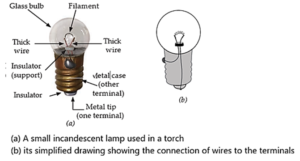
- This type of lamp contains a thin wire inside a glass bulb called a filament. When electric current passes through the filament, it gets hot and glows, producing light.
- An incandescent lamp has two terminals that must not touch each other: the metal case at the base and the metal tip at the center of the base.
- Circuit Connection: It will glow regardless of which terminal is connected to the positive or negative pole of the cell, as long as the circuit is complete.
- Failure: A lamp is considered "fused" when its filament breaks. A broken filament interrupts the circuit, preventing the flow of current and thus stopping the lamp from glowing.
Light-Emitting Diode (LED) :
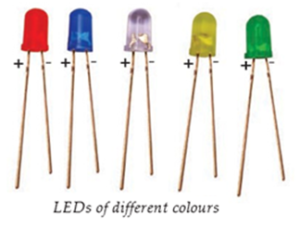
- LEDs do not have a filament. They produce light when current passes through them.
- LEDs have two terminals, one positive and one negative. The positive terminal is attached to a longer wire, and the negative terminal is attached to the shorter wire.
- In LED is directional. Current can only pass through it in one direction.
- It will only light up when its positive terminal (longer wire) is connected to the positive terminal of the battery and its negative terminal (shorter wire) is connected to the battery's negative terminal.
Symbol : In the symbol for an LED the triangle points to direction in which the current can flow. The two arrows indicate that light is emiited by an LED as shown in Fig.

The Electric Switch (Control) :
- Function: A switch is a simple device designed to either complete or break an electrical circuit.
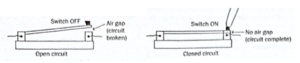
- 'ON' Position: When a switch is in the 'ON' position, it closes any gap in the circuit, creating a complete path. This is known as a closed circuit, allowing current to flow and power the device (e.g., make a lamp glow).
- 'OFF' Position: When a switch is in the 'OFF' position, it creates a gap in the circuit, breaking the path. This is known as an open circuit, which prevents current from flowing.
- Placement: A switch can be placed anywhere within a circuit to control it.
Electrical Conductors and Insulators :
Materials are classified based on their ability to allow the passage of electric current.
(i) Conductors : Materials that allow electric current to flow through them easily are known as conductors of electricity.
Examples:
- Metals are generally good conductors.
- Silver, copper, and gold are cited as the best electrical conductors.
- Copper is the most common material for electrical wires due to its relatively low cost and abundant supply.
- The human body is also a conductor of electricity.
(ii) Insulators : Materials that do not allow electric current to pass through them are called insulators (or poor conductors).
Examples: Plastic, rubber, and ceramics are common insulators.
Application:
- Conductors and insulators are both essential.
- Conductors are used for wires, switches, and plug connectors.
- Insulators are used to cover these conductive parts (e.g., wire coatings, plug tops, switch casings) to protect people from electric shocks.
Electrical Safety and Types of Current :
Safety Precautions :
The source context provides explicit safety warnings regarding the handling of electricity:
- Electricity can be dangerous if not handled carefully. Experiments should never be performed with power supplies from homes, schools, or portable generators.
- Only low-power batteries or cells should be used for experiments.
- The human body is a conductor, and electric current passing through it can cause severe injury or death.
- Electrical appliances must be handled with care. One should never touch switches or plugs with wet hands, use devices in wet areas, or handle equipment with damaged insulation or broken plugs.
Direct Current (DC) vs. Alternating Current (AC) :
There is a fundamental difference between the electricity from portable sources and that from power plants:
- Direct Current (DC): This is the type of electricity supplied by batteries and cells. It typically powers smaller devices.
- Alternating Current (AC): This is the type of electricity generated by power plants and supplied to wall sockets. It is used to run larger appliances.
We reply to valid query.