Notes
What Do We Eat? :
Food : Food is defined as the essential substance consumed for energy, growth, repair, and disease prevention.
- Food is an essential component of life, summarized by the Sanskrit saying annena jātāni jivanti ("food gives life to living beings").
- Nutrition is not merely biological but is deeply intertwined with geography, climate, and technology.
Food in different regions :
- Food is different in various regions because of changes in climate, culture, and available ingredients.
- Even within India, people eat different types of food in different states and areas.
Reasons for Variation in Food :
- Climate: The weather of a region affects the type of crops grown and the kind of food people eat.
- Local Crops: People mostly eat food made from crops that are grown in their area.
- Culture and Traditions: Food habits are influenced by local customs, festivals, and traditions.
- Taste Preferences: People in different regions develop their own tastes and cooking styles over time.
Therefore, food preferences in India vary greatly due to climate, locally available ingredients, culture, and traditions.
Some traditional food items, along with the crops grown in different states of India are given in the table below.
| Region | Locally Grown Crops | Traditional Food Items | Traditional Beverages |
| Punjab | Maize, wheat, chickpea, pulses | Makki di roti, sarson da saag, chhole bhature, parantha, halwa, kheer | Lassi, chhach, milk, tea |
| Karnataka | Rice, ragi, urad, coconut | Idli, dosa, sambhar, coconut chutney, ragi mudde, palya, rasam | Buttermilk, coffee, tea |
| Manipur | Rice, bamboo, soya bean | Rice, eromba (chutney), utti (yellow peas/onion curry), singju, kangsoi | Black tea |
All these food items have some essential components that are required for the proper growth and development of an individual.
How have cooking practices changed over time? :
- Cooking practices have changed a lot due to better technology, transport, and communication.
- New methods make cooking faster, easier, and more convenient.
Use of Modern Tools :
- Traditional wood-burning chulhas are now mostly replaced by modern gas stoves.
- Manual tools like sil-batta (stone grinder) are replaced by electric grinders.
- These tools save time and reduce effort in cooking.

Impact of These Changes :
- Cooking has become quicker and more efficient.
- People can now use a variety of ingredients easily available from different places.
- It has increased convenience in daily life.
Effect of Cooking on Nutrients :
- Cooking improves taste and makes food easier to digest.
- However, it can also reduce some important nutrients.
Loss of Nutrients
- Heat Sensitivity: Vitamins like Vitamin C get destroyed when exposed to high heat.
- Washing Practices: Repeated washing of rice and pulses removes nutrients.
- Washing fruits and vegetables after cutting or peeling also causes loss of vitamins and minerals.
Modern cooking methods make life easier, but care should be taken to preserve nutrients while preparing food.
What are the Components of Food? :
Food, Ingredients and Nutrients :
- Each food item is made up of one or more ingredients. These ingredients come from plants or animals.
- Ingredients contain important components needed by our body. These components are called nutrients.
Meaning of Nutrients : Nutrients are substances required by our body for growth, proper functioning, and good health.
Types of Nutrients : The major nutrients present in our food are:
- Carbohydrates
- Proteins
- Fats
- Vitamins
- Minerals
Classification of Food Based on Nutrients :
- Energy Giving Foods : These foods provide energy to our body. They are rich in carbohydrates and fats.
- Body Building Foods : These foods help in growth and repair of the body. They are rich in proteins.
- Protective Foods : These foods protect us from diseases and keep us healthy. They are rich in vitamins and minerals.
A balanced diet should include all types of nutrients to keep our body healthy and active.
Components of Food (Nutrients) :
- Nutrients are essential substances needed by the body to function properly.
- They are classified based on their roles in the body.
(i) Energy-Giving Foods :
(a) Carbohydrates :
- They are the main source of instant energy.
- Types include starch and sugars.
- Sources: Wheat, rice, maize, potatoes, mango, papaya.
(b) Fats :
- They store energy and provide more energy than carbohydrates.
- Plant Sources: Groundnuts, walnuts, coconuts, sunflower seeds.
- Animal Sources: Butter, ghee, milk, cream, cheese, eggs, fish, meat.
- Health Note: Too much fat in the body can lead to obesity.
(ii) Body-Building Foods (Proteins) : Proteins help in growth and repair of body tissues.
- Plant Sources: Gram, moong, tuar dal, kidney beans, peas, soybeans.
- Animal Sources: Milk, paneer, eggs, fish, meat.
- Must Know: Edible mushrooms are also a good source of protein and grow in dark, moist places.
(iii) Protective Foods (Vitamins and Minerals) : These nutrients are needed in small amounts but are very important for health and disease prevention.
(a) Vitamins :
| Vitamin | Function | Sources |
| Vitamin A | Maintains healthy eyes and skin | Papaya, carrot, mango, milk |
| Vitamin B₁ | Supports heart health and body functions | Legumes, nuts, whole grains, seeds |
| Vitamin C | Helps fight against diseases | Amla, guava, citrus fruits, tomato |
| Vitamin D | Aids calcium absorption for bones/teeth | Sunlight, milk, butter, fish, eggs |
(b) Minerals :
- Calcium: Essential for bones and teeth (Sources: Milk, curd, paneer).
- Iodine: Required for physical and mental activities (Sources: Seaweed, iodised salt).
- Iron: A critical component of blood (Sources: Green leafy vegetables, beetroot, pomegranate).
Water and Roughage (Dietary Fibre) :
(a) Roughage : Roughage is the fibrous part of food that cannot be digested by our body. It is mainly obtained from plant-based foods. Roughage is also called dietary fibre.
Sources of Roughage
- Green leafy vegetables
- Fresh fruits
- Whole grains
- Pulses
- Nuts
Importance of Roughage :
- It does not provide any nutrients to the body.
- It adds bulk to the food.
- It helps in removing undigested food from the body.
- It ensures smooth and easy passage of stool.
Even though roughage has no nutrients, it is very important for proper digestion and a healthy digestive system.
(b) Water : It is one of the major constituents of our food. About 70% of the human body is made up of water.
- It helps our body to absorb nutrients from food.
- It removes waste from the body as urine and sweat.
One can get water by the following ways :
- Most of the water can be obtained from the liquids like water, milk and tea.
- In addition, water is also obtained from fruits and fresh vegetables.
- Even while cooking, a lot of water is added to the food.
All nutrients, along with water and roughage, are important for maintaining good health and proper body functioning.
How to Test Different Components of Food? :
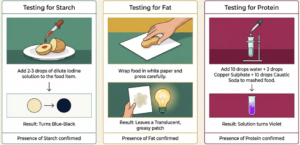
The presence of major nutrients in food can be identified through simplified chemical tests:
- Starch (Carbohydrate) Test: Application of diluted iodine solution. A change to blue-black indicates the presence of starch.
- Fat Test: Pressing food against a piece of paper. The appearance of a translucent oily patch (that remains after drying) indicates fat content.
- Protein Test: Combining a paste of the food with two drops of copper sulphate and ten drops of caustic soda. A violet color indicates protein.
Balanced Diet :
Diet : The total amount of food a person eats in a whole day is called their diet.
Balanced Diet : A balanced diet is a diet that contains the right amount of all nutrients. It also includes a good amount of roughage (dietary fibre) and water.
Importance of a Balanced Diet :
- It provides the body with enough energy.
- It fulfills all nutrient requirements of the body.
- It helps in proper functioning of the body.
Different Needs of Different People :
- A balanced diet is not the same for everyone.
- The type and amount of nutrients depend on age, gender, physical activity, health and lifestyle.
Examples :
- Sports persons need more proteins to build their muscles.
- Children in their growing stage need the right amount of protein for proper growth and development.
Junk Food and Its Effects :
- Packaged foods like chips, wafers, candy bars and soft drinks are called junk food.
- Junk food contains high sugar and fat, which gives high calories.
- It has very low amounts of proteins, vitamins, minerals and dietary fibre.
- These foods can harm health and may cause obesity.
| Know This :
Packaged Food and Nutritional Information :
Fortification of Food :
Examples of Fortified Foods :
Role of FSSAI :
|
Milestone Research: Coluthur Gopalan
- Coluthur Gopalan (1918–2019) was a pioneer of nutrition research in India.
- He studied and analysed more than 500 Indian food items for their nutritional value.
- He suggested suitable diets based on Indian food habits.
- He conducted surveys to understand the nutritional status of people in India.
- His research showed that many people were lacking protein, energy, and other important nutrients.
Impact of His Work :
- His findings helped in starting the Mid Day Meal Programme in 2002.
- This programme provides balanced meals to children in government and government-aided schools.
- Today, this scheme is known as PM POSHAN.
- The programme has improved the health and nutrition of millions of children across the country.
Deficiency Diseases :
The diseases which occur due to the lack of specific nutrients in our diet over a long period of time are called deficiency diseases.
Some diseases caused due to the deficiency of vitamins and minerals are tabulated below.
| Nutrient | Deficiency Disease | Main Symptoms |
| Vitamin A | Loss of vision | Poor vision; night blindness; total loss of vision |
| Vitamin B₁ | Beri-beri | Swelling, tingling/burning in feet/hands; breathing trouble |
| Vitamin C | Scurvy | Bleeding gums; slow healing of wounds; low immunity |
| Vitamin D | Rickets | Soft and bent bones |
| Calcium | Bone and tooth decay | Weak bones; tooth decay |
| Iodine | Goitre | Swelling at the front of the neck |
| Iron | Anaemia | Weakness; shortness of breath |
The link between deficiencies and their associated vitamins or minerals can be clarified through the following cases.
- Case 1: James Lind found that sailors with bleeding and swollen gums recovered after eating lemons and oranges. This disease is called scurvy, caused by a deficiency of Vitamin C.
- Case 2: In the Himalayan and Northern plains of India, people had swelling in the neck. This disease is called goitre, caused by a deficiency of iodine. Using iodised salt helped reduce this problem.
Know This :
|
To prevent such deficiency, diseases, it is important to consume foods rich in vitamins and minerals.
Recently, millets have gained popularity due to their high content of vitamins, minerals (iron, calcium) and dietary fibres, offering numerous health benefits.
Millets: Nutrition-rich Cereals :
Millets are highly nutritious grains. They have been a part of the Indian diet for many years.
- Examples of millets include jowar, bajra, ragi and sanwa (barnyard millet).
Growth and Cultivation : Millets are native crops of India. They can grow easily in different climatic conditions.
Nutritional Value : Millets are rich in essential nutrients. They are also called nutri-cereals because of their high nutritional value.
Importance in Diet : Millets help in maintaining a balanced diet. They support the normal functioning of the body.
Food Miles: From Farm to Our Plate :
Eating locally grown, plant-based food is healthy. It is also good for the environment and the planet.
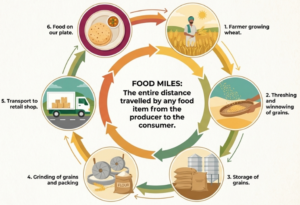
Food Miles Concept : The journey of food from farms to our plate is called food miles. It helps us understand how local foods like millets are more eco-friendly.
The food produced on farms reaches our plate through various steps. These steps involves considerable amount of time and efforts of many people.
For example, the entire process of making the chapati can be understood from the image given below.
Benefits of Reducing Food Miles
Reducing food miles mean decreasing the distance of food travel from the place of its production to the consumer. This practice provides the following benefits.
- Fresh and Healthy Food : Locally grown food is fresher and more nutritious.
- Better for the Environment : Less transportation means less pollution and lower carbon emissions.
- Energy Saving : Reduces the use of fuel needed to transport food over long distances.
- Supports Local Farmers : Buying local food helps farmers in your area.
- Less Food Waste : Food that travels shorter distances is less likely to spoil.
- Cost Effective : Local food can be cheaper as transportation costs are lower.
- Promotes Sustainable Living : Encourages eco-friendly and responsible food choices.
We reply to valid query.