Solutions
Question 1. Answer in one sentence only.
(1) What is Double Entry System?
Double Entry System is a scientific method of recording the two-fold aspects of every monetary transaction in the books of accounts using debits and credits.
(2) What is an Account?
An account is a summarized record of transactions relating to a specific person, asset, liability, expense, or income maintained at one place.
(3) State the meaning of Single Entry System.
Single Entry System is an unscientific and incomplete method of accounting that typically records only personal accounts and cash book transactions.
(4) What is Personal Account?
A Personal Account represents accounts of individuals, groups of persons, or organizations with whom the business deals.
(5) State the rule of Nominal Account.
The rule of Nominal Account is to debit all expenses and losses and credit all incomes and gains.
(6) Give two examples of intangible assets?
Two examples of intangible assets are Goodwill and Patents.
(7) State the meaning of Real Account.
A Real Account represents the various assets and properties owned by the business.
(8) Give two examples of income and gains.
Two examples of income and gains are Commission Received and Interest Received.
(9) State the rule of Personal Account.
The rule of Personal Account is to debit the receiver and credit the giver.
(10) How many methods of recording accounting information are there?
There are two main methods of recording accounting information: the Indian System and the English System.
Question 2. Write one word / term or phrase which can substitute each of the following statement.
(1) Method of Accounting which records both aspect of transaction.
(2) Right hand side of an account.
(3) Name of the account which is debited when proprietor uses business money for personal use.
(4) Accounts of Assets and Properties.
(5) Accounts of Expenses and Losses and Incomes and Gains.
(6) Left hand side of an account.
(7) The Assets which cannot be seen, touched or felt.
(8) Person who invented the Double Entry System.
(9) Incomplete system of recording business transactions.
(10) Scientific system of recording business transactions.
| Statement | Word/Term/Phrase |
| (1) Method of accounting which records both aspects of transaction | Double entry system |
| (2) Right hand side of an account | Credit (Cr.) side |
| (3) Name of the account which is debited when proprietor uses business/ money for personal use | Drawings A/c |
| (4) Accounts of assets and properties | Real A/c |
| (5) Accounts of expenses and losses and incomes and gains | Nominal A/c |
| (6) Left hand side of an account | Debit (Dr.) side |
| (7) The assets which cannot be seen, touched or felt | Intangible assets |
| (8) Person who invented the double entry book-keeping system | LUCA D. BARGO PACIOLI |
| (9) Incomplete system of recording business transactions | Single entry system |
| (10) Scientific method of recording business transactions | Double entry system |
Question 3. Select the most appropriate alternatives from those given below and rewrite the statements.
(1) International Accounting day is observed on . . . . . . . . . . . . . .
(a) 10th November (b) 12th November
(c) 10th December (d) 15th December
(a) 10th November
(2) Conventional system of accounting is . . . . . . . . . . . . . .
(a) English entry system (b) Double entry system
(c) Indian system (d) None of these
(c) Indian system
(3) Every debit has corresponding . . . . . . . . . . . . . .
(a) Debit (b) Credit
(c) Right hand side (d) None of these
(b) Credit
(4) Radha`s Account is a type of . . . . . . . . . . . . . account.
(a) Nominal (b) Personal (c) Real (d) Expenses
(b) Personal
(5) Machinery Account is . . . . . . . . . . . . . account.
(a) Nominal (b) Income (c) Personal (d) Real
(d) Real
(6) Goodwill is . . . . . . . . . . . . . . asset.
(a) Tangible (b) Current
(c) an intangible (d) None of these
(c) an intangible
(7) Prepaid expenses is . . . . . . . . . . . . account.
(a) Real (b) Personal (c) Nominal (d) Income
(b) Personal
(8) Debit the receiver, Credit the . . . . . . . . . . . . . .
(a) Goes out (b) Giver
(c) Income and gains (d) Comes in
(b) Giver
(9) Debit what comes in, Credit what . . . . . . . . . . . . . .
(a) Giver (b) Expenses and losses
(c) Goes out (d) Income and gains
(c) Goes out
(10) Debit all . . . . . . . . . . . . . . and Credit all income and gains.
(a) Giver (b) Expenses and losses
(c) Goes out (d) None of these
(b) Expenses and losses
Question 4. State whether the following statements are True or False with reasons.
(1) Outstanding expense is nominal account.
Statement is : False
Reason:
Outstanding expense is a Personal Account, not a nominal account. It represents an amount of expense that is due but not yet paid to a person or party. Since it shows a liability (amount payable), it is treated as a Personal Account under accounting rules.
- Nominal Accounts record expenses, losses, incomes, and gains (e.g., Salary A/c, Rent A/c).
- Outstanding Expenses represent a person or party to whom the payment is due, so it is considered a representative personal account.
Therefore, the statement “Outstanding expense is a nominal account” is False.
(2) Capital account is a real account.
Statement is : False
Reason:
A Capital Account represents the owner of the business. Therefore, it is treated as a Personal Account, not a Real Account.
- Real Accounts relate to assets and properties of the business (e.g., Cash A/c, Building A/c, Machinery A/c).
- Capital Account shows the amount invested by the owner, so it belongs to the owner’s account, which is a Personal Account.
(3) Every debit has equal and corresponding credit.
Statement is : True
Reason:
This statement is based on the Double Entry System of Accounting.
- According to this system, every financial transaction affects at least two accounts. One account is debited and another account is credited with the same amount.
- This ensures that the total debits are always equal to the total credits in the books of accounts.
Therefore, the statement “Every debit has equal and corresponding credit” is True.
(4) Discount received is a nominal account.
Statement is : True
Reason:
Discount received is an income (gain) for the business because it is the discount allowed by the supplier to the business.
In accounting:
- Nominal Accounts record incomes, gains, expenses, and losses.
- Since discount received is a gain, it is classified as a Nominal Account.
Therefore, the statement “Discount received is a nominal account” is True.
(5) Drawings account is a nominal account.
Statement is : False
Reason:
A Drawings Account records the amount withdrawn by the owner from the business for personal use. It represents the owner, so it is treated as a Personal Account.
- Nominal Accounts record expenses, losses, incomes, and gains.
- Drawings Account is related to the owner of the business, therefore it is a Personal Account.
(6) Outstanding salary is a nominal account.
Statement is : False
Reason:
Outstanding salary means salary that is due but not yet paid. It represents an amount payable to employees, so it is a liability. Therefore, it is treated as a Representative Personal Account, not a nominal account.
- Nominal Accounts record expenses, losses, incomes, and gains (e.g., Salary A/c).
- Outstanding Salary represents a person to whom salary is payable, so it is a Personal Account.
(7) Loan account is personal account.
Statement is : False
Reason:
A Loan Account represents the person, bank, or institution from whom the loan is taken or to whom the loan is given. Since it relates to a person or organisation, it is classified as a Personal Account.
- Personal Accounts include accounts of individuals, banks, companies, or institutions.
- Example: Bank Loan A/c, Ram’s Loan A/c.
Therefore, the statement “Loan account is a personal account” is True.
(8) Goodwill account is a real account.
Statement is : True
Reason:
Goodwill is an intangible asset of a business. Real accounts include all assets and properties of the business, whether tangible (like machinery, building) or intangible (like goodwill, patents).
Since Goodwill is an asset, it is classified as a Real Account.
Therefore, the statement “Goodwill account is a real account” is True.
(9) Discount account is a nominal account.
Statement is : True
Reason:
A Discount Account records discount allowed or discount received, which are considered expenses or incomes of the business.
- Nominal Accounts deal with expenses, losses, incomes, and gains.
- Since discount relates to expense (discount allowed) or income (discount received), it is classified as a Nominal Account.
Therefore, the statement “Discount account is a nominal account” is True.
[Note : Trade discount is not recorded in the books of accounts. It is deducted from the list price of goods directly on the invoice, and only the net amount is entered in the books.
Since no separate Trade Discount Account is maintained, it cannot be classified as a nominal account.
The statement “Trade discount account is a nominal account” is False.]
(10) Personal transactions of proprietor are recorded in the books of account of business.
Statement is : False
Reason:
According to the Business Entity Concept, the business and the owner (proprietor) are treated as separate entities. Therefore, only business transactions are recorded in the books of accounts of the business.
The personal transactions of the proprietor are not recorded in the business books, except when the proprietor withdraws money or goods for personal use (Drawings).
(11) Motor car account is a Real Account.
Statement is : True
Reason:
A Motor Car is a tangible asset of the business. Real accounts include all assets and properties owned by the business, whether tangible or intangible.
Since Motor Car is a tangible asset, its account is classified as a Real Account.
Therefore, the statement “Motor Car Account is a Real Account” is True.
(12) The rule of Nominal Account in Debit the receiver and Credit the giver.
Statement is : False
Reason:
The rule “Debit the receiver and Credit the giver” belongs to a Personal Account, not a Nominal Account.
The correct rule for Nominal Accounts is:
- Debit all expenses and losses
- Credit all incomes and gains
(13) Bank loan account is a Nominal account.
Statement is : False
Reason:
A Bank Loan Account represents the bank from which the loan is taken. Since it relates to a bank (an organisation/person), it is classified as a Personal Account.
- Nominal Accounts record expenses, losses, incomes, and gains.
- Bank Loan Account represents a party (bank), so it is a Personal Account.
(14) Assets = Capital + Liabilities
Statement is : True
Reason:
This statement represents the Accounting Equation, which shows the relationship between assets, capital, and liabilities in a business.
According to the accounting equation:
Assets = Capital + Liabilities
- Assets are the properties or resources of the business.
- Capital is the owner’s investment in the business.
- Liabilities are the amounts payable to outsiders.
This equation always remains balanced for every business transaction.
Therefore, the statement “Assets = Capital + Liabilities” is True.
(15) Trademark account is a personal account.
Statement is : False
A Trademark is an intangible asset of a business. Real accounts include all assets and properties, whether tangible or intangible.
Since Trademark is an intangible asset, it is classified as a Real Account, not a personal account.
Question 5. Fill in the blanks.
(1) Increase in asset is debited and decrease in asset is . . . . . . . . . . .
Credited
(2) Assets = Liabilities + . . . . . . . . . . .
Capital
(3) Increase in capital is credited and decrease in capital is . . . . . . . . . . .
Debited
(4) Scientific and complete system of recording is known as . . . . . . . .
Double entry system
(5) Debit all expenses and losses, Credit all . . . . . . . . . . .
Incomes and gains
(6) Land and Building account is . . . . . . . . . . . account.
Real
(7) Cash Book and Personal Accounts are only maintained under . . . . . . . system.
Single entry system
(8) Debit what comes in and credit what goes out is the rule of . . . . . . . . account.
Real
(9) Travelling expenses account is . . . . . . . . . . .type of Account.
Nominal
(10) Every transaction has . . . . . . . . . . . effect.
Two fold
(11) . . . . . . . . . . . accounts are accounts of properties and assets.
Real
(12) Laptop account is a . . . . . . . . . . . account.
Real
Question 6. Classify the following accounts under the types of Personal, Real and Nominal account.
| (1) Mr. Rohit’s capital A/c
(3) Drawing A/c (5) Prepaid Rent A/c (7) Patent A/c (9) Prepaid Expenses A/c (11) Freight A/c (13) Sundry Income A/c (15) Goods distributed as free sample A/c (17) Outstanding Wages A/c (19) Bank of Maharashtra A/c (21) Computer A/c (23) Fixed Deposit A/c (25) Audit Fees A/c (27) Loss by fire A/c (29) Income tax A/c (31) Siddhivinayak Trust A/c (33) Stock of Stationery A/c (35) Income Received in Advance A/c (37) Discount A/c (39) Repairs A/c |
(2) Loose Tools A/c
(4) Cartage A/c (6) Copyright A/c (8) Outstanding Income A/c (10) Commission Received A/c (12) Plant and Machinery A/c (14) Live Stock A/c (16) Radhika`s A/c (18) Loss on Sale of Furniture A/c (20) Loan A/c (22) Legal Expenses A/c (24) Income Receivable A/c (26) Trademark A/c (28) Motor Car A/c (30) GST A/c (Goods and Service Tax) (32) Offfice Equipment A/c (34) Indian Railways A/c (36) Dividend on Investment A/c (38) Raj & company A/c (40) Royalty A/c |
| Personal Account | Real Account | Nominal Account |
| (1) Mr. Rohit's Capital A/c
(3) Drawings A/c (5) Prepaid rent A/c (8) Outstanding income A/c (9) Prepaid expense A/c (16) Radhika's A/c (17) Outstanding wages A/c (19) Bank of Maharashtra A/c (20) Loan A/c (24) Income receivable A/c (29) Income Tax A/c (31) Siddhivinayak Trust A/c (34) Indian Railways A/c (35) Income received in advance A/c (38) Raj & Company A/c |
(2) Loose Tools A/c
(6) Copyright A/c (7) Patent A/c (12) Plant and Machinery A/c (14) Livestock A/c (21) Computer A/c (23) Fixed deposit A/c (26) Trademark A/c (28) Motor car A/c (32) Office equipment A/c (33) Stock of stationery A/c |
(4) Cartage A/c
(10) Commission received A/c (11) Freight A/c (13) Sundry income A/c (15) Good distributed as free samples A/c (18) Loss on sale of furniture A/c (22) Legal expense A/c (25) Audit fees A/c (27) Loss by fire A/c (30) GST A/c (Goods and Services Tax) (36) Dividend on investment advance A/c (37) Discount A/c (39) Repairs A/c (40) Royalty A/c |
Question 7. Complete the following Accounting equation table.
| Transaction | Assets (₹) | = | Liabilities (₹) | + | Capital (₹) |
| 1. Started business with Cash ₹ 50,000 | ? | = | ? | + | 50,000 |
| 2. Purchased goods of
₹ 10,000 |
? | = | ? | + | ? |
| 3. Goods stolen ₹ 1,000 | ? | = | ? | + | ? |
| 4. Sold goods for cash
₹ 5,000 |
? | = | ? | + | ? |
| 5.Loan ta ken from
Bank ₹ 7,000 |
? | = | ? | + | ? |
Accounting Equation (Assets = Liabilities + Capital)
| Transaction | Assets (₹) | = | Liabilities (₹) | + | Capital (₹) |
| 1. Started business with Cash ₹ 50,000 | 50,000 | = | 0 | + | 50,000 |
| 50,000 | = | 0 | + | 50,000 | |
| 2. Purchased goods of ₹ 10,000 | (-)10,000
(+)10,000 |
= | 0 | + | 0 |
| 50,000 | = | 0 | + | 50,000 | |
| 3. Goods stolen ₹ 1,000 | (-)1,000 | 0 | + | (-)1,000 | |
| 49,000 | = | 0 | + | 49,000 | |
| 4. Sold goods for cash ₹ 5,000 | (+)5,000
(-)5,000 |
= | 0 | + | 0 |
| 49,000 | = | 0 | + | 49,000 | |
| 5. Loan taken from Bank ₹ 7,000 | (+)7,000 | = | 7,000 | + | 0 |
| 56,000 | = | 7,000 | + | 49,000 |
[Explanations for the Table:
- Started business: Cash (an asset) increases by ₹ 50,000, and Capital increases by the same amount.
- Purchased goods: This is treated as an internal change in assets where Cash decreases by ₹ 10,000 and Stock increases by ₹ 10,000. The total value of Assets remains ₹ 50,000.
- Goods stolen: A loss reduces both the asset (Stock) and the proprietor's Capital. Thus, both sides of the equation decrease by ₹ 1,000.
- Sold goods for cash: Similar to the purchase, this is an exchange of assets (Stock goes out, Cash comes in). Assuming the goods were sold at cost (as no profit/loss is mentioned), the total Assets remain ₹ 49,000.
- Loan taken: Taking a loan increases the business's Cash (Asset) while simultaneously creating a Bank Loan (Liability). Both Assets and Liabilities increase by ₹ 7,000.]
Question 8. Give necessary transactions for the following effect of increase and decrease in Assets, Capital and Liabilities.
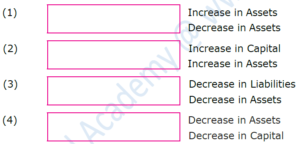
| 1 | Purchased Machinery for cash ₹ 5,000. | Increase in Assets
Decrease in Assets |
| 2 | Started business with cash ₹ 50,000. | Increase in Capital
Increase in Assets |
| 3 | Payment of a Bank Loan or paying a Creditor | Decrease in Liabilities
Decrease in Assets |
| 4 | Paid for Salaries ₹ 3,000 | Decrease in Assets
Decrease in Capital |
[Explanations :
(1) Increase in Assets, Decrease in Assets
- Explanation: In this transaction, the asset "Machinery" increases (comes in), while the asset "Cash" decreases (goes out). Another example is depositing cash into a bank, where bank balance (asset) increases and cash (asset) decreases.
(2) Increase in Capital, Increase in Assets
- Explanation: When the proprietor starts a business, the "Cash" account (asset) increases because money comes into the business, and the "Capital" account increases because the proprietor is the giver of that fund. Bringing in additional capital also has this same effect.
(3) Decrease in Liabilities, Decrease in Assets
- Explanation: According to the modern approach, a decrease in liabilities is debited and a decrease in assets is credited. If you pay a liability like a Bank Loan or a Sundry Creditor using cash, your total liabilities decrease and your cash (asset) also decreases.
(4) Decrease in Assets, Decrease in Capital
- Explanation: Paying an expense like salaries reduces "Cash" (asset) and also reduces "Capital" because expenses and losses result in a decrease in the owner's equity. Other examples include withdrawing cash for personal use (Drawings) or goods being destroyed by fire.]
PRACTICAL PROBLEMS :
Question 1 Prepare a chart showing Analysis of the following transactions in a Tabular form according to Traditional Approach:
(1) Rajasaheb started business with cash ₹ 85,000.
(2) Goods Purchased for cash ₹ 5,000.
(3). Sold goods on credit worth ₹ 6,000.
(4) Cash deposited into Bank of Maharashtra ₹ 12,000.
(5) Interest received ₹ 700 from Radhika.
(6) Paid Rent ₹ 2,000 to landlord.
(7) Bought goods on credit from Birajmohan ₹7 ,000.
(8) Withdrew cash from bank ₹ 1,000 for office use.
(9) Purchased computer ₹ 9,000 for cash.
(10) Paid Mobile bill (office) ₹ 500.
(11) Sold old Mobile ₹ 2,000.
(12) Received Rent ₹ 1,000 from tenant.
Analysis of Transactions (Traditional Approach) :
| Sr. No. | Transaction | Two Aspects / Effects | Accounts Involved | Classification | Rules Applied | Account
to be Debited |
Account
to be Credited |
| 1 | Rajasaheb started business with cash ₹ 85,000 | 1. Cash comes in | Cash A/c | Real | Dr what comes in | Cash A/c | |
| 2. Proprietor is giver | Capital A/c | Personal | Cr the giver | Capital A/c | |||
| 2 | Goods Purchased for cash ₹ 5,000 | 1. Purchase is an expense | Purchases A/c | Nominal | Dr all expenses | Purchases A/c | |
| 2. Cash goes out | Cash A/c | Real | Cr what goes out | Cash A/c | |||
| 3 | Sold goods on credit worth ₹ 6,000 (to Mr.X) | 1. Mr.X is receiver | Mr.X A/c | Personal | Dr the receiver | Mr.X A/c | |
| 2. Sales is an income | *Sales A/c | Nominal | Cr all incomes | Sales A/c | |||
| 4 | Cash deposited into Bank of Maharashtra ₹ 12,000 | 1. Bank is receiver | Bank of Maharashtra A/c | Personal | Dr the receiver | Bank of Maharashtra A/c | |
| 2. Cash goes out | Cash A/c | Real | Cr what goes out | Cash A/c | |||
| 5 | Interest received ₹ 700 from Radhika | 1. Cash comes in | Cash A/c | Real | Dr what comes in | Cash A/c | |
| 2. Interest is income | Interest A/c | Nominal | Cr all incomes | Interest A/c | |||
| 6 | Paid Rent ₹ 2,000 to landlord | 1. Rent is an expense | Rent A/c | Nominal | Dr all expenses | Rent A/c | |
| 2. Cash goes out | Cash A/c | Real | Cr what goes out | Cash A/c | |||
| 7 | Bought goods on credit from Birajmohan ₹ 7,000 | 1. Purchase is an expense | Purchases A/c | Nominal | Dr all expenses | Purchases A/c | |
| 2. Birajmohan is giver | Birajmohan's A/c | Personal | Cr the giver | Birajmohan's A/c | |||
| 8 | Withdrew cash from bank ₹ 1,000 for office use | 1. Cash comes in | Cash A/c | Real | Dr what comes in | Cash A/c | |
| 2. Bank is giver | Bank A/c | Personal | Cr the giver | Bank A/c | |||
| 9 | Purchased computer ₹ 9,000 for cash | 1. Computer comes in | Computer A/c | Real | Dr what comes in | Computer A/c | |
| 2. Cash goes out | Cash A/c | Real | Cr what goes out | Cash A/c | |||
| 10 | Paid Mobile bill (office) ₹ 500 | 1. Mobile bill is expense | Mobile Bill A/c | Nominal | Dr all expenses | Mobile Bill A/c | |
| 2. Cash goes out | Cash A/c | Real | Cr what goes out | Cash A/c | |||
| 11 | Sold old Mobile ₹ 2,000 | 1. Cash comes in | Cash A/c | Real | Dr what comes in | Cash A/c | |
| 2. Mobile goes out | Mobile A/c | Real | Cr what goes out | Mobile A/c | |||
| 12 | Received Rent ₹ 1,000 from tenant | 1. Cash comes in | Cash A/c | Real
Nominal |
Dr what comes in | Cash A/c | |
| 2. Rent is income | Rent A/c | Cr all incomes | Rent A/c |
*Note: Since no specific name is mentioned for the credit sale in transaction 3, "Customer A/c" or "Debtors A/c" is used to represent the receiver. In transactions involving expenses (like Rent) or incomes (like Interest), the person's name (landlord, Radhika) is ignored as the focus is on the nature of the expense or income.
Question 2. Prepare Chart showing Analysis of the following transaction in a Tabular form according to Modern Approach.
(1) Mr. Meghraj started business with cash ₹ 30,000.
(2) Deposited cash into Bank of India ₹ 2,000.
(3) Withdrew cash ₹ 1,000 for personal use.
(4) Purchased goods on credit from Nilesh ₹ 2,000.
(5) Cash purchases ₹ 3,000.
(6) Paid Wages ₹ 400.
(7) Purchase a chair for office use ₹ 3.200.
(8) Sold goods to Mohan worth ₹ 1,200.
(9) Withdrew Cash for Office use ₹ 3,000.
(10) Sold old furniture ₹ 9,000.
(11) Received Dividend of ₹ 1,000.
(12) Paid for Printing bill book ₹ 200.
Analysis of Transactions (Modern Approach) :
| Sr. No. | Transaction | Two Aspects / Effects | Accounts Involved | Categories | Rules Applied | Account to be Debited | Account to be Credited |
| 1 | Started business with cash ₹ 30,000 | 1. Cash comes in | Cash A/c | Asset | Increase in Asset | Cash A/c | |
| 2. Proprietor is giver | Capital A/c | Capital | Increase in Capital | Capital A/c | |||
| 2 | Deposited cash into Bank of India ₹ 2,000 | 1. Bank balance increases | Bank of India A/c | Asset | Increase in Asset | Bank of
India A/c |
|
| 2. Cash goes out | Cash A/c | Asset | Decrease in Asset | Cash A/c | |||
| 3 | Withdrew cash ₹ 1,000 for personal use | 1. Drawings is receiver | Drawings A/c | Capital | Decrease in Capital | Drawings A/c | |
| 2. Cash goes out | Cash A/c | *Asset | Decrease in Asset | Cash A/c | |||
| 4 | Purchased goods on credit from Nilesh ₹ 2,000 | 1. Purchase is expense | Purchases A/c | Expense | Increase in Expense | Purchases A/c | |
| 2. Nilesh is giver | Nilesh's A/c | Liability | Increase in Liability | Nilesh's A/c | |||
| 5 | Cash purchases ₹ 3,000 | 1. Purchase is expense | Purchases A/c | Expense | Increase in Expense | Purchases A/c | |
| 2. Cash goes out | Cash A/c | Asset | Decrease in Asset | Cash A/c | |||
| 6 | Paid Wages ₹ 400 | 1. Wages is expense | Wages A/c | Expense | Increase in Expense | Wages A/c | |
| 2. Cash goes out | Cash A/c | Asset | Decrease in Asset | Cash A/c | |||
| 7 | Purchased a chair for office use ₹ 3,200 | 1. Chair (Furniture) comes in | Furniture A/c | Asset | Increase in Asset | Furniture A/c | |
| 2. Cash goes out | Cash A/c | Asset | Decrease in Asset | Cash A/c | |||
| 8 | Sold goods to Mohan worth ₹ 1,200 | 1. Mohan is receiver (Debtor) | Mohan's A/c | Asset | Increase in Asset | Mohan's A/c | |
| 2. Sales is revenue | Sales A/c | Revenue | Increase in Revenue | Sales A/c | |||
| 9 | Withdrew Cash for Office use ₹ 3,000 | 1. Cash comes in | Cash A/c | AssetAsset | Increase in Asset | Cash A/c | |
| 2. Bank is giver | Bank A/c | Decrease in Asset | Bank A/c | ||||
| 10 | Sold old furniture ₹ 9,000 | 1. Cash comes in | Cash A/c | Asset | Increase in Asset | Cash A/c | |
| 2. Furniture goes out | Furniture A/c | Asset | Decrease in Asset | Furniture A/c | |||
| 11 | Received Dividend of ₹ 1,000 | 1. Cash comes in | Cash A/c | Asset
Revenue |
Increase in Asset | Cash A/c | |
| 2. Dividend is income | Dividend A/c | Increase in Revenue | Dividend A/c | ||||
| 12 | Paid for Printing bill book ₹ 200 | 1. Printing is expense | Printing A/c | Expense | Increase in Expense | Printing A/c | |
| 2. Cash goes out | Cash A/c
|
Asset | Decrease in Asset | Cash A/c |
*Note: Under the Modern Approach, Drawings are treated as a reduction in Capital.
Question 3. Give the accounting equation for the following transactions:
(1) Mr. Vaibhav started business with Cash ₹ 1,00,000.
(2) Purchased goods on credit from Rita Stores ₹ 9,000.
(3) Purchase Laptop for office use ₹ 10,000.
(4) Sold goods to Rina on credit ₹ 12,000.
(5) Received Interest ₹ 2,500
(6) Paid Telephone bill ₹ 1,300.
Accounting equation Assets = Liabilities + Capital
Accounting Equation Table
| Transaction | Assets (₹) | = | Liabilities (₹) | + | Capital (₹) |
| 1. Started business with Cash ₹ 1,00,000 | 1,00,000 | = | 0 | + | 1,00,000 |
| 1,00,000 | = | 0 | + | 1,00,000 | |
| 2. Purchased goods on credit (Rita Stores) ₹ 9,000 | (+) 9,000 | = | (+) 9,000 | + | 0 |
| 1,09,000 | = | 9,000 | + | 1,00,000 | |
| 3. Purchase Laptop for office use ₹ 10,000 | (+) 10,000
(-) 10,000 |
= | 0 | + | 0 |
| 1,09,000 | = | 9,000 | + | 1,00,000 | |
| 4. Sold goods to Rina on credit ₹ 12,000 | (-) 12,000
(+) 12,000 |
= | 0 | + | 0 |
| 1,09,000 | = | 9,000 | + | 1,00,000 | |
| 5. Received Interest ₹ 2,500 | (+) 2,500 | = | 0 | + | (+) 2,500 |
| 1,11,500 | = | 9,000 | + | 1,02,500 | |
| 6. Paid Telephone bill ₹ 1,300 | (-) 1,300 | = | 0 | + | (-) 1,300 |
| Total | 1,10,200 | = | 9,000 | + | 1,01,200 |
[Explanation of Transactions:
- Started business: Cash (Asset) increases and Capital increases by ₹ 1,00,000.
- Credit Purchase: Goods (Asset) increase and Sundry Creditors (Liability) increase by ₹ 9,000.
- Purchase Laptop: This is an exchange of assets. The asset "Laptop" comes in (+10,000) and "Cash" goes out (-10,000). The total assets remain unchanged.
- Credit Sale: This involves an exchange of assets where "Stock" goes out (-12,000) and a "Debtor" (Rina) is created (+12,000). As no profit or loss is mentioned, capital remains unchanged.
- Received Interest: Cash (Asset) increases by ₹ 2,500. Since interest is a revenue/gain, it increases the Capital.
- Paid Telephone bill: Cash (Asset) decreases by ₹ 1,300. As an expense, it reduces the total Capital.]
Question 4. Give the accounting equation for the following transactions.
(1) Mr. Swaraj commenced business with Bank balance ₹ 1,10,000.
(2) Purchased Furniture on credit from S.M Furniture Mart ₹ 25,000.
(3) Bought goods on credit from Yuvraj ₹ 15,000.
(4) Purchased Machinery ₹ 10,000.
(5) Paid Electricity bill ₹ 3,500.
(6) Goods destroyed by fire ₹ 1,500.
Accounting equation Assets = Liabilities + Capital
Accounting Equation Table
| Transaction | Assets (₹) | = | Liabilities (₹) | + | Capital (₹) |
| 1. Commenced business with Bank balance ₹ 1,10,000 | 1,10,000 | = | 0 | + | 1,10,000 |
| New Balance | 1,10,000 | = | 0 | + | 1,10,000 |
| 2. Purchased Furniture on credit (S.M Furniture Mart) ₹ 25,000 | (+) 25,000 | = | (+) 25,000 | + | 0 |
| New Balance | 1,35,000 | = | 25,000 | + | 1,10,000 |
| 3. Bought goods on credit from Yuvraj ₹ 15,000 | (+) 15,000 | = | (+) 15,000 | + | 0 |
| New Balance | 1,50,000 | = | 40,000 | + | 1,10,000 |
| 4. Purchased Machinery ₹ 10,000 | (+) 10,000(-) 10,000 | = | 0 | + | 0 |
| New Balance | 1,50,000 | = | 40,000 | + | 1,10,000 |
| 5. Paid Electricity bill ₹ 3,500 | (-) 3,500 | = | 0 | + | (-) 3,500 |
| New Balance | 1,46,500 | = | 40,000 | + | 1,06,500 |
| 6. Goods destroyed by fire ₹ 1,500 | (-) 1,500 | = | 0 | + | (-) 1,500 |
| Final Total | 1,45,000 | = | 40,000 | + | 1,05,000 |
[Explanation of Transactions:
- Commenced business: The bank balance (Asset) increases, and Capital increases by the same amount as the proprietor is the giver of funds.
- Furniture on credit: This creates a new asset (Furniture) and a new liability (Sundry Creditors).
- Goods on credit: Similar to transaction 2, this increases assets (Stock) and increases liabilities (Creditors).
- Purchased Machinery: This is an internal exchange of assets. Machinery comes in (+10,000) and Bank/Cash goes out (-10,000), leaving total assets unchanged.
- Paid Electricity bill: As an expense, this reduces assets (Bank/Cash) and also reduces Capital.
- Goods destroyed by fire: A loss reduces the asset (Stock) and directly reduces the proprietor's Capital.]
Question 5. Show accounting equation for the following transactions:
(1) Rohit started business with cash ₹ 50,000.
(2) Bought goods on credit from Manoj ₹ 6,000.
(3) Cash purchases ₹ 5,000.
(4) Paid wages ₹ 3,000 to Casual labour.
(5) Sold goods to Santosh ₹ 7,000 on credit.
(6) Received Commission ₹ 1,000 from Vaishali.
Accounting equation Assets = Liabilities + Capital
Accounting Equation Table :
| Transaction | Assets (₹) | = | Liabilities (₹) | + | Capital (₹) |
| 1. Started business with cash ₹ 50,000 | 50,000 | = | 0 | + | 50,000 |
| New Balance | 50,000 | = | 0 | + | 50,000 |
| 2. Bought goods on credit from Manoj ₹ 6,000 | (+) 6,000 | = | (+) 6,000 | + | 0 |
| New Balance | 56,000 | = | 6,000 | + | 50,000 |
| 3. Cash purchases ₹ 5,000 | (+) 5,000(-) 5,000 | = | 0 | + | 0 |
| New Balance | 56,000 | = | 6,000 | + | 50,000 |
| 4. Paid wages ₹ 3,000 | (-) 3,000 | = | 0 | + | (-) 3,000 |
| New Balance | 53,000 | = | 6,000 | + | 47,000 |
| 5. Sold goods to Santosh on credit ₹ 7,000 | (-) 7,000(+) 7,000 | = | 0 | + | 0 |
| New Balance | 53,000 | = | 6,000 | + | 47,000 |
| 6. Received Commission ₹ 1,000 | (+) 1,000 | = | 0 | + | (+) 1,000 |
| Final Total | 54,000 | = | 6,000 | + | 48,000 |
We reply to valid query.